Economic questions as Starmer lays out AI-planpublished at 16:10 GMT 13 January 2025
Adam Durbin Live reporter
The government's plan for the impending AI revolution has been laid out by the prime minister, but questions about the health of the economy and the future of the chancellor have overshadowed elements of the rollout.
Here's an at-a-glance look at we've learned this afternoon:
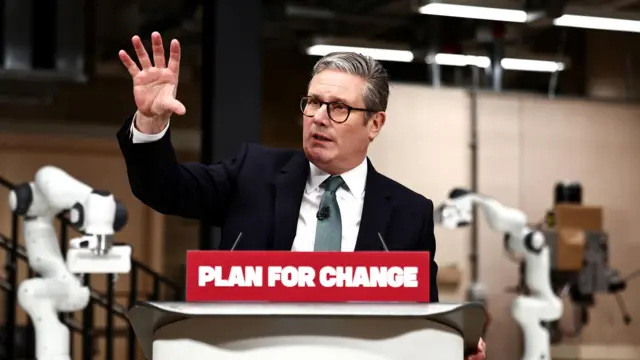
Keir Starmer has announced the government's AI action plan, promising to turn the UK into an AI superpower, as well as use it to "turbocharge" the economy and improve public services.
The less-than-stellar economic news prompted reporters to grill Starmer on the future of Chancellor Rachel Reeves - who said he had "full confidence" in her, but did not answer if she would still be in post at the next election.
Experts weigh in on government's AI planspublished at 16:06 GMT 13 January 2025
Across the scientific community, there has been some positive reaction to Starmer's AI plans.
Gaia Marcus, director at the Ada Lovelace Institute, says it was "encouraging" to see a recognition by the government of its spending power, which can be used "to shape the development of AI through smarter procurement".
Sir John Lazar, who heads the Royal Academy of Engineering, hailed the announcement as "a key step to ensure the UK can seize the opportunities associated with the responsible development and adoption of AI across the public and business sectors".
While Dr Shweta Singh, assistant professor of information systems at the University of Warwick, says that although the AI plan offers "significant benefits", it also "faces several major challenges despite its promise". One significant challenge, she says, is regional inequality, as historically such innovations have been focused around London or the south-east.
We know the what, but not so much the howpublished at 15:51 GMT 13 January 2025
Liv McMahon Technology reporter
The PM’s speech contained a lot of punchy quotes about what AI
could potentially achieve with the government’s new plan.
But questions are already being asked about how much time and
money will be needed to achieve the vision amid concerns about over-promising
and under-delivering.
And more abound over how exactly some of the measures outlined
today will "unlock" AI’s benefits while mitigating its risks – particularly
when it comes to protecting data that will be made available to AI developers
in the National Data Library.
Generative AI tools that can create text, images, video and more
in response to simple text prompts, for instance, have a habit of making things
up – something we’ve seen with erroneous AI summaries of BBC notifications or search results.
And there have also been concerns around the role that systems
capable of generating biased or inaccurate information could play if integrated
into important decision-making environments, such as regarding access to health
services or benefits.
"Just as the government is investing heavily in realising
the opportunities presented by AI, it must also invest in responding to AI’s
negative impacts now and in the future," says Gaia Marcus of the Ada
Lovelace Institute.
"It is critical that the government look beyond a narrow
subset of extreme risks and bring forward a credible vehicle and roadmap for
addressing broader AI harms."
Actors union campaigns against 'AI show stealers'published at 15:46 GMT 13 January 2025
Chris Vallance Technology Reporter
While the government has been keen to promote positive reviews
from various tech luminaries for its plans, there were boos, even hisses even
from the performing arts union Equity.
The actors union is campaigning against so called "AI show
stealers", worried that AI could be used to create synthetic performances
without actors being properly rewarded or having control of how their voice and
likeness is used.
Paul W Fleming, Equity general secretary, has accused the AI
sector of carrying out intellectual property theft on an industrial scale.
"Government is effectively giving the green light to Big
Tech to further line their pockets at the expense of our world-leading creative
industries," he says.
The government is currently consulting on proposals for how copyright
works could be used by AI firms to train their models – including giving rights
holders the ability to opt-out.
Fleming says these proposals are simply "flawed".
"AI can be a powerful positive force but protections must
be in place, and creative workers and their trade unions must be part of policy
making and future licensing schemes," he says.
Reeves to be chancellor for whole parliament, government sources tell mepublished at 15:24 GMT 13 January 2025
Chris Mason Political editor
Would you expect a prime minister to commit publicly to
keeping his chancellor for the next four and a half years?
Sir Keir Starmer didn’t do that this morning, when asked
more than once.
However arguably unreasonable the question – a lot can
happen in almost half a decade – ducking the question inevitably leads to
headlines that are easy to write: the prime minister has refused to back
keeping his chancellor.
Starmer was asked more than once because there is a fair
amount of Westminster chat about Rachel Reeves, with the government in
something of a funk, or maybe at least the beginnings of a funk, about the
economic backdrop: a stagnant economy, government borrowing costs spiralling
etc etc.
Remember Reeves is absolutely central to the Labour project
– a key figure in convincing enough people that Labour could be trusted with
the economy that they won the election and did so handsomely, at least in
terms of seats.
But it is also true that her Budget hasn't gone down well
with many – and the change Labour promised is a change for the worse as some
now see it.
I am told now by senior folk in government that Sir Keir "will be working with her in her role of chancellor for the whole of this
parliament" -- which he didn't quite manage to say out loud in front of the
cameras this morning.
Spotlight on chancellorpublished at 15:11 GMT 13 January 2025
Image source, Reuters
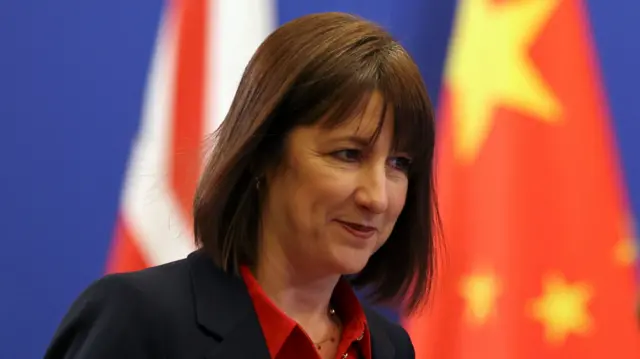
The spotlight on Rachel Reeves' performance as chancellor comes shortly after a visit to China, where she reached agreements worth £600m to the UK over the next five years.
The Treasury says the trip delivered on a "commitment to explore deeper economic cooperation" between the prime minister and President Xi, made last year.
But, the agreements were overshadowed by UK borrowing costs hitting a 16-year high and a fall in the value of the pound.
Tory MP Tom Tugendhat said that the timing of Reeves' visit was questionable.
"She looks like she's going with a begging bowl, not with a trading deal," he suggests, amid high UK borrowing costs and a stagnant UK economy.
Drop in pound and rise in borrowing costs prompt Reeves questionspublished at 14:53 GMT 13 January 2025
Questions to the prime minister about the performance and future of Chancellor Rachel Reeves come as the pound has dropped to its lowest value against the dollar since November 2023.
Government borrowing costs have also continued a recent upwards trajectory, as concerns over the health of the economy have spooked the markets.
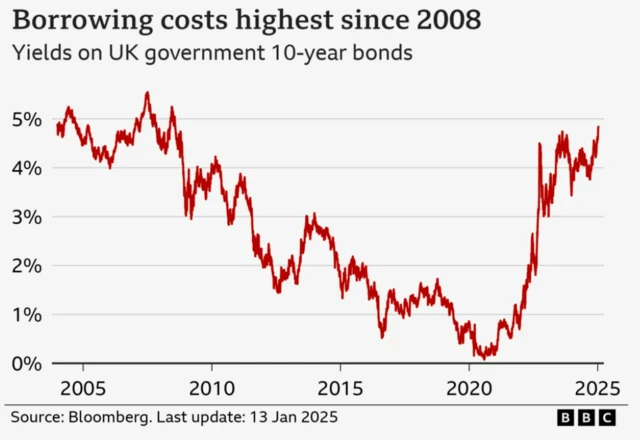
The pound fell to $1.21 on Monday while the rate at which the government can borrow money hit its highest level since 2008 by one measure.
Borrowing costs for many countries are rising across the world, though some have said decisions made in the Budget have made the UK particularly vulnerable.
Tories focus on economy and chancellorpublished at 14:20 GMT 13 January 2025
Image source, PA Media
Image caption,
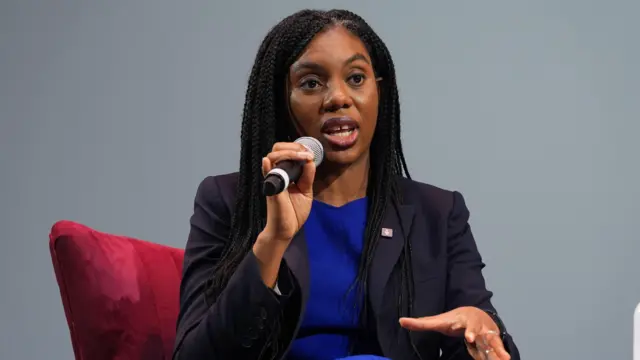
Kemi Badenoch highlighted the PM's response to questions about his chancellor
Just now, we've heard some reaction to Keir Starmer's speech from the Conservatives. Shadow science secretary Alan Mak criticises Labour for "delivering analogue government in a digital age".
He says today's AI plan "will not support the UK to become a tech and science superpower".
Mak says Labour cut "£1.3bn funding for our first supercomputer and AI research" while hiking employers' National Insurance.
Tory leader Kemi Badenoch, meanwhile, highlights the PM's response to questions about Chancellor Rachel Reeves.
Starmer did not answer press questions of whether Reeves would be the chancellor at the next election directly.
"The prime minister just refused to back his chancellor staying in her job," the Conservative leader responds.
But, when asked about Reeves' performance, Starmer said that she has his "full confidence" and is "doing a fantastic job".
Starmer frames AI as positive for growth – BBC analysis of the announcementpublished at 14:05 GMT 13 January 2025
Meanwhile our economics editor, Faisal Islam, explains that Starmer is framing AI as positive for
UK growth and hoping to project confidence and vision in the
fastest growth area of the world economy, despite the significant barrier
represented by high energy costs
'UK must bring clean energy leadership to AI revolution'published at 13:53 GMT 13 January 2025
We've just heard from a former head of the government's Office
for Artificial Intelligence, who says the prime minister's action plan being
revealed has elicited a "measured level of excitement" in the
industry.
But Sana Khareghani, who left the role in 2022 and is now a
professor at King's College London, also tells Radio 4's World at One programme
that more information is needed about how the plan will be put into practice.
She says one of the main areas of the plan covers the
"fundamentals of AI", including what infrastructure is needed for it
to thrive – like data centres or supercomputer.
Another key area, Khareghani says, is how to encourage other
industries to start using the technology. This includes how to improve the
provision of the public sector and services, the academic notes.
She goes on to say she is grateful to see the government is
looking at the possible environmental impact of AI.
Khareghani describes the UK as "leading the way on clean
energy technology".
"Continuing this clean energy leadership into the AI
revolution would really give the UK a fantastic advantage."
Energy plans still to comepublished at 13:41 GMT 13 January 2025
By Anthony Reuben
Artificial Intelligence (AI) uses a lot of energy because it
needs big data centres for all the data that trains it.
There were some measures on energy in last year's Budget,
including the creation of Great British Energy to help create clean energy
businesses and investment in carbon capture, but there was nothing specifically
for AI.
Today's announcement includes plans to set up a new AI Energy
Council including industry leaders from the energy and AI sectors.
They'll be working on "innovative energy solutions" including
Small Modular Reactors, which are small nuclear generators that allow a lot of
power to go to remote areas.
Soothing market anxiety with boosterish AI growth talkpublished at 13:23 GMT 13 January 2025
Faisal Islam Economics editor
There's something else going on here.
The questions posed in the markets weren't just about the Budget maths, they were perhaps even more so about UK prospects for growth.
AI is being framed as positive for both. Public services can be more efficient from teaching to the NHS to the provision of public services, and so save money.
But the PM is right that (partly as a result of his predecessors work) the UK is very well positioned on AI, especially with Deepmind’s [now part of Google] work.
These changes are longer term, of course. There are many questions, not least the significant barrier represented by high energy costs.
But it is important for the PM to project confidence and vision in the fastest growth area of the world economy.
This is especially so at a time when the markets are less enamoured with borrowing money to fund decarbonisation.
Government turns away from 'AI threat' talkpublished at 13:22 GMT 13 January 2025
Faisal Islam Economics editor
Image source, Reuters
The government has chosen to “go for it” on AI, not just as a long term strategy but as a short term message to those in the markets doubting UK growth prospects.
While the PM said he wasn't being "boosterish", it certainly sounded like he'd taken a leaf from one of his predecessors.
"Mark my words" the UK will be an AI superpower and the "best place in the world to start and scale" an AI business, Starmer said.
The government accepted the Clifford review in full saying it "backs AI to the hilt" and talks of "mainlining AI into the veins" of the entire nation.
It is a conscious turn away from the "AI threat" to our existence story that has dominated much talk in the area, often because of leading figures in the industry itself.
Both infrastructure and skills need to be built for AI revolutionpublished at 13:07 GMT 13 January 2025
Zoe Kleinman Technology editor
The plan has been unveiled, now the building work begins.
Quite literally, in the case of the numerous data centres which are promised - giant computer powerhouses which are needed to drive AI tools.
But in addition to bricks, mortar and cabling, there's another backbone needed to make this work: skills.
The government talks about encouraging skilled AI workers to come to the UK - but we also need to upskill our own workforce, both the current one and the young people who are our future.
Here, there is less detail despite a commitment to doing it. Former PM Rishi Sunak faced backlash to the proposal that children should study maths until the age of 18 - but it is a fundamental element of much tech innovation.
And then there's a whole new language of digital literacy for those who will need to master the use new AI tools; such as prompt engineering.
How will we learn, what will the benchmark be and how quickly can the curriculum evolve to accommodate it?
Because we already have many children leaving education this summer who have probably not seen any of this in a formal classroom setting.
That said, they are digital natives and it didn't take them very long to figure out that ChatGPT can be rather good at homework.
Key announcements in today's AI planpublished at 12:50 GMT 13 January 2025
Image source, PA Media
AI businesses encouraged: Several "AI growth zones"around the UK will be created, starting with Culham in Oxfordshire - meaning that if you're an AI business, you can set yourself up in one of these zones and benefit from faster planning processes. It will be easier to build data centres there, the government says
New supercomputer: The UK will build a new supercomputer to boost the UK's computing power twentyfold by 2030. The previous government had already announced plans for a supercomputer in Edinburgh - but the current government ditched it when they took power
Make public sector more efficient: The government says AI will make public services "more human", for example reducing admin for teachers so they have more time with pupils. The PM is writing to all his ministers asking them to adopt AI more in their sectors
Potholes and speeding up paperwork: The plan also gives other examples for how AI could be used - for example to inspect roads and spot potholes around the country, and for small business owners to speed up planning and record-keeping
National data library: Starmer announced a national data library that would collect, for example, anonymised health data. We don't know much more about the kind of data that will be collected - but asked whether it would be available to companies to buy, the PM said it was "important that we keep control of that data"
Starmer is fifth UK PM to make 'world leader' vow on AIpublished at 12:47 GMT 13 January 2025
Joe Tidy Cyber correspondent
Image source, PA Media
Keir Starmer has become the fifth UK prime minister to vow to make the UK “a world leader” in artificial
intelligence after a long list of previous promises from governments that has
largely fallen flat.
Rishi Sunak announced plans
to make the UK a world leader in AI particularly in AI safety in November 2023.
Theresa May announced plans
to "supercharge", external
the UK’s AI industry in 2018 to make it a world leader.
As far back as 2014 David
Cameron talked about, external making the UK a world leader in "The Internet of
Things" – a loose term used for connected tech in which the government threw in
AI as a part of it.
In spite of the ambition the
UK has not yet produced a household name company in AI. All the innovation, be
it in generative AI, large language models and driverless cars, has been led by
the US and China.
According to many rankings
the UK is in third place in AI innovation and the latest evaluation from
Stanford University’s Human Centred AI centre puts the country well behind both
the US and China and just above India.
Starmer bets big on AIpublished at 12:27 GMT 13 January 2025
Marc Cieslak AI correspondent, reporting from the speech
A
lot of faith is being put on AI as a driver for economic growth.
From the
tone of the prime minister's speech, AI is going to be doing a lot of heavy lifting across healthcare, education and employment.
The big question remains: while
some of
these technologies have clearly made huge advances, the government is taking a
big bet on AI when a lot of the tech is still in its infancy.
The business
folks I've spoken to are all broadly positive about this plan, but it might take a
while for some of it to trickle down in a positive way for everyone in
the UK.
The next few years are going to throw up big challenges around
AI regulation even if the government doesn't want to talk too much about it.
The PM didn't under-sell AI's potentialpublished at 12:23 GMT 13 January 2025
Iain Watson Political correspondent
Indeed he seemed to see it as a cure for many of the nation’s
ills.
The elusive prize of public sector productivity is being talked
about inside government as a "bonus".
And Keir Starmer said AI can secure growth, raise living
standards, and transform public services.
It’s almost though he had asked ChatGPT, "How do I deliver
my manifesto?"
Though the next question should be… How soon can I deliver my
manifesto? in the face of restless voters.
Starmer finishes proposal for AI revolutionpublished at 12:19 GMT 13 January 2025
Image source, PA Media
After nearly an hour on the new artificial intelligence plan, that's it from Keir Starmer for now.
The prime minister was strident about the benefits of the proposed technological revolution, but had to field questions about the cost of the new scheme.
We've got some analysis on the way, so stick with us.