OK, OK - Maths may not sound like the most Christmassy of subjects.
But a bit of adding up and multiplying can actually make one of the traditions of the festive season feel a little less stressful, help the environment and, perhaps even more amazingly, answer an age old question on Santa’s Christmas Eve shift.
Ready to dive in? Let’s start with wrapping paper.
Reduce your giftwrap wastage
Mathematician Dr Sara Santos developed a formula for wrapping square presents which doesn’t just reduce waste, it also helps match patterns together at the join. She shared this technique on The One Show in 2012.
The exact formula Dr Santos uses may look a bit complicated when written down. It’s:
1/2 (d+2h+w)² = 2(w+h)²
Not just complicated, terrifying even. But you don’t need to double up on fingers and toes to work it out. Here’s the step-by-step method:
Firstly, take your square gift and measure the diagonal of its largest side in centimetres (if it’s a cube, measure the diagonal of any side).

Dr Sara Santos' method of wrapping gifts can even help the pattern match up
Add this measurement to one-and-a-half times the present’s height. The result is the measurement in cm you’re going to use for the four sides of a square on your wrapping paper (so if the result of your sum is 28, you’re going to measure out a 28 x 28 cm square on your giftwrap).
Cut out the square. Then, place your gift diagonally in the centre of the paper. When viewed from above, your gift will look like a diamond inside a square.
Bring in the four corners and then fold in the tabs that are created. If you are using a simple patterned paper, such as a stripe, these should also match up at the joins.
Pop on a bow and a gift tag and there’s one perfectly wrapped present.
Dr Santos’s formula also works for oblong presents - except it won’t make the pattern match up.
The perfect bauble ratio
If you want your Christmas tree to look as aesthetically pleasing as possible, take a tip from Sheffield University Maths Society (SUMS for short). They developed a series of formulae to stop your creation in the corner of the living room looking too cluttered. Just make sure you have the height of your tree handy.
Pi - or π - (approximately 3.141592) is not only a mathematical device useful for measuring circles, it works with tinsel and tree lights too.

Sheffield University Maths Society (SUMS) has devised a series of formulae to maximise your Christmas decoration mission
You’ll need a calculator for the next bit. For the amount of tinsel required to go round your tree, multilpy π by 13, then divide it by eight. Multiply the result by the height (in cm) of your tree. Your answer is the optimum length of tinsel, in cm, that will look smashing draped around the branches.
It’s a little easier to work out how many tree lights are required. Multiply the height of your tree, in cm, by π to reveal the best length, also in cm.
You won’t need π for your baubles. Instead, SUMS suggest you first take the square root of 17 (around 4.123) and divide it by 20. Multiply the result by the height of your tree in cm. This gives the number of baubles which are just right for arranging in regularly spaced gaps around the pine needles (whether they’re fake or not).
And last but not least, the Christmas star at the top. That height of the tree you’re still keeping handy? Divide it by 10. Hey presto, the perfect height of your Christmas star. In centimetres.
Santa’s big night
But now it’s time for the ultimate festive headscratcher. How does Father Christmas find the time to deliver all those presents to so many nice, well-behaved children in just one evening? He must have to maintain a massive average speed in miles per hour.
We all know there’s a bit of magic involved because Santa has sackfuls of it, protecting him, his elves, his reindeer, sleigh and all the presents loaded upon it from the incredibly swift speeds they have to operate by.
Luckily, Santa maths expert Larry Silverberg, a professor of mechanical and aerospace engineering at North Carolina State University in America has, with the help of his students, been able to weave in a bit of number crunching around the elf-powered amazingness. They revealed their findings in a much-quoted study from 2006.
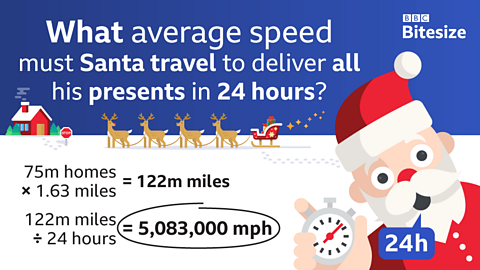
Professor Larry Silverberg and his students devised this sum to determine Santa's average speed. And that's some speed
Father Christmas has just 24 hours to complete his deliveries. In that time, Prof Silverberg and his students have worked out he must deliver gifts to an estimated 200m excited youngsters. They’re spread over an area of 200m square miles and 75m homes.
With an average distance between each home of 1.63 miles, that means the man in the red suit has a beard-quaking 122m miles to cover. In 24 hours.
But we’re forgetting that this is all possible through Christmas magic. To complete his shift and be back with Mrs Claus in time to open his own stocking, Santa’s sleigh would need to travel at 5,083,000 mph. It’s fast, but not the fastest thing around. Light travels at 669,600,000 mph, 130 times faster than Santa would need to travel at to get all those presents delivered.
Now, this is the science bit. Light already exists, and moves at a proven speed. Therefore, it must be possible for something to move slower than the speed of light. And because Santa exists, and has magical powers, it’s perfectly plausible he can do just that.
So don’t worry if you can’t spot that sleigh in the sky on Christmas Eve. It will be going so fast, you won’t be able to see it. But it is there. Promise.