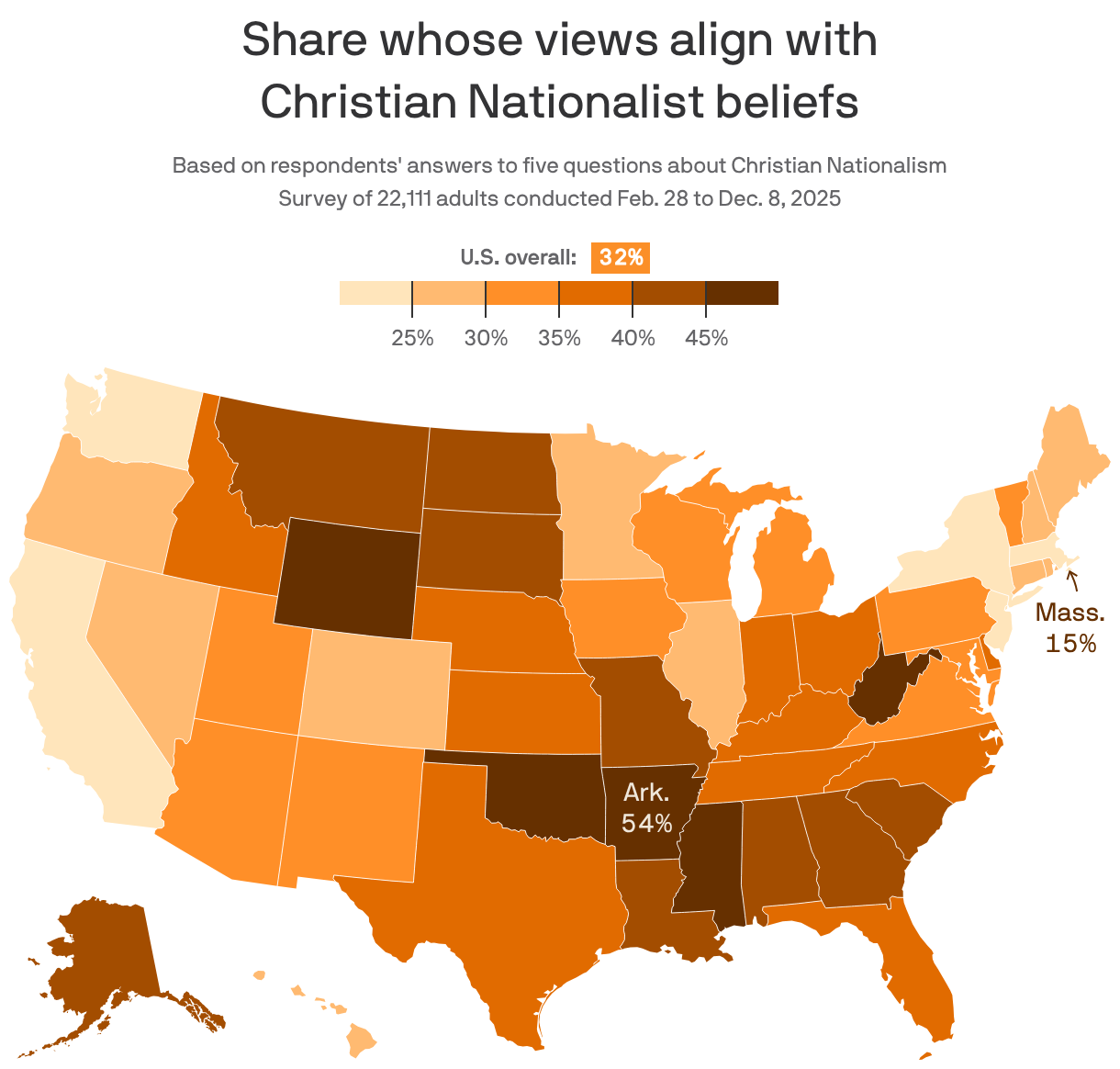
Data: PRRI; Note: Map shows the share who were classified as "adherents" or "sympathizers" based on their responses to five questions; Map: Erin Davis/Axios Visuals
Christian nationalism is now deeply entrenched inside today's Republican Party, according to a sweeping 50-state survey.
Why it matters: The once-fringe ideology holds that the U.S. was founded as a Christian nation and should be governed according to strict Christian values, even as the country becomes less religious and more racially diverse.
The divide reflects a broader clash over whether America's future is pluralistic or rooted in a singular religious-national identity.
By the numbers: About one-third of Americans qualify as Christian nationalism "adherents" or "sympathizers," a new survey released Tuesday by the nonpartisan Public Religion Research Institute finds.
56% of all Republicans are Christian nationalism "adherents" or "sympathizers," the survey said.
Meanwhile, only 25% of independents and just 17% of Democrats are "adherents" or "sympathizers," according to the survey.
State of play: Many adherents say the U.S. was founded as the "Promised Land" for white European Christians, and falsely believe the founding fathers sought to create a Christian nation, PRRI president Robert P. Jones tells Axios.
Critics say Christian nationalism reinforces rigid, male-dominated leadership models in church, home and government, and merges religious identity with white ethnic nationalism.
It also elevates Christianity — often a specific conservative Protestant expression — above other faiths.
Between the lines: This is one of the first type of studies to show how widespread Christian nationalism has become, PRRI CEO Melissa Deckman tells Axios.
PRRI first developed its five-question Christian nationalism scale in 2022, measuring agreement with statements such as declaring the U.S. a Christian nation and basing laws on Christian values.
The overall share of Americans qualifying as "Adherents" or "Sympathizers" has remained largely steady over the past three years.
Zoom in: The new survey also shows that Christian nationalism strongly correlates with those who have a favorable opinion of President Trump and those who live in states with GOP-controlled state legislatures.
In Arkansas and Oklahoma, for example, Republicans control roughly 80% of state legislative seats — and those states rank among the highest in Christian nationalism support.
Blue states such as California (22%), New York (21%) and Washington (18%) report the lowest levels.
Zoom out: The report found that many of those who support Christian nationalism also support far-right conservative views around immigration, pluralism, and gender roles, Deckman said.
Around 67% of adherents say immigrants are "invading" and replacing Americans' culture, for example.
Another 61% support deporting undocumented immigrants to foreign prisons without due process.
73% of adherents view Trump as a strong leader who should be given the power he needs, while majorities of skeptics call him a dangerous dictator, the survey found.
The bottom line: Christian nationalism remains a minority view nationally.
But inside the Republican Party, and in many Republican-led states, it is a majority current, tightly aligned with Trump and with growing implications for immigration policy, executive power and the future shape of American democracy.
Methodology: PRRI conducted the survey between Feb. 18-Dec. 8, 2025. The poll is based on a representative sample of 22,111adults living in all 50 states.
The margin of error is ±0.87percentage points at the 95% confidence level, for results based on the entire sample.