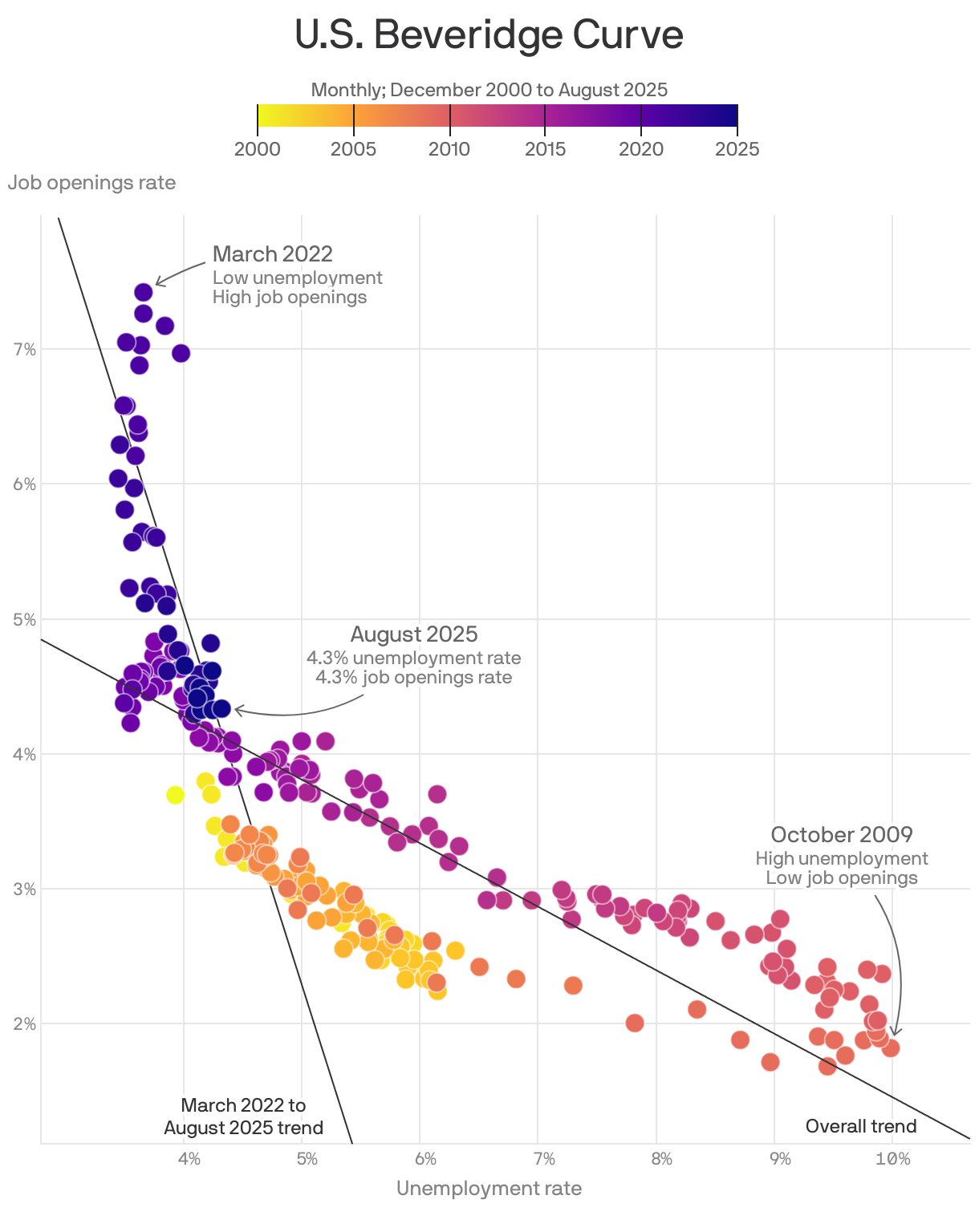
The U.S. labor market looks to be in a precarious balance, in solid shape for the moment but vulnerable to a rapid worsening. The big picture: That's the implication of the chart above, which captures the relationship between the rate of job openings and unemployment. Based on this historical experience, if employers were to pull back on the number of job postings even slightly, it would coincide with a rapid rise in the jobless rate. State of play: The relationship between vacancies and unemployment is known as the Beveridge Curve, developed by British economist William Beveridge in the 1940s. Zoom in: The visual above tells the story. Each dot represents a single month since the year 2000. (The pandemic period is excluded because it distorted economic data so severely.) Between the lines: Employers have been cutting back on job postings since the openings rate peaked more than three years ago, with only modest pain for workers. Any further cutbacks in job openings are more likely to hurt. What they're saying: "By these measures that have been predictive in the past, we look to be fairly close to ending up with some of those nonlinear dynamics," SGH Macro Advisors chief U.S. economist Tim Duy tells Axios. Of note: August is the most recent job openings data available, but private sector sources point to a drop since then. As of Sept. 26, the Indeed Job Postings Index was down 2.5% from a month earlier. The bottom line: Yes, historical patterns are only that. But if employers cut back on hiring intentions even a little, the benign job market of the last few years could change quickly.