This century has known a stunning decrease in global income inequality, bringing it down to levels not seen in well over a century. That's the conclusion that Branko Milanovic, one of the world's foremost inequality researchers, comes to in an important essay for Foreign Affairs. Why it matters: The U.S. has only about 4% of the world's population. Increasing equality is good for the planet as a whole, but it foreshadows an end to U.S. hegemony.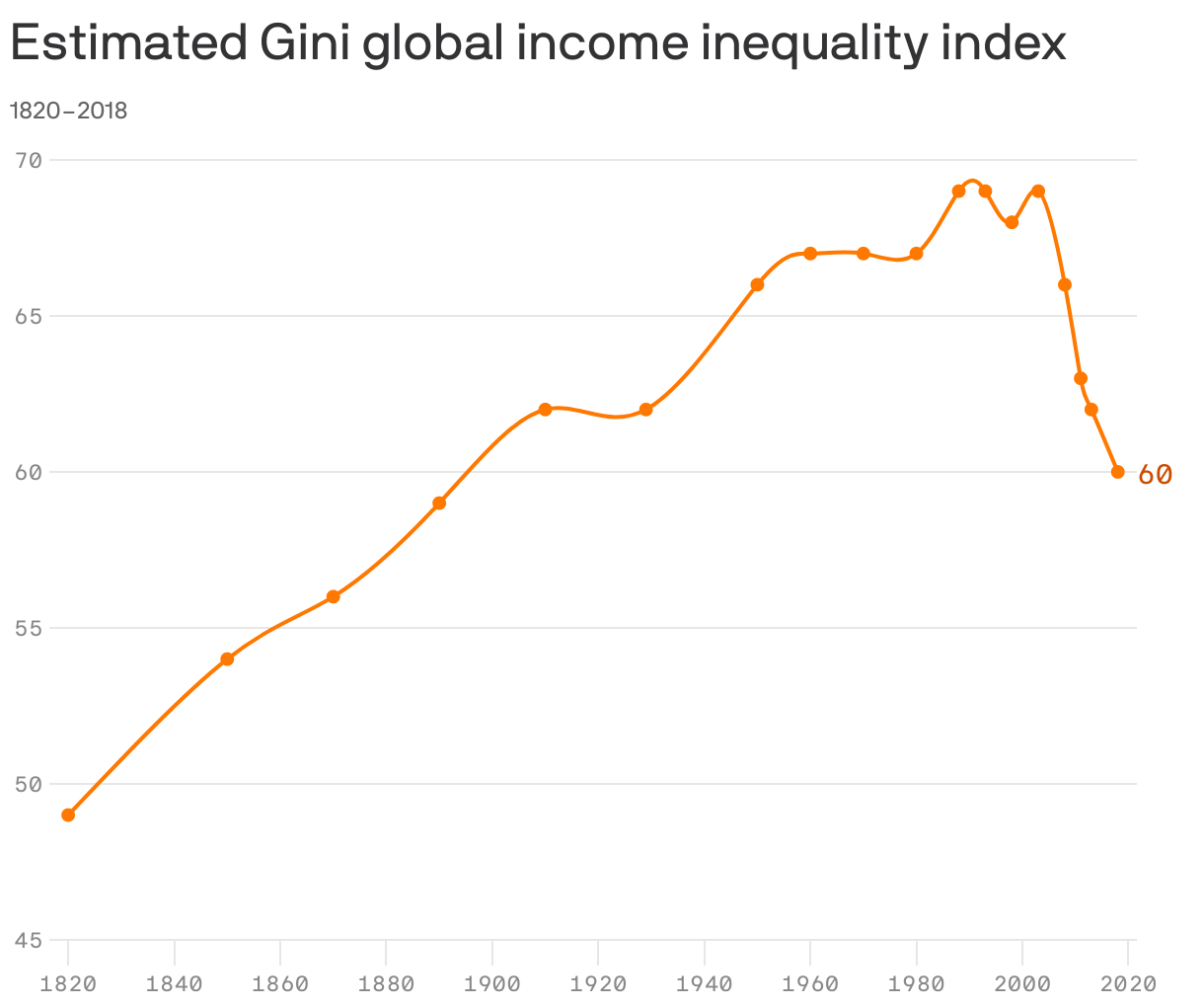
By the numbers: Inequality is measured using the Gini coefficient, which runs on a scale from 0 (perfect equality) to 100 (where one person would have all of the world's income). Between the lines: The part of that number due to inequality within countries has ticked up slightly — it now stands at about 13, up from 7 in the 1990s. Conversely, the component due to inequality between countries plunged from a high of 63 in 1988 to just 47 in 2018. Be smart: What we're seeing is not just China getting richer, although that is a large part of the story. The big picture: People who are poor by U.S. and other rich countries' standards have been rich by global standards for as long as anyone can remember. Yes, but: While the rise of Asia in general and China in particular is inexorable, the decline of global inequality is not. The bottom line: The countries with the richest citizens are generally the world's most powerful. That power is now more broadly distributed than at any point in over a century.