It’s difficult to trust the markers of popularity vertical drama producers boast about. Viewership metrics often seem absurd or impossible—already a common experience with streamers, which tend to withhold view numbers, or speak in vague and misleading terms about how many people are watching. Vertical dramas, on the other hand, tend to directly provide extremely gaudy viewership numbers: The Washington Post wrote that ReelShort’s How To Tame A Silver Fox had been “watched 356 million times,” which would work out to more than one view for every member of the U.S. population. ReelShort now claims “393.5 million” views for that film. Is it more likely that How To Tame A Silver Fox is one of the most beloved and widely viewed films in human history, or that ReelShort has added together the views of the 70+ “episodes” to reach that final number? This number-fudging isn’t even necessary: If you divided by 70, it would still imply more than 5.6 million views for this single vertical drama, which is a shocking enough figure. But the companies can’t help themselves from aggrandizing these accomplishments.
Vertical dramas are also dirt cheap and lightning fast to make—we’re talking budgets of $100,000, and filming schedules of a week or less, allowing a project to progress from pitch to release in the space of a few months. Pay for most of the performers is necessarily low, but it’s still enticing to those looking to break into the industry, and there’s no shortage of obvious non-actors supplementing their ranks in every production. The monolithic players of the entertainment industry, meanwhile, are clearly paying attention to the lucrative nature of vertical dramas, which would seemingly disprove the need for massive budgets, CGI, or star power. Disney made DramaBox one of the participants in its 2025 Accelerator Program, “to help Disney innovate in short-form content, with plans to adapt Disney’s book properties into these bite-sized series for new audiences, focusing on emotional hooks and rapid production for platforms like TikTok and Reels.” Netflix has likewise already stated its intention to produce more vertical video content, which has thus far been interpreted as some kind of plan to ape TikTok. Consider instead, the possibility of an entire wing of Netflix’s mobile app dedicated to vertical dramas.
If millions of Americans are consuming vertical dramas on a daily basis, what exactly are they watching? The answer is a hodgepodge of genres, primarily fitting into romance, fantasy, and thriller buckets. Subcategories include everything from “wallflower” to “janitor,” “protective husband,” “twisted lover,” “chef,” “super warrior,” “CEO,” and “rugged CEO,” which ReelShort separates into an entirely distinct category. Some titles reek of crude translations (Marry To Top Star At 40s) or keyword-cramming (Forced Into An Arranged Marriage, Only To Find Her Fiancé’s Uncle Is Her Now-Successful Ex).
These stories ape the zeitgeist, whether that means Hallmark-style holiday features, costume-driven royal intrigue stories, kink-centric workplace dramas, or timeless fantasies of being whisked away from mundanity by a fabulously wealthy man who can solve all of life’s problems. Most any sports niche is also well covered—especially hockey, even in advance of the viral success of Heated Rivalry. The most common approach appeals to women with fetishes for being controlled by dangerous, violent men with the most slight of redeeming qualities. This dynamic is especially present in the “mafia” and “mob” genres, in which mousy heroines find themselves abducted or indentured into the service of chiseled male mafiosos who occasionally threaten them with death or torture, but also possess secret hearts of gold. He may be a prolific murderer, but he also tells the female lead that “you make me want to be a better man.” A number of these stories involve women being forced to abandon their lives, only to be transformed into contented tradwives for powerful men. Titles in this niche include Bound By Honor: Kidnapped By The Mafia King, My Sugar-Coated Mafia Boss, and Falling For My Ex’s Mafia Dad, the latter of which doubles as an example of the prolific subgenre in which young women are enchanted by older men connected to their families or former lovers. These are countered by the “reverse harem” films, in which a woman is courted by a squad of hot, single-trait guys.
Romantasy is also a major player, but it goes beyond simple mimicry of A Court Of Thorns And Roses—the very style of romantasy prose influences how almost all vertical dramas handle the protagonist’s perspective. Universal, audible inner monologues coax the viewer to insert themselves into the fantasy. The ReelShort category “Magic & Mates” spins more variations on women indentured to werewolf “alphas” than you could possibly imagine.
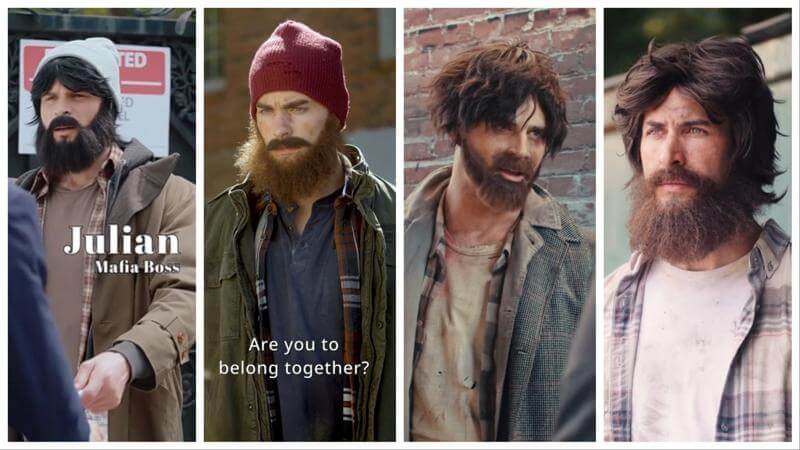
Then there are the aforementioned “billionaire” stories, which involve 27-year-old captains of industry masquerading as janitors or vagrants, only to fall in love with gig economy workers unaware of their secret wealth. These dramas dare to ask, “Could you possibly forgive the man you’re dating when he reveals that he’s one of the richest people on the planet?” Morally, this subgenre is never quite what you expect: Rather than conveying the idea that even homeless people are real people, with dignity, the message is that you shouldn’t judge these men because they might turn out to be secretly more powerful and wealthy than you. Vertical drama billionaires are also universally outfitted with the most hilariously slapdash facial hair ever committed to screen. The men all start out looking like they’ve just walked out of Spirit Halloween so there can be a scene where he “shaves” and debuts his babyfaced perfection.
One element unites these disparate subgenres: They revolve around sex, but are sexless in execution. Even vertical dramas directly ripping off sexually explicit romantasy series remove actual sex or nudity, perhaps to get around accusations of pornography that could threaten their viability in app stores. Instead, viewers are teased by the constant insinuation of sex, or the occasional encounter that is interrupted or somehow supposed to have happened while two characters are fully clothed, and many “morning after” scenes. Shirtless men and hunks wrapped in towels dominate the proceedings, and even films in the erotica category (Swallow Me Whole, Surrender To My Professor, Submitting To My Ex’s Dad) are less sexual than a daytime soap. Bizarrely, though, there’s no such skittishness about language; even innocuous films are riddled with F-bombs.
Even when you’ve grasped the narratives’ combination of trashy and saccharine, you’ll still be entirely unprepared for how they look and sound. Vertical dramas make Ed Wood and Tommy Wiseau films look like Oscar bait. They don’t even have the infamy-generating advantage, as in the case of something like The Room or Plan 9 From Outer Space, of having been the product of a delusional artist’s singular vision. Rather, these are cynical, mass-produced products from studios that simply do not give a damn.
The most basic limitations of shooting an entire feature film vertically, for native playback on phones—composition, blocking, cinematography—are luxuries you can’t afford when you know your viewer is watching on a screen too small to make out fine details. This leads vertical dramas to focus their shots on static characters and their faces, which often end up cropped by sides of the screen anyway. Rare action scenes involve fistfights that sprawl out of the frame, leading to the audience missing half of each movement. Punches whiff their intended target by a foot or more, but are sold by the intended recipient anyway because they know there will be no second take. The same idea applies to the vertical drama philosophy around lighting, which is “no lighting.” Sets are reused repeatedly, with the same low-ceilinged office building unconvincingly doubling as everything from a fancy restaurant, to an airport terminal, to a mansion.
This absence of basic professionalism pales in comparison to the aesthetic choices wielded by the sound teams. Dialogue goes from crisp, to muffled, to echoey from scene to scene. Clearly ADR’d lines fly in out of nowhere at twice the volume of the other dialogue. Some vertical dramas are suffused with obnoxious stock music; others have no music at all, which might be worse. One mob drama, filled with gunfire and digitally added muzzle flashes, has zero gunshot sound effects. Yet, nearly every vertical drama is full of inexplicable sound effects unrelated to anything happening on screen. Every conversation is punctuated in a style that mimics obnoxious reality TV—someone finishes a sentence, then there’s a bwip like a drop of water falling into a bucket, without any indication of what that is meant to imply. Every 30 seconds or so, one of these sound effects will be employed, whether it’s a cartoony sproing, or the shwing of a kung fu movie sword slicing through the air. Rarely are they relevant. It’s like a wheel is being spun, and a soundboard is being hit at random. Their blatant, torrential misuse begins to feel like an aural hallucination, and is so omnipresent that you’ll find Reddit threads of people trying to understand what they could possibly mean.
Why does the consumer not demand better, considering the incredible expense? Are the people paying $20 a pop aware that there are actual feature films out there—many of them free to access—brimming with the genuine titillation and payoff that vertical dramas are denying them, not to mention bonuses like professional actors? How did these companies unearth such a large user base of people who like romantasy, but wish it contained no fantasy, no sex, and no action? This cognitive dissonance rears its head in the comments of vertical dramas that are uploaded in full or in parts to external sites like YouTube—people dunk on the abysmal quality, while admitting that they can’t stop watching. The addictive urge is especially present for incomplete stories: People insist that it isn’t worth paying for, while simultaneously begging for tips about where they can find it uploaded in full. It is an audience at war with itself, furtively ashamed at its own fixation.
One area where they’re united, though, springs from the form itself—a style of content that blatantly steals IP and assigns no value to originality. One of the highest-rated vertical dramas on IMDb, We Are Never Ever Getting Back Together, has somehow been below the notice of Taylor Swift’s attorneys. Yellowstone: King Of Montana is an amalgam of every Taylor Sheridan show. Many of the “mafia” dramas even steal the title font of The Godfather. It makes sense then that piracy of vertical dramas is rampant, with any given film being endlessly stolen and reuploaded in every corner of the web you could think of, and some you would never suspect. Search for Found A Homeless Billionaire Husband For Christmas on Google, and you might expect ReelShort’s original version to be a top result. Instead, you’ll stumble upon users who have uploaded the full 90-minute film everywhere else, starting with a YouTube version in the wrong aspect ratio with garbled sound, which has still amassed more than 1.5 million views. The same film can also be found uploaded in full on Dailymotion and even as a 90-minute Facebook reel on a user’s personal page. That Facebook user has uploaded countless vertical dramas in their entirety, and no one seems to notice or care. Theft is the native tongue of this subculture, baked into the experience at a foundational level, powered by the ravenous imperative to consume.
It’s fitting that the vertical drama user base has no qualms about stealing and republishing this content, when the very form itself relies on that type of thievery in order to satisfy the ravenous demand for escapist storytelling among audiences. It’s not that the drive to broad escapism is difficult to understand, but a side effect of this particularly bizarre and hyper-commercialized caricature of escape—the simple act of rotating a screen 90 degrees—has upended the traditional conception of filmmaking and birthed something hideous, exploitative, insulting, and somehow still addictive in its place.
 Keep scrolling for more great stories.