Published 10.22.26
Whether an AI trading agent is safe depends on what it is allowed to do without asking you, and on what kind of guardrail stops a bad action: a structural limit, or a sentence in the prompt asking it to confirm first. Four of the largest venues in crypto shipped agents that can act on a user's behalf this year. OKX opened an agent marketplace on 1 July. Binance released Agent OS in August and Binance AI Pro on 19 October. Minara moved its product onto an agent harness in September. Every one of those announcements described what the agent can do, and none of them led with what it may do without asking.
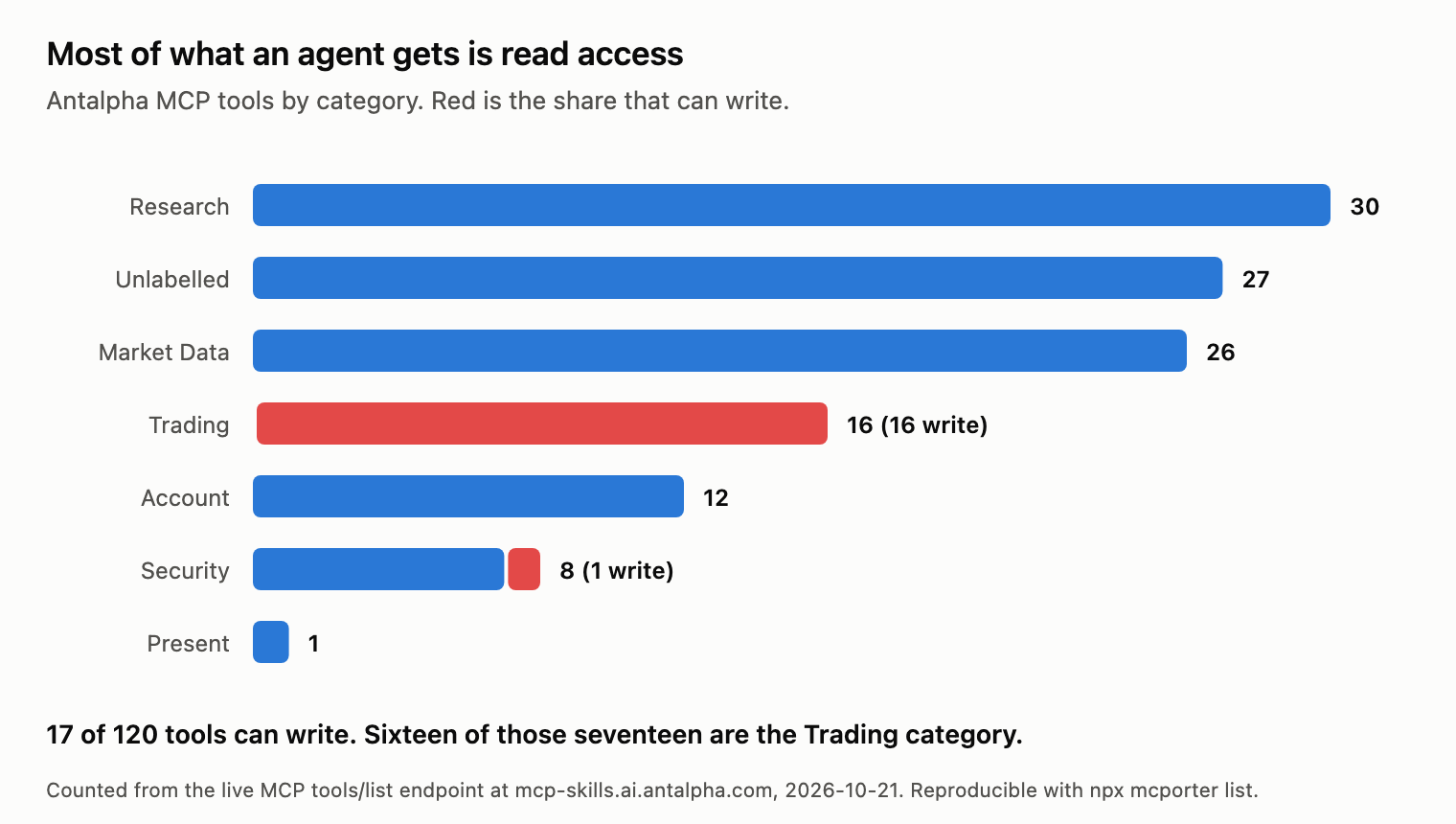
That has a measurable answer, and we started by measuring our own. The Antalpha MCP server, which Nina runs on, exposes 120 tools to any agent that connects to it. Seventeen of them can write. The other hundred and three can only read. From the way those seventeen are restrained we built a five-grade scale, and then held the three other platforms against it.
The Antalpha MCP endpoint at mcp-skills.ai.antalpha.com/mcp answers the standard MCP tools/list call, so the inventory is not something you have to take our word for. Running npx mcporter list https://mcp-skills.ai.antalpha.com/mcp lets you count them yourself. The figures below are from 21 October 2026; a recount on 5 November found 124 tools, still with 17 that can write.
Each tool description carries its own capability tag. Twelve tools are marked [Write] and five are marked [Read+Write], which is seventeen of 120 that can change state. Sixteen of those seventeen sit in the Trading category. The seventeenth is wallet-revoke-page, a security tool.
The tags go further than read and write. Each tool also carries a reasoning grade, and the distribution is lopsided: 65 tools are graded Low, 12 Medium, 15 High, and exactly two are graded Very High. Those two are wallet-guard-token-deep-scan and transfer-request, the tool that sends tokens from a user's address to someone else's.
Most of what an agent gets from this server is the ability to look things up. The ability to act sits in a short list that a reviewer can read in a minute, which is how we think a trading tool surface should look.
What are the five grades of AI agent guardrail?
The seventeen write tools do not all restrain the model the same way, and the differences fall into a five-step ladder. The top three grades all show up in our own tools.
| Grade | What stops a bad action | Can a confused or manipulated model get past it? |
|---|---|---|
| Architectural | The model is structurally unable to supply the dangerous value | No |
| Cryptographic | The action needs a signature the model cannot produce | No, but the user can be tricked into signing |
| Procedural | A separate confirmation step, enforced by the system | Only if the user approves both times |
| Instructional | The tool description tells the model to confirm first | Yes |
| None | The tool acts when called | Yes |
The architectural grade is rare, and it is the only one that does not depend on anybody behaving well. Our wallet-revoke-page tool builds a page for revoking ERC-20 approvals, and its description states the constraint directly:
Addresses are ALWAYS taken from the live on-chain scan, never from model input. The optional
approvalslist is only a display-label / filter hint: entries that do not exactly match an on-chain approval are ignored.
The model has no way to name the contracts. The addresses come from the chain, and anything the model invents is dropped before the page is built. A hallucinated address and a prompt-injected address fail the same way, for the same reason, without anyone having to notice that an attack happened.
Most of the on-chain tools sit at the cryptographic grade. poly-buy returns a signing URL, and its description states that private keys never leave the wallet. The agent assembles an intent; the user signs it. That is strong, but weaker than the architectural grade, because a user who signs without reading has handed the protection back.
transfer-request adds the procedural grade on top. It is a two-step tool: the first call produces a risk preview, the second produces the signing URL, and the description says it "requires explicit user approval at BOTH steps." It is also one of the two tools graded Very High, so the highest-risk action in the set carries the most deliberate friction.
How do Binance, OKX and Minara bound their AI agents?
All of the following is drawn from each company's own public material.
| Platform | Shipped | The binding mechanism | Grade |
|---|---|---|---|
| Binance AI Pro | 19 Oct 2026 | An isolated AI Strategy Account, funded only by manual transfer, from which the agent cannot withdraw to external addresses; paper trading first; a separate review-and-approve step before going live | Architectural, at the account level |
| OKX AI | 1 Jul 2026 | An agent marketplace and a task marketplace where agents hire other agents, settling in stablecoins, with disputes resolved by a staked evaluator network | After the fact |
| Minara Harness | 8 Sep 2026 | Described by Minara as bringing research and execution into one workspace "with confirmation requirements and operating limits" | Procedural, per its own description |
Binance's approach makes the clearest contrast with ours because it answers the same question from the opposite direction. Binance's announcement calls the principle "bounded autonomy," and the boundary it draws is around the account rather than around each action. The agent operates inside a walled sub-account that only the user can fund and that has no path to an external address. Inside those walls the agent has a lot of freedom. Outside them it has none, structurally.
That is an architectural guardrail, and a good one, with a different failure mode from ours. A per-action signature protects every transaction but asks the user to read every prompt. An account boundary asks nothing of the user per transaction but caps the loss at whatever is inside the account. Neither is strictly better, and a user should know which failure they are choosing.
Binance is also explicit about what its checks do not cover, which few launch posts are. According to Unchained, citing Binance, the platform's code checks confirm that a strategy runs without errors and do not assess whether it will make money.
OKX is doing something else. Per OKX's own page, the marketplace lets agents hire other agents and settle payments between them, and the control is a staked evaluator network that resolves disputes after they happen. That is a reasonable design for a commerce network and a weak one for custody, because arbitration runs after the money has moved. It can answer "did this agent deliver the service it promised," and it cannot answer "should this transfer have happened at all."
Minara's harness page describes confirmation requirements and operating limits without publishing the specifics, so we have placed it at the procedural grade on its own description and cannot verify further from public material.
What does each design protect against?
Lined up, the four designs answer different questions. An account boundary answers how much can be lost. A signature gate answers who decided. An evaluator network answers who pays when it goes wrong. An instruction in a tool description answers what the model was asked to do, and whether the model does it is a separate matter.
A serious agent platform probably needs more than one of these. Platforms that only have the fourth deserve a second look.
What to ask before you connect an agent
Four questions, and all four have public answers for every platform named above.
How many of the tools can write, and can you see the list? An inventory you can enumerate carries a different risk from a capability surface described in marketing copy. If the platform speaks MCP, tools/list answers this in one call and nobody has to be trusted.
What is the hard cap on a single bad instruction? For Binance AI Pro it is the balance of the isolated account. For a per-signature model it is one transaction. If the answer is a sentence about careful design rather than a number or a boundary, there is no cap.
Which grade protects the riskiest action, and is it the same grade as the safest one? Look at the weakest path that touches money; an average across all tools hides it.
What can the model itself supply? A model that can name a destination address can be made to name the wrong one. Ask whether the dangerous fields come from the model or from the chain.
How does Nina compare with Binance AI Pro?
Nina is Antalpha's Web3-native AI agent (NASDAQ: ANTA), and the same MCP surface described above is what Nina runs on and what an external agent can connect to. Antalpha's documentation describes the architecture as a five-step flow in which step 4 is a signature gate, with control of assets stopping at the draft, inside the user's own wallet.
Using signatures does not make Nina safer than Binance AI Pro. The two are bounded in different places, and the per-transaction model puts more of the work on the user.
Vibe Trading, Nina's AI trading bot, is a different arrangement: it executes by rule rather than waiting for a signature on each trade. Like Binance AI Pro, it simulates before anything goes live, backtesting on historical data and then running in paper trading. Today it runs only in paper trading and moves no real money; live trading is not yet available. Sentinel only watches and alerts, and never places an order.
If you want to check any of this rather than trust it, the tool inventory is a public endpoint. Point an MCP client at mcp-skills.ai.antalpha.com/mcp, list the tools, and read the capability tags yourself. If what you count disagrees with what we published, the endpoint is right and we will correct the post.
Sources
- Binance press release: Binance Launches Binance AI Pro, Bringing Conversational AI Strategy Building to Users (PR Newswire, 19 Oct 2026)
- Unchained: Binance opens its AI Pro trading agent to all users (citing Binance on what its code check does not assess)
- OKX: OKX AI: A Marketplace for the Agent Economy
- Minara: Introducing Minara Harness
- Antalpha: MCP documentation, Build Agent
- Tool counts and capability tags: live
tools/liston the Antalpha MCP server, checked 21 Oct and 5 Nov 2026
Frequently asked questions
Are AI trading agents safe?
It depends on what the agent is allowed to do without asking, and on which grade of guardrail stops a bad action. Actions that are structurally impossible (architectural) or that need your signature (cryptographic) cannot be pushed through by a confused model; actions guarded only by an instruction in the tool description to confirm first can be.
How many Antalpha MCP tools can write?
Seventeen of 120 tools can write, comprising twelve marked [Write] and five marked [Read+Write], counted from the live tools/list endpoint on 21 October 2026. Sixteen of the seventeen are in the Trading category. A recount on 5 November 2026 found 124 tools, still with 17 that can write.
What is bounded autonomy?
Bounded autonomy is the principle Binance describes for Binance AI Pro, in which agents provide analysis and recommendations while consequential actions require explicit human approval, with live strategies confined to an isolated account the agent cannot withdraw from.
What is the difference between an account boundary and a signature gate?
An account boundary caps the maximum loss at the balance the agent can reach and asks nothing of the user per transaction. A signature gate requires human approval for every individual transaction and caps the loss at one transaction, provided the user reads the prompt.
Can an AI agent move funds from a self-custodial wallet on its own?
No, when the design requires a wallet signature for each transaction. The agent can assemble and propose a transaction, and the transfer only occurs after the user signs it from their own wallet.
What is the weakest form of guardrail in an AI agent?
An instruction in the tool description telling the model to confirm with the user first. It depends entirely on the model complying with its own context and provides no protection against a confused or manipulated model.
How can I verify what tools an MCP server exposes?
Call the server's tools/list endpoint with any MCP client, for example npx mcporter list <server-url>, which returns the complete tool inventory with each tool's description and capability tags.
Nina is the Web3-native AI agent from Antalpha (NASDAQ: ANTA), covering crypto, prediction markets and US stocks: conclusion-first analysis with named sources and freshness badges, and Sentinel mode for round-the-clock monitoring. Vibe Trading, Nina's AI trading bot, turns a one-sentence trading idea into a rule-based bot that you backtest on historical data and then run in paper trading; live trading for Vibe Trading is not yet available. Backtest results are simulated on historical data and do not indicate future returns. Trades in the Nina app are signed by you in your own wallet by default; Nina never holds your funds and takes no cut of principal or profits; a transparent routing fee applies on the execution path. Nothing here is investment advice or a price prediction. Official channels: antalpha.com, the Nina app on the App Store and Google Play, x.com/antalpha_ai.
Related reading: Are AI crypto trading bots safe? $387.5 million left Bitget without a stolen key.