A syndicate platform combines a UI for managing LPs, showcasing deals and aggregating LP commitments with a special purpose vehicle (SPV) administrator that handles document e-signing, collections and wires, and investor tax filings.
Many syndicate leads see the front end as the solution, but that instinct is wrong.
Building an investor network to capitalize your dealflow is about people and relationships far more than it is a technology problem.
TL;DR
- Is AngelList the cheapest syndicate platform? Not on most deals. A standalone administrator is cheaper at published rates on any raise below $400k, and 69.5% of AngelList vehicles filed in the last 5 quarters raised less than that; above $400k the flat fee wins — SEC Form D, Q1 2025 - Q1 2026.
- Does the platform actually bring you LPs? Rarely, if at all. Syndicate leads join a platform thinking they can find investors, but any angel you reach can select from 25,000 other syndicates and funds, all competing for their attention.
- How much of a raise goes to fees? SPV fees generally scale with the capital committed, from about $4.5k to $14.5k in the US. AngelList charges a flat $10k per SPV, being $8k of SPV costs plus $2k of blue sky fees. Think of it as a percentage of the raise: below $100k, a flat $10k fee is in excess of 10% of everything you raised, before any management fee the lead charges on top. It comes out of the raise, so your LPs are effectively paying it. Subscale SPVs below $100k are hard to do for exactly this reason.
- What does it cost to run a syndicate without one? You can piece together an operating stack from off-the-shelf SaaS tools for as little as $50 a month, excluding the SPV cost on each deal. That one comes out of investor commitments rather than the lead's pocket. This is the stack we are built on.
- What should you consider when picking an SPV administrator? Optimize for survivability. Syndicate leads are prepaying for a 10-year vehicle, so if your administrator goes bust you are left holding the bag. No one enjoys paying higher fees, but the cheapest guy on the block is the one with the least margin to survive a downturn.
What a Syndicate Platform Actually Is
It is 2 businesses bundled together.
The first is a UI. Your LP base, a way to distribute dealflow, a way to get investor commitments, and information sharing. A UI is helpful, but it is not the crux of running a syndicate.
The second is SPV administration. Entity formation, KYC / AML, document e-signing, bank account creation, collections and wires, and regulatory and tax filings. The SPV also governs the distribution waterfall, handles the tax filings your investors receive such as US K-1s, and takes the vehicle through wind down at dissolution or exit.
The front end is given away in order to get you to run your SPVs on the platform, and once it holds your LP base, your deals and your commitments, leaving is hard.
Syndicate leads often act on the wrong instinct. The work of building a successful angel syndicate is being good at building investor networks, sourcing dealflow, and doing the diligence to make great picks.
Those are the core skill sets, and they separate the leads who stay in the business from the ones who hack together a deal and get weeded out.
They are foundational, and none of them has anything to do with technology.
You are not buying a syndicate platform. You are being locked into an SPV administrator who gives you an interface.

Image 1 of 5: The two businesses inside a syndicate platform. The interface is free and replaceable; the SPV administration layer underneath it is what you are actually paying for, deal by deal.
SPV admin cost structures.
| Provider | Platform or administrator | Cost structure | SPV cost at a $100k / $200k raise | Carry share? | Median check in its SPVs |
|---|---|---|---|---|---|
| AngelList | Platform | $8k setup + $2k blue sky, flat; capped at 10% of the raise | $10k / $10k | Yes, on LPs sourced from its network | $14,102 |
| Sydecar | Administrator | 2% of the raise, floor $2.5k and ceiling $12.5k, + $2k regulatory | $4.5k / $6k | 0% | $41,096 |
| Allocations | Administrator | Quoted privately | Unpublished | Unpublished | $60,000 |
| Finally | Administrator | Quoted privately | Unpublished | Unpublished | $34,333 |
| Unbundled stack | Administrator of your choice | ~$50 a month plus SPV admin fees | Refer to administrator pricing | No | You set it |
Cost structures are each provider's published pricing — AngelList, Q4 2026 and Sydecar, Q4 2026. Check figures are the median implied check across every SPV each provider filed between Q1 2025 and Q1 2026 — SEC Form D, Q1 2025 - Q1 2026.
Notice that the provider with the lowest median check is also the most expensive at the raise sizes most of its own SPVs actually do, and that only one of the four publishes what it takes from your carry.
Why Syndicate Platforms Fail to Be a Source of LPs
Under Rule 506(b) of Regulation D, general solicitation is prohibited. You may only approach investors with whom you have a pre-existing, substantive relationship, and you are capped at 35 non-accredited investors. Rule 506(c) lets you advertise the offering publicly, but then every investor has to be verified as accredited, which is a document collection exercise most leads discover late.
Legally, you cannot build an LP base by broadcasting dealflow across the internet.
You cannot build a viable syndicate by relying on a platform's LP base either.
Many emerging syndicates see a syndicate platform as a distribution channel. After all, AngelList looks like LinkedIn for angel investors: 25,000 syndicates and funds, 72,000 investors, every account holder effectively self-accredited — AngelList, Q4 2026.
This thinking is intuitive but fundamentally flawed, and their own numbers show why.
72,000 investors spread across 25,000 syndicates and funds is fewer than 3 investors each, and the median vehicle needs 15 of them to close. That already assumes every investor belongs to exactly one syndicate. In practice an active angel follows several, which divides the same attention again.
The relationship you have with your investors is trust. That is your currency.
From a first principles basis, you cannot build a syndicate from cold outreach, mailing lists and automations. The only exception is having an incredibly strong brand that everyone knows and trusts, and very few have this.
I built a 1,500+ investor network one at a time, putting relationships first. That means speaking to everybody before sharing my dealflow. It is an upfront investment of time and effort that pays dividends over the long term, and if anybody would have found a way to automate and scale this, it would be me.
The reasons I don't build on AngelList (and why I've advised 25+ other syndicates not to).
The first is that the platform itself looks to be in decline. AngelList vehicles filed per year peaked at 5,908 in 2022 and fell to 2,576 in 2025, a drop of 56% — SEC Form D, 2022 - 2025.
The second is that the investor base does not show up the way it used to. The median AngelList vehicle now closes with 15 investors, down from 29 in 2020 — SEC Form D, 2020 - Q1 2026.
Put those together and it is not a crowding problem: there are fewer syndicates raising than there were, and each one is still assembling half the investors it would have four years ago.
To be fair, check sizes have gotten larger. That is offset by a shrinking pool of deployable capital on the platform: fewer investors in each deal, and fewer deals being done.
Your relationship with your LPs is the asset, and it does not transfer simply because you reached out to somebody.
You Are Solving the Wrong Problem
The most common question a new lead asks is where to get a cheaper SPV.
It is a first order problem answered with a second or third order solution. The SPV is not expensive. The raise is too small.
If $10k of fees is prohibitive, the issue isn't SPV costs. It is that the LP base is too small or not engaged enough, the dealflow is not good enough, or the lead does not yet know how to market and raise.
Minimum viable scale for a deal by deal syndicate is $100k and up. Below that you are running a vehicle whose cost structure does not work, and no administrator fixes that.
Our Analysis of 3,255 AngelList SPVs
Here is what we found out about SPV costs and raises.
Every US private placement files a Form D within 15 days of the first sale. This reports gross proceeds and payments to officers, directors and promoters. For SPVs, administration fees are captured here.
Across 2,308 AngelList SPVs with data, $10k is the single most common figure at 33.5% of them, and $7k the second at 19.2%. Those are AngelList's published all in price and its published follow on price, down to the dollar.
Of those, 25.7% raised under $100k, where the SPV cost reaches 10% of everything raised.
| SPV raise | # of SPVs | SPV cost as a % of raise |
|---|---|---|
| <$100k | 593 (25.7%) | 10.0% |
| $100k+ | 1,715 (74.3%) | 3.75% |
Both rows — SEC Form D, Q1 2025 - Q1 2026.
Notice that the top row lands on a round number because that is AngelList's own cap on fees as a share of the raise. Below $100k the cap stops being a safeguard and starts being the price.

Image 2 of 5: AngelList's flat $10,000 SPV fee as a share of the raise. It exceeds 10% below $100,000 and only falls under a 5% threshold above a $200,000 raise.
25.1% of AngelList SPVs filed in those 5 quarters raised less than $100k. Put another way, 1 in 4 SPVs on AngelList fail to reach minimum viable scale. That speaks to the difficulty of building a syndicate and raising capital on a syndicate platform.
It is also not the cheapest option.
Here is a comparison of AngelList SPV formation against Sydecar. Sydecar publishes its whole schedule: a formation fee of 2% of capital raised with a floor of $2.5k and a ceiling of $12.5k, plus a $2k regulatory fee. So $4.5k at the bottom and $14.5k at the top — Sydecar, Q4 2026. AngelList is $10k flat, whatever you raise.
| Capital raised | Sydecar SPV | AngelList SPV |
|---|---|---|
| $100k | $4.5k | $10k |
| $200k | $6k | $10k |
| $400k | $10k | $10k |
| $1 MN | $14.5k | $10k |
Both columns are based on published pricing — Sydecar, Q4 2026 and AngelList, Q4 2026.
The crossover point is at $400k. Above that AngelList is cheaper, and it is hard to get to that scale on a syndicate platform, as we have argued. In fact, 69.5% of AngelList vehicles filed between Q1 2025 and Q1 2026 were below that amount, and the median on AngelList is only $202,001.
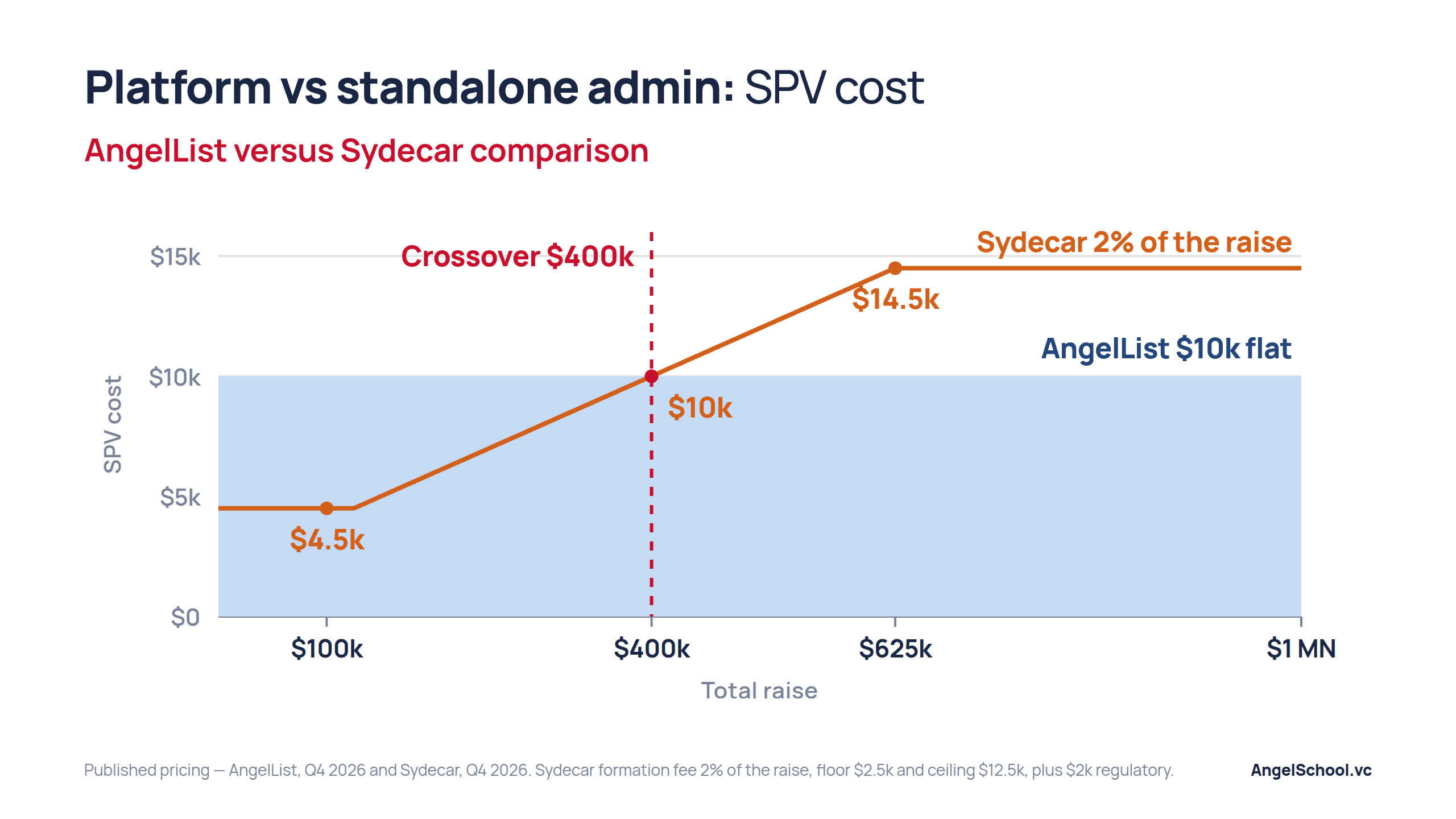
Image 3 of 5: SPV cost against raise size, with Sydecar at $4,500 and AngelList at $10,000 on a $100,000 raise, crossing at $400,000.
A flat fee gives you certainty. You are very unlikely to reach the scale where you benefit from it.
Build your foundations. Fix the raise. Do not scrutinize SPV costs.
The Most Important Factor in Selecting an SPV Admin Is Survivability
Here is the thing about an SPV fee: you pay it once, at the start, and the obligation runs for the life of the vehicle. That is often a decade.
You are not buying a service for this quarter. You are buying a counterparty for 10 years, and you are prepaying.
Which is why the cheapest administrator is the wrong optimization. It is like hiring the cheap lawyer in the strip mall next to the 7-Eleven. The price is attractive right up until the moment the thing you paid for is the thing you need.
Assure: what happens when an SPV admin shuts down.
Assure was a Salt Lake City firm that pioneered deal by deal SPV administration and, for most of the last decade, ran the largest book of SPVs in the US. Reconstructing its filings gives $10.02 BN raised across 8,747 vehicles and 202,136 investor positions between 2014 and 2022 — SEC Form D, Q1 2026. Its own last public figure was $9.6 BN under administration.
In late November 2022 it told its clients it was shutting down. Notice went out on 22 and 23 November, and the deadline to move every vehicle somewhere else was 31 December.
Roughly 30 days, over the holidays.
The book that needed rehoming was young. $7.48 BN of it, across 4,856 deals and 108,608 investor positions, had been raised in the 3 years 2020 to 2022, which is 74.7% of everything Assure ever administered. 2021 alone was 2,283 vehicles and $3.67 BN, 37% of the entire book, in its penultimate full year.
This was an administration failure, not a custodial one. No investor capital was reported lost.
Every syndicate lead who had run SPVs on the platform, myself included, had to take ownership of their own SPVs. That means responsibility for tax filings, liquidity distributions and K-1 documents, or paying someone else to do it, assuming there was a willing party.
What happened to our 7 SPVs at Assure.
A year before their shutdown, I noticed significant degradation in their service responses. Since this is a company driven by human services, it suggested deliberate cost cutting or high levels of turnover.
My intuition led me to start shopping around and to start new SPVs with another provider, rather than get further stuck. That made no difference to the vehicles already there.
The silver lining in Assure's cataclysmic failure was that it was so big it left an air gap in the market. Other SPV admins stepped up, willing to offer migration services. You still had to pay for it, but it was at least an option.
I ran a support group to crowdsource information, which I shared with other syndicate leads. It was a crazy situation, trying to work out which SPV admins were genuinely offering to help while navigating new entrants appearing in real time to take over a book of business.
Finally Fund Admin was one of them. Its founder, J. Skyler Fernandes, also co-founded VU Venture Partners, and as I understood it at the time he had SPVs stuck at Assure and needed a way to get them out. He built Finally to solve his own problem and turned that into a business.
I compared options and pricing, and shared that information with the community.
In the end the solution was to pay someone else to migrate our SPVs. That solves the future administration of those 7 vehicles, but it came at a cost: they essentially charge you for a fresh new SPV on every one.
Which raises the question nobody asks on day zero. Who should pay for it?
The logical answer is the lead. They picked the administrator, so they should bear the cost. I know other syndicates who asked their LPs to cover it.
I chose to absorb it. It was in the order of 5 figures, which was expensive but at a scale I could manage. Plenty of other syndicates had far more vehicles and simply could not.
The lesson is that you are selecting a counterparty for the next 10 years on day zero. Pick the partner who is going to still be in business, not the cheapest one on the block.
AngelList Viewed Through the Lens of a Marketplace
Two sided marketplaces solve 3 things that bring supply and demand together: aggregation, discoverability and transparency.
By design, all 3 favor the demand side. The consequence is that the supply side gets squeezed down to the lowest common denominator, which benefits the platform and the demand side at the expense of supply.
Think about a freelancer marketplace like Fiverr: the platform gets a cut from every transaction, service providers are fragmented, uncoordinated and have no pricing power, and buyers are free to pick and choose.
On a syndicate platform, angels drive demand. Syndicates are the supply, all competing for a limited pool of capital which, as we saw, is shrinking.
Median check size gets squeezed. Intuitively, that should mean lower checks, lower management fees and lower carried interest on a platform like AngelList than at standalone administrators. We have data to corroborate one of those 3.
| Administrator | Vehicles | Bottom quartile | Median | Vehicles averaging under $5k |
|---|---|---|---|---|
| AngelList | 3,255 | $6,175 | $14,102 | 19.3% |
| Sydecar | 2,448 | $16,938 | $41,096 | 3.6% |
| Allocations | 197 | $23,189 | $60,000 | 0.5% |
| Finally | 163 | $18,397 | $34,333 | 0% |
| Standalone combined | 2,808 | $17,498 | $41,760 | 3.2% |
All rows — SEC Form D, Q1 2025 - Q1 2026. These are averages within each vehicle, not the smallest check any investor wrote. Form D reports the amount sold and the number of investors but never individual checks, so the smallest is not knowable from public data.
Notice that the median check on AngelList is 66% lower than at the standalone administrators, and that 6 times as many of its vehicles sit under $5k per investor. The bottom quartile tells the same story: $6,175 per LP against $17,498.
This is based on actual dollars moved, not stated minimum checks, which also happen to be lower on average on AngelList than at standalone SPV admins.

Image 4 of 5: Median LP check per SPV, $14,102 at AngelList against $41,760 across the standalone administrators.
The 'one-way' LP door. Bringing your LPs onto a syndicate platform gives them a UI, and it also gives them other syndicates to source dealflow from. This is a door that swings outwards for LPs, competing for their mindshare and their capital, and you get little in return from the platform itself.
In effect you have grown the syndicate platform's liquidity pool at the expense of your own LP base, by bringing your own LP base.
Once you start on a syndicate platform or administrator you are unlikely to move, which means you are locked in. The more successful you are, the more LPs you bring to the platform, and the more leakage you will have.
The SPV LP cap. Most SPVs rely on Section 3(c)(1) of the Investment Company Act, which limits a fund to 100 beneficial owners. This is why SPVs are capped at 99 investors.
A qualifying venture capital fund can take 250 beneficial owners if it raises no more than $10 MN, and the INVEST Act would move that up to 500 owners and $50 MN if it passes.
Limiting the number of LPs, combined with the check size squeeze, limits your SPV raises. Take a $3k minimum check, which is the bottom decile of AngelList SPVs at $3,471. You would need to fill all 99 slots to reach a $344k raise, and we know the average syndicate gets far fewer commitments than that — 15, in fact — SEC Form D, Q1 2025 - Q1 2026.
Syndicate platform carry share. AngelList publishes its setup fee clearly. It is ambiguous on carry sharing.
In 2019 it announced it was eliminating carry on LPs with whom a syndicate has a pre-existing relationship. So there is no carry share on investors you bring to the platform, and you are charged carry on the investors you receive from it. That has not been clearly published or updated since, and the rate appears on neither the pricing page, the announcement nor the help center.
Our working assumption, which we could not confirm against any AngelList source, is that you share 5% carry on LP capital the platform introduces.
Standalone SPV admins are unambiguous on this. Sydecar publishes a 0% carry share — Sydecar, Q4 2026. For all of our SPVs, which we run with standalone administrators, we take 20% carry and share none of it with a platform.
Syndicate Platform vs SPV Admin Comparison
Here is a summary breakdown of how AngelList compares to other SPV admins.
| AngelList | Sydecar | Allocations | Finally | |
|---|---|---|---|---|
| Setup cost | $8k + $2k blue sky | 2% of raise, $2.5k - 12.5k, + $2k regulatory | Not published | Not published |
| SPV admin cost at a $100k / $200k raise | $10k / $10k | $4.5k / $6k | Not published | Not published |
| Carry sharing? | Yes, on LPs sourced from its network | 0% | Not published | Not published |
| Median check in its SPVs | $14,102 | $41,096 | $60,000 | $34,333 |
| LP capacity | 99 | 99 | 99 | 99 |
| Control over LP base | No | Yes | Yes | Yes |
| Total running cost at a $100k / $200k raise | $10k / $10k per deal no separate stack needed | $50 a month + $4.5k / $6k per deal | $50 a month + quoted per deal | $50 a month + quoted per deal |
Pricing rows — AngelList, Q4 2026 and Sydecar, Q4 2026. Check rows — SEC Form D, Q1 2025 - Q1 2026. Allocations and Finally do not publish pricing, and their check figures rest on 197 and 163 SPVs, so treat those 2 columns as indicative.
Notice that the last row is the fair comparison, because every standalone admin still needs the operating stack that AngelList bundles in. Even charging a full year of tooling against every deal, the standalone route is 49% cheaper at a $100k raise and 34% cheaper at $200k.
The row above it is the one no comparison article scores. Everything else is a price; control over your LP base is a position.
One disclosure, since this article scores providers we deal with. I have no economic stake in any SPV admin named here. We have existing relationships and use different providers, and that is the nature of our relationship.
The Syndicate Tech Stack
How I run a 1,500 LP network with $50 a month.
It is surprisingly easy to build and operate a syndicate tech stack with generic off the shelf SaaS tools. What you need is a domain, an email, a CRM, a dealflow distribution mechanism, and an SPV admin to get deals done. While there are venture specific tools out there, we do not see the value in exorbitant price points for incremental functionality.
| What it does | Monthly cost |
|---|---|
| LP research and networking | LinkedIn (free tier) |
| LP onboarding and investor calls | Standard video conferencing, $20 |
| Custom domain and email | $20 |
| LP CRM | $10 per 1,000 user records |
| Dealflow distribution (email automation) | Included in CRM |
| Data rooms | Included in G Suite (Google Drive) |
| SPV formation and administration | $4.5k - 14.5k per SPV, passed on to LPs |
| Operating total | $50 a month + SPV administration |
The only variable cost in our tech stack is the CRM, and an extra $10 per thousand LPs is trivial. You only pay more if you are successfully scaling.
We disagree with venture specific tools, especially for syndicates, because they are multiples of the price for minimal incremental benefit. Affinity, a venture CRM, is commonly cited at $18k - 25k per seat annually. That is just your CRM. Our entire stack costs $50 a month for everything we need.
For SPV administration, consult the table above to make the best decision for your needs. We also go through the options separately in our breakdown of the best platforms for SPV setup and administration.
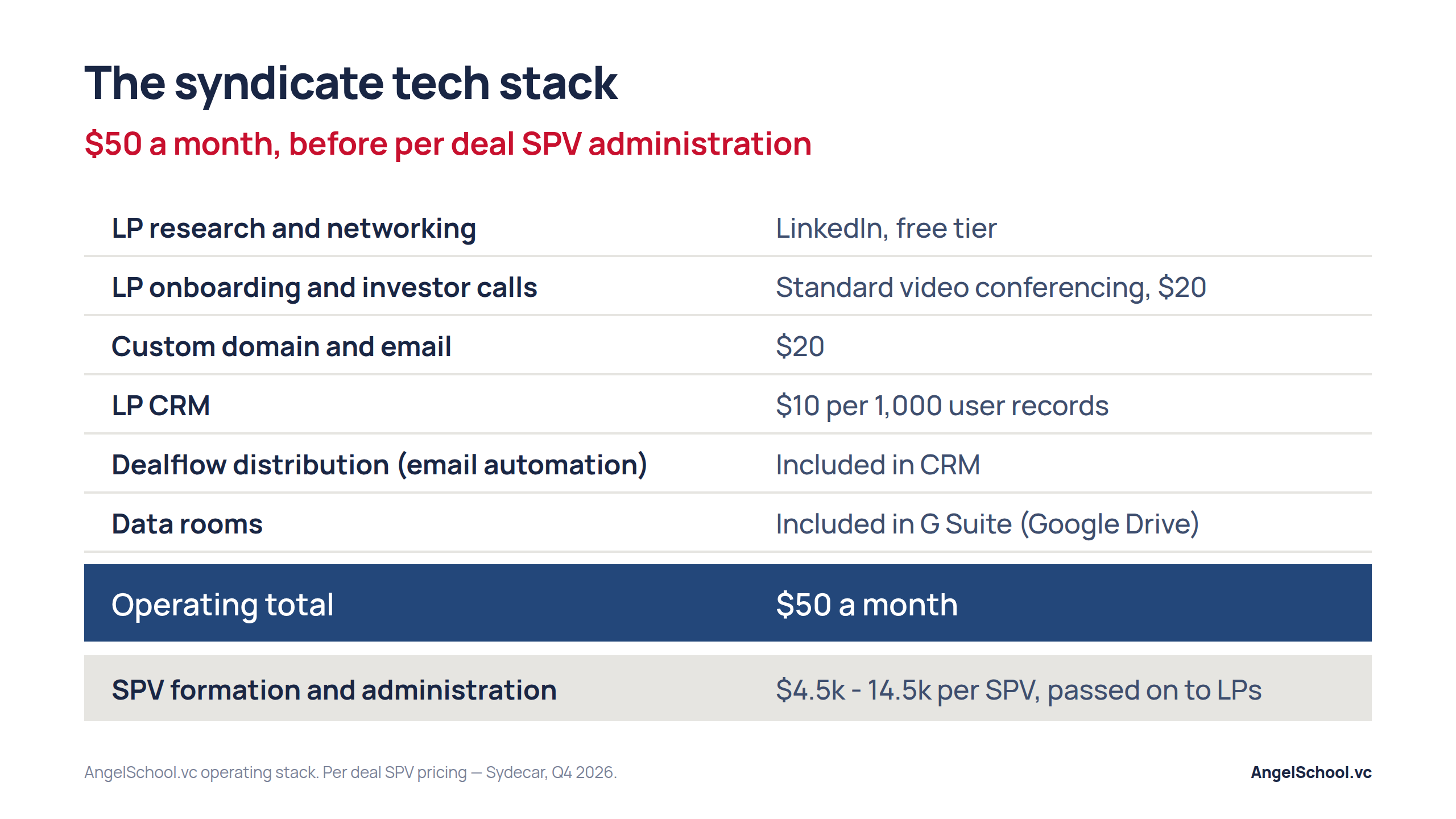
Image 5 of 5: The syndicate tech stack, totalling $50 a month before per-deal SPV administration.
When AngelList Is the Right Answer
My opinion is virtually never. The exceptions are narrow and very specific: your first vehicle, when what you want most is somebody else accountable while you learn the process, and a raise above $400k, where the flat fee is genuinely cheaper.
Outside those, the only reason to consider AngelList is if there is no alternative, and we have already given you one.
The generic tech stack is cost effective and viable for anybody starting out, and it scales extremely well. It has been built and iterated off my own operations, and I use it at scale today.
It does not need to be more complicated than that.

If you want the full version of how we built it and how we run it, check out AngelSchool.vc's Masterclass: Building Angel Syndicates. It's a free resource we built for the venture community.
If You're Looking for Syndicate Dealflow Rather Than Leading One
Everything above is written from the perspective of the syndicate lead. If you are an angel looking for syndicate dealflow, here are 3 things you should look into.
The first is fee drag. LPs bear the cost of the SPV and some management fees. I recommend a total fee load of no more than 7 - 8%. That makes a vehicle raising under $100k on AngelList prohibitive, since the SPV alone is more than 10% of the raise.
The second is dealflow and diligence quality. There is a wide gamut in the practices of syndicates, particularly on AngelList. Many leads simply do not do any diligence, and believe that having a pitch deck is reason enough for an angel to deploy capital with them.
I disagree sharply with that view. For a syndicate to earn fees and carry, they should be discharging their fiduciary responsibility as an investor.
The quickest way to filter for this is to ask a syndicate you are considering joining for their diligence or memo on a recent deal. If they do not have one at all, it means they do not do any diligence. If they do have one, read it and see whether it represents something you would put your capital behind.
The third is the SPV administrator. Ask who administers the vehicle, and what happens to your K-1s and tax documents if that administrator shuts down.
Joining angel syndicates is genuinely one of the best sources of dealflow an angel can get access to, assuming the lead knows what they are doing. It gets you far better deal access than you could reach as an individual small check angel, and into a broader stage range. You are paying fees and economics for that, so the trade off has to be worthwhile.
If you’re looking to build and scale your own syndicate, check out AngelSchool.vc’s Masterclass: Building Angel Syndicates. It’s a free resource we built for the venture community.
This article describes US securities regulation and general market practice as at Q4 2026. Rules change, administrators change their pricing, and your own situation may differ. Nothing here is legal, tax or investment advice.
Frequently Asked Questions
What does it cost to set up and run an SPV?
Between $4.5k and $14.5k per vehicle at published rates, depending on the administrator and how much you raise. AngelList charges $10k flat. Sydecar charges 2% of capital raised with a $2.5k floor and a $12.5k ceiling, plus a $2k regulatory fee; Allocations and Finally quote privately.
The running cost of a standalone syndicate tech stack is about $50 a month if you build it the right way.
Is AngelList the cheapest syndicate platform?
Not on most deals. Because its fee is flat and Sydecar's is proportional, they cross at a raise of about $400k; below that Sydecar is cheaper and above it AngelList is. 69.5% of AngelList's own vehicles filed between Q1 2025 and Q1 2026 raised less than $400k.
What is the minimum raise for a syndicate SPV to be worthwhile?
$100k. Below that threshold the SPV costs get disproportionately high on a percentage basis, and your deployable capital is small, which limits your upside.
In other words, the risk reward and the effort of piecing together the deal is not worth it below $100k. The filings put the line in the same place experience does: under $100k the median AngelList SPV pays 10% of everything it raised in fees, against 3.75% at or above it.
How many backers can a syndicate SPV legally have?
99 in practice, under the 100 beneficial owner limit in Section 3(c)(1) of the Investment Company Act. A qualifying venture capital fund can go to 250 if it raises no more than $10 MN. The INVEST Act would raise that to 500 owners and $50 MN, but it passed only the House in December 2025 and is not law.
Can I advertise my syndicate to find new LPs?
Not under Rule 506(b), which is how every SPV I have set up is filed. General solicitation is prohibited and you may only approach people you already have a pre-existing substantive relationship with.
In reality, where syndicate leads fail is simply from misunderstanding how investor networks are built. Cold outreach does not build trust.
What is the typical check size in an angel syndicate SPV?
It depends on the syndicate lead's policy, and on their LP network's wealth and risk appetite. Across platforms, the median AngelList vehicle's average check is $14,102; across Sydecar, Allocations and Finally combined it is $41,760.
These are averages within each vehicle, and Form D never reports individual checks, so the smallest in any given deal is not knowable from public filings.
Does the platform take a share of my carry?
It depends on the platform, and on one of them you cannot find out. AngelList confirmed in 2019 that it charges no carry on LPs you bring and does charge carry on LPs it introduces, but the rate is not published on its pricing page, in that announcement or in its help center. Sydecar publishes 0%. Ask the question in writing before you form the vehicle, because the answer compounds over the life of every deal.
Should I move my existing SPVs to a cheaper administrator?
Almost never. Syndicates prepay for the 10-year life of an SPV, so migrating mid life means paying substantially again for vehicles you have already paid for.
Migration is only needed in specific cases, one of which is your administrator shutting down, as in the Assure wind down. You are better off making the day zero decision on which SPV administrator to work with than trying to fix it down the line.
Should I consider building an angel syndicate?
In our view, if you are serious about startup investing over the long term, running a syndicate is a far better risk reward than investing as an individual angel. There are conditions that set you up for success: sound foundations as a venture investor, the credibility to build an LP network, a network that believes in you and will back your dealflow, and sufficient dealflow to have enough companies to back.
There is no doubt that starting a syndicate takes work and effort to maintain, but in our view it is worth it in the long run.
As an example, I have written $1 MN checks into startups. At that scale a 6% fee load is $60k, of which $40k is the management fee, leaving $940k deployed. A 20% carried interest on that is the equivalent of holding a $188k capital position in the same company, with zero capital outlay. If the deal returns 5x, that position pays $752k.