Problem 00065 17 Mar, 2025
Let \(x_1, x_2, \dots x_n \in \mathbb{R}_{+}\), prove:
\[\sum_{i=1}^n \left[\frac{1}{1+\sum_{j=1}^i x_j}\right] \lt \sqrt{\sum_{i=1}^n \frac{1}{x_i}} \]
... beneath a Full Moon 🌕
If you’d like to help out with reviewing, feel free to drop me a message (see the About Page).
Special thanks to:
meithecatte - for pointing out that one of statements was incorrect.cryslith - for pointing out some mistakes in my comments and helping me correct a few solutions.Gheorghe Craciun - for inspiring and allowing me to borrow some of his problems.Thomas Klausner - for his kindness in reporting errors in some of the proofs.If I forgot to include a source or mistakenly credited an exercise to the wrong author, please know it was unintentional. Some of the problems are original (created by me), but not all are signed, as the results are too elementary to require attribution. Similarly, some solutions are original, while others are based on official ones (just presented in slightly more detail).
Writing this short article made me nostalgic and brought back fond memories of my high school math teacher, Carmen Georgescu, who had a positive influence on me, as well as Gabriel Tica, who also inspired me when I was a young student.
Inequalities are among the most “fascinating” and versatile topics in competitive mathematics because they challenge solvers to think creatively and intuitively. If you look at the IMO problem sets, you will find that inequality problems are almost always present, year after year.
Approaching an “inequality” problem requires more than just sheer “mathematical force” (although using techniques from Real Analysis can help); you need to take a step back and come up with clever manipulations, substitutions, and (sometimes) novel ideas. In essence, inequality problems blend “beauty” with “intellectual challenge”, and they embody so well the spirit of “competitive mathematics”.
I am a bad salesperson when it comes to selling mathematics, but the main idea is inequality problems are cool.
In case you haven’t seen one, this is what hard inequality problems look like:
Problem 00065 17 Mar, 2025
Let \(x_1, x_2, \dots x_n \in \mathbb{R}_{+}\), prove:
\[\sum_{i=1}^n \left[\frac{1}{1+\sum_{j=1}^i x_j}\right] \lt \sqrt{\sum_{i=1}^n \frac{1}{x_i}} \]
Problem 00066 17 Mar, 2025
Let \(a,b,c\) be positive real numbers. Prove that:
\[ \frac{a}{\sqrt{a^2+8bc}} + \frac{b}{\sqrt{b^2+8ac}} + \frac{c}{\sqrt{c^2+8ab}} \ge 1 \].
9th ○ hard ○ #algebra #inequalities
It is generally unwise to label something as “hard” or “difficult,” especially in mathematics. However, considering that these problems are actual IMO challenges, it is reasonable to label them in this way.
The purpose of this article is to highlight some techniques and methods that can assist math hobbyists, novice problem solvers, and curious undergraduates in approaching seemingly difficult inequality problems. This writing will only touch upon a small portion of this expansive (debatable epithet) class of problems.
An edgy teacher, names excluded, once said: “In an ideal world people would solve inequality problems instead of Sudoku!”. We haven’t spoken since, I like Sudoku.
There is a subtle distinction between an inequality and an inequation, although the terms are often used interchangeably in everyday mathematical language.
An inequation, a less common term, behaves just like a mathematical equation involving an inequality symbol. Inequations emphasize the algebraic problem-solving aspect of an inequality.
Those are inequations:
Problem 00067 17 Mar, 2025
If \(x\in\mathbb{R}\), solve:
\[ |x^2-9|+|x^2-16| \lt 47 \]
9th ○ easy ○ #algebra #inequalities
Problem 00068 17 Mar, 2025
Find real numbers \(x\) for which the following "inequality" holds:
\[ \sqrt{3-x}-\sqrt{x+1} \gt \frac{1}{2} \]
9th ○ easy ○ #algebra #inequalities
An inequation is all about finding solutions, while inequalities focus on the actual relationship between numbers, a statement of truth that applies for all numbers in a given domain.
The following are inequalities:
Problem 00069 17 Mar, 2025
Let \(a, b\) real numbers. Prove that:
\[ |a+b|\le|a|+|b| \]
9th ○ easy ○ #algebra #inequalities
Now, let’s try to use the previous result (the modulus inequality) in a creative way:
Problem 00070 17 Mar, 2025
Let \(a,b\) real numbers. Prove the inequality:
\[ | 1 + ab | + | a + b | \ge \sqrt{|a^2-1||b^2-1|} \]
Problem 00071 17 Mar, 2025
Let \(x\in\mathbb{R}\). Prove that:
\[ x^2+x+1\gt0 \]
9th ○ easy ○ #algebra #inequalities
Problem 00072 17 Mar, 2025
Let \(a,b\) real numbers such that \(a+b \gt 0\), prove:
\[ \frac{a^2+b^2}{a+b} \geq \frac{a+b}{2} \]
9th ○ easy ○ #algebra #inequalities
Problem 00073 17 Mar, 2025
Let \(a,b\) real numbers, \(a+b \ge 0\), prove:
\[ \frac{a}{b^2}+\frac{b}{a^2} \ge \frac{1}{a}+\frac{1}{b} \]
9th ○ easy ○ #algebra #inequalities
Problem 00074 17 Mar, 2025
Let \(a, b\) be positive real numbers. Prove that:
\[ \frac{1}{a+b} \leq \frac{1}{4}\left(\frac{1}{a}+\frac{1}{b}\right) \]
9th ○ easy ○ #algebra #inequalities
In rare (but “intentional”) cases we can use inequalities to solve system of equations:
Problem 00075 17 Mar, 2025
Find positive real numbers \(a, b, c\) such that:
\[ \begin{cases} \frac{1}{a+b}+\frac{1}{b+c}+\frac{1}{c+a} = \frac{3}{2} \\ \frac{1}{a}+\frac{1}{b}+\frac{1}{c} = 3 \end{cases} \]
Keep in mind the following two inequalities, as they will be helpful when solving more complex problems:
Problem 00076 17 Mar, 2025
Let \(x,y,z \in \mathbb{R}\). Prove that:
\[ x^2+y^2+z^2 \ge xy + yz + zx \]
9th ○ easy ○ #algebra #inequalities
Problem 00077 17 Mar, 2025
Let \(a, b\) be positive real numbers. Prove that:
\[ a^3+b^3 \ge a^2b+ab^2 \]
9th ○ easy ○ #algebra #inequalities
For the next problem, consider applying an inequality we have already established.
Problem 00078 17 Mar, 2025
Let \(a,b,c\) positive real numbers, such that \(abc=1\). Prove the following inequality:
\[ a^4+b^4+c^4 \geq a+b+c \]
9th ○ easy ○ #algebra #inequalities
In a similar fashion:
Problem 00079 17 Mar, 2025
Let \(a,b,c\) positive real numbers such that \(abc=1\). Prove the inequality:
\[ \frac{a^3}{bc}+\frac{b^3}{ca}+\frac{c^3}{ab} \geq a+b+c \]
Do you know how to factor your symmetric polynomials ?
Problem 00080 17 Mar, 2025
For \((x,y)\neq(0,0)\), prove:
\[ x^4+x^3y+x^2y^2+xy^3+y^4\gt0 \]
I wouldn’t call the next problem a “fundamental” result, but it’s definitely a useful trick that I’ve seen applied to solve at least two or three problems in various math competitions:
Problem 00081 17 Mar, 2025
Let \(x\) a positive real number such that \(x\gt1\), prove that:
\[ \sqrt{x} \gt \frac{1}{\sqrt{x+1}-\sqrt{x-1}} \]
9th ○ easy ○ #algebra #inequalities
The following two problems have similar solutions. The key idea is to bound each term between two fixed values.
Problem 00082 17 Mar, 2025
Let \(n \in \mathbb{N}\) and \(n \gt 1\). Prove that:
\[\frac{1}{2}\lt\frac{1}{n+1}+\frac{1}{n+2}+\dots+\frac{1}{2n}\lt\frac{3}{4}\]
Problem 00083 17 Mar, 2025
Let \(n\in\mathbb{N}^{*}\setminus\{1\}\). Prove that:
\[ \frac{1}{2} \lt \frac{1}{n^2+1} + \frac{2}{n^2+2} + \frac{3}{n^2+3} + \dots + \frac{n}{n^2+n} \lt \frac{1}{2} + \frac{1}{2n} \]
There is something elegant about the next problem:
Problem 00084 17 Mar, 2025
Prove that for any \(x \in \mathbb{R}_{+}\) the following inequality is true:
\[ \sqrt{x^2+x+\sqrt{x^2+x+\sqrt{x^2+x+\sqrt{x^2+x+\dots+\sqrt{x^2+x}}}}} < x+1 \]
\(n\) is the number of subsequent "radicals".
9th ○ easy ○ #algebra #inequalities
The following are the first non-trivial challenges in this article that can be solved without using advanced techniques or inequalities. Try using the provided hints before checking the full solution.
Problem 00085 17 Mar, 2025
Let \(a_1, a_2, \dots, a_n\) positive real numbers such that \(\sum_{i=1}^{2009}a_i = 2009\). Prove the inequality:
\[ \frac{a_1^2+a_2^2}{a_1+a_2}+\frac{a_2^2+a_3^2}{a_2+a_3}+\dots+\frac{a_{2009}^2+a_1^2}{a_{2009}+a_1} \geq 2009 \]
Problem 00086 17 Mar, 2025
Let \(a,b,c\) positive real numbers such that: \(abc=1\). Prove that:
\[ \frac{1}{a^3+b^3+1}+\frac{1}{b^3+c^3+1}+\frac{1}{c^3+a^3+1} \leq 1 \]
Problem 00087 17 Mar, 2025
Let \(a,b,c\) positive real numbers such that \(abc=1\). Prove that:
\[ 2\left(\frac{a}{b}+\frac{b}{c}+\frac{c}{a}\right) \geq \frac{1}{a} + \frac{1}{b} + \frac{1}{c} + a + b + c \]
Problem 00088 17 Mar, 2025
Prove that for each positive integer \(n \gt 1\):
\[ \sqrt{n+1}+\sqrt{n}-\sqrt{2} \gt 1 + \frac{1}{\sqrt{2}} + \frac{1}{\sqrt{3}} + \dots + \frac{1}{\sqrt{n}} \]
Problem 00089 17 Mar, 2025
Let \(x,y,z\) positive real numbers. Prove the following inequality:
\[ \frac{1}{x\sqrt{x}+y\sqrt{y}+\sqrt{xyz}} + \frac{1}{y\sqrt{y}+z\sqrt{z}+\sqrt{xyz}}+\frac{1}{z\sqrt{z}+x\sqrt{x}+\sqrt{xyz}} \leq \frac{1}{\sqrt{xyz}} \]
Problem 00090 17 Mar, 2025
Let \(a,b,c\) positive real numbers such that \(ab+bc+ca=1\). Prove the inequality:
\[ \frac{1}{a+b}+\frac{1}{b+c}+\frac{1}{c+a} \ge \sqrt{3} + \frac{ab}{a+b} + \frac{bc}{b+c} + \frac{ca}{c+a} \]
The following inequality may seem counterintuitive at first glance. How can a function $f(x,y,z)$, which clearly depends on the variables $x$, $y$, and $z$, attain its maximum value independently of $x$? Upon deeper reflection, however, there’s no contradiction. This kind of behavior is entirely possible under the right structure:
Problem 00091 17 Mar, 2025
Let \(x,y,z\) positive real numbers. Prove the inequality:
\[ \sqrt{\frac{x+y}{x+z}}+\sqrt{\frac{x+z}{x+y}} \leq \frac{y+z}{\sqrt{yz}} \]
Just a general observation: if we explore the mindset of problem creators, we find that inequalities like Problem IVI20.1 are especially appealing. They often serve as the building blocks for crafting more intricate and elegant problems. For instance, we can use that very inequality as the basis for generating new, seemingly more challenging problems. Let’s step into the mindset of a problem composer.
Recall that we have just proven the following inequality:
\[ \sqrt{\frac{x+y}{x+z}}+\sqrt{\frac{x+z}{x+y}} \leq \frac{y+z}{\sqrt{yz}} \tag{1} \]
Now, as a creative twist, we apply cyclic substitutions to obtain two additional inequalities:
\[ \sqrt{\frac{y+z}{y+x}}+\sqrt{\frac{y+x}{y+z}} \leq \frac{z+x}{\sqrt{zx}} \tag{2} \] \[ \sqrt{\frac{z+x}{z+y}}+\sqrt{\frac{z+y}{z+x}} \leq \frac{x+y}{\sqrt{xy}} \tag{3} \]
Adding inequalities \((1)\), \((2)\), and \((3)\), we obtain:
\[ \sqrt{\frac{x+y}{x+z}}+\sqrt{\frac{x+z}{x+y}} + \sqrt{\frac{y+z}{y+x}}+\sqrt{\frac{y+x}{y+z}} + \sqrt{\frac{z+x}{z+y}}+\sqrt{\frac{z+y}{z+x}} \leq \] \[ \frac{y+z}{\sqrt{yz}} + \frac{z+x}{\sqrt{zx}} + \frac{x+y}{\sqrt{xy}} \Leftrightarrow \] \[ \frac{\sqrt{x+y}+\sqrt{z+y}}{\sqrt{x+z}} + \frac{\sqrt{x+z}+\sqrt{y+z}}{\sqrt{x+y}} + \frac{\sqrt{z+x}+\sqrt{y+x}}{\sqrt{z+y}} \leq \] \[ \frac{\sqrt{x}+\sqrt{y}}{\sqrt{z}} + \frac{\sqrt{y}+\sqrt{z}}{\sqrt{x}} + \frac{\sqrt{z}+\sqrt{x}}{\sqrt{y}} \tag{4} \]
To add a final layer of challenge, we can impose the condition \(x + y + z = 1\). This leads to the following "new" problem, which appears more complicated but is structurally equivalent to the original:
Let \(x,y,z\) positive real numbers such that \(x+y+z=1\). Prove that:
\[ \frac{\sqrt{1-z}+\sqrt{1-x}}{\sqrt{1-y}} + \frac{\sqrt{1-y}+\sqrt{1-x}}{\sqrt{1-z}} + \frac{\sqrt{1-y}+\sqrt{1-z}}{\sqrt{1-x}} \leq \] \[ \leq \frac{\sqrt{z}+\sqrt{x}}{\sqrt{y}} + \frac{\sqrt{y}+\sqrt{x}}{\sqrt{z}} + \frac{\sqrt{y}+\sqrt{z}}{\sqrt{x}} \]
And there you have it, your first composed inequality problem, born from a simple yet powerful foundational result.
If the problem you've just created is too elementary or too similar to an existing one (as in our case), you might choose not to attach your name to it. However, if you do choose to sign it, be sure to acknowledge the original source and clarify your own contribution. Noblesse oblige.
Weak inequalities are inequalities that allow for the possibility of equality. . They are typically denoted by the symbols $\ge$ or $\le$. In contrast, strict inequalities, use $\gt$ and $\lt$ and they don’t permit equality.
A renaissance way to grasp the concept of a weak inequality is to think of the “finger of God” touching Adam’s hand. In this metaphor, a strict inequality is represented by the following painting, as it depicts a situation that never occurs, at least not in olam ha-ze (this world).

From a mathematical standpoint, we know, for example, that $x^2+y^2\ge2xy$. This inequality is always true because $(x-y)^2\ge0$. If we plot $x^2+y^2$, and $2xy$, we will a see thin line where the graphical representation “touch”. This red line is key to solving many problems in physics and engineering. It is specific to weak inequalities.
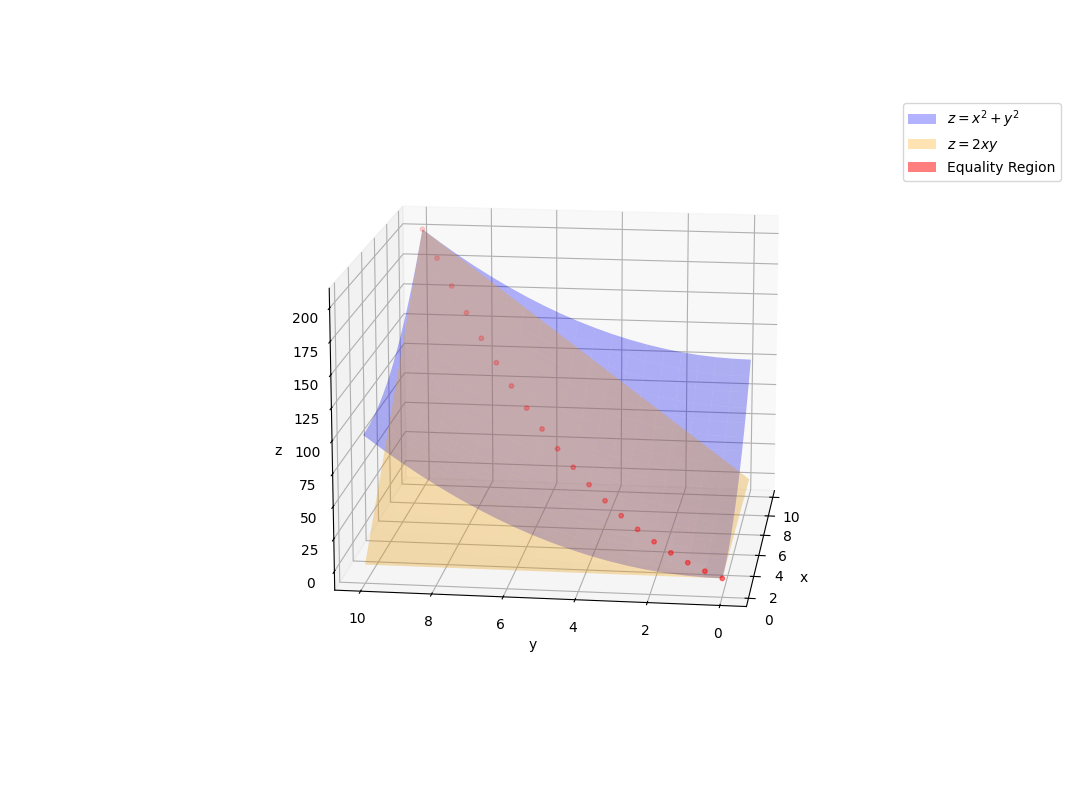
All in all, the main idea is that weak inequalities are more interesting than strict inequalities.
Before delving into specific inequalities, it’s important to highlight a few key identities that problem creators frequently use when designing challenges. These identities are not only essential for understanding inequalities but also serve as powerful tools for solving a variety of other problems.
Some of my favorite identities are:
Should you memorize all of these identities? It depends. If you’re actively participating in contests, I believe it’s worth memorizing them. Otherwise, simply being aware of their existence is sufficient. When you come across similar structures, check if these identities can help you. In a contest, you can present them as lemmas, and for clarity, it’s advisable to offer brief proofs. Fortunately, the proofs are typically straightforward, relying on simple algebraic manipulations.
For example, consider the following problems:
Problem 00012 17 Mar, 2025
Let \(x,y,z \in \mathbb{R}^{*}\), where \(x< y < z\), and \(\frac{x^2}{yz}+\frac{y^2}{xz}+\frac{z^2}{xy}=3\). Prove that the arithmetic mean of \(x,y,z\) is 0.
Problem 00013 17 Mar, 2025
Find all pairs of distinct non-negative natural numbers \((x,y)\) such that:
\[x^3+y^3=(x+y)^2\]
unknown ○ medium ○ #algebra #equations #dyophantine #number theory
This wasn’t an inequality problem, but similar structures can arise in various contexts. Knowing your identities can significantly reduce the effort required to solve a problem.
If you enjoyed the previous problem, give the next one a try:
Problem 00014 17 Mar, 2025
Let \(x,y,z \in \mathbb{R}\), and assume that \((x+y+z)^3=x^3+y^3+z^3\). Prove that for all \(n \in \mathbb{N}\), the following holds:
\[(x+y+z)^{2n+1}=x^{2n+1}+y^{2n+1}+z^{2n+1}\]
The AM (Arithmetic Mean) - GM (Geometric Mean) is a fundamental result in algebra that states:
For any set of non-negative real numbers \(a_1, a_2, \dots , a_n\) the arithmetic mean is always greater than or equal to the geometric mean:
\[ \frac{a_1+a_2+\dots+a_n}{n} \ge \sqrt[n]{a_1*a_2*\dots*a_n} \]
Or:
\[ \sum_{i=1}^n a_i \ge n \sqrt[n]{\prod_{i=1}^n a_i} \]
The equality holds, if, and only if \(a_1=a_2=\dots=a_n\).
For $n=2$ the inequality can be written as: $\frac{a+b}{2} \ge \sqrt{ab}$.
For $n=3$ the inequality can be written as: $\frac{a+b+c}{3} \ge \sqrt[3]{abc}$.
An interesting case arises when $\prod_{i=1}^na_i=1$. In this situation, the inequality gives us: $\sum_{i=1}a_i \ge n$, which means the sum of the numbers is always greater than or equal to $n$ (the number of numbers).
With that in mind, let’s move on to the following problems:
Problem 00001 17 Mar, 2025
Let \(x \in \mathbb{R}_{+}\) prove that:
\[x+\frac{1}{x} \ge 2\]
9th ○ easy ○ #algebra #inequalities
Now, let’s extend this concept by solving the following problem:
Problem 00002 17 Mar, 2025
Let \(x_1,x_2,\dots,x_n \in \mathbb{R}_{+}\). Prove that:
\[S=\frac{x_1}{x_2}+\frac{x_2}{x_3}+\dots+\frac{x_{n-1}}{x_n}+\frac{x_n}{x_1} \ge n \]
With a bit of creativity, you can solve the next problem in a manner similar to the previous one.
Problem 00003 17 Mar, 2025
Let \(n\) be a positive integer greater than \(1\). Show that:
\[ \frac{1}{n}+\frac{1}{n+1}+\frac{1}{n+2}+\dots+\frac{1}{2n-1} \gt n \left(\sqrt[n]{2} - 1\right) \]
Do you know your Partial fraction decomposition ?
Problem 00004 17 Mar, 2025
Prove that \(\forall n \in [5,\infty) \cap \mathbb{N}\):
\[ \frac{1}{1*3}+\frac{1}{3*5}+\dots+\frac{1}{(n-2)n}\gt\frac{1}{\sqrt{n}}-\frac{1}{n} \]
What if you apply the AM-GM inequality twice?
Problem 00005 17 Mar, 2025
Let \(a,b\) positive real numbers, prove:
\[ a^4+b^4 \geq 2\sqrt{2}ab^2-1 \]
9th ○ easy ○ #algebra #inequalities
The AM-GM inequality reveals a profound connection between the sum (∑) and the product (∏) of positive real numbers. With this insight in mind, let’s explore and solve the following problems:
Problem 00006 17 Mar, 2025
Let \(x_1, x_2, \dots x_n\) positive real numbers different than \(0\). Can you find a value for \(P=\prod_{i=1}^nx_i\) so that \(S=\sum_{i=1}^n x_i \ge \pi\) ?
Problem 00007 17 Mar, 2025
Let \(x,y,a,b \gt 0\), prove that:
\[ \frac{a}{x}+\frac{b}{y} \ge \frac{4(ay+bx)}{(x+y)^2} \]
9th ○ easy ○ #algebra #inequalities
Now, for a bit of fun, let’s tackle a problem that may appear more challenging at first glance. You just need to apply the AM-GM twice.
Problem 00008 17 Mar, 2025
Let \(a,b,c\) positive real numbers. Prove that:
\[ \frac{1}{x^2+yz}+\frac{1}{y^2+zx}+\frac{1}{z^2+xy} \leq \frac{1}{2}\left(\frac{1}{xy}+\frac{1}{yz}+\frac{1}{zx}\right) \]
The following problem was shortlisted for the 1971 International Mathematical Olympiad. While not particularly difficult, it requires discovering a clever trick.
Problem 00009 17 Mar, 2025
Let \(a_1, a_2, a_3, a_4\) be positive real numbers. Prove the the inequality:
\[ \frac{a_1+a_3}{a_1+a_2} + \frac{a_2+a_4}{a_2+a_3} + \frac{a_3+a_1}{a_3+a_4} + \frac{a_4+a_2}{a_4+a_1} \ge 4 \]
For the next exercise the key idea is to leverage the additional conditions provided and incorporate them into your proof of the main inequality.
Problem 00010 17 Mar, 2025
Let \(a,b,c\) positive real numbers such that \(abc=1\). Prove that:
\[ \frac{c+ab+1}{1+a+a^2}+\frac{a+bc+1}{1+b+b^2}+\frac{b+ca+1}{1+c+c^2} \ge 3 \]
9th ○ easy ○ #algebra #inequalities
Sometimes you can solve “inequations” using “inequalities”:
Problem 00011 17 Mar, 2025
Find \(x,y,z \in [\frac{1}{3}, \infty)\) such that \(x+y+z \leq 4\) and \(\sqrt{3x-1}+\sqrt{3y-1}+\sqrt{3z-1} \geq 3\sqrt{3}\).
Before proceeding further, let’s familiarize ourselves with two important notions: cyclic inequalities and symmetrical inequalities.
A cyclic inequality involves a set of variables arranged in a cyclic order, where each term follows a repeating pattern by “rotating” the variables. For instance, for three variables we perform the transformation:
\[ a \rightarrow b, \quad b \rightarrow c, \quad c \rightarrow a \]
The cyclic behavior can be expressed using the notation:
\[ \sum_{\text{cyc}} f(a,b,c) = f(a,b,c) + f(b,c,a) + f(c,a,b) \]
Here are some examples that illustrate cyclic sums and their corresponding inequalities:
\[ \sum_{\text{cyc}} a^2 = a^2+b^2+c^2 \overbrace{\geq}^{AM-GM} 3\sqrt[3]{(abc)^2} \] \[ \sum_{\text{cyc}} \frac{a}{b} = \frac{a}{b} + \frac{b}{c} + \frac{c}{a} \overbrace{\geq}^{AM-GM} 3 \] \[ \sum_{\text{cyc}} a^3b^2c = a^3b^2c + b^3c^2a + c^3a^2b \overbrace{\geq}^{AM-GM} 3(abc)^2 \] \[ \sum_{\text{cyc}} \frac{c+ab+1}{1+a+a^2} = \frac{c+ab+1}{1+a+a^2}+\frac{a+bc+1}{1+b+b^2}+\frac{b+ca+1}{1+c+c^2} \ge 3 \]
In contrast, a symmetrical inequality is one that remains unchanged under any permutation of its variables. A function $f(a,b,c)$ is said to be symmetric if it satisfies:
\[ \underbrace{f(a,b,c)=f(a,c,b)=f(b,a,c)=f(b,c,a)=f(c,a,b)=f(c,b,a)}_{3! \quad \text{permutations}} \]
In other words, any swap or rearrangement of $a, b, c$ leaves the function invariant. This complete symmetry is denoted by the notation: $\sum_{\text{sym}}$, which indicates summing over all distinct permutations of the variables.
Consider the following examples:
\[ \sum_{\text{sym}} a = a + a + b + b + c + c \overbrace{\geq}^{AM-GM} 6\cdot\sqrt[3]{abc} \] \[ \sum_{\text{sym}} a^2b = a^2b + a^2c + b^2c + b^2a + c^2a + c^2b \overbrace{\geq}^{AM-GM} 6 \cdot abc \]
To highlight the difference, compare the following two sums:
\[ \sum_{\text{sym}} a^2b = \underbrace{a^2b + a^2c + b^2c + b^2a + c^2a + c^2b}_{3! \quad \text{permutations}} \overbrace{\geq}^{AM-GM} 6\cdot abc \] \[ \sum_{\text{cyc}} a^2b = \underbrace{a^2b + b^2c + c^2a}_{3 \quad \text{"swaps"}} \overbrace{\geq}^{AM-GM} 3 \cdot \sqrt[3]{(abc)^2} \]
Another comparison:
\[ \sum_{\text{sym}} \frac{a}{b} = \frac{a}{b} + \frac{a}{c} + \frac{b}{a} + \frac{b}{c} + \frac{c}{a} + \frac{c}{b} \overbrace{\geq}^{AM-GM} 6 \] \[ \sum_{\text{cyc}} \frac{a}{b} = \frac{a}{b} + \frac{b}{c} + \frac{c}{a} \overbrace{\geq}^{AM-GM} 3 \]
These examples illustrate how the cyclic and symmetrical sum notations capture different patterns of symmetry within inequalities. While cyclic sums rotate the variables in a fixed order, symmetrical sums account for every possible permutation, reflecting complete invariance under any swap of the variables.
Solving more complex inequality problems requires more than just applying the general formula. A common approach involves strategically grouping terms to our advantage, then applying the Arithmetic Mean-Geometric Mean (AM-GM) inequality (or another relevant inequality) to each group.
Finally, we combine the resulting inequalities to form a larger, more powerful inequality.
With practice, this technique will become second nature. However, at first glance, it may seem unintuitive.
Can you solve the following problems without relying on any hints?
Problem 00032 17 Mar, 2025
Let \( a,b,c \in \mathbb{R}_{+} \). Prove the inequality:
\[ (a^2+bc)(b^2+ca)(c^2+ab) \ge 8(abc)^2 \]
9th ○ easy ○ #algebra #inequalities
Problem 00033 17 Mar, 2025
Let \(x,y,z\) positive real numbers, and \((1+x)(1+y)(1+z)=8\), prove that \(xyz \le 1\).
9th ○ easy ○ #algebra #inequalities
Problem 00034 17 Mar, 2025
Let \(x_i \in \mathbb{R}_{+}\), where \(n\) is an even natural number and \(\prod_{i=1}^nx_i=1\). Prove that:
\((x_1^2+x_2^2)(x_3^2+x_4^2)\dots(x_{n-1}^2+x_{n}^2)\ge 2^{\frac{n}{2}}\)
Problem 00035 17 Mar, 2025
Let \(x,y,z\) positive real numbers such that \(xyz=6\). Prove the inequality:
\[ \frac{2x}{(2x^2+y^2)(x^2+2z^2)}+\frac{3y}{(3y^2+z^2)(y^2+3x^2)}+\frac{5z}{(5z^2+x^2)(z^2+5y^2)} < \frac{1}{8} \]
9th ○ easy ○ #algebra #inequalities
Problem 00036 17 Mar, 2025
Let \(n\) a natural number greater than \(0\), prove that:
\[ \sqrt{1\cdot2}+\sqrt{2\cdot3}+\dots+\sqrt{n(n+1)} < n(n+1) \]
8th ○ easy ○ #algebra #inequalities
Problem 00037 17 Mar, 2025
Let \(n \in \mathbb{N}^{*}\) such that \(n\gt1\), prove the inequality:
\[ n^3+n^2+2n \gt 4\sqrt{n}(1+\sqrt{2}+\dots+\sqrt{n}) \]
The next problem is more difficult to solve but a previous exercise might help:
Problem 00038 17 Mar, 2025
Let \(n \in \mathbb{N}\setminus\{0,1\}\). Prove the inequality:
\[ \frac{1}{5+2^4}+\frac{1}{5+3^4}+\frac{1}{5+4^4}+\dots+\frac{1}{5+n^4} \lt \frac{n-1}{4\cdot n} \]
Remember, the key to solving the next problem is to leverage the additional condition to your advantage. While the terms may already be “grouped” for you, this alone won’t be sufficient.
Problem 00039 17 Mar, 2025
Let \(a,b,c\) positive real numbers such that \(a+b+c=1\). Prove the inequality:
\[ \Bigl(\frac{1}{a}-1\Bigl)\Bigl(\frac{1}{b}-1\Bigl)\Bigl(\frac{1}{c}-1\Bigl) \ge 8 \]
9th ○ easy ○ #algebra #inequalities
The next problem, proposed by Dorin Marghidanu, is a generalisation of the previous one, but can you “spot” the similarity?
Problem 00040 17 Mar, 2025
If \(0 \lt a_1, a_2, \dots, a_n \leq 1\), such that \(a_1+a_2+\dots+a_n=n-1\), then:
\[ (n-1)^n \cdot (1-a_1) \cdot (1-a_2) \cdot \dots \cdot (1-a_n) \leq a_1 a_2 \dots a_n \]
The next problem is another generalisation of an exercise proposed to the Romanian (Olympiad) Team Selection Test from 2002:
Problem 00041 17 Mar, 2025
Let \(k, x_1, x_2, \dots, x_n \in (0,1)\) such that \(k \gt \max\{x_1, x_2, \dots, x_n\}\). Prove the following inequality:
\[ \sqrt{\prod_{i=1}^n x_i} + \sqrt{\prod_{i=1}^n(k-x_i)} \lt k \]
Problem 00042 17 Mar, 2025
Let \(a,b,c\) be positive real numbers such that \(a^3+b^3+c^3=3\). Prove the inequality:
\[ \frac{a(1-a)}{(1+b)(1+c)} + \frac{b(1-b)}{(1+a)(1+c)} + \frac{c(1-c)}{(1+a)(1+b)} \le 0 \]
We have already solved the following inequality using a different technique, but can you now prove it again by applying ‘grouping’ and the AM-GM inequality?
Problem 00043 17 Mar, 2025
Let \(x,y,z\) positive real numbers. Prove that:
\[ x^2+y^2+z^2 \ge xy + yz + zx \]
Problem 00044 17 Mar, 2025
Let \(x,y,z\) positive real numbers. Prove that
\[ x^2+y^2+z^2 \ge x\sqrt{yz}+y\sqrt{zx}+z\sqrt{xy} \]
Problem 00045 17 Mar, 2025
Let \(a,b,c\) positive real numbers, prove:
\[ a^3+b^3+c^3 + 3 \ge a+b+c+ab+bc+ca \]
In a somewhat similar fashion:
Problem 00047 17 Mar, 2025
Let \(a,b,c \in (0,1]\), and n natural number \(\geq 2\) prove that:
\[ \frac{c}{a^n + b^n + 3n-2} + \frac{a}{b^n+c^n+3n-2} + \frac{b}{c^n+a^n+3n-2} \leq \frac{1}{n} \]
Problem 00048 17 Mar, 2025
Let \(a,b,c \in \mathbb{R}_{+}\). Prove that:
\[ a^3+b^3+c^3 \ge \frac{3}{2}(ab+bc+cd-1) \]
9th ○ easy ○ #algebra #inequalities
Problem 00049 17 Mar, 2025
Let \(a,b,c \in \mathbb{R}_+\), prove:
\[ a^3+b^3+c^3 \ge \frac{1}{3} (a+b+c)(ab+bc+ca) \]
The next two problems can be easily solved using an inequality that we will discuss shortly. However, let’s first attempt to solve them using the AM-GM inequality, employing a strategy similar to the one we used earlier:
Problem 00050 17 Mar, 2025
Let \(x,y,z \in (0, \infty)\). Prove:
\[ \frac{x^3}{y}+\frac{y^3}{z}+\frac{z^3}{x} \ge x^2 + y^2 + z^2 \]
Problem 00051 17 Mar, 2025
Let \(x,y,z\) positive real numbers, prove:
\[ \frac{x^2+\sqrt{yz}}{2\sqrt{yz}}+\frac{y^2+\sqrt{zx}}{2\sqrt{zx}}+\frac{z^2+\sqrt{xy}}{2\sqrt{xy}} \ge \sqrt{x}+\sqrt{y}+\sqrt{z} \]
9th ○ easy ○ #algebra #inequalities
The next problem is a classic exercise from APMO 1998. Its solution closely resembles the previous examples (once you spot a simple but effective trick):
Problem 00052 17 Mar, 2025
Let \( x, y, z \) be positive real numbers. Prove the following inequality:
\[ \left(1+\frac{x}{y}\right)\cdot\left(1+\frac{y}{z}\right)\cdot\left(1+\frac{z}{x}\right) \geq 2 + 2\cdot\frac{x+y+z}{\sqrt[3]{xyz}} \]
An important thing to take in consideration is that when we sum/multiply weak inequalities involving interdependent terms, we need to verify conditions across the inequalities to check if they remain consistent:
Problem 00053 17 Mar, 2025
Let \( a,b,c \in \mathbb{R}_{+} \) such that \(ab+bc+ca=1\). Prove that:
\[ a+b+c\gt\frac{2}{3}(\sqrt{1-ab}+\sqrt{1-bc}+\sqrt{1-ac}) \]
The next problem is a textbook example of a clever application of the AM-GM inequality:
Problem 00054 17 Mar, 2025
Let \(a,b,c,d\) positive real numbers. Prove that:
\[ \sqrt[3]{\frac{a^2}{b(c+d)}}+\sqrt[3]{\frac{b^2}{c(d+a)}}+\sqrt[3]{\frac{c^2}{d(a+b)}}+\sqrt[3]{\frac{d^2}{a(a+b)}} > 3 \]
Sometimes, we need to find creative ways to group terms. If you’re unable to find the solution right away, don’t worry, this inequality is quite challenging to solve using only the AM-GM inequality.
Problem 00055 17 Mar, 2025
Let \(a,b,c \in (0,\infty)\) such that \(bc+ac+ca=abc\). Prove that:
\[ 3\sqrt{abc} \gt 2\sqrt{2}(\sqrt{a}+\sqrt{b}+\sqrt{c}) \]
Problems can become even more elegant when we apply strategic grouping to well-known identities. In this context, try solving the following exercise without relying on any hints:
Problem 00056 17 Mar, 2025
Let \(a,b\in(0,\infty)\) and \(a-b\gt0\). Prove that:
\[a^3+b^3\gt 4ab\sqrt{b(a-b)}\]
9th ○ easy ○ #algebra #inequalities
At the end of this section, let’s refocus on some elegant weak inequalities:
Problem 00057 17 Mar, 2025
Let \(x_1, x_2, \dots, x_n\) be positive real numbers. Prove that:
\[ 1+\sum_{j=2}^n\left[\left(\sum_{i=1}^j x_i\right) * \left(\sum_{i=1}^j \frac{1}{x_i}\right)\right] \ge \frac{n(n+1)(2n+1)}{6} \]
Problem 00058 17 Mar, 2025
Let \(n\in\mathbb{N}^{*}\) and \(x_1,\dots,x_n \in (0, \infty)\), satisfying the conditions:
\(S_1=\sum_{i=1}^n x_i = 9\) and \(S_2=\sum_{i=1}^n\frac{1}{x_i}=1\)
Find \(x_1,\dots,x_n\).
The following problems are not primarily about grouping terms but rather about identifying “structures” where the AM-GM inequality can be applied to help move toward the solution:
Problem 00059 17 Mar, 2025
Let \(a,b,c,d \in \mathbb{R}_{+}\) with \(a+b+c+d=k\), prove that:
\[ \frac{ab}{c+d+1}+\frac{bc}{a+d+1}+\frac{cd}{a+b+1}+\frac{da}{b+c+1} \lt k^2 \]
The next problem is more about “splitting” than grouping:
Problem 00060 17 Mar, 2025
Let \(x,y,z\) positive real numbers, prove that:
\[ \frac{x}{\sqrt{(x+y)(x+z)}}+\frac{y}{\sqrt{(y+x)(y+z)}}+\frac{z}{\sqrt{(z+x)(z+y)}} \leq \frac{3}{2} \]
9th ○ easy ○ #algebra #inequalities
In a similar fashion:
Problem 00061 17 Mar, 2025
Let \(x, y, z\) be positive real numbers. Prove that:
\[ \frac{x}{\sqrt{(x^2+y^2)(x^2+z^2)}}+\frac{y}{\sqrt{(y^2+x^2)(y^2+z^2)}}+\frac{z}{\sqrt{(z^2+x^2)(z^2+y^2)}} \leq \] \[ \leq \frac{1}{2}\left(\frac{1}{x}+\frac{1}{y}+\frac{1}{z}\right) \]
Problem 00062 17 Mar, 2025
Let \(x,y,z\) be positive real numbers, prove that:
\[ \frac{x}{x+\sqrt{(x+y)(x+z)}}+\frac{y}{y+\sqrt{(y+z)(y+x)}}+\frac{z}{z+\sqrt{(z+x)(z+y)}} \le 1 \]
Problem 00063 17 Mar, 2025
If \(a, b, c\) are real numbers greater than 1. Prove for any exponent \(r\gt0\), the sum:
\[ S = (\log_{a}bc)^r + (\log_{b}ca)^r + (\log_{c}ab)^r \ge 3*2^r \]
Problem 00064 17 Mar, 2025
Let \(a,b,c\) positive real numbers such that \(abc=1\). Prove that:
\[ \left(a-1+\frac{1}{b}\right)\left(b-1+\frac{1}{c}\right)\left(c-1+\frac{1}{a}\right) \leq 1 \]
Now that we’ve learned how to group and pair terms to our advantage, it’s time to introduce a powerful theorem used for symmetric inequalities, Muirhead’s theorem (named after Robert Muirhead).
Before delving into Muirhead’s theorem, we first need to understand the concept of majorisation.
Consider two sequences of numbers \(p=(p_1, p_2, \dots, p_n)\) and \(q=(q_1, q_2, \dots, q_n)\) aranged in decreasing order.
We say \(p\) majorises \(q\) (written as \(p \succ q\)), if the following two conditions hold:
An example:
Consider the sequences:
\[p=(3,2,1), \quad q=(2,2,2)\]
We wish to determine if \(p \succ q\).
We check the partial sums:
\[ k = 1 \Rightarrow p_1 \geq q_1 \Leftrightarrow 3 \geq 2 \quad \textbf{\text{True}} \] \[ k = 2 \Rightarrow p_1 + p_2 \geq q_1 + q_2 \Leftrightarrow 5 \geq 4 \quad \textbf{\text{True}} \]
Since the partial sum conditions test holds, we test if the total sums are equal:
\[ p_1 + p_2 + p_3 \overbrace{=}^{?} q_1 + q_2 + q_3 \Leftrightarrow 6 = 6 \quad \textbf{\text{True}} \]
So yes, \(p \succ q\).
Now that we understand what majorisation is, let’s discuss Muirhead’s theorem:
If \(a_1, a_2, \dots, a_n\) are positive reals, and \(x_n\) majorises \(y_n\) then the following inequality is true:
\[ \sum_{\text{sym}} a_1^{x_1} * a_2^{x_2} * \dots *a_n^{x_n} \geq \sum_{\text{sym}}a_1^{y_1}*a_2^{y_2}*\dots*a_n^{y_n} \]
Note that Muirhead’s Inequality is “symmetrical” in nature, so it doesn’t work for “cyclic” inequalities.
For example let’s take the coefficients $(4,2,0)$ and $(3,2,1)$. We observe that the first sequences majorises the second, $(4,2,0) \succ (3,2,1)$.
In this regard, the following is true:
\[ \sum_{\text{sym}}a^4b^2 \geq \sum_{\text{sym}} a^3b^2c \Leftrightarrow \] \[ a^4b^2 + a^4c^2 + b^4a^2 + b^4c^2 + c^4a^2 + c^4b^2 \overbrace{\geq}^{Muir.} \] \[ \geq a^3b^2c + a^3c^2b + b^3a^2c + b^3c^2a + c^3b^2a + c^3a^2b \]
But the following is not true (by Muirhead’s inequality):
\[ \sum_{\text{cyc}}a^4b^2 \not\geq \sum_{\text{cyc}} a^3b^2c \Leftrightarrow \] \[ a^4b^2 + b^4c^2 + c^4a^2 \not\geq a^3b^2c + b^3c^2a + c^3a^2b \]
Now let’s solve two elementary inequalities, but this time without using “elementary” techniques or the AM-GM inequality. Use Muirhead’s Theorem instead:
Problem 00104 17 Mar, 2025
Let \(a,b,c\) be positive real numbers. Prove that:
\[ a^2+b^2+c^2 \geq ab + bc + ca \]
Problem 00105 17 Mar, 2025
Let \(a,b,c\) positive real numbers. Prove the inequality:
\[ \frac{(a+b)(b+c)(c+a)}{abc} \geq 8 \]
I don’t want to overemphasize Muirhead’s Inequality because, although it’s a recognized theorem, its use is generally discouraged in math competitions. Moreover, any result you might prove using Muirhead can also be demonstrated with the more established AM-GM inequality. Think of Muirhead’s Inequality as a powerful, albeit somewhat brute-force, method to be used when other approaches fail… and only then.
Also known as the QM-AM-GM-HM Inequalities, or how things are getting more serious.
Before presenting the actual inequality, let us first define two new types of means: the harmonic mean and the quadratic mean.
Let \(x_{i=1\dots n} \in \mathbb{R}_{+}\). Then, the following definitions hold::
\[ \text{Harmonic Mean}=\frac{n}{\frac{1}{x_1}+\dots+\frac{1}{x_n}}=\frac{n}{\sum_{i=1}^n \frac{1}{x_i}} \\ \\ \\ \]
\[ \text{Quadratic Mean}=\sqrt{\frac{x_1^2+\dots+x_n^2}{n}}=\sqrt{\frac{\sum_{i=1}^n x_i^2}{n}} \]
This HM-GM-AM-QM inequality is a fundamental result in mathematic involving the harmonic mean, geometric mean, arithmetic mean, and the quadratic mean:
Consider \(x_1, x_2, \dots, x_n\) as positive real numbers. The following inequality, known as the HM-GM-AM-QM inequality, holds:
\[ 0 \lt \frac{n}{\sum_{i=1}^n \frac{1}{x_i}} \le \underbrace{\sqrt[n]{\prod_{i=1}^n x_i} \le \frac{\sum_{i=1}^n x_i}{n}}_{\text{AM-GM Inequality}} \le \sqrt{\frac{\sum_{i=1}^n x_i^2}{n}} \]
Equality holds if \( x_1 = x_2 = \dots = x_n \).
If \(n=2\), the inequality becomes:
\[ 0 \lt \frac{2x_1x_2}{x_1+x_2} \le \sqrt{x_1x_2} \le \frac{x_1+x_2}{2} \le \sqrt{\frac{x_1^2+x_2^2}{2}} \]
If \(n=3\), the inequality becomes:
\[ 0 \lt \frac{3x_1x_2x_3}{x_1x_2+x_2x_3+x_3x_1} \le \sqrt[3]{x_1x_2x_3} \le \frac{x_1+x_2+x_3}{3} \le \sqrt{\frac{x_1^2+x_2^2+x_3^2}{3}} \]
We can now solve several new problems using the relationships we’ve just established. The identities we’ve encountered remain useful, and the ‘grouping’ technique continues to be applicable.
Problem 00097 17 Mar, 2025
Let \(a,b,c\) be positive real numbers, and \(abc=1\). Without using the AM-GM inequality prove that:
\[ab+bc+ca\ge3\]
9th ○ easy ○ #algebra #inequalities
Problem 00098 17 Mar, 2025
Let \(a,b,c,x,y,z\) be positive real numbers such that \(x+y+z=a+b+c=1\). Prove that:
\[ \frac{1}{ax+by+cz}+\frac{1}{cx+ay+bz}+\frac{1}{bx+cy+az} \ge 9 \]
9th ○ easy ○ #algebra #inequalities
In a similar fashion with the previous problem let’s try to solve the next inequality:
Problem 00099 17 Mar, 2025
Let \(x,y,z\) positive real numbers such that \(x+y+z=k\), \(k\) fixed. Prove that:
\[ \frac{1}{\sqrt{xy+yz}}+\frac{1}{\sqrt{yz+zx}}+\frac{1}{\sqrt{zx+xy}} \geq \frac{6}{k} \]
Problem 00100 17 Mar, 2025
Let \(a,b,c \in \mathbb{R}^*_{+}\) such that \(abc=1\), prove that:
\[ \sum_{\text{cyc}} \frac{5+\frac{a+b}{c}+\frac{b+c}{a}}{\frac{1}{a}+\frac{1}{b}+\frac{1}{c}} \leq 3 + 2*\sum_{\text{cyc}}a \]
Problem 00101 17 Mar, 2025
Let \(a,b,c\) positive real numbers such that \(abc=1\). Prove the inequality:
\[ \frac{1}{a+b}+\frac{1}{b+c}+\frac{1}{a+c} \leq \frac{a^2+b^2+c^2}{2} \]
Problem 00102 17 Mar, 2025
Let \(a,b,c \in (0,1)\) or \(a,b,c \in (1, \infty)\). Prove that:
\[ \log_a bc + \log_b ca + \log_c ab \ge 4\left( \log_{ab} c +\log_{bc} a + \log_{ca} b\right) \]
Problem 00103 17 Mar, 2025
Find \(x,y,z \in \mathbb{R}_{+}\) if:
\[ \begin{cases} x^3 + 3 \le 4z \\ y^3 + 3 \le 4x \\ z^3 + 3 \le 4z \end{cases} \]
The Weighted AM-GM inequality is a generalization of the standard AM-GM inequality that includes weights for each term.
Let \(a_1, a_2, \dots, a_n\) positive real numbers, and their associated (positive real) weights \(w_1, w_2, \dots, w_n\), such that:
\[ w_1 + w_2 + \dots + w_n = W \]
The Weighted AM-GM inequality states:
\[ \frac{a_1w_1+a_2w_2+\dots+a_nw_n}{W} \ge (a_1^{w_1}a_2^{w_2}\dots a_n^{w_n})^{\frac{1}{W}} \]
If \(W=1\), the inequality has the following form:
\[ a_1w_1+a_2w_2+\dots+a_nw_n \ge a_1^{w_1}a_2^{w_2}\dots a_n^{w_n} \]
If \(w_1=w_2=\dots=w_n=1\) then \(W=n\), so we obtain the "classical" AM-GM inequality:
\[ \frac{a_1+a_2+\dots+a_n}{n} \ge (a_1a_2\dots a_n)^{\frac{1}{n}} \]
Let’s try a classical exercise:
Problem 00149 17 Mar, 2025
If \(a,b\) real positive numbers, if \(p>1\) and \(q>1\) are real numbers such that: \(\frac{1}{p}+\frac{1}{q} = 1\), prove:
\[ qa^p+pb^q \ge qab + pba \]
9th ○ easy ○ #algebra #inequalities
Now, let’s try to solve a classical problem proposed by Nguyen Manh Dung (I’ve found it in multiple sources) using the Weighted AM-GM inequality:
Problem 00150 17 Mar, 2025
Let \(a,b,c\) positive real numbers such that \(a+b+c=1\). Prove that:
\[ a^ab^bc^c + a^bb^cc^a + a^cb^ac^b \le 1 \]
The last problem in this section is authored by Dan Sitaru, the editor of the Romanian Mathematical Magazine:
Problem 00151 17 Mar, 2025
Let \(a,b,c,d>0\), prove that:
\[ (a+c)^c(b+d)^d(c+d)^{c+d} \le c^dd^d(a+b+c+d)^{c+d} \]
9th ○ easy ○ #algebra #inequalities
Actually, there’s no real power in substitutions; it’s simply that our brains are inept at handling “complications”.
Substitutions are powerful mechanisms in mathematics because they simplify complex problems, reveal hidden structures, and transform seemingly impossible problems into more familiar or solvable forms. By changing variables, substitutions allow viewing the same problem from different perspectives, often leading to new insights - or new problems. I assure you, problem creators love substitutions.
In this regard, let’s solve the following inequality:
Problem 00119 17 Mar, 2025
Let \(x,y,z\) positive real numbers suchat that \(xyz=1\). Prove the following inequality:
\[ \frac{1+xy}{1+z}+\frac{1+yz}{1+x}+\frac{1+zx}{1+y} \geq 3 \]
Or inequation:
Problem 00120 17 Mar, 2025
Solve for \(x \in \mathbb{R}\):
\[ E(x) = 18^x + 12^x + 9^x + 4^x + 3^x + 2^x \leq 6^{x+1} \]
Or this equation:
Problem 00121 17 Mar, 2025
Find all real triplets \((a,b,c)\) satisfying:
\[ (2^{2a}+1)\cdot(2^{2b}+2)\cdot(2^{2c}+8)=2^{a+b+c+5} \]
Radicals can be nasty to handle. If you can isolate them and make a clever substitution, go for it, don’t hesitate!
Problem 00122 17 Mar, 2025
Let \(x, y, z\) be positive real numbers. Prove that:
\[ 3 \ge \frac{2(\sqrt{x}+1)}{2(\sqrt{x}+1)+x} + \frac{2(\sqrt{y}+1)}{2(\sqrt{y}+1)+y} + \frac{2(\sqrt{z}+1)}{2(\sqrt{z}+1)+z} \]
As a general piece of advice, whenever you encounter logarithms in an inequality, you can try two approaches: either make a clever substitution or rewrite everything in a common base. Let’s apply this idea to the next problem:
Problem 00123 17 Mar, 2025
Let \(a,b,c \in (0,1)\). Prove the following inequality:
\[ \frac{1}{2+\log_a b} + \frac{1}{2+\log_b c} + \frac{1}{2+\log_c b} \leq 1 \]
A special type of substitution, known as Ravi Substitution, is a powerful technique used in geometric inequalities involving the sides of a triangle. The key idea is to express the sides of the triangle in terms of sums of positive variables, which often simplifies the given inequality and makes algebraic manipulations more natural. This transformation is particularly useful when dealing with symmetric inequalities in triangle geometry.
This technique gets its name from Ravi Vakil a mathematician known for his contributions to algebraic geometry. The technique appears in mathematical problem-solving, particularly in inequalities involving the sides of a triangle. He wasn’t the first one to introduce it (it appears in books of problems prior to 1940), but he was the one to popularise it.
In its most basic form, Ravi substitution works as follows:
Let \(a,b,c\) be the sides of a triangle. The triangle inequality states that:
\[ a+b \gt c, \quad b+c \gt a, \quad c+a\gt b \]
To handle this structure more easily, we introduce new "variables":
\[ a = x + y, \quad b = y+z, \quad c = z+x \]
Where \(x,y,z\) are positive real numbers.
Why is Ravi substition useful ?
First of all, it eliminates the triangle constraints. In a triangle with sides $a,b,c$ the triangle inequality states that $a+b \gt c$, $b+c \gt a$, and $c+a \gt b$. By setting $a=x+y$, $b=y+z$, and $c=z+x$, these inequalities automatically hold, and its no longer needed to explicitly verify them. For example:
\[ a+b \gt c \Leftrightarrow \underbrace{(x+y)}_{a} + \underbrace{(y+z)}_{b} \gt \underbrace{z+x}_{c} \Leftrightarrow (z+x)+2y \gt z+x \Leftrightarrow 2y \gt 0 \]
With this new technique in mind, let’s try solving the following IMO problems:
Problem 00128 17 Mar, 2025
Let \(a,b,c\) be the lengths of a triangle, show that:
\[ a^2(b+c-a) + b^2(c+a-b) + c^2(a+b-c) \leq 3abc \]
Problem 00129 17 Mar, 2025
Let \(a,b,c\) be the lengths of the sides of a triangle. Prove the inequality:
\[ a^2b(a-b)+b^2c(b-c)+c^2a(c-a) \geq 0 \]
Nesbitt’s Inequality is a classic and elegant result in inequalities, commonly taught in competitive mathematics. Using it can help you bypass tedious steps where you would otherwise need to apply AM-GM or other inequalities.
I was curious to learn more about Nesbitt, but there is little information about him online. Eventually, I came across this link.
In a generalized form:
If \(x_1, x_2, \dots, x_n\) are positive real numbers, and \(S=\sum_{i=1}^n x_i\), then:
\[\sum_{i=1}^n \frac{x_i}{S-x_i}\ge\frac{n}{n-1} \]
Equality holds if \(x_1=x_2=\dots=x_n\).
Most of the times you will apply it in this form:
If \(a,b,c\) are positive positive real numbers, then:
\[ \frac{a}{b+c}+\frac{b}{a+c}+\frac{c}{a+b} \ge \frac{3}{2} \]
Can you prove Nesbitt’s inequality using known inequalities (AM-HM, I am looking at you!)?
Problem 00106 17 Mar, 2025
Let \(x_1, x_2, \dots, x_n\) be positive real numbers, and \(S=\sum_{i=1}^n x_i\), prove:
\[ \sum_{i=1}^n \frac{a_i}{S-a_i}\ge\frac{n}{n-1} \]
Can you solve the next problems using substitutions and Nesbitt’s Inequality ?
Problem 00107 17 Mar, 2025
Let \( x,y,z \in (1,\infty) \). Prove that:
\[ \log_{xy}z+\log_{yz}x+\log_{zx}y\ge\frac{3}{2} \]
Problem 00108 17 Mar, 2025
Let \(x, y, z\) be positive real numbers. Prove the following inequality:
\[ \frac{zy}{x(z+y)}+\frac{zx}{y(z+x)}+\frac{xy}{z(x+y)} \ge \frac{3}{2} \]
9th ○ easy ○ #algebra #inequalities
For the next one, there’s an easy solution using the AM-GM inequality, but can you prove it using Nesbitt’s inequality instead?
Problem 00109 17 Mar, 2025
Let \(x, y, z \in \mathbb{R}_{+}\) be the sides of a triangle. Prove that:
\[ \frac{-x+y+z}{x}+\frac{x-y+z}{y}+\frac{x+y-z}{z} \ge 3 \]
Can you solve the next problems using Nesbitt’s Inequality:
Problem 00110 17 Mar, 2025
Let \(a,b,c\) be positive real numbers such that \(a+b+c=1\). Prove the inequality:
\[ \frac{1+a}{1-a}+\frac{1+b}{1-b}+\frac{1+c}{1-c} \ge 6 \]
Problem 00111 17 Mar, 2025
Let \(a,b,c\) positve real numbers. Prove that:
\[ \frac{a^2+1}{b+c}+\frac{b^2+1}{c+a}+\frac{c^2+1}{a+b} \ge 3 \]
Problem 00112 17 Mar, 2025
Let \(a, b, c\) be positive real numbers such that \(a+b+c = 3\). Prove that:
\[ \frac{1}{a+b}+\frac{1}{b+c}+\frac{1}{c+a} \ge \frac{3}{2} \]
The next one looks rather peculiar, but can you solve it using Nesbitt’s Inequality and something else ?
Problem 00113 17 Mar, 2025
Let \(x,y,z\) be positive real numbers, prove that:
\[ \frac{2^{x-y+1}}{1+2^{z-y}}+\frac{2^{y-z+1}}{1+2^{x-z}}+\frac{2^{z-x+1}}{1+2^{y-x}}\ge\frac{2x}{1+x^2}+\frac{2y}{1+y^2}+\frac{2z}{1+z^2} \]
For the next problems, the Nesbitt structure is harder to spot:
Problem 00114 17 Mar, 2025
Let \(x, y, z\) be positive real numbers such that \(xyz = 1\). Prove that:
\[ \frac{1}{yz+z}+\frac{1}{zx+y}+\frac{1}{xy+z}\ge\frac{3}{2} \]
9th ○ easy ○ #algebra #inequalities
Problem 00115 17 Mar, 2025
Let \(a,b,c\) positive real numbers. Prove that:
\[ \frac{(a^3+1)^2}{4bc(b+c)}+\frac{(b^3+1)^2}{4ca(c+a)}+\frac{(c^3+1)^2}{4ab(a+b)} \ge \frac{3}{2} \]
Problem 00116 17 Mar, 2025
Let \(a,b,c\) positive real numbers. Prove that:
\[ \frac{1}{a^3+b^3+2abc}+\frac{1}{b^3+c^3+2abc}+\frac{1}{c^3+a^3+2abc} \le \frac{3}{4abc} \]
Problem 00117 17 Mar, 2025
Let \(a, b, c > -\frac{1}{2}\) be real numbers. Prove that the following inequality holds:
\[ \frac{a^2+2}{b+c+1}+\frac{b^2+2}{a+c+1}+\frac{c^2+2}{a+b+1} \geq 3 \]
The final problem presents a fascinating inequality that resembles Nesbitt’s Inequality structure, though not exactly. Nevertheless, it’s an interesting and noteworthy result:
Problem 00118 17 Mar, 2025
Let \(x,y,z\) positive real numbers, with \(x+y+z=3\), prove that:
\[ \frac{\sqrt{x}}{y+z}+\frac{\sqrt{y}}{x+z}+\frac{\sqrt{z}}{y+x} \ge \frac{3}{2} \]
Together with the AM-GM inequality, the CBS Inequality forms the cornerstone of inequality problems in intermediate and advanced math competitions. In its simplest algebraic form, it appears as follows:
For the real numbers \(a_{i=1 \dots n}, b_{i=1 \dots n}\) the inequality states:
\[ \Bigl(\sum_{i=1}^n a_i b_i\Bigl)^2 \le \Bigl(\sum_{i=1}^n a_i^2\Bigl)\Bigl(\sum_{i=1}^n b_i^2\Bigl) \]
Equality holds if \(a_i = k*b_i\), \(\forall i\).
Alternatively, in expanded form:
\[ (a_1b_1+a_2b_2+\dots+a_nb_n)^2 \le (a_1^2+a_2^2+\dots+a_n^2)(b_1^2+b_2^2+\dots+b_n^2) \]
You would be surprised in how many ways the CBS Inequality can be applied.
Can you solve the next problems using the CBS Inequality ?
Problem 00015 17 Mar, 2025
Let \(a,b,c\) real numbers. Show that:
\[ 3(a^2+b^2+c^2)\ge(a+b+c)^2 \]
9th ○ easy ○ #algebra #inequalities
Problem 00016 17 Mar, 2025
Let \(x, y, z \in \mathbb{R}\). Prove that:
\[ 3x^2+10y^2+15z^2 \ge 2(x+y+z)^2 \]
9th ○ easy ○ #algebra #inequalities
Problem 00017 17 Mar, 2025
Let \(n\in\mathbb{N}\), prove that:
\[ \frac{n^2}{(n+1)^2}\le\sum_{i=1}^n\frac{1}{i^2}*\sum_{i=2}^{n+1}\frac{1}{i^2} \]
Problem 00018 17 Mar, 2025
Let \(a, b, c\) be positive real numbers such that \(a + b + c = 3\). Prove that:
\[ a^2+b^2+c^2 \ge 3 \ge ab + bc + ca \]
9th ○ easy ○ #algebra #inequalities
Problem 00019 17 Mar, 2025
Let \(a, b, c, d, e \in \mathbb{R}\) with \(a^2 + b^2 + c^2 + d^2 + e^2 = 55\). Prove that:
\[a+2b+3c+4d+5e \le 55\]
9th ○ easy ○ #algebra #inequalities
We have already proven the following inequality (as part of a previous problem) using the AM-GM inequality. However, can you find a solution that uses the Cauchy-Schwarz inequality instead?
Problem 00020 17 Mar, 2025
Let \(x,y,z\) positive real numbers. Prove the inequality:
\[ xy^3+yz^3+zx^3 \ge xyz(x+y+z) \]
9th ○ easy ○ #algebra #inequalities
Problem 00021 17 Mar, 2025
Let \(a, b\) be positive real numbers satisfying \(a + b = 1\). Prove that:
\[\sqrt{1+2a}+\sqrt{1+2b}\le 2\sqrt{2}\]
9th ○ easy ○ #algebra #inequalities
Problem 00022 17 Mar, 2025
Let \(a,b,c\) positive real numbers, prove the inequality:
\[ \sqrt{a(b+c)}+\sqrt{b(c+a)}+\sqrt{c(a+b)} \leq \sqrt{2}(a+b+c) \]
9th ○ easy ○ #algebra #inequalities
Problem 00023 17 Mar, 2025
Let \(x, y, z \in (0, \infty)\) and \(x+y+z=6\). Prove that:
\[ x\sqrt{x-1}+y\sqrt{y-1}+z\sqrt{z-1} \ge 6 \]
Problem 00024 17 Mar, 2025
Let \(x,y,z \ge 1\) such that \(\frac{1}{x}+\frac{1}{y}+\frac{1}{z}=2\). Prove the inequality:
\[ \sqrt{x+y+z} \ge \sqrt{x-1} + \sqrt{y-1} + \sqrt{z-1} \]
Problem 00025 17 Mar, 2025
Let \(a, b, c\) be positive real numbers such that \(a^2 + b^2 + c^2 = 1\). Prove that:
\(a^3+b^3+c^3 \ge \frac{\sqrt{3}}{3}\)
We’ve already proven Nesbitt’s Inequality using the AM-GM inequality, but can you prove it using the CBS Inequality? In case you need help, please follow the generous hints.
Problem 00026 17 Mar, 2025
Let \(a, b, c\) be positive real numbers. Prove Nesbitt's Inequality using the CBS Inequality:
\[ \frac{a}{b+c}+\frac{b}{a+c}+\frac{c}{a+b} \ge \frac{3}{2} \]
9th ○ easy ○ #algebra #inequalities
The following problem uses an interesting pattern/trick, can you solve it ?
Problem 00027 17 Mar, 2025
Let \(a\), \(b\), and \(c\) be positive real numbers satisfying \(a^2 + b^2 + c^2 \ge 4\). Prove that:
\[ \frac{a^3}{b+3c}+\frac{b^3}{c+3a}+\frac{a^3}{a+3b}\ge1 \]
Problem 00028 17 Mar, 2025
Let \(\lambda \ge 3\) be fixed, and let \(x\), \(y\), and \(z\) be positive real numbers such that \(x + y + z = 3\). Find the minimum of:
\[ P = \frac{x}{\lambda - x}+\frac{y}{\lambda - y} + \frac{z}{\lambda - z} \]
Problem 00029 17 Mar, 2025
Let \(z \in [0, \infty)\), and \(x, y \in [1, \infty)\). Prove the following inequality:
\[ \frac{x+y}{(y+z)(z+x)}+xyz \ge \frac{x+y+z}{xy+yz+zx} \]
Can you think of an identity and some algebraic manipulations to solve the next problem:
Problem 00030 17 Mar, 2025
Let \(x, y, z\) be positive real numbers. If:
\[ k = \frac{1}{z}(x + 2\sqrt{yz}) + \frac{1}{x}(y + 2\sqrt{zx}) + \frac{1}{y}(z + 2\sqrt{xy}), \]
Prove the following inequality:
\[ \left(1 + \frac{y}{x}\right)\left(1 + \frac{z}{y}\right)\left(1 + \frac{x}{z}\right) \ge k - 1. \]
The next problem looks more difficult than it is in reality:
Problem 00031 17 Mar, 2025
Let \(a,b,c\) positive real numbers, prove that:
\[ \sqrt{\frac{ab}{ab+c(a+b+c)}}+\sqrt{\frac{bc}{bc+a(a+b+c)}}+\sqrt{\frac{ca}{ca+b(a+b+c)}} \leq \frac{3}{2} \]
Refinement of an inequality refers to the process of strengthening or improving an existing inequality by making it sharper or more precise. This typically involves replacing a given inequality with a stronger one that still holds under the same conditions but provides a tighter bound.
I was reading an article about how Nesbitt’s inequality can be useful for solving certain geometric inequalities, particularly those involving the sides of a triangle (though we won’t be discussing that topic in this article). During my reading, I came across an interesting refinement: A new generalisation of Nesbitt’s Inequality, by D. M. Batinetu-Giurgiu and Neculai Stanciu.
Let’s try to prove it:
Problem 00124 17 Mar, 2025
Let \(x, y, z, a, b\) be positive real numbers. Prove the following inequality:
\[ \frac{x}{ay+bz}+\frac{y}{ax+bz}+\frac{z}{ax+by} \ge \frac{3}{a+b} \]
With this in mind, let’s try to solve the following problems:
Problem 00125 17 Mar, 2025
Let \(a, b, c\) be the lengths of the sides of a triangle. Prove the following inequality:
\[ \frac{a+c-b}{a+2b-c}+\frac{a+b-c}{a+2c-b}+\frac{b+c-a}{b+2a-c} \ge \frac{3}{2} \]
Problem 00126 17 Mar, 2025
Let \(a\), \(b\), and \(c\) be positive real numbers, \(x \in (0, 6]\), and \(a + b + c = 3\). Prove the following inequality:
\[ \frac{a+1}{x(b-c)+6c}+\frac{b+1}{x(c-a)+6a}+\frac{c+1}{x(a-b)+6b} \ge 1 \]
And finally, the next problem is not exactly a refinement, but an interesting “generalisation”:
Problem 00127 17 Mar, 2025
Let \(a,b,c \) be positive real numbers greater or equal than \(1\), and \(k\in\mathbb{R}_{+}\). Prove that:
\[ \frac{a}{k+b+c}+\frac{b}{k+c+a}+\frac{c}{k+a+b} \ge \frac{3}{k+2} \]
In 2001, Titu Alexandrescu, who was at that time an USA IMO trainer, gave a lecture on a special case of the Cauchy-Bunyakovsky-Schwartz. Shortly after, one of his results (which was already known in the mathematical world) proved to be extremely effective for solving and “simplifying” difficult inequality questions. The technique was so efficient, that it got the popular name of “Titu’s Lemma”. Titu’s Lemma states:
For any real numbers \(a_1,\dots,a_n\) and any positive real numbers \(b_1,\dots,b_n\) we have:
\[ \frac{a_1^2}{b_1}+\dots+\frac{a_2^2}{b_n}\ge\frac{(a_1+\dots+a_n)^2}{b_1+\dots+b_n} \]
The proof for two terms doesn’t need to involve the CBS inequality and it’s quite straightforward. Why don’t you try it:
Problem 00130 17 Mar, 2025
Let \(a, b \in \mathbb{R}\) and \(x, y \in \mathbb{R}_{+}\), prove:
\[ \frac{a^2}{x}+\frac{b^2}{y} \ge \frac{(a+b)^2}{x+y} \]
9th ○ easy ○ #algebra #inequalities
Now, let’s try to prove it for 3 terms:
Problem 00131 17 Mar, 2025
Let \(a, b, c \in \mathbb{R}\) and \(x, y, z \in \mathbb{R}_{+}\). Prove the following inequality:
\[ \frac{a^2}{x}+\frac{b^2}{y}+\frac{c^2}{z}\ge\frac{(a+b+c)^2}{x+y+z} \]
Any problem that can be solved using the CBS inequality can be solved just as effectively, if not more easily, using Titu’s Lemma.
Problem 00132 17 Mar, 2025
For \(a \in \mathbb{R}\), prove:
\[ 3(a^4+a^2+1) \ge (a^2+a+1)^2 \]
9th ○ easy ○ #algebra #inequalities
As a cool exercise, try proving Nesbitt’s inequality using Titu’s Lemma:
Problem 00133 17 Mar, 2025
Let \(a,b,c\) positive real numbers, prove:
\[ \frac{a}{b+c}+\frac{b}{a+c}+\frac{c}{a+b}\ge\frac{3}{2} \]
Two of the problems we’ve solved so far become “one-liners” just by applying Titu’s Lemma directly:
Let \(a, b, c\) be positive real numbers, and \(a+b+c=3\). Prove that:
\( \frac{1}{a+b}+\frac{1}{b+c}+\frac{1}{c+a} \ge \frac{3}{2} \)
Solution:
Applying Titu's Lemma:
\[ \frac{1}{a+b}+\frac{1}{b+c}+\frac{1}{c+a} \ge \frac{(1+1+1)^2}{2(\underbrace{a+b+c}_{=3})} = \frac{3}{2} \]
The equality holds if \(a=b=c=1\).
Let \(a,b,c,x,y,z\) be positive real numbers, and \(x+y+z=a+b+c=1\). Prove that:
\[ \frac{1}{ax+by+cz}+\frac{1}{cx+ay+bz}+\frac{1}{bx+cy+az} \ge 9 \]
Solution:
Applying Titu's Lemma:
\[ \frac{1}{ax+by+cz}+\frac{1}{cx+ay+bz}+\frac{1}{bx+cy+az} \ge \frac{(1+1+1)^2}{(\underbrace{a+b+c}_{=1})(\underbrace{x+y+z}_{=1})} = 9 \]
The equality holds when \(a=b=c=x=y=z=\frac{1}{3}\).
To emphasize the power of Titu’s Lemma, let’s first solve some “harder” inequality problems using traditional methods, relying on tricks and clever manipulations, before demonstrating the much simpler approach with Titu’s Lemma.
Problem 00134 17 Mar, 2025
Let \(x,y,z\) be positive real numbers. Prove that:
\[ \frac{y^2+z^2}{x}+\frac{z^2+x^2}{y}+\frac{x^2+y^2}{z} \ge 2(x+y+z) \]
9th ○ easy ○ #algebra #inequalities
Problem 00135 17 Mar, 2025
Let \(a,b,c,d\) positive real numbers. Prove that:
\[ \frac{a}{b+2c+d} + \frac{b}{c+2d+a} + \frac{c}{d+2a+b} + \frac{d}{a+2b+c} \ge 1 \]
8th ○ easy ○ #algebra #inequalities
For the next problems, Titu’s Lemma plays a special role in simplifying them:
Problem 00136 17 Mar, 2025
Let \(a,b,c\) positive real numbers, such that \(a^2+b^2+c^2=3\). Prove the inequality:
\[ \frac{a}{a+3}+\frac{b}{b+3}+\frac{c}{c+3} \leq \frac{3}{4} \]
Problem 00137 17 Mar, 2025
Let \(x,y,z \in (0,1)\) or \(x,y,z \in (1, \infty)\). Prove the following inequality:
\[ \frac{\log_x y}{x+y} + \frac{\log_y z}{y+z} + \frac{\log_z x}{z+x} \geq \frac{9}{2(x+y+z)} \]
Problem 00138 17 Mar, 2025
Let \(a,b,c\) positive real numbers such that \(a+b+c=1\), prove that:
\[ \frac{\log^2_{ab}c}{a+b} + \frac{\log^2_{bc}a}{b+c}+\frac{\log^2_{ca}b}{c+a} \geq \frac{9}{8} \]
Problem 00139 17 Mar, 2025
Let \(a,b,c\) positive real numbers such that \(ab+bc+ca=3\). Prove the inequality:
\[ \frac{(a+b)^3}{c} + \frac{(b+c)^3}{a} + \frac{(c+a)^3}{b} \geq 24 \]
9th ○ easy ○ #algebra #inequalities
Problem 00140 17 Mar, 2025
Let \(a,b,c\) positive real numbers, prove that:
\[ A = \frac{a^2}{(a+b)(a+c)}+\frac{b^2}{(b+c)(c+a)}+\frac{c^2}{(c+a)(c+b)} \ge \frac{3}{4} \]
9th ○ easy ○ #algebra #inequalities
Problem 00141 17 Mar, 2025
Let \(a,b,c\) positive real numbers such that \(a+b+c=1\). Prove the following inequality:
\[ \frac{1}{\sqrt{(a+2b)(b+2a)}} + \frac{1}{\sqrt{(b+2c)(c+2b)}} + \frac{1}{\sqrt{(c+2a)(a+2c)}} \geq 3 \]
9th ○ easy ○ #algebra #inequalities
Problem 00142 17 Mar, 2025
Let \(a,b,c\) positive real numbers and \(a+b+c=3\), prove that:
\[ \frac{(a+1)^2(b+1)}{2\sqrt{b}(c+a)}+\frac{(b+1)^2(c+1)}{2\sqrt{c}(a+b)}+\frac{(c+1)^2(a+1)}{2\sqrt{a}(b+c)} \ge 6 \]
Problem 00143 17 Mar, 2025
Let \(x_1, x_2, \dots, x_n\) positive real numbers, \(\sum_{i=1}^{n}\frac{1}{x_i}=k\), where is k fixed positive real number, prove that:
\[ \sum_{i=1}^{n}(x_i+\frac{1}{x_i})^2 \ge \frac{(n^2+k^2)^2}{nk^2} \]
Problem 00144 17 Mar, 2025
Let \(a,b,c\) positive real numbers, prove:
\[ \frac{a^2+1}{b+c}+\frac{b^2+1}{a+c}+\frac{c^2+1}{a+b} \ge 3 \]
9th ○ easy ○ #algebra #inequalities
Problem 00145 17 Mar, 2025
Let \(a,b,c \in (0, \infty)\), and \(abc=\frac{1}{3}\). Prove:
\[ \frac{2ab}{a+b}+\frac{2bc}{b+c}+\frac{2ca}{c+a} \ge \frac{a+b+c}{a^3+b^3+c^3} \]
Problem 00146 17 Mar, 2025
Let \(a,b,c\) positive real numbers:
\[ \frac{(a^3+1)^2}{b+bc}+\frac{(b^3+1)^2}{c+ca}+\frac{(c^3+1)^2}{a+ba} \ge 3(abc+1) \]
Problem 00147 17 Mar, 2025
Let \(a,b,c\) positive real numbers, \(a+b+c=1\), prove that:
\[ \Bigl(1+\frac{1}{a}\Bigl)\Bigl(1+\frac{1}{b}\Bigl)\Bigl(1+\frac{1}{c}\Bigl) \ge 64 \]
Problem 00148 17 Mar, 2025
Let \(x,y,z \gt 0\), show that:
\[ \frac{x^3}{z^3+x^2y}+\frac{y^3}{x^3+y^2z}+\frac{z^3}{y^3+z^2x} \ge \frac{3}{2} \]
Problem 00210 28 Aug, 2026
Let \(a,b,c\) be positive real numbers such that \(a^2+b^2+c^2=1\). Prove that:
\[ \frac{a^3}{b^2+c^2}+\frac{b^3}{c^2+a^2}+\frac{c^3}{a^2+b^2} \ge \frac{\sqrt{3}}{2} \]
The problems from this chapter a little more challenging, so don’t get discouraged if won’t be able to solve them after the first try.
Problem 00092 17 Mar, 2025
Let \(a,b,c \in (0,1)\) and \(x,y,z \in (0, \infty)\) such that:
\[ a^x=bc, \quad b^y=ca, \quad c^z = ab \]
Prove the inequality:
\[ \frac{1}{2+x}+\frac{1}{2+y} + \frac{1}{2+z} \leq \frac{3}{4} \]
The next problem is an inequality problem “spiced-up” with just a little number theory:
Problem 00093 17 Mar, 2025
Let \( n \) be a natural number with exactly 12 positive divisors, denoted by:
\[ 0 < x_1 < x_2 < \dots < x_{12} \]
Prove the following inequality:
\[ \frac{x_1 + x_2}{x_3 x_4} + \frac{x_5}{x_6} + \frac{x_8}{x_7} + \frac{x_{11} + x_{12}}{x_9 x_{10}} > \frac{4\sqrt{n}}{n} + 2. \]
In a similar fashion:
Problem 00094 17 Mar, 2025
Prove that for any integer \(n \gt 1 \) the sum \(S\) of all divisors of \(n\) satisfies the following inequality:
\[ k\cdot\sqrt{n} < S \]
Where \(k\) is the number of divisors of \(n\).
Problem 00095 17 Mar, 2025
Let \(a,b,c \in \mathbb{R}^{*}_{+}\) such that \(a+b+c=1\). Prove the inequality:
\[ (ab)^{\frac{5}{4}} + (bc)^{\frac{5}{4}} + (ca)^{\frac{5}{4}} \lt \frac{1}{4} \]
Problem 00096 17 Mar, 2025
Let \( a, b, c, d \) be positive real numbers, and define \( K = a + b + c + d + 1 \). Prove the inequality:
\[ \sum_{\text{cyc}} \frac{1}{K-a} < \frac{1}{3}\left( \frac{\sqrt{d\sqrt{c\sqrt{b}}}}{c\sqrt{b\sqrt{a}}} + \frac{\sqrt{c\sqrt{b\sqrt{a}}}}{d\sqrt{c\sqrt{b}}} + \frac{\sqrt{b\sqrt{a\sqrt{d}}}}{a\sqrt{d\sqrt{c}}} + \frac{\sqrt{a\sqrt{d\sqrt{c}}}}{b\sqrt{a\sqrt{d}}} \right) \]
This article was just an introduction. In the upcoming articles in this series, I plan to discuss the following topics: Jensen’s Inequality, Hölder’s Inequality, Radon’s Inequality, Chebyshev’s Inequality, Bernoulli’s Inequality, the PQR Technique, Calculus Techniques, and Lagrange Multipliers.
If you have started to develop a taste for solving inequality problems, there are several excellent resources that can help you advance further.
First of all, if you want to read a more “serious” material, I recommend you to go through Vasile Cartoaje’s books:
Secondly there are multiple articles online with similar content (most of them are accesible as a PDF files). For example:
I recommend you also the following Facebook groups where people gather to actually solve “difficult inequalities” (and not only):
CutTheKnot has a quite a few gems with full solutions available.
Leo Giugiuc’s Blog (who’s one of our “local experts” in inequalities) blog contains some advanced inequalities that are not easily solvable using conventional techniques.