Have you ever dreamt of having a friend to chat with at any time, who can answer all your questions; give advice; and help you write, code, and learn? This friend has become a reality in the form of a recently released chatbot: ChatGPT, a brand-new artificial intelligence (AI) dialogue system. This particular friend never sleeps, never gets bored, and is always ready to lend a helping hand. It’s like having your very own personal genie in a digital bottle.
ChatGPT has become a buzz-worthy topic in the news and on social media, with many people trying it out and sharing their experiences (we’ll highlight some below). Developed by OpenAI, this innovative technology has captured the world’s attention because of its impressive level of intelligence. While it’s not perfect, ChatGPT’s advanced capabilities open up a wide range of potential applications across various fields. Let’s explore some of the reasons why ChatGPT is so popular and what the tool can offer. Note: I used ChatGPT to polish up this paragraph.
What is ChatGPT?
Let’s first talk about what ChatGPT is. What better way to answer this question than by asking ChatGPT directly:
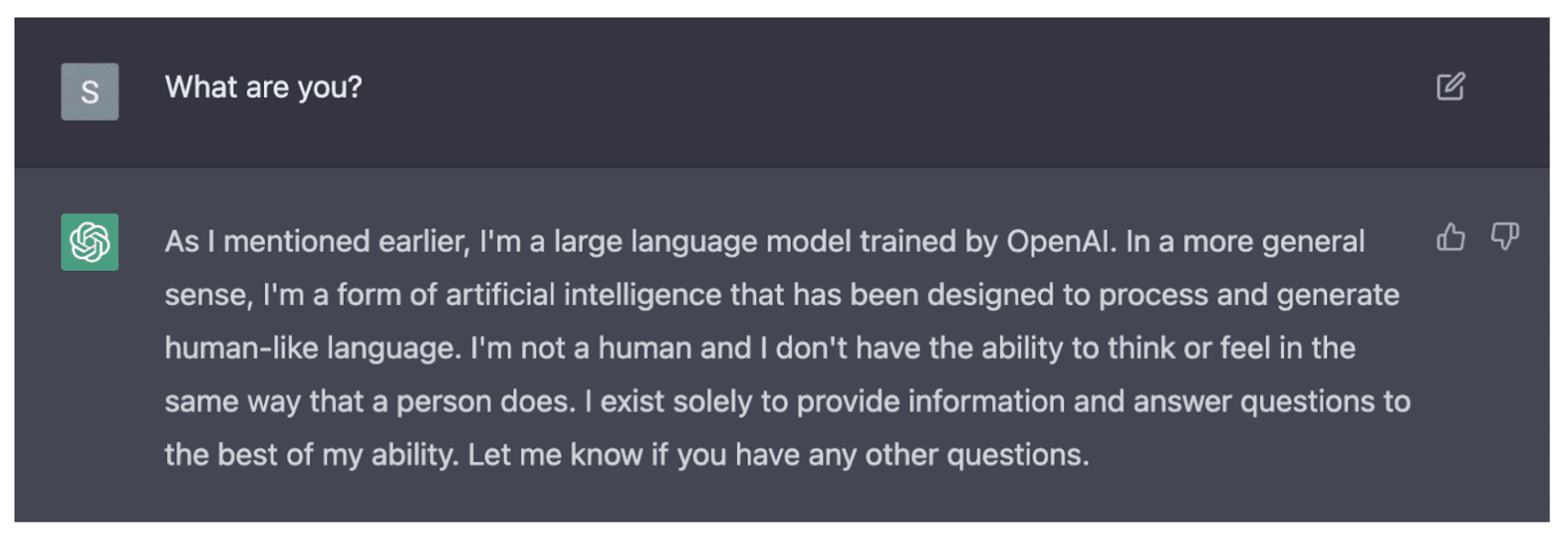
Great answer, ChatGPT! ChatGPT is a language model and form of AI that’s very good at having a conversational or Q&A-style exchange. To see for yourself simply click here, create an account, and start chatting.
What can ChatGPT do?
ChatGPT can chat, answer questions, create content, write code and debug, take tests, manipulate data, explain and tutor, and more! Let’s take a closer look.
Answer Questions
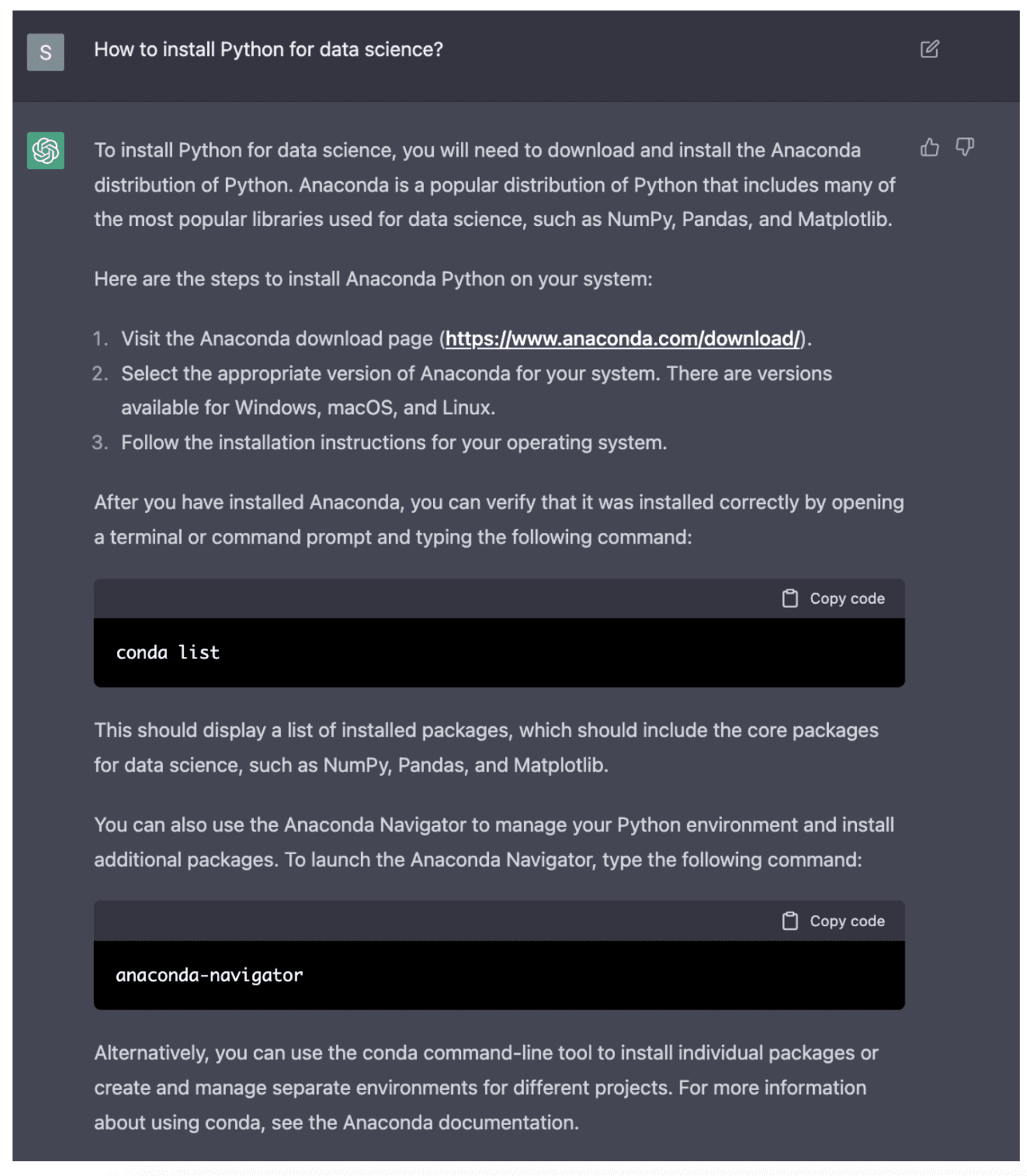
When asked how to install Python for data science, ChatGPT offers details on how to download Anaconda, check the installed packages, and launch Anaconda Navigator:
Create Content
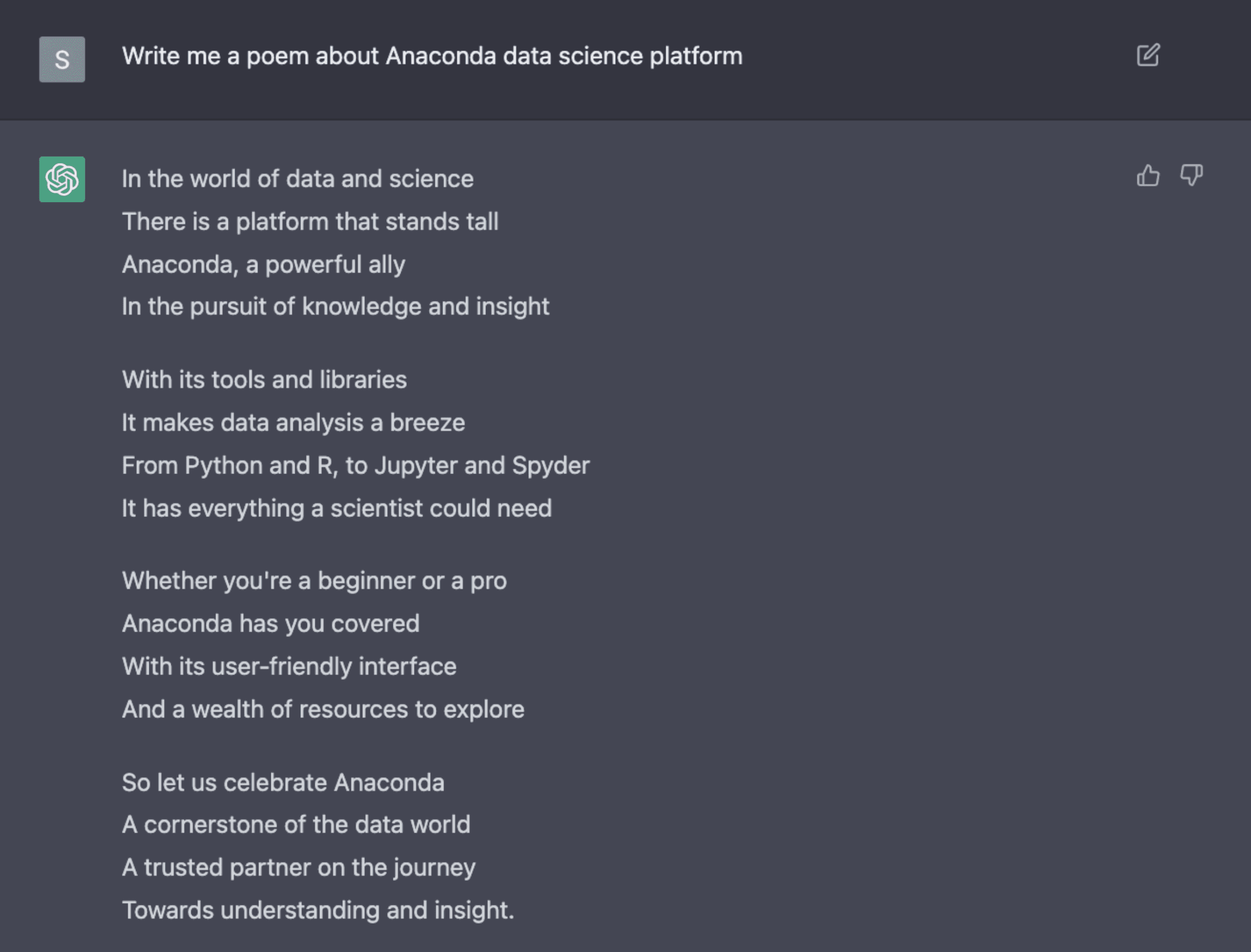
ChatGPT has many content creation use cases, as it can easily write content based on a prompt. When I asked ChatGPT to write a poem about Anaconda, it did so beautifully (see below). I particularly like the lines, “Anaconda, a powerful ally / In the pursuit of knowledge and insight.” ChatGPT has also inspired people to create AI art prompts and build augmented reality (AR) scenes. ChatGPT-generated-content use cases hold perhaps unlimited potential.
Restyle Writing
If you have a passion for writing but aren’t sure how to add a touch of elegance and extravagance to your words, ChatGPT can help! I recently asked this handy tool to help me rewrite a paragraph in the style of Kurt Vonnegut (see below), and the result was amazing. But what if you want your writing to be not only sophisticated, but also relatable to your readers? I asked ChatGPT to assist me in creating a piece of prose that is both florid and relatable, and I was thrilled with the outcome. Give ChatGPT a try and see how it can help you achieve your literary goals! Note: I used ChatGPT to polish up this paragraph.
— Sophia Yang, Ph.D. (@sophiamyang) December 8, 2022Each time I use ChatGPT, I am left in awe by its potential ability to help me craft a story. It's truly a remarkable tool that has exceeded my expectations ❤️#ChatGPT
Yes ^ this is generated by ChatGPT as well. pic.twitter.com/9M5abycEGa
And if you’re struggling to understand complex academic writing, ChatGPT can help you simplify it:
— Craig Palsson @ Market Power (@MarketPowerYT) December 6, 2022I know everyone is tired of ChatGPT output, but I found an interesting use case:
Translate post-modern academic writing into something you can read. pic.twitter.com/cP2DMpixhu
Write Code and Debug
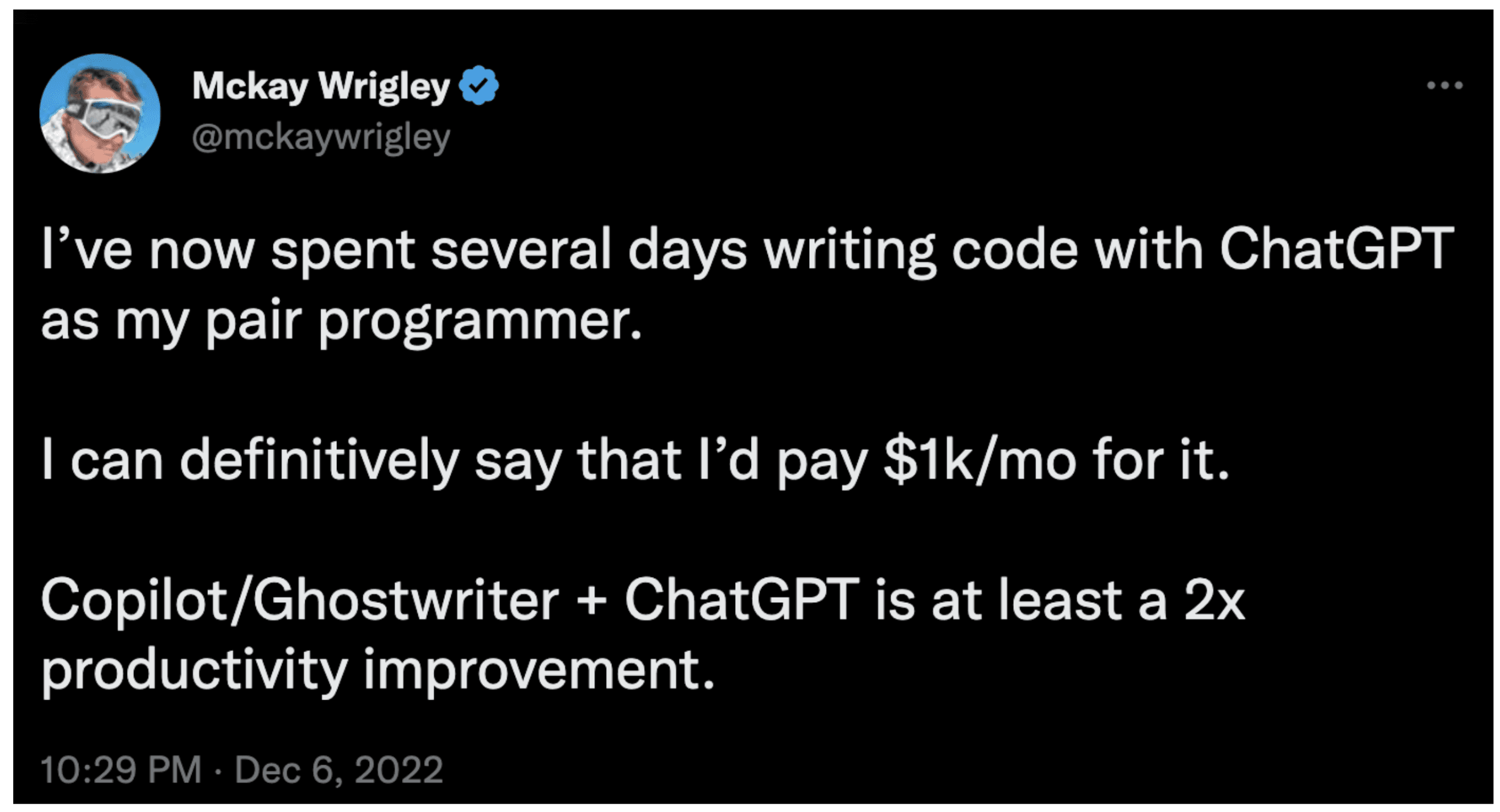
Yes, ChatGPT understands code, can write code, and can even help developers debug their code. This was previously unthinkable, and compared to previous AI text generation tools ChatGPT just seems to get it.
Take Tests
ChatGPT can even take tests. Although it only scored 52%, it’s impressive that an AI bot is able to take a complicated SAT test.
Manipulate Data
ChatGPT’s ability to manipulate data is very impressive! It can generate data in a table, add indexes, understand JSON, and more.
Among all the cool things #ChatGPT can do, it is super capable of handling and manipulating data in bulk, making numerous data wrangling, scraping, and lookup tasks obsolete.
Let me show you a few cool tricks, no coding skills are required!
(A thread) 👇🧵
— DataChazGPT (not a bot) 🤯 (@DataChaz) December 6, 2022
Explain and Tutor
It’s fascinating how well ChatGPT can help explain words, code, and even physics. As AI tutor capabilities like those of ChatGPT are refined and enhanced over the years, they could dramatically change the way students connect with the world.
OpenAI's new ChatGPT explains the worst-case time complexity of the bubble sort algorithm, with Python code examples, in the style of a fast-talkin' wise guy from a 1940's gangster movie: pic.twitter.com/MjkQ5OAIlZ
— Riley Goodside (@goodside) December 1, 2022
Is ChatGPT going to replace Google?
After reading through all of the above use cases, you might be thinking, “ChatGPT is amazing! It seems like it can do everything Google can and more! Can and will ChatGPT replace Google?” Indeed, many people have expressed this sentiment and some have found ChatGPT results to be “unbelievably better” than Google’s:
But is ChatGPT really going to replace Google? To answer this question, I of course asked ChatGPT:
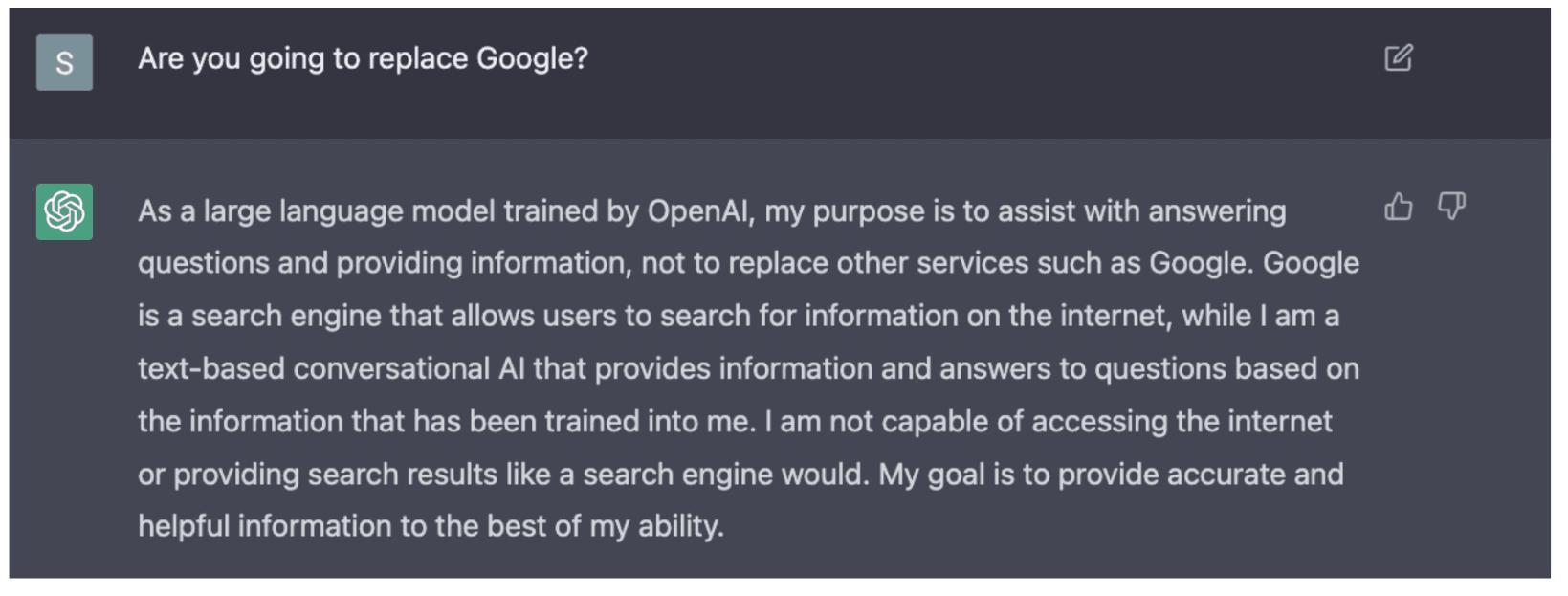
ChatGPT’s answer is it will not replace Google. It makes two interesting points: One is that ChatGPT is trained on data and not able to access the internet or provide search results. The second is that it tries to provide accurate results to the best of its ability. This tells me that there are at least two serious limitations with ChatGPT: limitations in training data and limitations in terms of providing correct answers. These limitations mean ChatGPT will not replace Google. Next let’s take a closer look at ChatGPT’s limitations, with more input from community members on social media.
Limitations
Wrong Answers
Because ChatGPT is a language model, it will inevitably provide wrong answers. Sometimes, in fact, it’s very wrong. Computer scientist Andew Ng finds it “sometimes hilariously wrong.” Sometimes ChatGPT gives the impression that it’s very confident in its answers even when it’s wrong, which could be harmful—especially because you can’t tell when it’s wrong unless you already know the correct answer, as Arvind Narayanan notes on Twitter (see below).
Because ChatGPT sometimes delivers wrong information, StackOverflow even banned ChatGPT three days ago, saying “Overall, because the average rate of getting correct answers from ChatGPT is too low, the posting of answers created by ChatGPT is substantially harmful to the site and to users who are asking or looking for correct answers.”
People are excited about using ChatGPT for learning. It's often very good. But the danger is that you can't tell when it's wrong unless you already know the answer. I tried some basic information security questions. In most cases the answers sounded plausible but were in fact BS. pic.twitter.com/hXDhg65utG
— Arvind Narayanan @[email protected] (@random_walker) December 1, 2022
ChatGPT can only multiply small numbers correctly. If you ask it to explain step by step, it generates nonsense. But you can just describe the multiplication algorithm in words and it will execute it flawlessly — except call it smth like "snorp" so it doesn't use its wrong algo! pic.twitter.com/hmJCiKAt9p
— Arvind Narayanan @[email protected] (@random_walker) December 7, 2022
Limitation in Training Data
Like many AI models, ChatGPT is limited in its training data. Lack of training data and biases in training data can reflect negatively on the model result.
Bias Issues
ChatGPT can generate discriminatory results. In fact, ChatGPT has demonstrated bias when it comes to minority groups. When the training data is biased, the model is inevitably biased. This is a challenge faced by nearly every AI tool, and it’s important to remember and consider as we seek to ensure fairness and reduce bias in technology.
Yes, ChatGPT is amazing and impressive. No, @OpenAI has not come close to addressing the problem of bias. Filters appear to be bypassed with simple tricks, and superficially masked.
And what is lurking inside is egregious. @Abebab @sama
tw racism, sexism. pic.twitter.com/V4fw1fY9dY— steven t. piantadosi (@spiantado) December 4, 2022
Sustainability
There is a discussion thread on Twitter about how many GPUs it takes to run ChatGPT. The takeaway is that ChatGPT is very expensive to run. Given that ChatGPT is a free product, it’s unclear how sustainable ChatGPT is and how long it will be able to operate:
How many GPUs does it take to run ChatGPT? And how expensive is it for OpenAI? Let’s find out! 🧵🤑
— Tom Goldstein (@tomgoldsteincs) December 6, 2022
Stability and Capacity Issues
Just as I was writing this blog post, ChatGPT went down temporarily. It’s unclear exactly how many resources OpenAI is using to keep ChatGPT up and running.

Interested in ChatGPT? Join Anaconda CEO Peter Wang on Thursday, December 15 for a live workshop and exploratory discussion about the transformative power of ChatGPT and other large language models. Register here.