
The World’s First
Photonic Reasoning
Processor

Our mission
Our mission
Akhetonics is building the RPU, the first Reasoning Processing Unit. Modern AI has hit a wall: reasoning, verification, and optimization workloads demand extreme single-threaded performance that today's electronic chips simply can't deliver. Our all-optical digital processor breaks that barrier through near latency-free optical memory and THz speeds, bringing unprecedented performance and energy efficiency to the hardest problems in AI, automated reasoning and operations research, built entirely on a sovereign European supply chain.
Our Optical Processor

Optical Data Interface
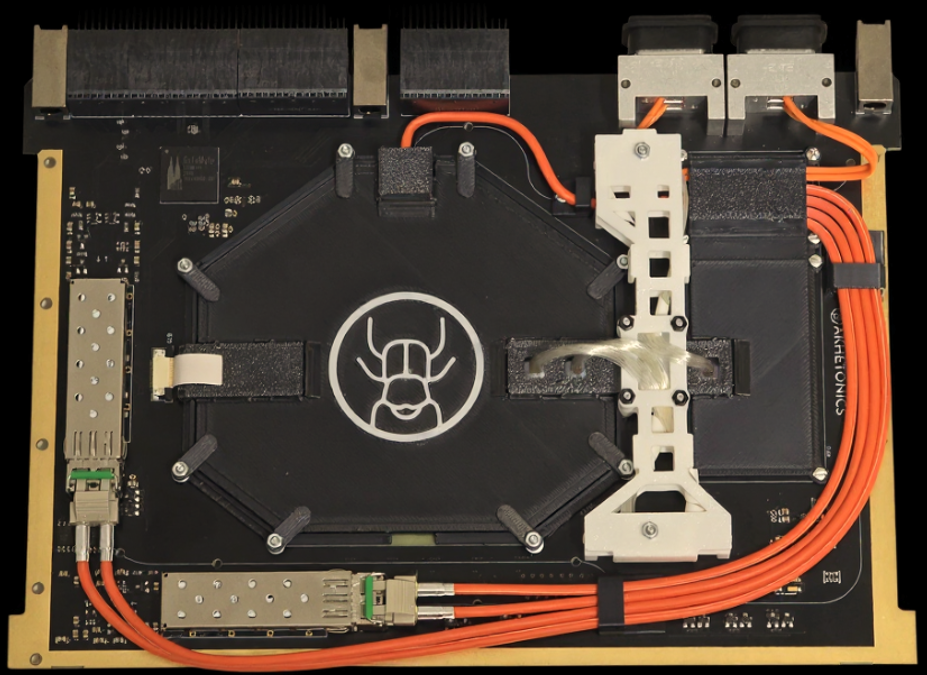
Our interface to the world is optical. Data enters and leaves optically through the network and remains in the processor in the optical domain even while processed, never converting to an electronic signal.

Cross Domain Processor
The heart is the all-optical XPU, which acts as the conductor and controls the flow of information between memory, network and RFUs.

Volatile Memory
Each XPU has its own optical local and stack memory to aid in processing. They are the main way how results are accumulated and passed on from operation to operation.

Non-Volatile Memory
Code is stored in a separate read-only optical memory, to ensure speed and security during operation. For large amounts of data, the global optical memory acts as the storage for anything from image data to large language models.

Digital, Analog & Quantum
Optical digital, analog and quantum computing share almost all characteristics in a single photonics platform. From analog vector matrix multiplication, quantum feed-forward to digital logic – in the first cross-domain computer.

Dynamic Systolic Array
The RFUs are special purpose optical accelerators for either digital, analog or quantum operations, which are dynamically combinable. Working in parallel, they act as the orchestra to the conducting XPU.

THz Clocking
Optical processors can switch at neck breaking speeds. Instead of GHz clock speeds found in electronics, the optical computer will dominate the THz domain.

Powering Up
Even an all-optical computer needs electricity to power lasers, amplifiers and tuners. However, the data itself passing through the processor never touches the electronic domain.
The Key Advantage
Bandwidth
Scaling the bandwidth of data transmitted and processed using light can be achieved extremely economically through multiplexing. This allows moving petabits of data through a tiny and single fiber.
Efficiency
Light in waveguides is a near lossless way to transmit data over long distances. And computing with light is almost as lossless.This is in stark contrast to electronics, where mere centimeters already reduce the efficiency noticably and resistors wasting immense amounts of energy.
Speed
As the data always stays optical in transmission, compute and storage, we completely eliminate the need for constant conversion between electronics and optics. This saves the maximum amount of latency, further enhanced by the speed-up thanks to femtosecond optical interactions.
Start the Optical Computing Revolution