,
ACLU Speech, Privacy, and Technology Project
February 22, 2019
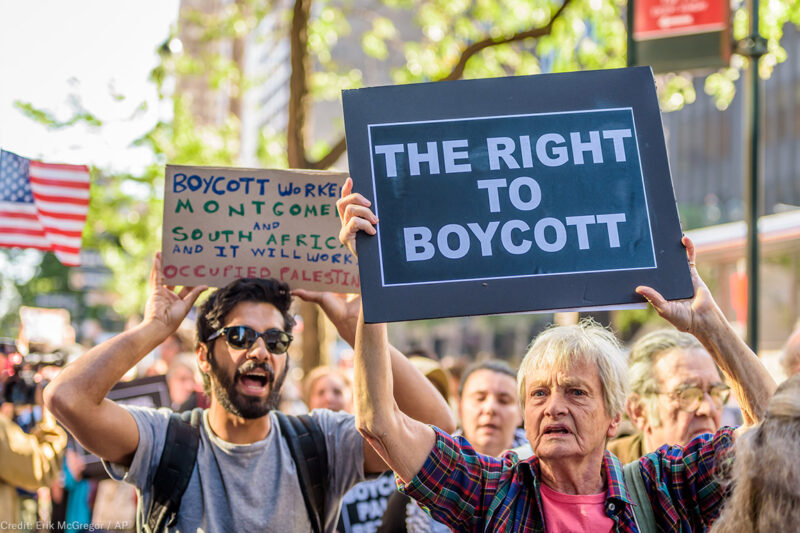
A number of states recently passed laws that require state contractors — including teachers, lawyers, newspapers and journalists, and even students who want to judge high school debate tournaments — to certify that they are not participating in politically motivated boycotts against Israel. Dozens of states have considered such “anti-BDS” laws, and a bipartisan group of 73 senators recently passed a bill — the Combating BDS Act — that would encourage states to adopt such laws.
The ACLU takes no position on boycotts of Israel or any foreign country, but we have long defended the right to boycott, which is protected under the First Amendment. That’s why we challenged anti-boycott laws in Kansas, Arizona, Arkansas, and Texas, and strongly opposed the Combating BDS Act in Congress.
Taking issue with our defense of the right to boycott, critics have accused us of hypocrisy for fighting laws that prohibit contractors from boycotting Israel while also supporting antidiscrimination laws that require businesses to serve the public. Anti-BDS laws, they argue, are also designed to prevent discrimination.
To be clear: Anti-BDS laws are not designed to prevent discrimination. In fact, they’re designed to discriminate against disfavored political expression, which is why two federal courts and several prominent First Amendment scholars have agreed that these laws violate the First Amendment.
And as professor and former ACLU staffer Amanda Shanor explains in a recent post, anti-BDS laws and antidiscrimination laws are nothing alike. The argument that anti-BDS laws serve a similar function as antidiscrimination laws demonstrates a flawed understanding of anti-discrimination laws. Such laws prohibit businesses from discriminating against customers and employees based on who people are — such as their sex, race, and religion.
When a business discriminates against people based on who they are — like when a cake shop owner refuses to sell a wedding cake to a same-sex couple — those discriminatory business decisions are not entitled to First Amendment protection. Even if identity-based discrimination is meant to express a political view, our society has an overriding interest in making sure that people are treated as equals in public accommodations, such as retail stores.
The same cannot be said about political boycotts. Refusing to purchase consumer goods and services to protest a country’s or company’s actions is not denying anyone access to public accommodations based on who they are — it’s classic political expression protected under the First Amendment. That’s where anti-BDS laws go wrong. They expressly target boycotts of companies operating in Israel or Israeli settlements because the government disapproves of the boycott’s message of protest against Israel.
Some have argued anti-BDS laws prevent discrimination based on national origin. But if states were genuinely interested in preventing discrimination by government contractors, they would broadly prohibit their contractors from discriminating based on protected characteristics, such as race, sex, and national origin. Many anti-BDS laws, on the other hand, prohibit only boycotts of Israel — boycotts targeting other countries or groups are completely unregulated. The myopic focus on BDS strongly suggests that these laws are meant to suppress protected speech rather than prevent discrimination.
Further, anti-BDS laws prohibit boycotts that do not even remotely target companies based on nationality. For instance, one of our clients, Mik Jordahl, refuses to buy Hewlett-Packard products for his one-person law firm. He boycotts Hewlett-Packard, an American company, because it provides information technology for Israeli checkpoints in the West Bank. But he does not boycott Israeli companies generally. His boycott nonetheless violates Arizona’s now enjoined anti-BDS law, which prohibits group boycotts of companies doing business in territories controlled by Israel, regardless of whether the boycott discriminates based on nationality.
Finally, antidiscrimination laws have not historically applied to boycotts of consumer goods or services. When Black citizens in Mississippi boycotted white-owned businesses to protest racial segregation, the Supreme Court held that the boycott was protected under the First Amendment. As the court made clear, consumers have a First Amendment right to withhold their patronage from businesses in order to express their political beliefs. On the other hand, businesses do not have the right to refuse service to consumers because of who they are.
Think about it this way: You have a First Amendment right to boycott Starbucks to protest their secular holiday cups. Starbucks does not have a First Amendment right to discriminate against you because of your Christian beliefs. The same principle applies to boycotts of consumer goods and services from foreign countries.
When the government cynically asserts an antidiscrimination interest to suppress disfavored political expression, the harm is twofold: It violates civil liberties and waters down genuine efforts to address the real threat posed by bigoted ideologies, including anti-Semitism. That’s why the ACLU champions civil rights and civil liberties.
You can’t have one without the other.
-

Free Speech
Tribunal Federal de Apelaciones invalida unánimemente la ley de censura de Puerto Rico aprobada durante la pandemia de COVID-19
SAN JUAN, Puerto Rico — En una decisión unánime, el Tribunal de Apelaciones del Primer Circuito de Estados Unidos anuló la ley de Puerto Rico de 2020 contra las llamadas "noticias falsas", al considerarla una regulación inconstitucional basada en el contenido que restringe la libertad de expresión protegida. Dos periodistas impugnaron la ley, argumentando que amenazaba con coartar cualquier reportaje que pudiera perjudicar la imagen del gobierno durante una emergencia. "Como periodista independiente en Puerto Rico, mi trabajo es buscar la verdad y exigir responsabilidades a quienes ostentan el poder, especialmente cuando surge una crisis y el público necesita información transparente y confiable", afirmó la periodista Sandra Rodríguez. “La ley de ‘noticias falsas’ de Puerto Rico era una amenaza constante. La decisión de hoy del Tribunal de Apelaciones del Primer Circuito es una victoria no solo para mí o la prensa, sino para todos los ciudadanos en Puerto Rico. Este fallo garantiza que podemos seguir haciendo nuestro trabajo —investigando, cuestionando e informando— sin temor a ser criminalizados por buscar la verdad”. “Este caso va más allá del ejercicio del periodismo. Esto atenta contra el significado mismo de vivir en una sociedad democrática donde las personas tienen derecho a expresarse libremente sin temor a ser silenciadas por el Estado”, declaró, por su parte, el periodista Rafelli González Cotto. “Agradezco al tribunal por defender la Primera Enmienda no solo para los periodistas, sino para todos los ciudadanos de Puerto Rico”. La ley de Puerto Rico de 2020 tipificaba como delito dar a sabiendas una “falsa alarma” sobre catástrofes inminentes o transmitir a sabiendas información falsa sobre cualquier tema cuando hacerlo resultara en un riesgo inminente para la seguridad, la salud o la propiedad. Quienes infringieran la ley se enfrentaban a penas de hasta tres años de cárcel y una multa de hasta $5,000 dólares. "La función de vigilancia de la prensa nunca es más importante ni está más en peligro que durante una emergencia", declaró Brian Hauss, subdirector del Proyecto de Libertad de Expresión, Privacidad y Tecnología de la ACLU. "Agradecemos que el tribunal haya declarado inconstitucional esta ley de 'noticias falsas', que amenazaba con silenciar al periodismo independiente precisamente cuando la ciudadanía más lo necesita". La demanda, presentada originalmente durante la crisis de salud por el COVID-19, fue interpuesta por la Unión Americana de Libertades Civiles (ACLU) y la ACLU de Puerto Rico en nombre de dos periodistas, Sandra Rodríguez Cotto y Rafelli González Cotto, quienes temían que la ley se utilizara para castigarlos por su cobertura de emergencias públicas, especialmente por reportajes que perjudicaran la imagen del gobierno. "Celebramos esta victoria que protege dos de nuestros derechos más fundamentales: la libertad de prensa y la libertad de expresión", afirmó Fermín Arraiza Navas, director legal de la ACLU de Puerto Rico. "Esta ley nefasta, firmada inicialmente por el exgobernador Ricardo Rosselló y enmendada por una legislatura en decadencia con la aprobación de la gobernadora Wanda Vázquez en La Fortaleza, solo tenía como norte criminalizar la disidencia y perseguir a la prensa en tiempos de emergencia por simplemente discrepar del discurso oficialista. No lo permitiremos". El 31 de marzo de 2023, el Tribunal de Distrito de los Estados Unidos para el Distrito de Puerto Rico dictó una orden judicial permanente contra la ley, al considerar que su alcance excesivamente amplio conllevaba el riesgo de enjuiciamientos politizados y de coartar la libertad de expresión protegida en asuntos de interés público. Este martes, 4 de agosto, el Tribunal de Apelaciones del Primer Circuito de los Estados Unidos confirmó la decisión, dictaminando que la ley viola la Primera Enmienda porque impone una restricción basada en el contenido a la libertad de expresión protegida sin justificación suficiente. El tribunal señaló que la ley carece de las limitaciones esenciales incluidas en otras leyes sobre falsas alarmas, y que podría utilizarse para procesar a quienes se oponen a la postura del gobierno en debates sobre temas controvertidos como la eficacia de las mascarillas durante la pandemia de COVID-19, así como en relación con chistes, sátira o ficción. Como escribió el tribunal, la ley de Puerto Rico “representa una restricción inadmisible de la libertad de expresión, especialmente en tiempos de emergencia, cuando es imperativo que el público esté bien informado y que el gobierno rinda cuentas”. “Con esta ley, el Gobierno de Puerto Rico puso en peligro el derecho a la libertad de expresión y la libertad de prensa, protecciones que son cada vez más indispensables”, declaró Annette Martínez Orabona, directora ejecutiva de la ACLU de Puerto Rico. “Esto también fue un intento de desalentar la fiscalización justa y necesaria del gobierno, precisamente durante periodos de emergencia como el que Puerto Rico vive en la actualidad, con una crisis en el servicio de agua potable. Se trata de derechos que están siendo atacados desde múltiples frentes y que hoy logramos proteger”. Puedes leer la opinión aquí. También puedes leer más sobre la ley aquí.
Court Case: Rodríguez-Cotto v. Pierluisi-Urrutia
Affiliate: Puerto Rico
-
Free Speech
Federal Appeals Court Unanimously Strikes Down Puerto Rico’s COVID-Era Censorship Law
SAN JUAN, Puerto Rico — In a unanimous decision, the U.S. Court of Appeals for the First Circuit struck down Puerto Rico’s 2020 “fake news” law, holding that the law is an unconstitutional content-based regulation of protected speech. Two journalists challenged the law, saying it threatened to chill any reporting during an emergency that may reflect poorly on the government. “As an independent journalist in Puerto Rico, my job is to seek the truth and hold those in power accountable—especially when crisis hits and the public needs transparent, reliable information most,” said journalist Sandra Rodriguez. “Puerto Rico’s 'fake news' law hung over our heads like a constant threat. Today’s decision by the First Circuit Court of Appeals is a victory not just for me or the press, but for every citizen in Puerto Rico. This ruling ensures that we can continue doing our jobs—investigating, questioning, and reporting—without fear of being criminalized for seeking the truth.” “This case goes beyond the practice of journalism. It strikes at the very meaning of living in a democratic society where people have the right to express themselves freely without fear of being silenced by the state,” said journalist Rafelli González Cotto. "I am grateful to the court for defending the First Amendment not only for journalists, but for all citizens of Puerto Rico.” The 2020 Puerto Rico law made it a crime to knowingly raise a “false alarm” about impending catastrophes or knowingly convey false information on any topic when doing so results in an imminent risk to safety, health, property; those found in violation of the law faced up to three years in jail and a fine of up to $5,000. “The watchdog function of the press is never more important, or more in danger, than during an emergency,” said Brian Hauss, deputy director of the ACLU’s Speech, Privacy, and Technology Project. “We’re grateful that the court struck down this unconstitutional ‘fake news’ law, which threatened to muzzle independent journalism precisely when the public needs it most.” Originally filed during the COVID-19 public health crisis, the American Civil Liberties Union and the ACLU of Puerto Rico filed the lawsuit on behalf of two journalists, Sandra Rodríguez Cotto and Rafelli González Cotto, who feared that the laws would be used to punish them for their reporting on public emergencies, especially reporting that reflects negatively on the government. “We celebrate this victory that protects two of our most fundamental rights: freedom of the press and freedom of expression,” said Fermín Arraiza-Navas, legal director of the ACLU of Puerto Rico. “This dangerous law, signed first by former Governor Ricardo Rosselló and amended by a decadent legislature with the approval of Governor Wanda Vázquez in La Fortaleza, had only one objective: to criminalize dissent and persecute the press in times of emergency simply for disagreeing with the official narrative. We will not allow it.” On March 31, 2023, the U.S. District Court for the District of Puerto Rico permanently enjoined the law, observing that the statute’s exceedingly broad sweep risked politicized prosecutions and chilling protected speech on matters of public concern. On August 4, the U.S. Court of Appeals for the First Circuit affirmed, holding that the law violates the First Amendment because it imposes a content-based restriction on protected speech without adequate justification. The court noted that the law lacks essential limitations included in other false alarm statutes, and that it could be used to prosecute people who oppose the government’s views in debates about contentious issues such as the efficacy of masks during the COVID-19 pandemic, as well as jokes, satire, or fiction. As the court wrote, Puerto Rico’s law “represents an impermissible restriction of speech, particularly during times of emergency when it is most imperative that the public be well-informed and the government held to account.” "With this law, the Government of Puerto Rico jeopardized the right to freedom of expression and freedom of the press, protections that are increasingly indispensable,” said Annette Martínez-Orabona, Executive Director of the ACLU of Puerto Rico. "This was also an attempt to discourage fair and necessary government oversight, precisely during emergencies like the one Puerto Rico is currently facing amid a drinking water service crisis. These rights are under attack on multiple fronts, and today we succeeded in protecting them." You can read the opinion here. You can read more about the law here.
Court Case: Rodríguez-Cotto v. Pierluisi-Urrutia
Affiliate: Puerto Rico
-
Free Speech
Professors Challenge Texas A&M System Over Censorship Policy, Detail Violations of Academic Freedom
HOUSTON – A group of professors filed suit Monday night challenging the Texas A&M University System’s new censorship policy that prohibits faculty from discussing certain topics and viewpoints related to race, sexual orientation, and gender. “My ethics course — the only one of its kind available to graduate students — was canceled for noncompliance with a draconian censorship policy,” said Leonard Bright (he/him), lead plaintiff, professor of Public Service and Administration, and president of the Texas A&M College Station chapter of the AAUP. “This policy has impacted my ability to do my job, my students’ ability to learn, and my colleagues’ ability to teach without fear of reprisal. The chilling effect of this policy is vast and immeasurable, and it poisons the very soul of what a university should be: a place where ideas are free to roam, and debate is uninhibited by the political winds.” The policy, which was implemented in late 2025 and requires extensive, bureaucratic syllabi review, has resulted in prohibitions on everything from the Oscar-winning film “Moonlight” to Plato’s writings on gender. The faculty impacted by this policy work throughout the Texas A&M System, which includes 12 universities, and across departments, from the Bush School of Government and Public Service to the English department. “The First Amendment plainly prohibits this egregious attack on academic freedom at a public university,” said Emerson Sykes (he/him), senior staff attorney with the ACLU’s Speech, Privacy, and Technology Project. “This broad policy and the university’s opaque enforcement process makes it impossible to teach or to learn freely and endangers course content about everything from the history of slavery to Shakespeare to the hard sciences. Universities are sites of inquiry, debate, and discovery — banning entire categories of ideas is a betrayal of both their mission and the First Amendment.” The censorship policy was implemented in November 2025 amid a sustained campaign to limit speech on certain topics in the college classroom. As a result of the policy change, numerous classes have been cancelled or forced to remove content. The women’s and gender studies program has been shuttered altogether because the program could not be reconciled with the new censorship policy. “This policy directly harms Black, Brown, LGBTQIA+, and all other Texans who have historically been discriminated against by subjecting discussion of their rights, identities, and indeed very existence to heavy-handed censorship.” said Chloe Kempf (she/her), staff attorney at the ACLU of Texas. “What’s more, it undermines all Texans’ First Amendment rights. If public officials can abuse their power to ban these topics and perspectives today, there’s nothing stopping them from targeting other subjects and points of view, including your own, down the line.” Cancelled courses include Religions of the World; Introduction to Race and Ethnicity; Ethics in Public Policy; and a course focused on LGBTQ+ literature. Professors have been forced to edit their syllabi to comply with the policy, removing works like Plato’s “Myth of Androgyne;” Kevin Kruse’s “White Flight;” and even the Academy Award-winning film “Moonlight.” One history professor was allowed to teach Phyllis Schlafly’s campaign against the Equal Rights Amendment, but not about how the Fourteenth Amendment expanded to protect women and LGBTQ+ people. “By embarking on a campaign of censorship, Texas A&M has abdicated its responsibility to support students’ right to learn and faculty’s right to teach,” said Todd Wolfson (he/him), president of the AAUP. “A university that censors Plato — as well as other significant texts — abandons its obligation to truth, free inquiry, and the public trust.” The suit was filed on behalf of the American Association of University Professors (AAUP) and Professors Leonard Bright, Vanita Reddy, Landon Sadler, and Aaron George in the U.S. District Court for the Southern District of Texas. The complaint argues that the censorship policy governing Texas A&M is unconstitutionally vague and violates the First Amendment by discriminating against certain viewpoints. “We’re proud to represent these professors challenging a censorship policy that betrays Texas A&M’s established legacy as an institution that supports free and open inquiry,” said Jamie A. Aycock (he/him), attorney at Yetter Coleman LLP. “At stake in this lawsuit is the bedrock First Amendment principle that America is strengthened by and depends upon open public debate, even on the most controversial topics. Nowhere is this more important than in our public academic institutions, which are charged with developing and teaching our future leaders to think critically and broadly about pressing issues affecting society.” You can read the complaint here.