- November 5, 2025
- WMD
At North Korea’s grand military parade on October 11, marking the 80th anniversary of the ruling Workers’ Party of Korea, the spotlight was dominated by a new intercontinental ballistic missile (ICBM). The Hwasong-20 ICBM, transported on a ginormous 22-wheel transporter-erector-launcher (TEL), immediately drew widespread attention from both media and military analysts. It symbolizes the growing reach of Pyongyang’s strategic capabilities and its determination to project power. Yet, notably absent from this display of force was another, arguably more significant, pillar of North Korea’s nuclear arsenal. Alongside its growing fleet of land-based ICBMs, the regime has been developing increasingly powerful submarine-launched ballistic missiles (SLBMs), potentially the more survivable and strategically valuable leg of its nuclear deterrent.
What North Korean SLBMS currently lack, however, is a submarine big enough to carry them. Historically their largest submarines have been modifications of the 1950s vintage Romeo-class which has a hull diameter of barely over 17 feet (5.3 meters), which is less than half the length of the latest missiles. Their displacement is just 1,800 tons compared to over 6,000 tons you would expect for even a small ballistic missile submarine. To this end, North Korea is building a much larger submarine which they claim will be nuclear powered. North Korean media even showed Kim Jong Un inspecting the hull of such submarine in an undisclosed shipyard (highly likely at Sinpho on the eastern coast) this past April.
In a new piece of the puzzle, it has since been reported that Russia is likely supplying Pyongyang with nuclear propulsion for submarines. South Korea’s Defense Minister Ahn Gyu-back reinforced that assertion on October 13 when he told parliament that the North is “likely receiving various technologies” from Russia for its submarines. Although the transfer of nuclear propulsion technology is unconfirmed, it is plausible and should be taken seriously.
Possible Supply of Nuclear Propulsion
Reports suggest that Russia may have supplied two or three propulsion systems from decommissioned nuclear submarines. These would contain a working reactor, steam turbines and vital cooling systems.
The transfer of this technology would not be unexpected and is logically a major part of the exchange that has North Korean troops dying on the front lines of Russia’s war with Ukraine. This also includes the supply of Russian oil products and has, both directly or via osmosis, enabled a major transfer of the latest battlefield technology and knowhow to Pyongyang.
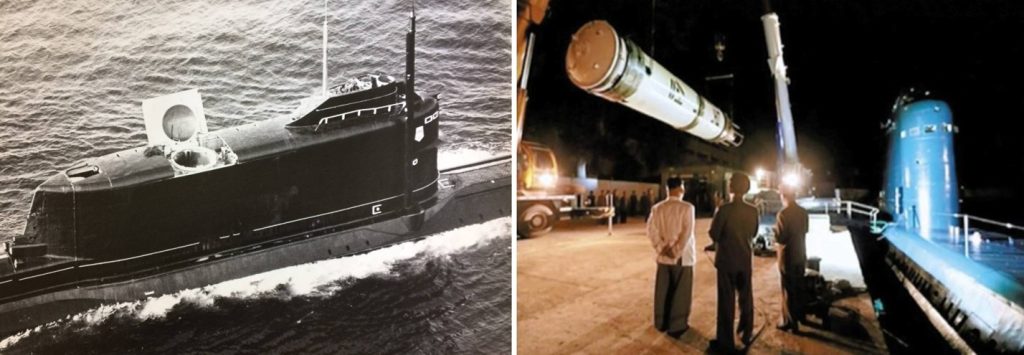
It would not be the first time that North Korean submarine technology has received a boost from Russia. In the mid-1990s, Russia supplied a number of obsolete submarines for scrap, including its believed Project 629 Golf-class ballistic missile submarines. While not nuclear powered, knowledge of their launch mechanism almost certainly contributed to North Korea’s own ballistic missile submarines built a decade later. The Gorae-class (Sinpo-B) test submarine, launched in 2014, has a missile tube arrangement generally similar to the Golf-class. Vertical launch tubes, capable of submerged launch, were subsequently incorporated into modified Romeo/Ming-class boats. But in both cases these submarines are not large enough to carry the latest North Korean SLBMs.
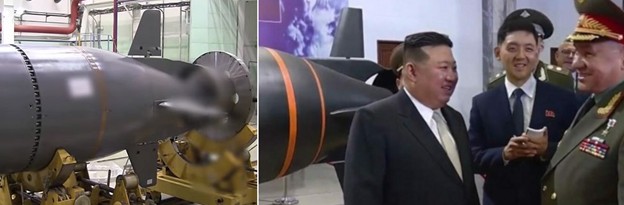
More recently North Korea unveiled a large underwater unmanned vehicle, the Haeil. This bears a remarkable similarity to the Russian Poseidon weapon, both physically and narratively. It was chosen among the developments to be inspected by Russian defense chief Sergei Shoigu during his visit to Pyongyang in July 2023. Where it differs from Poseidon is in propulsion. It is likely packed with diesels and batteries while the Russian type is nuclear powered. This limits its potential range, and means that it is at best a complement, rather than a substitute, for submarine-launched missiles. In another sign of the willingness to supply technology, North Korea’s latest warships, the Choe Hyon-class, now sports Russian weapon systems.
Russia has previously helped other nations with nuclear submarine technology. India leased two nuclear powered submarines from the USSR and later Russia, including the comparatively modern Pr.971 Akula-class boat Nerpa, which served as INS Chakra. That boat was returned to Russia in summer of 2021 and has since been largely inactive. There were even reports in Russian media that the submarine would be dismantled instead of resuming active service with the Russian navy. This boat is, coincidentally, a possible candidate for the propulsion modules supplied to Pyongyang.
Prospective Propulsion Donors
Russia has been decommissioning nuclear submarines at the Zvezda shipyard near Vladivostok for decades, and a large number of submarine reactor compartments are stored nearby. Submarine classes dismantled there include Akula-, Victor- and Delta-classes, as well as many older types. Analysis of satellite imagery shows movement at the storage facility in recent months, but has so far been inconclusive.
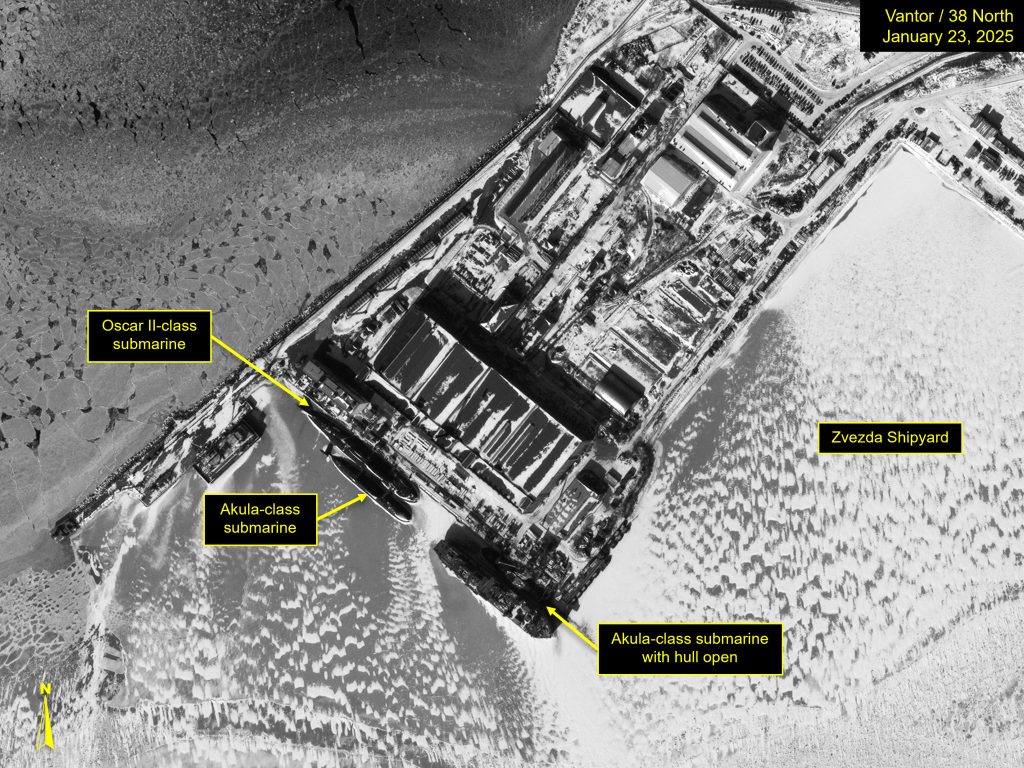
Several submarines have been berthed at the shipyard for several years, with an Oscar II-class cruise missile submarine and an Akula-class attack submarine (likely Nerpa) arriving in the late summer of 2021. They were later joined by a second Akula class boat. One of the Akula’s has had the hull opened in the vicinity of its reactor compartment. While this is far from conclusive, it suggests that if Russia has supplied submarine propulsion, it may be from this Akula.
The Project 971 Akula class has a single OK-650B pressurized water nuclear reactor capable of producing 190 megawatts. This drives two 43,000 hp (32 megawatt) steam turbines. The OK-650B is naturally the same reactor used aboard the Akula submarine leased to India to help start their nuclear submarine program.
What Difference Does It Make?
While the complexity of designing and building nuclear reactors for submarines must not be underestimated, it is unreasonable to assume that North Korea lacks the expertise. It is a technology which has been available for decades and North Korea has been operating nuclear reactors for almost 40 years. It bears reflection that the world’s first nuclear powered submarine, the US Navy’s USS Nautilus, was under construction barely ten years after the first nuclear reactor. Essentially, North Korea doesn’t necessarily need Russian assistance to achieve this goal.
Russian assistance could however speed up development process and help North Korea immensely. The provided reactor and components, if true, could possibly be placed in the new submarine directly or, alternatively, studied and lessons learned incorporated into North Korea’s own design.
Nuclear submarines are able to deploy on much longer missions and only need to approach the surface for communications and to launch their missiles. This greatly improves the ‘indiscretion rate.’ Added to this, the Russian exchange is likely to provide noise quietening technology which will also make them harder to detect. It will be at least theoretically possible for a North Korean nuclear submarine to deploy into the vast expanse of the North Pacific where its missiles can threaten mainland United States.
South Korea and regional allies will need to up their submarine game to keep pace with the emerging threat of nuclear powered submarines in Pyongyang’s hands. The case has never been stronger for South Korea and Japan to adopt their own nuclear boats, and South Korea, in particular, has been trying to acquire the rights for years.
The launch of a nuclear submarine would not transform the situation on the ground overnight. And several years would be needed to bring it into operation, much less build a fleet. We are not there yet, but with every revelation from the North it is clear that we are getting closer.