Southold, New York · 11971
Chilling Effects
Updated Aug. 17, 2026
Flock records every driver in Southold. 59 outside agencies can search the record. No one voted for any of it.
Call them cameras and you understate them. The devices on our roads are endpoints of a technology being weaponized against the people it watches. They photograph every vehicle, log every trip, and feed a national database searched by 59 outside agencies nobody in this town chose. The Supreme Court held in Carpenter v. United States that the government may not track the whole of a person's movements without a warrant. This system tracks the whole of everyone's movements, every day, and no warrant is ever asked.
Observation becomes supervision, and supervision becomes control, and the control sits in everybody's hands but yours. When every trip is logged, people weigh who might see the record: the clinic, the meeting, the protest, the church. That is the chilling effect this site is named for. Southold cannot rule out that ICE agents reach this data. On the national record, the likelier truth is that access already flows.
The North Fork runs on tourism, and these cameras put a price on visiting. Every vineyard, brewery, farm stand, bar, and restaurant out here depends on people choosing to come. Now a visit can raise your car insurance: this is the foundational data of surveillance pricing, and the record of where you drove, joined to your card records, is a simple purchase for the companies that price your car, home, and health coverage. The visit follows you home in your premiums, for years. A region that bills its visitors through their insurance is a region people stop visiting. The cameras are a threat to the livelihood of everyone who works out here. Everything about you is available to them. Nothing about them is available to you. Everything goes up: your rates, and the price of your rights. And these endpoints carry video and audio sensors: coupled with AI, that data can be made to infer health itself, for sale to insurers who already buy inferred data about their customers.
This implementation has already cost the town its character. Greenport's reaction, a resident petition condemning the use of this network for immigration enforcement, says the community knows it.
It is called Flock for a reason. We are sheep only if we let this happen.
Every number on this page comes from documents the Town of Southold produced under New York's Freedom of Information Law. Read the harms · Our position · Take action.
59
Outside agencies that can search Southold's cameras directly
4,278
Cameras across 279 networks that Southold's system can search, per the Town's Aug. 3 device count
906
Flock searches by Southold police in the first six months of 2026, per the Town's raw audit logs
0
Opt-in or opt-out decisions the Town made about any of this sharing, in its own words
Sources: Town of Southold FOIL productions of June 5, 2026 (Exhibits E1 "Agencies with access to Southold Network" and E2 "Networks shared with Southold", snapshot May 18, 2026) and Aug. 3, 2026 (raw per-search audit logs, Jan.–June 2026; device count). Agency names throughout this page are reproduced verbatim from the Town's spreadsheets.
The central fact
The record of your movements leaves Southold, and Southold does not decide who sees it.
Access runs in two directions. Inbound: 59 outside agencies can pull data from Southold's cameras. Outbound: Southold's own logins can search 139 other networks across eight states, plus a multi-state police intelligence network, without a warrant, an agreement, or anyone's sign-off. The Town confirmed in writing that there were "no opt-in or opt-out decisions" governing any of it. Southold did not choose these connections one by one. They came as defaults from the Flock network.
Southold's outbound reach: one third of it leaves New York
New York: 93 networks Out of state: 46 networks (CT, MA, PA, RI, NJ, DE, TX)
Who they are
| Police departments | 48 |
| District attorneys' offices | 3 |
| Sheriff's offices | 2 |
| School districts & campus police | 2 |
| New York State Police | 1 |
| Intelligence / fusion center | 1 |
| Transit authority police | 1 |
| Other government (NYC DEP police) | 1 |
| Police departments | 113 |
| Sheriff's offices | 12 |
| School districts & campus police | 6 |
| Intelligence / fusion networks | 2 |
| Other local government | 2 |
| Private corporation (Home Depot) | 1 |
| Tribal police (Foxwoods, CT) | 1 |
| State police (CT) | 1 |
| Airport | 1 |
The list includes a school district near Syracuse, a casino's tribal police force in Connecticut, the Fort Worth, Texas police department 1,600 miles away, and Home Depot Corporation, a private company. All of them sit in the same sharing network as the record of every drive you have taken past a Southold camera. Nobody in Southold approved any of these connections. The Town cannot say who searched its data, or why, without asking the vendor.
The device count behind the list
On Aug. 3, 2026 the Town produced the device count behind its sharing list. It shows 279 network entries totaling 4,278 cameras, where the June production had described 139 networks. The single "Home Depot Corporation" entry on the June roster resolves into roughly 25 individual Home Depot store networks, one of them labeled "Condors", Flock's live-video camera. The largest single entry is 1,021 live pan-tilt-zoom video cameras in one Fort Worth, Texas network, so the system's reach includes live video feeds, not just plate photographs.
The Town's raw search logs show that reach being used. Individual searches queried up to 5,946 networks at once, and 411 of the 906 searches in the first half of 2026, about 45%, went beyond 100 networks.
Source: Town of Southold FOIL production, Aug. 3, 2026: device count (Exhibit 10) and raw per-search audit logs (Exhibits 1–6).
The full roster
Every name below is copied verbatim from the Town's own spreadsheets (Exhibits E1 and E2, snapshot May 18, 2026). Out-of-state entries are bolded. Membership of the Flock network changes over time.
| Agency / network | State | Category | |
|---|---|---|---|
| Inbound: agencies with access to Southold's cameras (Exhibit E1) | |||
The hardware
What the cameras actually are
The Town described license-plate cameras. The equipment in the field includes live video cameras, and the Town owns 3 of the 11.
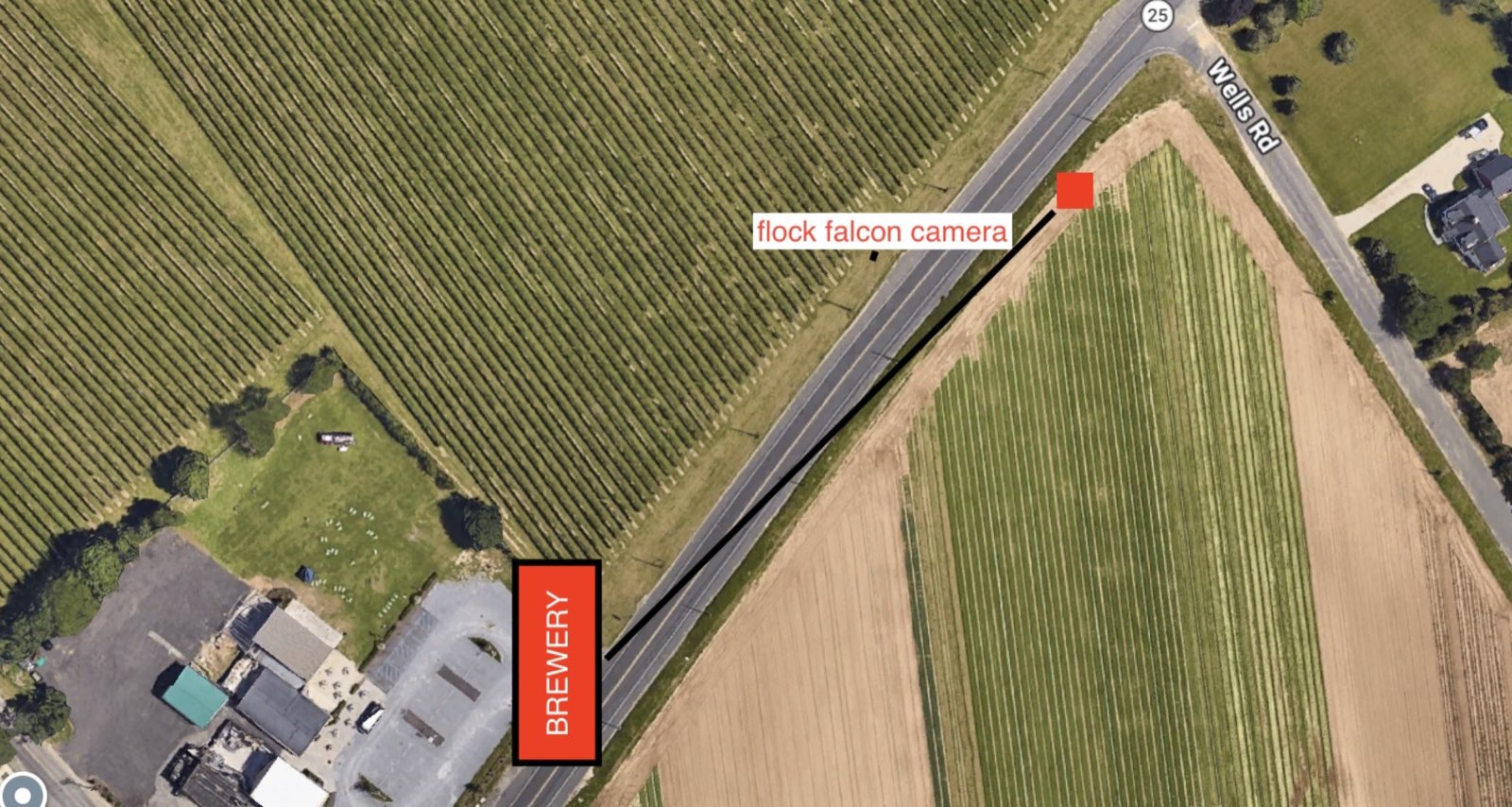
Roughly 11 Flock cameras operate in Southold. The Town bought only 3 of them (with a state LETECH grant). The rest were donated by the Suffolk County Sheriff's Office or sit on New York State right-of-way along Route 25, so other governments control most of the cameras that operate in Southold.
| Falcon (license-plate reader) | Captures plates at up to 100 mph. Logs make, model, color, and identifying details like racks, decals, and damage. This is the only device described in the Town's contract. |
| Condor (pan-tilt-zoom video) | Live-streaming PTZ video with 30-day storage, marketed for "virtual patrols." Deployed in Southold although public descriptions of the program said no live video, and never named in the authorizing resolution. The Town's Aug. 3 device count confirms Condor devices and 1,021 live-PTZ cameras among the networks Southold can search. |
| Raven (audio sensor) | Acoustic detection (gunshots, glass, tire screech) that can automatically swivel Condor cameras toward a sound. The Town did not answer a request to certify whether Raven is deployed in Southold. |
The cameras run software that stopped getting security updates in 2021
Flock's devices run Android 8.1, an operating system that reached end of life in 2021. Security researchers have published working attacks against exactly this hardware: an unauthenticated administrative interface on the device itself (CVE-2025-59403), hardcoded API keys in the software (CVE-2025-59405), and a physical-access debug mode that yields full control of the device in about 30 seconds. In December 2025, researchers found more than 60 Flock Condor cameras streaming live to the open internet, no password required.
The Town's own systems were breached before, and the Town now spends about $500,000 to harden its network. These cameras connect to that environment through the vendor's cloud.
Sources: Town contract and sole-source letter (FOIL Exhibits E6–E7); public vulnerability disclosures CVE-2025-59403 and CVE-2025-59405; 404 Media reporting, December 2025.
The costs
What Southold pays to be watched
Southold pays about $9,000 a year, with no end date, for equipment it never owns and data it does not control.
$9,000/yr
Recurring cost once the grant runs out, indefinitely, under auto-renewal
$1
What Flock pays to take the hardware back: the Town never owns the equipment
$0
Current cyber-insurance coverage: the Town's produced 2024 policy package contains a cyber exclusion, and no current policy was produced
~$500K
What the Town spends separately to secure the network these end-of-life cameras connect to
The contract auto-renews. The $1 buy-back clause means the Town never owns anything of value. The data lives in Flock's cloud, so a town that cancels loses its records, which keeps towns from canceling. The Town keeps the risk: cameras on end-of-life software carry its name, connect to its network, and have no current cyber coverage on file.
The spending goes beyond Southold. In August 2025 the Suffolk County Legislature voted $542,500 to expand the County's own Flock fleet from 25 cameras to 60.
Sources: Flock contract and invoice (FOIL production, March 13, 2026); insurance package, Exhibit E8 (June 5, 2026); Suffolk County Legislature, August 2025; Town network-hardening bond, 2025.
Accountability
Nobody signed off, and nobody maintains it
The record shows a system that no one fully authorized, no one updates, and no one in Town government controls.
What was authorized. The Town Board approved resolution RES-2025-75 by a unanimous vote. The resolution describes a license-plate reader program. It does not mention the national network, the 139-network sharing list, or the live-video cameras.
What was never authorized. The Town's June 2026 production contains no agreement, no Board vote, no policy, and no supervisory sign-off for the national network access or for any entry on the sharing rosters. The Town also stated there were "no opt-in or opt-out decisions." No produced document names the person who approved the expanded access.
Who operates it. The Town's own May 18, 2026 lists show 41 active user accounts. Three of those users appear nowhere on the Town's Flock training report, and three more never passed the Flock Search Certification. Six of the 41, including civilian dispatchers, hold no search certification. The Town's audit notes document one more person who ran searches while appearing on neither list, so the user list does not even capture everyone who has operated the system. The record does not show whether other uncertified users ran searches, and for every period before February 2026, no audit exists to answer.
Who checks it. The three produced audit reviews are self-reviews by a single supervisor, and the earliest covers February 2026 onward. The system operated for years before that with no documented audit at all. The one review that recorded searches with no case number still concluded that "no discrepancies were identified."
What is not maintained. The cameras run an operating system that stopped receiving security updates in 2021, and the Town has produced no update plan. Published attacks against this exact hardware exist (CVE-2025-59403, CVE-2025-59405).
The spending works against itself. The Town spends about $500,000 to harden its network while cameras with published exploits sit at the edge of it: devices the Town does not own, does not patch, and cannot audit. Security researchers warn that an attacker who takes control of one camera can use it as a pivot point toward an agency's own network. Attackers now use automated, AI-assisted tools, and even air-gapped systems have been compromised. The hardening money cannot do its job while known-vulnerable devices stay connected.
Where the exposure lands. The cameras carry the Town's name and connect, through the vendor's cloud, to the Town's environment. The Town's produced insurance package contains a cyber exclusion, and no current cyber policy was produced. If this system is breached or misused, the legal and financial exposure lands on the Town and its taxpayers.
These questions remain open on the record:
- Who owns each camera, and who can turn the system off?
- Who approved the national network access and the sharing defaults?
- Who is responsible for patching, or retiring, devices that no longer receive security updates?
- Who pays if the data is breached, misused, or sold?
Sources: RES-2025-75 (Exhibit E6); Town cover letter and Exhibits E1–E2 (June 5, 2026); insurance package (Exhibit E8); public vulnerability disclosures; June 2026 meeting record.
The seven-day promise
Flock cut its retention default. Southold's clock did not change.
On Aug. 13, 2026, under pressure from reporting on officers who used the system to stalk people, Flock announced a shorter default. Read the announcement closely and it does not reach Southold at all.
What Flock announced. The company cut its recommended and default retention period from 30 days to seven, on the stated ground that more than 90 percent of searches already happen within a week of capture. The same package adds mandatory case codes, mandatory multi-factor authentication, machine-learning "audit assistance" to flag abnormal search patterns, and an "Evidence Mode" that moves flagged data into cold storage for an active investigation. It followed reporting by Atlanta News First on more than a dozen cases in a year in which officers were relieved of duty or arrested for allegedly misusing the Flock database for personal reasons, including stalking romantic partners.
What it does not do. In Flock's own words: "Existing customers will keep their current, democratically approved retention periods." The seven-day figure is a default for new deployments and an opt-in for everyone else. Nothing about Southold's retention changes unless the Town affirmatively changes it.
On "democratically approved." That is the vendor's characterization of how existing retention periods came to be set. Southold's own FOIL response states there were "no opt-in or opt-out decisions." No produced record identifies who set a retention period for Southold, or when, or under what authority. Whatever clock is running on residents' movement data, the Town has produced no document showing that anyone accountable to Southold voters chose it. The vendor is describing its own defaults to the public as a democratic outcome.
Retention was never the load-bearing safeguard. A retention window governs how far back an investigator can look. It does not govern whether the capture happens, who may query it, or what gets derived from it before the clock runs out. Every search documented on this page happened inside the existing window: the 906 searches in six months, the searches reaching 250 networks, the searches logged with no case number. A shorter window would not have prevented one of them. What a shorter window does change is how long the evidence of a search survives to be audited. Southold's audit record already begins in February 2026, years into the program. Deleting the underlying data faster makes that gap permanent instead of merely undocumented.
One capture, four clocks. The photograph and the metadata row sit in the vendor's cloud under the stated schedule. The exported search hit leaves the vendor entirely. Once it is pasted into a case file, an RMS record, or an intelligence bulletin, it lives under the receiving agency's schedule, which is not seven days. The derived product (visit counts, frequency, affinity, a risk score) survives deletion of every upstream source. Flock's announcement addresses the first two. It makes no mention of analytics, aggregated data, or derived data.
Nobody outside the vendor can verify a retention setting. Retention is a switch inside a system the customer cannot inspect, and the record on such switches is poor. Oxnard, California set its access to California-only in 2023 and suspended its entire camera program in February 2026 after learning that a vendor-side change had enabled nationwide queries anyway. Ventura County disabled National Lookup in June 2023 to comply with state law; the vendor re-enabled it, and outside agencies ran more than 364,000 queries, 299 of them citing immigration enforcement. In Evanston, Illinois and in Littleton, Massachusetts, cameras that towns had ordered shut off were reinstalled or switched back on without the town's authorization. A retention period is a switch of the same kind.
How the announcement was received. The ACLU called the package "a thinly veiled PR attempt," noted that seven days remains far longer than the 48 hours it recommends, and warned that Evidence Mode could preserve more data than the old 30-day default if it retains everything connected to a case-numbered search rather than only the hit returned. The EFF titled its response "Too Little, Too Late." Both organizations made the same structural point about the new case-code requirement: a case number is a text field. As EFF senior staff attorney Saira Hussain put it, "What's to stop them from lying and giving case numbers?" Southold's own records already answer that locally: three searches logged with zeros in the case-number column, in a review that concluded "no discrepancies were identified."
A retention limit constrains only the searches nobody has run yet. It does nothing about the searches already run, the copies already exported, or the profile already built.
What follows for the Town. The announcement hands the Board something concrete to vote on, and three questions it can answer this month:
- What is Southold's current Flock retention period, who set it, and on what date?
- Will the Board adopt the seven-day setting by public vote, rather than leaving a vendor default in place and letting the vendor call it democratic?
- Does the deletion schedule cover the analytics and derived data built from Southold's captures, or only the stored images and the searchable records? Put the question to Flock in writing and publish the answer.
Sources: Flock Safety, "Flock guardrails address LPR privacy concerns and police transparency" (Aug. 13, 2026); Atlanta News First (Aug. 13, 2026); ACLU, "Despite 'New' Updates, Flock's Creepy Cameras Remain Major Civil Liberties Threat"; EFF, "Too Little, Too Late: Flock Admits Their Technology Needs Reforms"; City of Oxnard news release (Feb. 27, 2026); Evanston RoundTable; The Boston Globe (Aug. 6, 2026); Town of Southold FOIL productions of June 5 and Aug. 3, 2026.
The harms
The safeguards are already failing
The Town's own audit records show misuse at home. National reporting shows where it leads.
In Southold's own records
On Aug. 3, 2026 the Town produced the raw per-search logs for January through June 2026, the records this site had been asking for since March. The numbers below come from those logs and from the Town's earlier audit summaries. The logs confirm the summaries' arithmetic, and they show what the summaries left out.
- 906 searches in six months (January–June 2026), in a town of about 22,000 people. One detective ran 45% of them.
- 45% of searches went beyond 100 networks. Fifty-eight searches queried more than 300 networks at once, and the widest queried 5,946 networks, effectively the national database, for local cases. The supervisor who writes the department's own audit reviews also ran national-scale searches.
- Three officers ran searches while appearing on no training or certification list the Town has ever produced, 43 searches among them. One of the three is the department's heaviest national-network searcher. Department policy says no member may operate the system without completing training first.
- The training came after the scrutiny. Every Flock certification the Town produced is dated 2026. The earliest is Jan. 4, 2026, less than three weeks after the first FOIL request, although the program had been running since 2025. Two officers were still completing certification in July 2026.
- Placeholder case numbers pass the audit. One search series was logged under case number "SH25000000." The produced audit reviews check that a case-number field is filled in, and a placeholder fills it in.
- Searches with no case number: run by an officer who appears on neither the Town's trained-officer list nor its active-user list. One search was explained afterward as an "officer safety issue" from a personal driving interaction outside Southold's jurisdiction. The audit review marked the system "compliant" anyway.
- Uncertified operators: six of the Town's 41 active users, including civilian dispatchers, hold no Flock Search Certification. Three of them have no Flock training record at all.
- Nationwide network access with zero authorization: the Town produced no agreement, no Board authorization, no policy, and no supervisory-approval requirement governing the national network its logs show officers searching.
- Unvetted sharing: nobody in Southold individually approved any entry on the sharing rosters, and there is no opt-out.
Two things should be said in fairness. The Town withheld the plate numbers and vehicle descriptions inside the logs, and it identified that redaction and its claimed legal basis in writing, which is how a redaction should be made. And the raw logs match the totals in the department's earlier audit summaries, so the summaries were honest arithmetic. The problems documented here are in what the system permits, not in the Town's math.
What this data reveals, and who can buy it
One photo of your plate shows where your car was at one moment. Months of photos show where you sleep, work, worship, seek medical care, and protest, and who you spend time with. In Carpenter v. United States (2018), the Supreme Court held that under the Fourth Amendment, government tracking of "the whole of one's physical movements" is a search that ordinarily requires a warrant. Whether that rule reaches plate-reader networks is being decided right now. In January 2026 a federal judge upheld Norfolk, Virginia's 176-camera Flock network, but only because its 21-day archive left gaps in any one driver's trail, and he warned that the answer could change as networks grow: "not today" (WHRO, February 2026). That case is now before the Fourth Circuit. Then on June 29, 2026, the Supreme Court held in Chatrie v. United States that people keep a reasonable expectation of privacy in their digital location data even over short periods, and even when a company stores it for them. Those are the two defenses plate-reader networks rely on. Flock's network logs those movements for everyone, without a warrant and without a way to opt out, and Southold's own logs show single searches reaching 5,946 networks of it.
Flock's standard terms once stated that it "does not own and shall not sell Customer Data." Flock removed that language before its February 2026 terms took effect. Its current policy reserves the right to disclose plate data to "law enforcement authorities, government officials, and/or third parties." New York has no statute that restricts ALPR data sharing or sale. Southold has no ordinance. A private corporation is already inside the network. No contract, statute, or local rule now prevents the sale of this data.
The national record, in brief
- Stalking: more than a dozen documented cases of officers using Flock to track ex-partners and others (404 Media).
- Person-search: Flock's "FreeForm" tool lets users search by clothing, tattoos, even race (404 Media).
- Immigration sweeps: local officers ran Flock searches to assist federal immigration enforcement, despite Flock's stated policy (404 Media). Since early 2025, more than 50 communities in at least 20 states have canceled, suspended, or refused Flock contracts, many after discovering exactly this.
- False hits: in June 2026 a journalist test-driving a press car was surrounded by four police cruisers over a misread plate. Flock's CEO called it an "edge case." The officers' advice was to leave the car parked so it did not get flagged again (CNN, July 2026).
Where this goes next
- Can ICE search it? Southold's rosters do not list federal immigration agencies. But 59 agencies and a national network can search the data with no per-search approval, and local officers around the country have already run Flock searches for federal immigration enforcement. The Town cannot rule it out.
- Has it been used against reproductive rights? Yes. In 2025 a Texas sheriff's office searched thousands of Flock cameras across the country for a woman after a self-managed abortion. The search was logged as a "death investigation" (404 Media).
- Can it touch your insurance? Insurers already buy driving data: 2024 reporting showed car makers sold driver behavior to data brokers, and insurers used it to set rates. Flock's current terms no longer bar the sale of its data. A record of where and when you drive can feed pricing decisions you never see: car insurance first, and inferences beyond it.
- Can a bumper sticker put you in a group? The cameras log decals and stickers as identifying details, and Flock's search tools let users query such attributes. A political sticker, a union sticker, or a parish sticker becomes a searchable trait in a national database.
- What if the data leaks? Data this valuable is bought by those who pay and taken by those who do not. Researchers already found more than 60 Flock cameras streaming live to the open internet with no password.
Sources: Town raw per-search audit logs and training report, FOIL production of Aug. 3, 2026 (Exhibits 1–6, 9); Town audit reviews and user rosters, FOIL Exhibits E3–E5 (June 5, 2026); 404 Media; CNN Wire, July 31, 2026; ACLU analysis of Flock's terms; Flock LPR policy; 2024 national reporting on automaker driver-data sales to insurers.
The pattern
What was said vs. what the records show
Eight times, the public statements and the Town's own records disagree. Each time, the records show more surveillance than the public was told about.
Police Chief Steven Grattan: the cameras capture "limited vehicle details (such as make, model, color and distinguishing features) as the vehicles pass the camera's location on public roadways," and are "not used for general surveillance of neighborhoods or for monitoring the daily activities of residents."
Condor pan-tilt-zoom live video cameras, with live streaming and 30-day recorded storage, are deployed in Southold. The authorizing resolution (RES-2025-75) describes none of this.
Chief Grattan: the department "maintains full control over all data for the cameras we own. Information may be shared with other law enforcement agencies only at our discretion and only for legitimate law enforcement purposes."
The Town stated in its FOIL response that there were "no opt-in or opt-out decisions" behind the 59-agency and 139-network sharing lists. And the Town owns 3 of the roughly 11 cameras in Southold, so "the cameras we own" leaves most of them outside that promise.
Chief Grattan: "The Flock system cannot be used to search for human characteristics such as race or gender."
404 Media reported that Flock's "FreeForm" tool lets users search by what a person wears, their tattoos, or their race. Flock's own response was that "guardrails" alert administrators when search terms include "race, ethnicity, religion, nationality." A guardrail that flags race terms exists because race terms can be entered.
Chief Grattan: "The Southold Town Police Department does not use Flock Safety Cameras for immigration enforcement." Public materials also state that system filters automatically prevent searches related to immigration or reproductive healthcare.
Nationally, local officers have run Flock searches to assist federal immigration enforcement, and in 2025 a Texas sheriff's office searched Flock cameras across the country for a woman after a self-managed abortion (404 Media). Southold's produced record shows no per-search approval that would catch such a search here.
The Town's own audit reviews conclude: "All searches were found to include valid case numbers and articulable law enforcement purposes consistent with department policy. No discrepancies were identified."
The same review's case-number column reads "3 by [one officer] have zeros for CC": three searches with no case number, by an officer on neither the trained-officer nor the active-user roster.
The vendor's sole-source letter, in the Town's own production (Exhibit 7), describes the system's full capabilities.
The Town's cover letter concedes the Board was never told of capabilities described in that same letter.
Department policy: no member may operate the ALPR system or access its data "without first completing department-approved training."
The raw logs show three officers running searches who appear on no training or certification list the Town has produced. Every certification the Town did produce is dated 2026, after the first FOIL request, although the program had been running since 2025.
At the June 25, 2026 meeting, the department committed to requiring sign-off before any search that crosses outside its jurisdiction.
The raw logs the Town produced contain no approval or sign-off field, and searches spanning 225 to 250 networks continued on the day of the meeting and in the days after it. If the sign-off exists, no produced record shows it.
Each row above quotes a public statement or the Town's own productions. The underlying documents will be published on this site as they are prepared for release.
Quoted statements: Police Chief Steven Grattan's public statements on the Flock program; the Town's audit reviews and cover letter, FOIL production of June 5, 2026 (Exhibits E3, E6, E7); the Town's raw audit logs and training report, FOIL production of Aug. 3, 2026 (Exhibits 1–6, 9); department ALPR policy; the June 25, 2026 meeting record; 404 Media reporting on FreeForm and immigration searches.
The bigger picture
The Suffolk County grid
A few roads carry all traffic on and off the North Fork. Cameras on those roads record every trip, and the county is adding more.
Southold sits on a peninsula. A small number of routes, Route 25 chief among them, carry essentially every trip on and off the North Fork. Cameras on those routes record every commute, every school run, every trip to a doctor, a church, a meeting, a protest. On a peninsula, you cannot drive around the cameras.
The network keeps growing, by design that avoids public votes. Most of Southold's cameras were donated by the Suffolk County Sheriff. In August 2025 the County Legislature funded an expansion of the County's own fleet from 25 to 60 cameras, expressly in areas that "don't require local or state legislative approval." Sixteen more cameras were planned along State rights-of-way, including Route 25 in Southold and Route 114 in Sag Harbor and East Hampton. And the County is signing right-of-way agreements town by town: in January 2026, Riverhead voted to let the Sheriff install on its town roads in exchange for data access. That agreement is the template. Has Southold been asked to sign one? The Town should answer that in public. Each new camera feeds the same vendor's national, searchable database, which, as the rosters above show, agencies and companies far outside the county can search.
Separate FOIL requests are being prepared for the County and the State. The Town owns only 3 of the roughly 11 cameras in Southold. The rest trace to the Suffolk County Sheriff and to State right-of-way along Route 25, so the records behind them sit with county and state custodians, not the Town. Requests are going to the Suffolk County Sheriff's Office, the county government, the Department of Public Works, the County Legislature, and NYSDOT. Results will be published here.
Bills that would regulate any of this in New York, S963 and S7713A/A907A, remain stuck in committee. Meanwhile the County Legislature is weighing IR 1393-2026, which would require certain businesses to provide their security-camera footage to law enforcement after felonies, extending the lattice to private cameras by law. Until a state law passes, each town sets its own limits, or none.
Sources: Suffolk County Legislature (August 2025 expansion; 2026 meeting agendas, IR 1393-2026); East End Beacon (January 2026) on the Riverhead right-of-way agreement and planned State-ROW cameras; Town FOIL productions on camera ownership; NY Senate/Assembly bill status.
How we know
FOIL
The Town released these records only after three rounds of requests, two appeals, and eight months of pressure.
- Dec 16, 2025First FOIL request filed. Ignored past the statutory 5-day window. Acknowledged only after a constructive-denial appeal. Granted Dec 23: the Town's ALPR policy covers plate readers only.
- Dec 31, 2025Second request: contract, capabilities, data-sharing, correspondence. Answered March 13 with 35 pages, with internal emails withheld in their entirety, contrary to controlling New York precedent.
- Mar 30, 2026Third request: 32 items on the national network, undisclosed hardware, audit gaps, and cybersecurity. A 30-day extension was claimed retroactively.
- Apr 29, 2026Extension expires. The Town issued no determination and produced no records.
- May 1, 2026The Town requests a second 30-day extension. Declined. An administrative appeal was filed the same day.
- May 15, 2026Appeal-determination deadline missed. Under New York law this counts as a denial, and a court can then compel the records.
- Jun 5, 2026First substantive response, 67 days after the request. The production includes the access rosters on this page, and concedes there were "no opt-in or opt-out decisions." Six categories of records remain withheld.
- Jun 25, 2026In-person meeting and camera walk-through with the police department. One commitment made: sign-off before out-of-jurisdiction searches. National access stays on. No new records.
- Jul 2026Two written promises of records ("as soon as I have them together" and "by the end of the month/early August").
- Aug 3, 2026The Town keeps the promise. Ten exhibits: six months of raw per-search audit logs, the RES-2025-75 minutes, the training-completion dates, and the device count (279 networks, 4,278 cameras), with a written statutory citation for each item withheld. The Town FOIL track closes the same day with a letter of thanks.
- Aug 11, 2026The open questions move to the Town Board. At public comment, several residents speak against the system, independently. Two questions are put to the Board on the record and repeated in writing the next day: will the Board bring the sharing settings to a public vote, and who outside Southold has searched residents' data. Neither received a clear answer at the meeting.
- Aug 2026Separate FOIL requests in preparation for Suffolk County (the Sheriff's Office, county government, DPW, and Legislature) and for NYSDOT. The Town never held the records for the cameras it does not own; those custodians do.
- Sep 2026The Article 78 window, the court deadline to compel records, closes in mid-September. The Aug. 3 production resolved most of what a petition would have sought; whether the narrow remainder warrants a filing is under review before the window closes.
Credit where it is due. Most of this timeline records delay, so it should record this too. Answering these requests took a large amount of work from people whose actual jobs are running a police department and a law office, and the Aug. 3 response was exemplary: records produced, every question answered in writing, every withholding tied to a stated legal basis. We still disagree with the Town about this system, how it was implemented, and the techniques it relies on. We are grateful all the same to the department, the captain, and the Town Attorney's office.
The requests, responses, and correspondence behind this timeline will be published here as a document library, redacted only for personal contact information.
Our position
What we want, and what comes next
We want the cameras removed. The harms fall on the whole community, and the rollout never matched its public description.
Removal. Every driver in Southold is recorded, the data leaves local control, and the safeguards have already failed in the Town's own audit records. We are asking the Town to end the program and remove the cameras.
The September court window. For months the Town withheld six categories of records past every statutory deadline, and the right to compel them in court under Article 78 of New York law vested in May. On Aug. 3 the Town produced most of those records with a written legal basis for each item withheld. What remains open is narrow: search logs from before 2026 and a user-account history, which the Town has not yet addressed, and two records it says it is not required to create, a Vaughn index of withheld records and a certification that no Flock video or audio devices are deployed here. Whether that remainder warrants a court filing is under review before the window closes in mid-September.
Counsel. We are in active dialog with civil-liberties organizations about joining a related case.
A separate question: the Town's own laws. We have not yet reviewed whether the rollout complied with the Town's own code and procurement rules. That review is a separate, planned effort. Nothing on this page claims a violation of Town law.
The questions now before the Town Board
We want the cameras gone. That ask has not changed. On the way there, two questions were put to the Board at public comment on Aug. 11 and repeated in writing on Aug. 12. Neither has received a clear answer.
- Will the Board put Flock's sharing settings to a public vote? The 59 outside agencies with direct access and the national network were never authorized by any elected body. The Town's own response concedes there were "no opt-in or opt-out decisions."
- Will the Town finally ask who has been searching Southold's cameras? It never has. The Town holds no inbound search log, and no produced record shows it ever requesting one. Two sets of cameras are in play: the three the Town owns, and the rest operating inside Southold that it does not own. The Board should obtain both records from Flock, showing who searched, when, and the stated reason, and publish them.
The rest of what we are asking:
- Suspend the national and external access pending Board review. The department has said this is a Town-level decision, so the Board can make it.
- Put the June commitment in writing. The department agreed to sign-off before out-of-jurisdiction searches. Make it a written, verifiable policy.
- Disclose the County's ask. Has the County requested a right-of-way agreement like Riverhead's? Bring any such agreement to a public vote, not a consent calendar.
- Answer on the record: who owns each camera, who can turn the system off, who is responsible for devices that no longer receive security updates, and who pays if the data is breached or sold?
Take action
What you can do
More than 50 communities have canceled or refused Flock contracts. In Southold, the Town Board makes these decisions, and you can speak to them directly.
- Show up. The Southold Town Board meets at Town Hall, 53095 Route 25. Residents already pressed the Town's Public Safety Task Force in April 2026 to drop the cameras, and several more spoke against the system at the Aug. 11 Board meeting. You are not alone. Ask the questions listed under Position, on the record.
- Write the Board. Ask for three things: local-only sharing by default, per-agency opt-in decisions made in public, and publication of the raw search audit logs the policy already requires.
- Ask the County. Suffolk County is expanding its own fleet with public money. Your county legislator votes on that.
- Back the state bills. S963 and S7713A/A907A would set statewide rules for ALPR data. Tell your state senator and assembly member to move them.
- See the national picture. DeFlock.org maps ALPR deployments nationwide and tracks communities that have opted out.