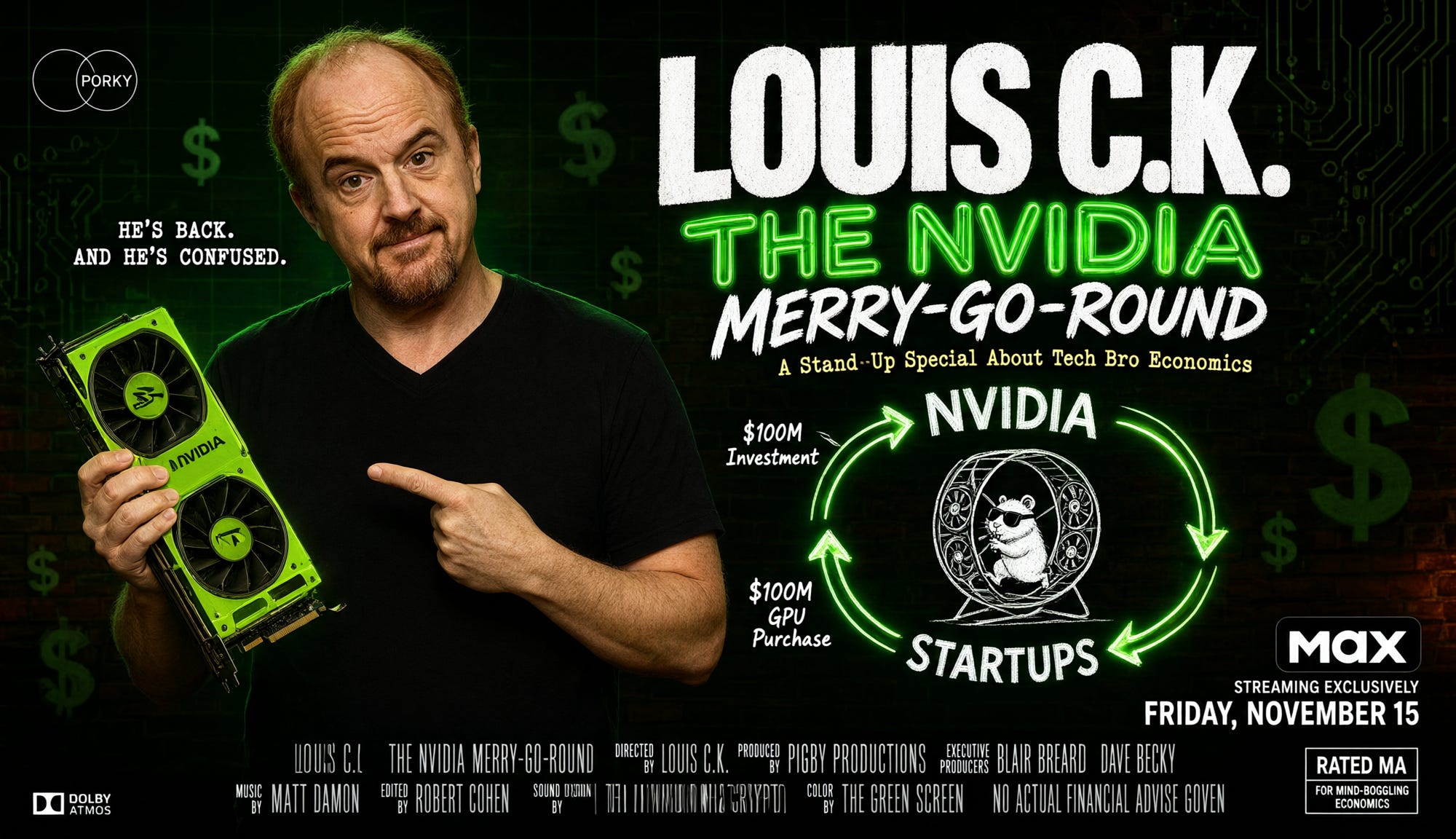
You ever notice how no one in the world has money anymore, except for these companies? And these companies don’t even have money. They have... promises of money. Like, they all found a way to pay each other with the same dollar. The same dollar, just going around in a circle, like a dog chasing its own tail, but the dog is worth four trillion dollars.
Let me explain it to you, because I’m not a smart man. I buy my pants at a place where they yell at you. But even I can see what’s happening here. There’s this company, Nvidia. They make these little chips, and these chips are like... crack. For computers. Every company on Earth is like, “I NEED the chips. I will sell my grandmother’s teeth for the chips.”
So Nvidia’s got the chips. Good for them. They’re rich. But here’s the problem: the people who want the chips — the AI companies — they’re all broke. They’re not profitable. They lose money the way I lose socks. It’s just constant, endless, tragic losing. So Nvidia says, “No problem! We’ll give you the money to buy our chips. With interest! Plus we’ll also invest in your company! And then you’ll take that money, and you’ll buy our chips! And then we’ll take the money from the chips and invest it in more companies that buy more chips!”
And everybody in the room nods, and they shake hands, and they say “synergy,” which is a word that means “nobody’s really sure what the other person is doing but we’re all getting paid.”
And they say it’s NOT circular. This is the part that kills me. Because Jensen Huang — the CEO, who looks like he got dressed in the dark at a motorcycle convention — he stands up in his little leather jacket, and he says, “The idea that this is circular financing is ridiculous.”
RIDICULOUS. I said “ridiculous” once to my daughter about her haircut, and I’m still in therapy. He says it about a circle. A literal circle. Here’s what they announced — I read about it, I’m not proud of it, I was on the toilet — they got six of the biggest money firms in the world. Apollo. BlackRock. Blackstone. Brookfield. Goldman Sachs. KKR. And they’re gonna “mobilize” over five hundred billion dollars. Five hundred. Billion. To finance these data centers.
Now, a data center is a building full of computers. That’s it. That’s the whole thing. It’s a warehouse with a million laptops taped together, and they put a tin roof on it and call it an “AI factory,” like it’s making cars. It’s not making cars. It’s making the same three paragraphs over and over until you ask it to stop.
But here’s the beauty part. The money firms are gonna lend money to the AI companies. The AI companies are gonna use that money to buy chips. From Nvidia. And Nvidia is gonna pay the money firms back a little bit. With interest. And the interest comes from... the money the money firms gave them. It’s a perfect circle. It’s beautiful. I saw a circle like that once — it was a flushing toilet, and I was throwing up in it, because I’d had a bad day.
And when they asked him about it, Jensen says — and I love this — he says the money firms “independently underwrite each project.” Independently! Like a bunch of guys standing around a table who all went to the same cocktail party where Nvidia gave them the same PowerPoint. Independent. Sure. My kids do their homework “independently,” which means they sit next to each other and one of them does it.
But wait, it gets better. Because if the money firms get nervous — if they start to smell the coffee, you know? — Nvidia says, “No problem, we’ll backstop up to 25% of the deals.”
Backstop. That’s a word. That’s a great word. It means: “If the whole thing falls apart, we will catch it.” With a dollar. A dollar that we printed by selling chips to the people who are falling.
It’s like if a guy loans you money so you can buy his car, and then you use the car as collateral for a loan from his cousin, and then you pay him back with the cousin’s money, and the car is still his, and everybody’s happy, and nobody has a car.
And the neoclouds! Oh my god, the neoclouds. I can’t even — there are these companies now called “neoclouds.” They’re clouds that are newer than other clouds. Clouds, from a company that was a search engine. And these neoclouds — CoreWeave, Nebius, Lambda — they buy chips from Nvidia. But they don’t have money, because they’re “clouds,” which is not a real business, that’s a weather thing. So they take out loans. And what do they put up as collateral? THE CHIPS. They borrow money to buy the chips, and the chips back the loan. The product is the collateral for the money that buys the product. I asked my accountant about this and he said “don’t worry about it” and then he started sweating.
And Nvidia doesn’t just sell them the chips. Nvidia invests in them. Nvidia owns a piece of the cloud. And then — this is my favorite part — Nvidia rents the cloud back. From the company it owns. So Nvidia’s money goes into the cloud, the cloud buys chips from Nvidia, and then Nvidia pays the cloud to use the chips that the cloud bought with Nvidia’s money.
It’s like if I gave my daughter five dollars, she bought me a sandwich, and then I paid her for the sandwich, and then I said “I made fifty dollars today, honey.”
And OpenAI. Let me get to OpenAI, because this is the crown jewel. OpenAI is the company that made ChatGPT. ChatGPT is that thing where you type a question and it writes a speech for your boss. They are not profitable. They lose money so fast it makes a sound. And they’re worth — get this — eight hundred and fifty-two billion dollars. EIGHT. HUNDRED. FIFTY. TWO. BILLION. For a company that sells “good enough” essays and occasionally makes a picture with the wrong number of fingers.
And Nvidia wants to backstop them. Two hundred and fifty billion dollars. To backstop a lease on a data center. In Ohio. OHIO. We’re gonna build the most expensive building in the history of the world in Ohio, and the money comes from six finance firms, backed by a chip company, to pay a company that loses money, so they can buy chips from the chip company, and the chips are worth money because of the company that’s losing money.
It’s not a bubble. It’s a carousel. A beautiful, golden carousel, and everybody’s on it, and everybody’s waving, and the music is playing, and the horses are going up and down, and nobody’s asking who owns the carousel. It’s Nvidia. Nvidia owns the carousel. They own the horses. They own the music. They sold the tickets. And at the end of the ride, you get off, and you’re back where you started, and you’ve spent a trillion dollars, and you have nothing — but you DID ride. You rode so hard. That’s what matters. That’s what Jensen tells you in his little leather jacket while he adjusts his sunglasses at night.
You know how you can tell it’s a bubble? When the guy in the middle of it says “it’s not a bubble.” That’s how you know. Last time, it was real estate. Guy on a billboard in a polo shirt: “PRICES ONLY GO UP.” This time it’s a man in a leather jacket saying “COMPUTE IS REVENUE.” Compute is revenue. I’m gonna get that tattooed. Right next to my other one, which says “I’m fine.”
We’re all gonna be fine. The circle’s gonna keep spinning. And if it stops... well, then it’s not a circle anymore. Then it’s a line. Pointing down.
And that’s it, that’s the joke. Goodnight, tip your servers — they’re all in Ohio, and they’re in debt.