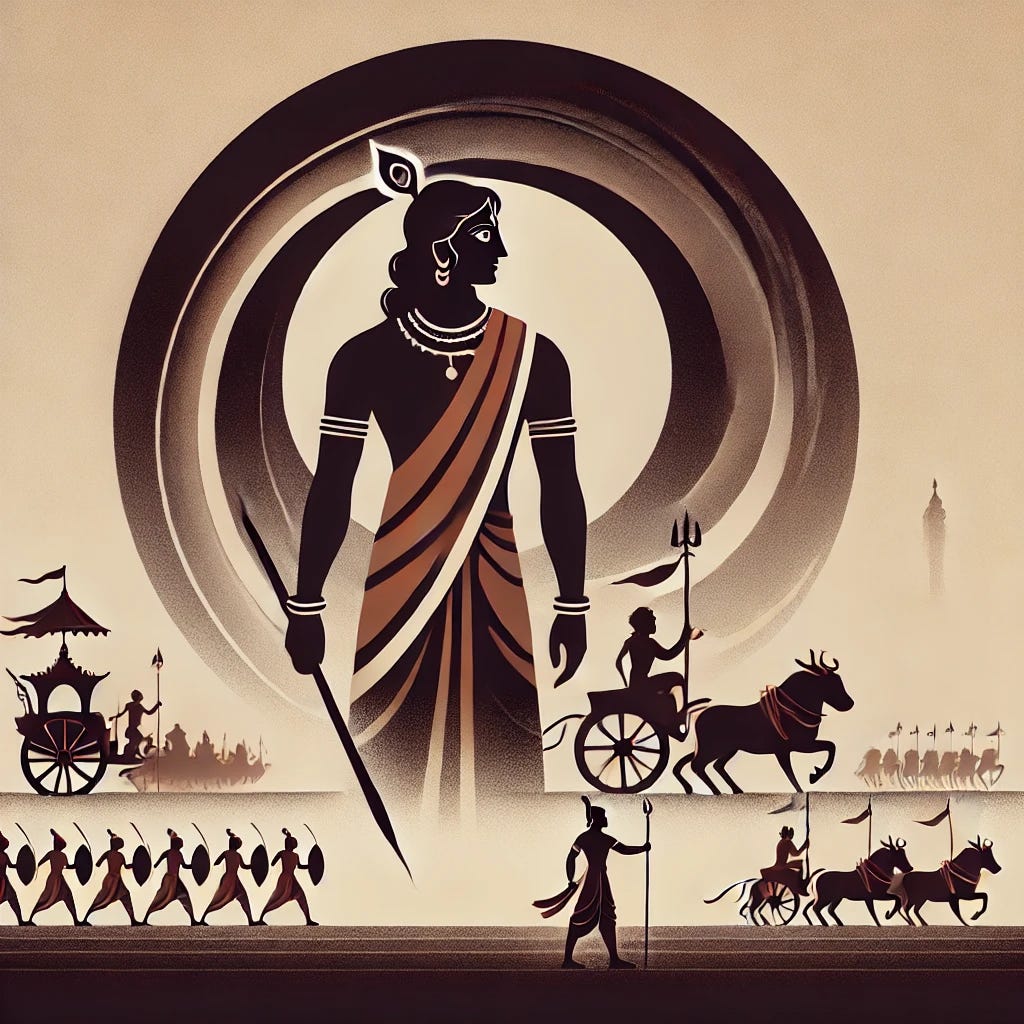
The most famous excerpt from The Mahabharata is the dialogue between Arjuna and Krishna, on the battlefield of Kurukshetra. At this critical juncture, Arjuna is gripped by paralysis, fear, and anguish at the idea of striking against his extended family on the opposite side of the conflict. Krishna, who reveals himself as an avatar of the ultimate Godhead, assures Arjuna of his duty; explaining the deontological nature of human progression, and the imperative to act. The instruction, and Arjuna’s inner battle, presupposes a personal will that must choose the right action.
What is the nature of free will, in Hindu cosmology? How does it manifest, and what is its significance — especially in the context of a paradigm that contains reincarnation?
As I briefly explored in a previous post, there is no canonical answer on free will in the Hindu tapestry. There are motifs — the cyclical cosmos, the system of reincarnation, the phases of cosmic progression — which serve as foundational tools for assembling an array of different belief systems. It’s more akin to a modular operating system, where different components and pathways have emerged over time, through the organic developments of intertwined philosophical systems.
However, the very nature of karma, especially as delineated in the Bhagavad Gita, implies a world where human agency is both real and meaningful. If every action is predetermined, why would God himself bother to incarnate and provide instruction on the battlefield? Why would that instruction hinge on a set of counterintuitive behaviors, which stress discipline over animalistic impulses? The central place of the Gita in modern Hinduism furthers the case. There are plenty of myths and philosophical renditions of the more instrumental, autonomous machinations of the cosmos. Millions of Hindus probably couldn’t tell you the first thing about those machinations; but they will affirm the moral imperatives, and the implicit claims about human agency and willpower, given by Krishna to Arjuna.
So if we accept that there is a notion of willpower and agency which permeates Hinduism in its most popular forms — the question then becomes: what is the nature of this agency? What are the imperatives for all of us who have it?
We can start with the Hindu conception of the human mind itself, and how each of its constituent components intersects with the idea of willpower. Most classical systems consider four key parts of the mind, which operate with interlocking functions. The manas; the chitta; the ahamkara; and the buddhi.
Manas is the processing faculty within the mind. It is what coordinates among the senses, selects among potentially competing stimuli, and integrates that information for subsequent interaction. Manas is concerned with moment-to-moment activity, and the reflexive generation of simple images and immediate reactions. When someone is trapped in attentional oscillation, switching, or looped compulsion — they are said to have an afflicted manas.
Chitta is the mental faculty that manages impressions and the associated emotional drives. As a person moves through the world (or, ostensibly, any sentient soul moves through any material environment), the chitta is the repository of the latent traces and impressions that are accumulated. The primary objects of chitta are known vritti; these are the perceptions, emotions, reactions, and conceptualizations that arise through subjective interaction. Vritti are analogized to waves constantly rising in the ocean; as they crash repeatedly upon the mind, they leave lasting impressions known as samskaras. Most yogic practices treat samskaras as critical points of examination — to address acute mental suffering, and to understand the deeper conditioning that is controlling the mind.
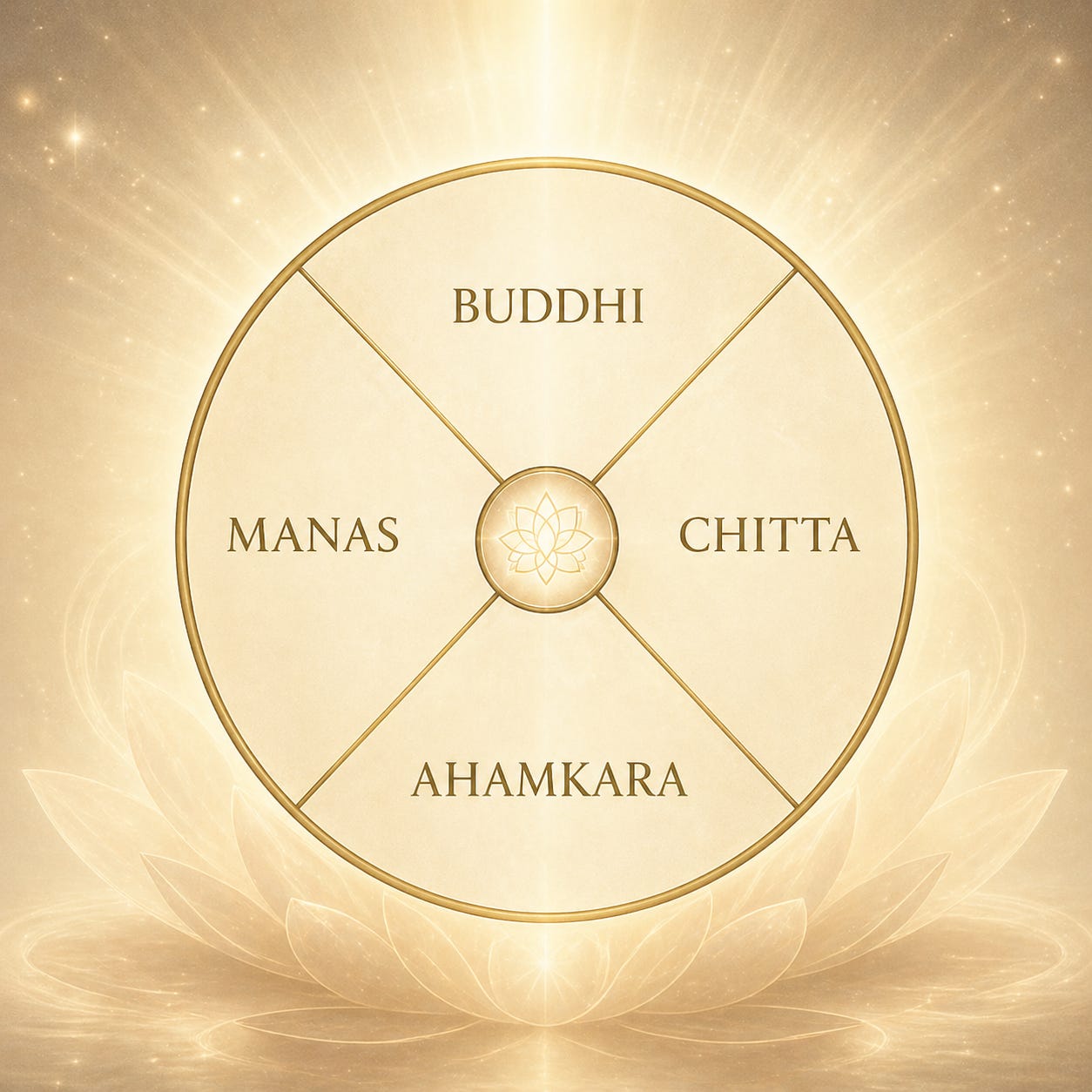
Ahamkara is the individuation engine that gives rise to the subjective sense of self; the “I” that distinguishes between self and outer world. It works with chitta to maintain a coherent identity across time, and is the source of personal narratives. Ahamkara is responsible for the sense of ownership that a person feels over their senses and body, and the authorship they feel when acting in the world. In most Hindu traditions, spiritual progression involves overcoming the delusions of ego and painful attachments that are anchored in ahamkara.
Buddhi, the final of the four common faculties, deals with discriminate cognition; it is what separates, analyzes, judges, and decides. As an individual receives and integrates data through their manas, collates those impressions through their chitta, and coalesces those experiences through a sense of self anchored in the ahamkara; the buddhi pulls on all of these faculties as it engages in rational discursion, and makes decisions. In return: the activity of the buddhi strengthens the individuation done by the ahamkara, and informs the functioning of the buddhi and chitta. Even in a fairly simple scheme, the mind is a matrix.
In essentially every Hindu system, these material faculties are complemented by a set of transcendental faculties. These revolve around the atman, or the individual and eternal soul that is present in a living being. In monistic traditions, the atman is a part of the eternal godhead (Brahman); while in dualistic traditions, it is a distinct spiritual essence — though still mired in the illusions and confusions that are generated by material circumstances. Some systems, like Kashmiri Shaivism, contain additional transcendental elements that specifically justify the existence of free will.
Kashmiri Shaivism, as the name implies, views Shiva as the prime divinity. He is said to be the singular and transcendent source that underpins not only all other divine representations, but also every material component of reality. While the tradition contains many intricate details that are personified through a Shiva-Shakti duality, it is particularly noteworthy for its taken on free will. Svatantrya is a central concept, which translates roughly to “self rule” or autonomy. As the prime mover, Shiva is referred to as Svatantryam Niravacchinnam —i.e., the one whose freedom is without any boundary.

In Kashmiri Shaivism, each atman (individual soul) is not only derived from Shiva, but ultimately, is said to be a fragment of his essence that is mired in illusion. Ontologically, it then follows that every individual soul inherits free will — svatantrya — in some attenuated form. The philosopher Abhinavagupta depicted the process of self-realization as uncovering this granted sovereignty; and at the limit, a person could recognize the ultimate sovereignty of God, while simultaneously understanding that they personally could only display an infinitesimal fraction of it.
This intertwines with concepts that are more general across Hindu systems; including, critically, one’s svadharma. If dharma is the categorical concept that encompasses duty and cosmic order, then an individual’s svadharma is their specific set of duties and imperatives. This includes personal conduct, family obligations, and the specific roles that the person plays in societal events. Across Hindu traditions, it is often said that an individual’s svadharma is revealed through their actions and spiritual questing, which can be catalyzed through interactions with gurus, studying, or simply adventuring through the world.
When considering human agency, svadharma provides a bridge of sorts, connecting the instrumental faculties of the mind with the transcendental faculties of the soul. The material faculties, like buddhi and manas, are ultimately given animation by the divine core, the atman; and the atman explicitly derives its sovereignty from the Godhead, in traditions like Kashmiri Shaivism. However, what someone does with this sovereignty (i.e., how they operate their mental and physical faculties) is a consequence of both the karma they have accumulated, and their understanding of their svadharma. One can imagine an individual’s psychic and spiritual baggage, in the form of karmic “fruits”, contending with their drive to pursue their destiny — as it is revealed over time.
The Gita’s setting carries with it a profound implication: it is not just that actions matter, but that the actions within an earthly incarnation matter. The entire discourse can be viewed as a synthesizing directive, which elevates the realm of action to a primary mode of spirituality. It is difficult to arrange Indian philosophy into timelines, but the Gita is considered to have risen in the swirling aftermath of many fragmented traditions, which focused on either devotional practices or mindful inquiry. Krishna answers the question implicit in the spiritual sprawl: righteous action, when properly oriented, is as valid a path to God as any other.
The story’s setting is referred to as Dharmakshetra, the “arena of dharma”; which offers a climactic backdrop for the events of the wider epic. But it also invites a particular question: is there something literally important about the physical setting of the story?

Commentaries on the Gita often refer to the extant world as “karma bhumi”; the world of action. While typically colloquial and non-specific, Bhumi in Hindu systems refers to both the general earthly plane, and a specific goddess who is said to be one-in-the-same with the planet. As Vedic cosmology (Jyotisha) developed in the first millennia across Puranic literature, theories on the relevance of Earth (Bhumi) in particular began to emerge. How did she relate to the nature of humanity, and human incarnation? There are stories of her approaching Brahma and Vishnu, drowned in sorrow — and appealing for help in overcoming the evil doings of mortals. Moreover, the Earth was placed in conjunction with other planetary bodies, which each exert different influences and contain different celestial associations.
In the web of this bardic mythology, a motif emerges: Bhumi, the Earth, has a unique place in the karmic universe. Among all the realms, the “arena of karma” is associated with the earthly realm, and specifically mankind. The term karmabhumi in the Vishnu Purana and the Garuda Purana convey that karma is radically affected by actions on Earth, compared to other realms. What we do with our lives can dramatically alter the arcs of our spiritual journey; whereas the actions of celestial beings, including the heterogeneous expanse of deities, are much more limited in how they change the balance of karma. In some renditions, the other realms are almost depicted as holding zones, where enjoyment or suffering takes place — before another earthly incarnation can occur, which then can once again meaningfully shift the balance of that soul’s karma.
These transcendental mechanics are intertwined with the cyclical structure of the Indian cosmos. It is not simply that one’s earthly lifetime matters, but the particular period of one’s lifetime carries structural peculiarities. Our current age, the Kali Yuga, is defined by an overflowing of unrighteousness (adharma). While positing more difficulties, it perhaps also provides deeper opportunities for righteous action and meaningfully altering the karmic trajectory of the soul.
Within this framework, it becomes straightforward to link Bhumi not just with karmic inflection, but with free will itself. As the “worldsoul” of Earth, she is what enables ensconced souls to operate with choice as they pursue life’s aims — i.e., often encapsulated broadly in the four purusharthas: dharma, artha, kama, and moksha. The nature of reality is in constant flux, which means that the “ideal” action is always contextually dependent; but the pursuit of righteous knowledge and action is possible for Bhumi’s children in a way it seemingly isn’t for incarnations in other realms. The devas (pantheon of gods) are generally ordered but bound by divine duties; the demons gnash in compulsion and distorted motivation; but humans, contending with both their luminous and darkened qualities, can forge themselves anew.
In essence: the human incarnation is a crown jewel in the infinite procession of the soul. What precisely the “end game” looks like, with respect to ultimate liberation and reunion with God, can be debated among the various Dharmic systems. But, even as the particulars are quibbled over, the imperative is clear: we each have been gifted with a rare and significant opportunity, and what we do in this life will echo into eternity. It is fascinating to consider that the devas and other celestial overseers may view their current positions as simply intermediate stops, on their path to true enlightenment; as they carry out their duties in anticipation of a future human incarnation. It also sheds light on the often complex actions of “demonic” entities in Hindu mythologies; while some are cartoonishly evil, there are others that seem aware of their fallen state. Could they, through incrementally righteous action, eventually earn a ticket back to Earth, the realm of karma — and gradually begin to work towards enlightenment too?
It would fit nicely with the idea of an infinitely loving and patient God, who has empowered all living beings with the sovereignty to eventually find their path back home. Even if it takes many, many lifetimes — there is always hope.