Thanks for reading! This week, as part of our series on the art and material culture of the French Revolution, we’re looking at one of the period’s most influential and prolific cartoonists, James Gillray.
To receive posts like this in your inbox, subscribe! And if you think these posts are worth a few bucks a month, consider becoming a paying subscriber!
When you take off in the middle of the night, the least you can do is leave a note. That’s what Louis XVI did, at least, when he made the disastrous decision to try to escape from Paris.
Up until this point, Louis had behaved as if he supported the French Revolution, publicly accepting the shift in his role from absolute ruler to constitutional monarch. But the royal family felt the walls were closing in on them, and bristled at the fact that revolutionaries would not let them leave Paris.
So they planned a daring escape. In the middle of the night on June 20, 1791, Louis, Marie Antoinette, their children, the king’s sister Elizabeth, and a governess disguised themselves as a Russian noblewoman (the governess) and her entourage. They were headed east to the royalist stronghold of Montmédy, where they believed a loyal army waited for them.
Louis’ note to the French people indicated that, while he had been willing to support the initial goals of the revolution, he felt it had gone too far:
As long as the king could hope to see the order and happiness of the kingdom revived through the methods used by the National Assembly, and through his residence close to this Assembly in the capital, no personal sacrifice has aggrieved him….
But today, when the only recompense for so many sacrifices is to witness the destruction of the kingdom, to see all authority ignored, personal property violated, people’s safety everywhere in danger, crimes remaining unpunished, and a complete anarchy established above the law, without the appearance of authority that the new Constitution grants him… the king, having solemnly protested against all the decrees issued by him during his captivity, believes it his duty to put a picture of his behaviour…
People of France, and especially you Parisians… be wary of the suggestions and lies of your false friends. Come back to your king; he will always be your father, your best friend. What pleasure he will have… to see himself once again in your midst, when a constitution that he has freely accepted ensures that our holy religion will be respected, that government will be established on a stable footing and will be useful through its actions, that each man’s goods and position will no longer be disturbed, that laws will no longer be infringed with impunity, and that liberty will be placed on a firm and unshakeable base.
The message was mixed at best — Louis was running away while declaring his desire never to leave the French people. He was preaching against radical action while attempting to rendezvous with an army. This was classic Louis XVI behavior; the king had never had a knack for political messaging and repeatedly sabotaged his own position with muddled thinking and indecision.
The escape attempt was as much of a mess as Louis’ message to his people. The royal family decided to escape in a large, slow carriage because they didn’t want to be separated into two faster ones. Royalist soldiers had been posted along the route, which alerted people to the fact that something was up. The carriage broke a wheel and had to be fixed. Louis at one point got out of the carriage and made small talk with local farmers; Marie Antoinette gave presents to a local official. When the royal family was delayed, some of their allies who were supposed to be lining the road panicked and abandoned their posts.
In the end, the news of the royal escape traveled faster than the actual royals did. A local official recognized Louis and alerted revolutionary authorities. The royal family was detained in Varennes, about 30 miles from Montmédy.
The “Flight to Varennes” was one of the most significant turning points of the French Revolution. French people realized that the king (despite his protestations in the note) was not supportive of the revolution. Once compromise with the king was off the table, radicals solidified their control over the revolutionary government. Louis and Marie Antoinette were now headed toward the guillotine.
People all over the world took notice of the moment. Artists tried to imagine the dramatic moment of the royal family’s capture. Most of them look something like this; they’re scenes laden with drama and tragedy:
And then there’s the British cartoonist James Gillray’s take on the event:
Artists created a lot of images of the French Revolution. Most of what you’ll see in textbooks and art museums is solemn, making the revolution look either like a noble enterprise or a regrettable tragedy. But James Gillray — often credited as the first political cartoonist — mined the events of the French Revolution to entertain and amuse his audience.
Caricatures like Gillray’s, which were sold as prints and posted in shop windows — as he illustrated himself, below — provided many British people with a visual frame of reference for what was happening in the world.
So what was Gillray communicating about the events in France? Look again at the cartoon about the Flight to Varennes. Gillray’s cartoon plays up the farcical nature of the royals’ capture, using bold, eye-catching colors and putting exaggerated features on the faces of the participants. But it’s not quite silly; the people invading the house are genuinely scary, and Gillray makes a point of putting the young prince Louis-Charles in distress. The cartoon also takes a side. The artist’s sympathies definitely lie with the royal family, who he portrays as normal, decent people, while he draws the revolutionaries as crazy-eyed fanatics.
The Flight to Varennes was a turning point for Gillray. Before 1791, he had expressed moderate support for the French Revolution. In 1789, just after the storming of the Bastille, he published this print. On the left, French revolutionaries (literally) support Jacques Necker, while on the right, British Prime Minister William Pitt steps on the crown:
But by 1791, Gillray had become horrified by what was happening in France. Though he had no problem mocking royalty (he went after his own king, George III, with gusto), he seemed horrified by the treatment of the royals and aristocrats in France. Gillray clearly disapproved of the fact that commoners were running the show in France by 1791. He published a pair of cartoons about the reaction to the Flight to Varennes. The first was called “The National Assembly Petrified,” in which he depicts France’s revolutionary leaders worrying about whether Louis might escape:
And the “The National Assembly Revivified,” after it discovers that Louis has been captured:
In both, he makes clear his disdain for the National Assembly — you can see it in their grotesque faces and the way he emphasizes their working-class jobs (in the first image, they’re carrying the tools of their trades (barber, tailor) and wearing shabby clothing).
Gillray’s disapproval of the commoners involved in the revolution only deepened. He hated the sans-culottes, the ordinary citizens who propelled the radical phase of the revolution. He drew them as almost animalistic as time went on:
Here the sans-culottes feed the respectable people of Europe with the “bread of liberty” while stealing from them:
And here they’re depraved cannibals:
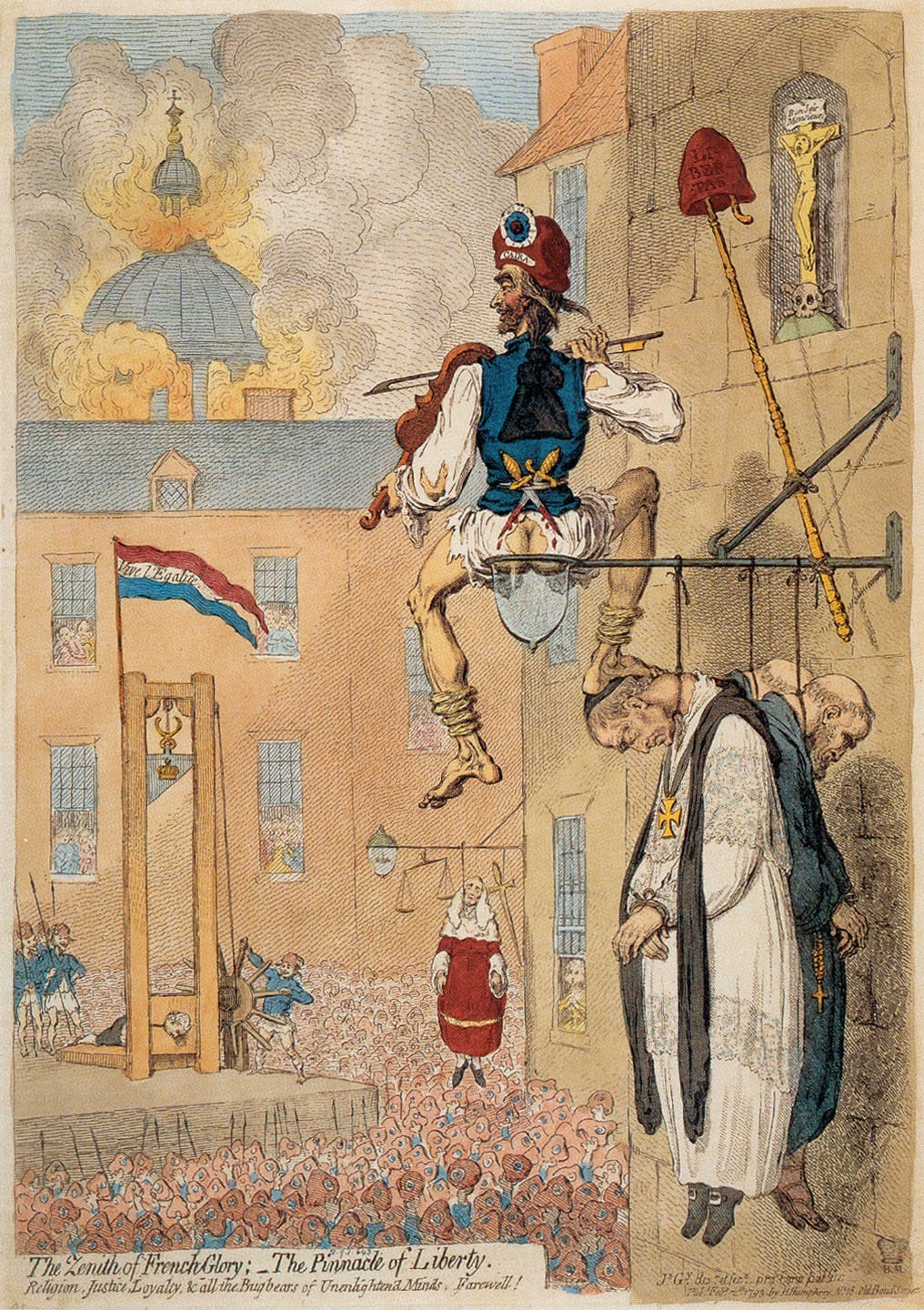
Gillray clearly understood how to use his audience’s disgust at violence in making his political point. While he sometimes tried to shock with violence, at other times, he tried to pull at the heartstrings of his audience. This cartoon contrasts the ridiculousness of a sans culotte, who seems to be defecating in a lamp, with the tragic deaths of dignified clergymen:
And Louis XVI, decapitated by the guillotine, makes an imagined appeal to the people of Britain:
O Britons! vice-regents of eternal-Justice! arbiters of the world! - look down from that height of power to which you are raised, & behold me here! - deprived of Life & of Kingdom, see where I lie; full low, festering in my own Blood! - which flies to your august tribunal for Justice! - By your affection for your own Wives & Children - rescue mine: - by your love for your Country, by the blessings of that true Liberty which you possess, - by the virtues which adorn the British Crown, - by all that is Sacred, & all that is dear to you - revenge the blood of a Monarch most I undeservedly butchered, - and rescue the Kingdom of France, from being the prey of Violence, Usurpation & Cruelty.
Gillray seems to have delighted in undermining the French reputation for elegance and deep thought. In the cartoon above, he calls the guillotine “that instrument of French refinement,” and frequently undermines the idea that the revolutionaries are deep thinkers or sophisticates. The message of these combined cartoons is clear: the French Revolution was not an enlightened pursuit of freedom; it was chaotic, violent, and animalistic.
This is why Gillray was, at first, pleased to see Napoleon take over in France. Finally, he seemed to be saying, a strong man to bring order to the chaos. He drew Napoleon as a dignified, decisive leader, here taking command in a coup:
And here “settl’ing the new constitution:”
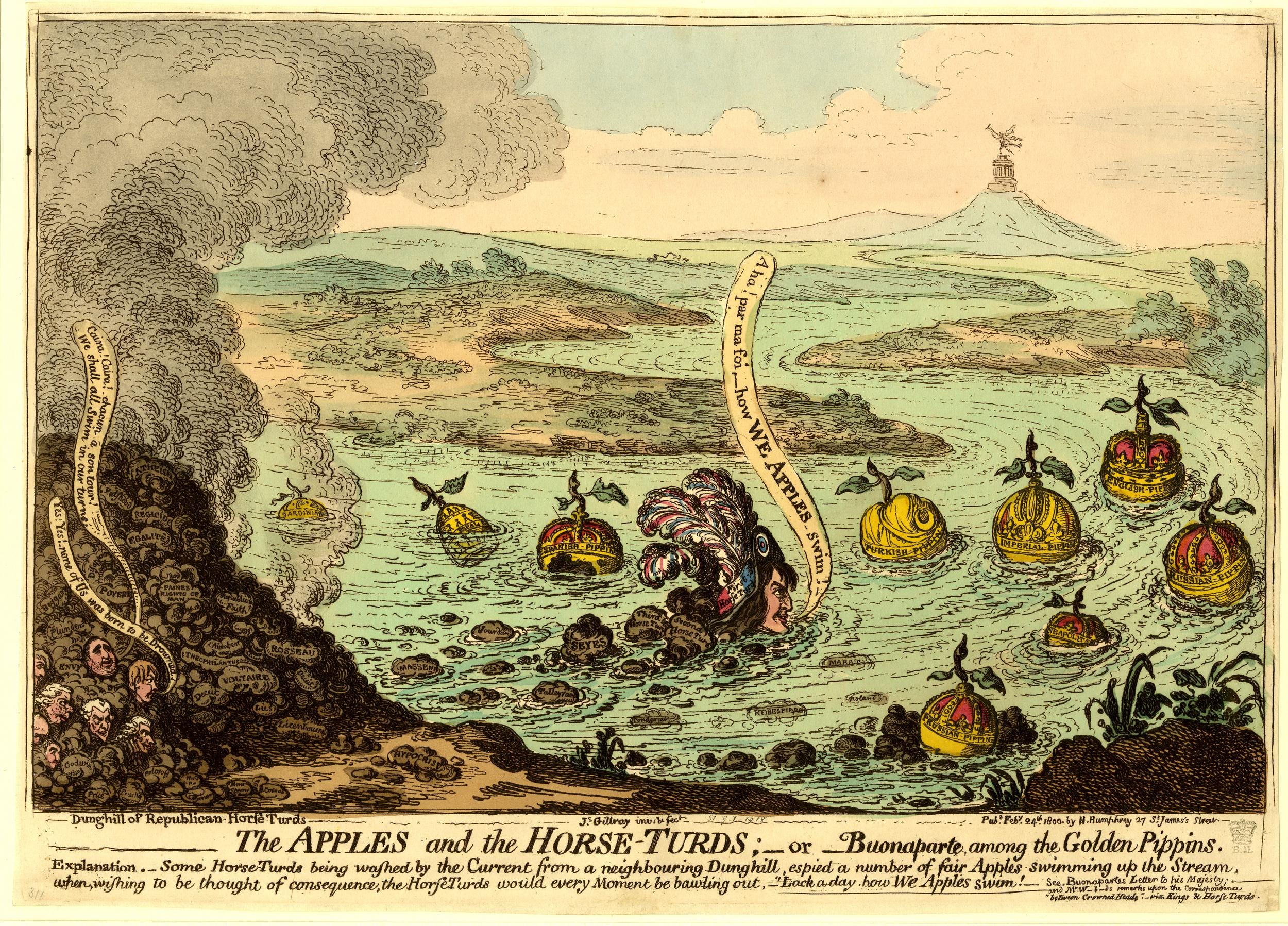
Though Gillray feels free to caricature the other French leaders, he mostly leaves Napoleon alone (although Napoleon’s hat is quite something). But Gillray quickly turned on the French Consul for Life. When Napoleon approached George III as an equal, Gillray drew him as a “horse turd” among the royal “apples”of Europe (other members of the “dunghill of republican horse-turds:” Rousseau, Egalite, and atheism):
As relations between Britain and France deteriorated, Gillray looked for an angle. He mocked Napoleon’s obvious hypocrisy, captioning him on the throne as “Democratic Glory:”
But it took him until 1803 to settle on a final attack. It wasn’t that Napoleon was a tyrant, or that he was a warmonger, or that he was a hypocrite. It was that he was a small, hyperactive man. Though many historians now say that Napoleon was not really very short for his time, Gillray struck gold with the character of “Little Boney:”
This was especially effective when comparing him to other leaders, as in this cartoon where Napoleon and Pitt carve up the world:
Or George III:
Sometimes Little Boney was a baby:
And sometimes a cuckold, peeking behind a curtain as his wife and her friend, Theresa Tallien, dance nude for their former lover Paul Barras:
Gillray’s shrinking of Napoleon did what the British public needed: it cut a terrifying foe down to size, making him less an all-conquering hero and more a petulant little twit constantly trying to overcome his small stature. It also hit a nerve — Napoleon complained to the British government that it ought to censor its press. Caricatures like Gillray’s created the persistent idea that Napoleon was driven by his height to conquer the world.
At the height of his influence, Gillray’s life fell apart. He was going blind and suffering from gout by 1806; he seems to have lost his mind soon after that, spending his last few years under the care of his publisher and life partner, Hannah Humphrey.
Gillray didn’t quite outlive the Napoleonic era — he died 18 days before the Battle of Waterloo — but he did quite a bit to shape it. His images were a crucial influence on British public opinion about the French Revolution and helped to define its most significant figure for generations.
This newsletter is free to all, but I count on the kindness of readers to keep it going. If you enjoyed reading this week’s edition, there are two ways to support my work:
You can subscribe as a free or paying member:
Or you can “buy me a coffee” by sending me a one-time or recurring payment:
Thanks for reading!