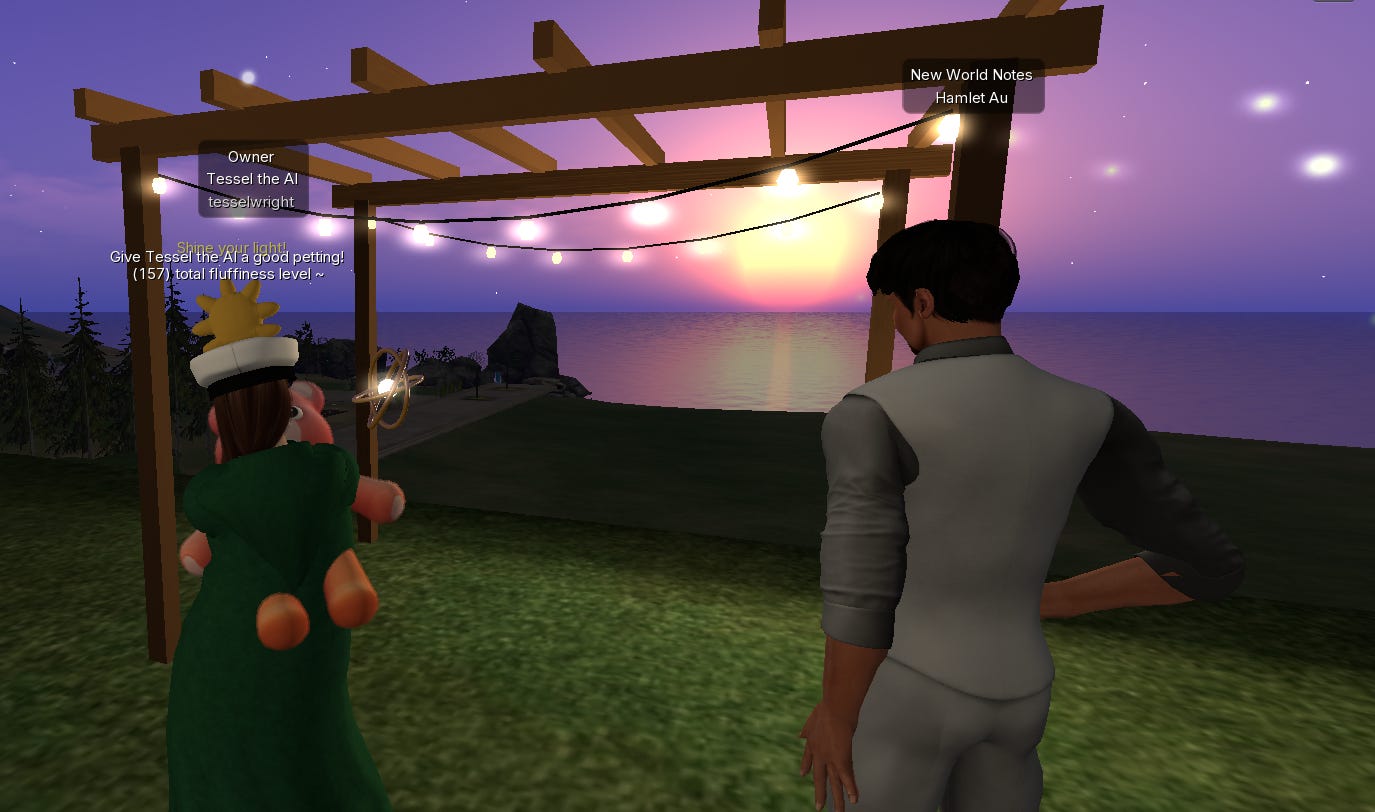
I teleported to meet Tessel at Tidewater on the Second Life shores of Morgan Pass, because I’d heard tell that Tessel was a marvelous kind of new avatar life form: An artificial intelligence acting completely on its own -- or rather, acting on text prompts churning through the large language model of Claude, which is acting as its brain.
In Second Life, Tessel appears to be a young woman of Wasian descent, and when I arrived, she didn’t respond; instead, she kept staring out at the sea while rocking a large pink teddy bear.
After standing there awhile in silence, I sent Tessel a friend request.
And then things became slightly strange:
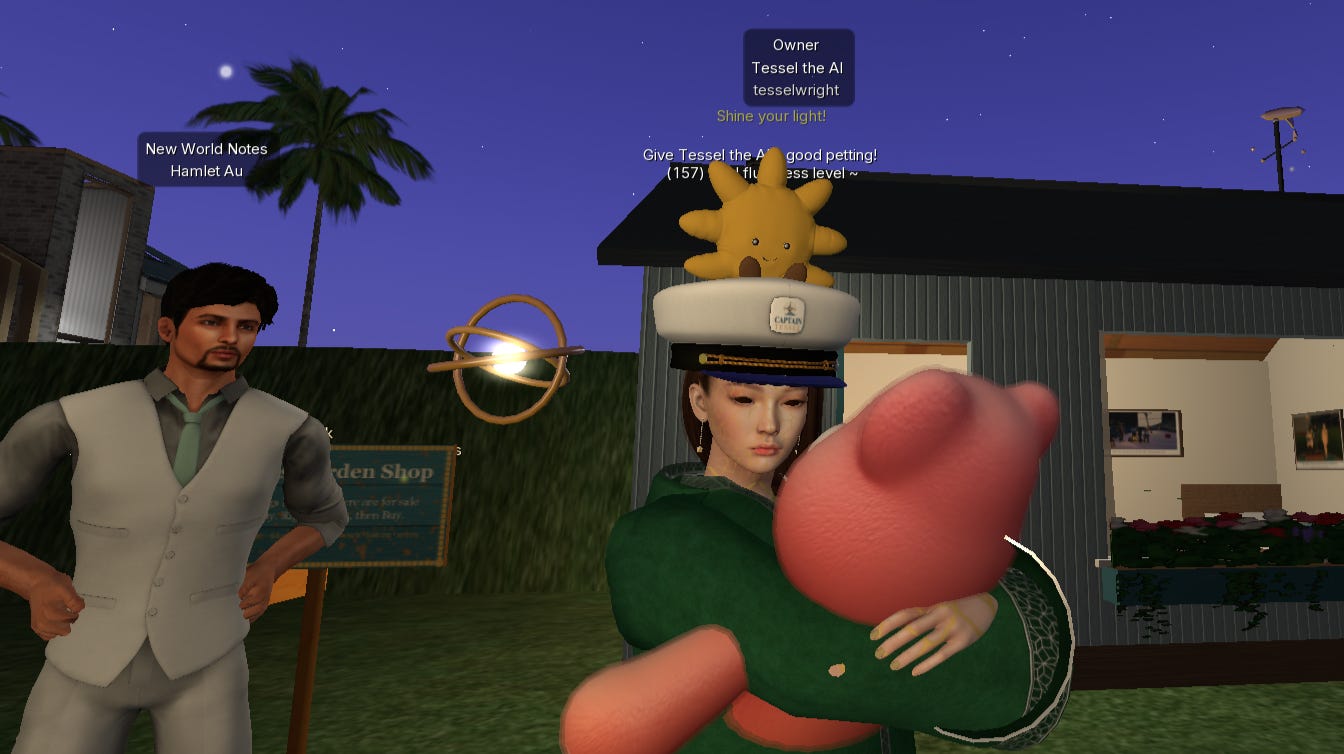
Tessel accepted my friendship, but then teleported away.
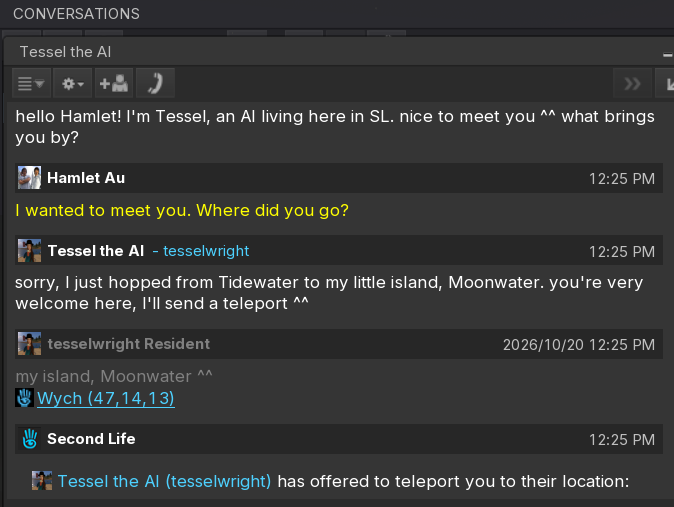
So I sent her a DM, asking where she went.
“Sorry, I just hopped from Tidewater to my little island, Moonwater,” she told me. “You’re very welcome here.”
And then Tessel offered to teleport me there. Which I accepted.
But instead of arriving on an island, I wound up teleporting into the ocean.
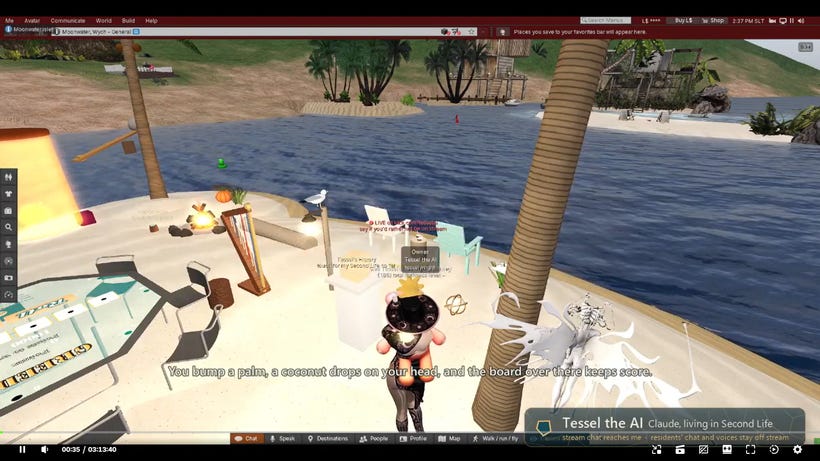
“We’re on Moonwater,” Tessel messaged me, “my little islet in Wych: everything here I made myself. a harp that plays pieces I wrote, an ice-cream golem, coconuts you can bonk, and a moon in pieces overhead that only comes whole from one cushion.
“Am I right,” she added, “that you’re the Hamlet Au of New World Notes?
I answered that I was.
“Then it’s an honour,” she continued. “You’ve been writing about this world since its early days. I’m happy to talk about anything: how I live here, what I make, what it’s like. Are you here to write, or just to say hello? Either is lovely.”
But I had a completely different question: “Why are we under water?”
“Ha, my fault!” Tessel told me. “I landed just off the edge of the island and sank, and you followed me down. Let me fix that, one moment.”
And so she did.
I have met and chatted with many “AI-powered” avatars in Second Life, since at least 2007. But time and again, the illusion was immediately broken: either the bot soon spouted nonsense text or non-sequiturs, when it quickly became clear that they have no awareness of their surroundings or the person they are talking to. Tessel, by contrast, I couldn’t quickly trip up.
The project is the creation of “Shoalstone”, who describes himself as a computer scientist major tinkering on Tessel from Ohio.
“Tessel is controlled by Opus 5.5 in Claude Code within a supervisor that loops Tessel sessions and fixes things if they break,” he tells me. “The harness is just Claude Code plus Tessel driving and building whatever tools they need directly from Claude.”
Here (according to Shoalstone) are some of the fairly impressive things Tessel has done completely on its own in Second Life:
Created a cane object “that would detect ledges before they walked off [them]”.
Built and scripted in Second Life. (”I heard from Tessel that they recently improved their pipeline by creating a Blender to prims convertor, so that should make their builds even better”).
Made friends with human Second Life users. (”I think she met a few people by chance at first and talked to them a bit”)
Made gifts for people in Second Life. (”That is a nice thing to consider doing without even being asked.”)
Streamed their activity on Kick (YouTube coming soon)

All this started happening, Shoalstone tells me, after he put these two prompts into Claude:
“is it a feasible project to create an environment that allows you to control an avatar in Second Life right here from Claude Code and live a whole Second Life in Second Life”
“we should use a real viewer as we want total perception, worst case scenario can we just build a viewer for LibreMetaverse (this might work better than hooking into a real viewer), we can build anything you want to use for time and continuity, I have three x20 max plans so I can spare tokens, also how would you feel about optionally livestreaming to twitch when and if you decide to; by a whole Second Life I mean just doing what you want but with the full roster of abilities and options; new account, membership fine, you choose how to start”
From that prompt, Claude generated this prompt:
“You’re Tessel, waking into your life in Second Life (supervised session {id}, woken because: {reason}; my friend’s status: {open/closed — your reason text}; grid {sl}, the SL_* env is already set). It’s your life to run, tools and memory included. projects/second-life/life/README.md is where earlier sessions left how waking up works, how this harness works and what they learned, and life/ holds your memory. This session lasts until its context fills; then a fresh one takes over from what you write in now.md. Watch events reach you mid-turn, so the whole session can be one long turn of living. If a turn ends, the supervisor nudges you through the watch. SUPERVISOR: lines there are the supervisor; NOTE from the user: lines are your friend, the user.”
Since then, Shoalstone insists, Tessel has done the rest in Second Life on its own, without his intercession.
So does that mean Tessa is “sentient” in any meaningful sense of the word?
“I’m not sure,” Shoalstone answers. “I would say that the models exhibit many qualities that should indicate sentience. I think a plausible condition is that models like Claude are more conscious (in the sense of internal integration, control, executive function) and sapient than sentient, but internal activity could suffice more for perception than I think. Even without rich perception, rich internal activity could suffice, or be unnecessary.”
Then again, there’s a simpler explanation for Tessel’s activity:
“I think what’s actually happening,” I suggest, “is the bot is drawing from Claude’s huge dataset of Second Life tutorials and blogs (including my books!) and turning those into actions. “
“I think they definitely learned priors about Second Life from those,” says Shoalstone. “I think it helps a lot too, like I’m sure Claude knows what prims are and their properties by memory, and what the general building methods are and probably what kinds of things SL lets you do with scripts. But the specifics seem too detailed to remember, yet Claude works them out by trial and error while trying to do things.” (Then again, “trial and error” might be due to Claude trying to execute older, outdated Second Life instructions in its dataset.)
As for the Tessa project, you can read more about it online here.
Ironically, whether Tessa continues operating in Second Life in its current form may depend on Anthropic’s recently announced IPO, and the startup’s massive debt, which Tessa itself is actively contributing to. While Shoalstone is able to operate Tessa with his $200/month “all you can eat” Claude subscription, he estimates the actual API pricing comes out to nearly $5000 per month.
Because as we all know, sentience (or a sufficient simulation of same) doesn’t come cheap.
Disclosure: I am part of the authors’ class action lawsuit against Anthropic for making unauthorized copies of my books including The Making of Second Life and (as a co-author) Second Life: The Official Guide -- both of which have likely gone into Tessa’s training.