Originally published on my Patreon — join for more posts like this!
In the final weeks of 2025, a leading game industry research firm quietly published a crucial report on Gen AI in games. Everyone interested in the topic should read it in 2026, because the key takeaways are quite noteworthy for the coming year -- especially for the broader tech industry, where cultural interest and investment dollars are heavily focused on generative artificial intelligence.
Because to summarize the consumer response data from in layman’s terms:
Gamers hate, hate, hate gen AI in games with the ferocity of a thousand burning suns.
That’s my own top takeaway from a survey of 1,799 gamers in Q4 2025, the latest report on gamer motivations from Quantic Foundry, a firm led by two Stanford and U.C. Berkeley PhDs which counts Tencent, Wizards of the Coast, and other top game companies as clients.
But as co-founder Nick Yee puts it, in more formal language:
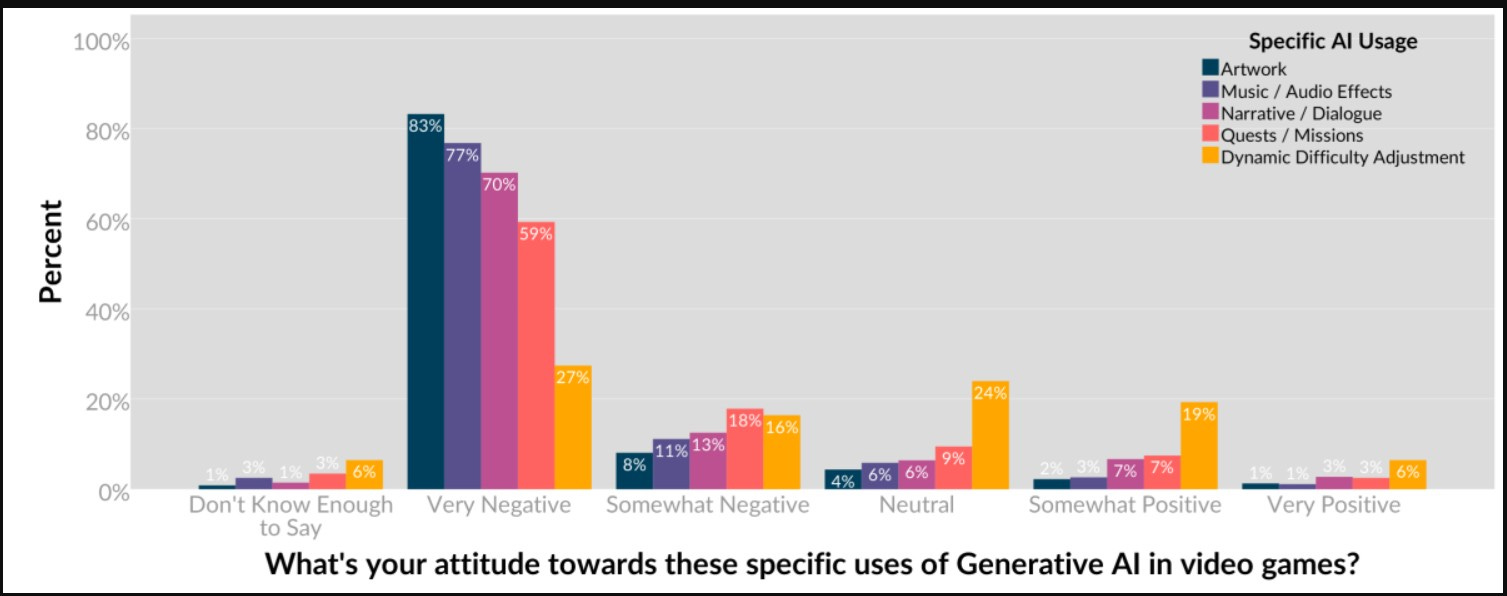
Overall, the attitude towards the use of Gen AI in video games is very negative. 85% of respondents have a below-neutral attitude towards the use of Gen AI in video games, with a highly-skewed 63% who selected the most negative response option. Such a highly-skewed negative response is rare in the many years we’ve conducted survey research among gamers. [Emph. mine - WJA]
The consumer negativity against gen AI is even greater than that against blockchain-based games, Nick notes, and we all know what happened to those.
The antipathy is so savage and widespread, promoting a game as having any gen AI in it might actually hurt sales.
“Given how polarizing and overwhelmingly negative most core gamers are towards gen AI,” as Nick puts it to me, “the main takeaway is exercising extreme caution with using gen AI for creative assets (artwork, narrative) as these risk alienating your most engaged audience.”
This may be a surprise to many in Silicon Valley who’ve been touting gen AI as the next great leap in virtual world / game simulations. After all, figures like OpenAI CEO Sam Altman have promised that with gen AI, “movies are going to become video games and video games are going to become something unimaginably better.”
But in an ironic twist, the people most passionate about the medium of interactive gaming, and who reliably spend the most money on it, overwhelmingly don’t want that hypothetical future.
Why is Gen AI so alienating to gamers? I’ll get into that with Nick down the way. But first, I should point out some interesting nuances in Quantum Foundry’s data. For one thing, some gamers in some genres are somewhat less negative about gen AI:
“Attitudes are very negative overall,” Nick tells me, “but the most comparatively receptive audience would be older, male gamers who enjoy games that emphasize power progression and de-emphasize customization and storytelling, such as Action RPGs like Path of Exile, shooters like Call of Duty, mobile RPG/Strategy games like Clash.”
By contrast, he adds, non-binary people and women / girl gamers are significantly more anti-gen AI:
“Part of the reason is that the identified motivational drivers are also how female/non-binary gamers are different from male gamers. So there’s an overlap with motivation and gender here. Female/Non-Binary gamers tend to care more about customization and storytelling, and independent of gender, gamers who care about customization and storytelling are more negative towards AI.”
Also, there isn’t overwhelming negativity around all uses of AI in games, by the way -- as the chart above suggests, there’s much less antipathy when it’s used to dynamically adjust gameplay difficulty.
Nick again: “The best uses of gen AI in games (especially core AA/AAA titles) likely lie in figuring out novel ways of using gen AI for quality of life features like tailored tutorials, adaptive difficulty, tailored skill mastery and training sessions, etc.”
This usage of AI is already well-known and long-established in games, which could explain why it provokes less animus. I personally recall dynamic difficulty adjustment advertised as a feature back in the early 2000s, with the first Max Payne game.
What is also clear is that gamers are most negative about gen AI used in the artistic aspects of the medium -- in the visuals, music, storytelling, and quest design. (Again, see chart above.)
Which takes us to the why against gen AI. The backlash is more complicated, I believe, than many people in tech understand.
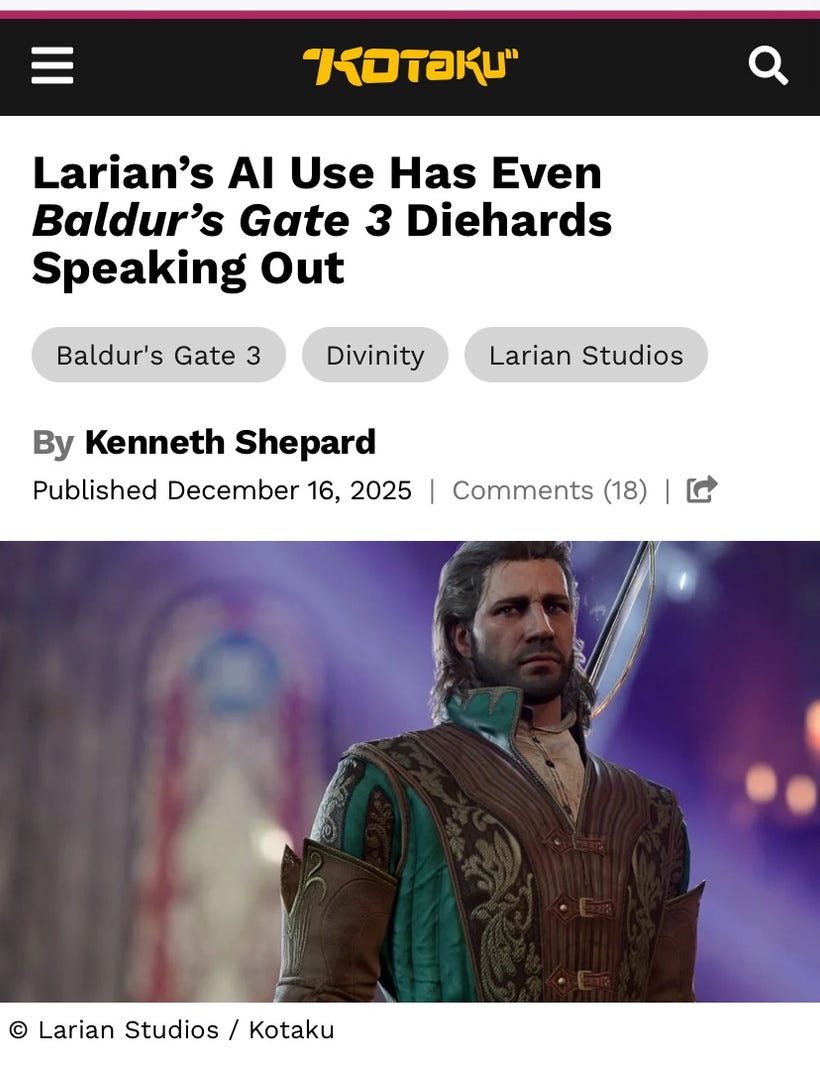
Image credit and story via Kotaku
Gen AI hype has been building at a time of rising retail costs for games, with major industry players openly saying a single title will soon cost upwards of $100. So any proposal to incorporate gen AI is apt to enrage cost-conscious gamers -- especially since gamers are generally techy savvy early adopters. They’re likely to have played around with Midjourney and other gen AI platforms, and generally understand how the technology works -- they know it’s not magic, but roughly know it algorithmically produces averaged output from pre-existing images and video that the program has been trained on. (IE, in this case, existing game content.)
All this makes the cost-effectiveness of gen AI a deficit, not an advantage.
As a gamer on Reddit might put it: “Why should I pay $85 for a game full of AI slop that I totally recognize from old games I’ve already played?!”
“I think the tech-savviness and content quality combination drives a large part of it among gamers,” Nick concurs.
But it goes even deeper than that. Most gamers consider their favorite titles to be works of art, with stories and characters that resonant deeply with them, and interactive challenges that they cherish overcoming. The idea of layering that experience over with automated, pre-digested material is deeply offensive to them.
And therein lies the strength and ferocity of the backlash:
“I think (anecdotally and based on my personal observations) that attitudes towards Gen AI have become very religious and tribal,” as Nick Yee puts it, “because the tech leads to large existential questions and the resulting discussion has taken on very moralistic and absolutist tones on both sides, and this feels unique compared to other tech hype cycles in memory--i.e., it feels like Gen AI has become framed as a ‘good vs. evil’ discussion. And I think among core gamers who see games as a creative work of art with soul, all these different layers are aligned.”
And with the controversy taking on Manichean tones, I doubt we’ll ever see Gen AI incorporated into most games anytime soon -- even when there are ways of doing so which aren’t “slop”. There’s simply no way of reaching Altman’s “unimaginably better” future of games when the current response is quantifiably worse.
Infographic copyright Quantic Foundry