Terence Tao recently did a very good talk at ICM about how AI, in particular LLMs, is changing the field of mathematics. I strongly recommend reading it before reading this post (or even, just reading it and skipping this post, I won’t mind)
Mathematics in the age of AI – Public lecture, International Congress of Mathematicians 2026
In it, he makes a key observation about the alignment of different goals1:
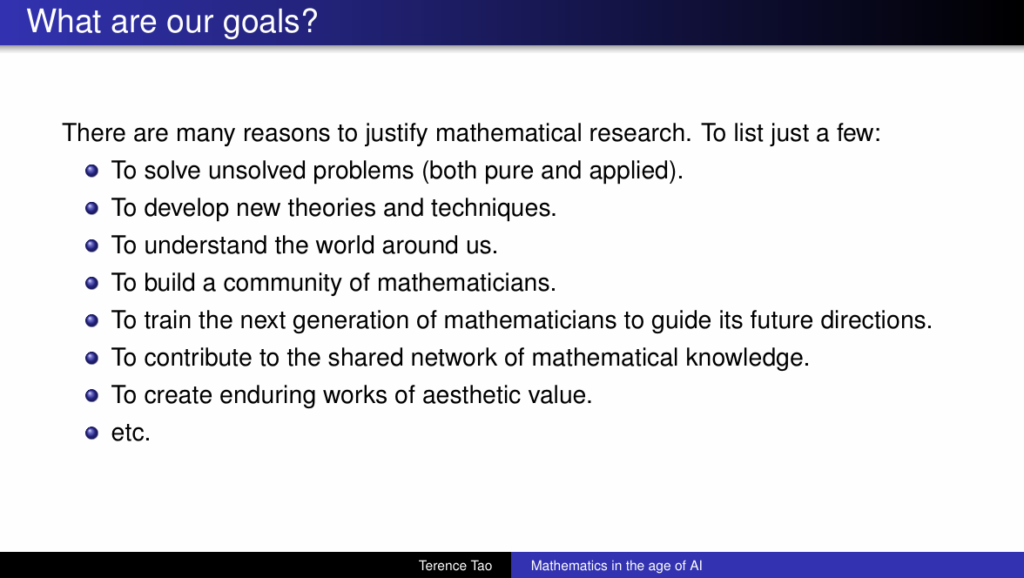
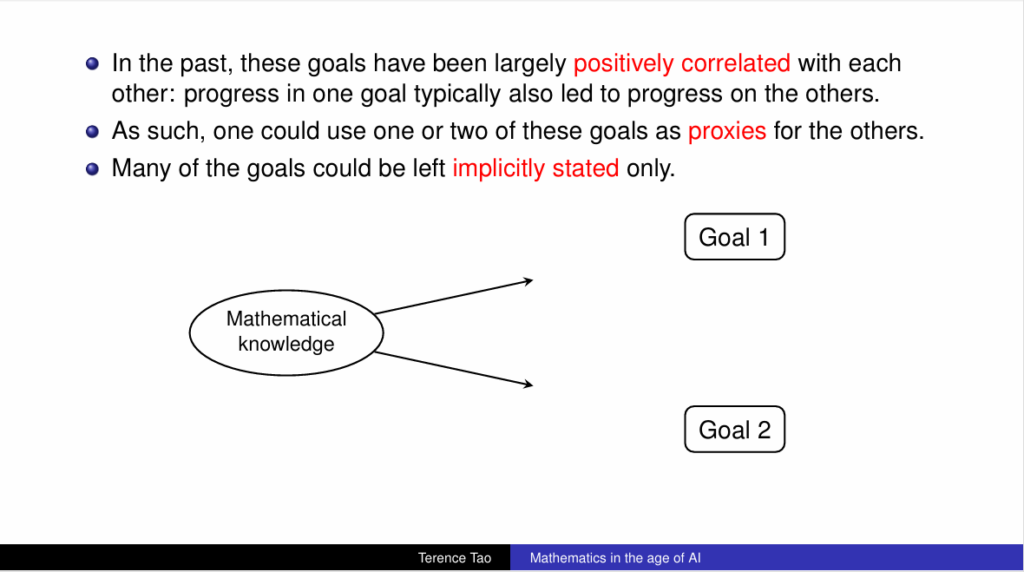
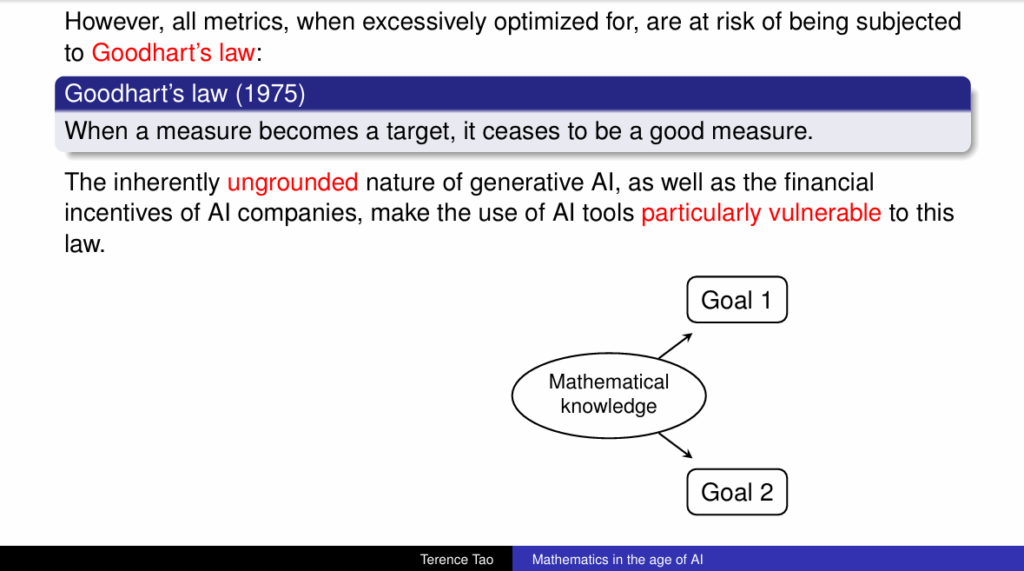
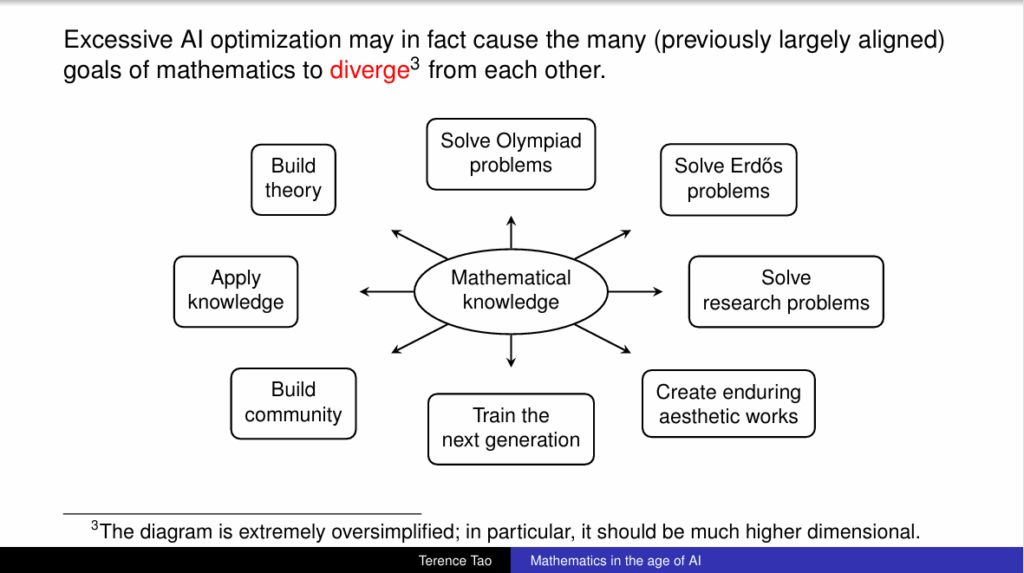
What’s notable about this observation is it trivially generalises. I want to apply it, as best I can, to something I’ve been working on and writing about for a while and might make what I mean easier to digest.
The economy is itself an optimization engine with many moving parts. Usually its goals are aligned with what we want, and when it is or isn’t is one of the longest running debates of all time. We use regulation and taxes and subsidies and benefits and tariffs and many other things to try and align it more with what we want, debating over both how well that works and what our “wants” even are.
I’m not here to really bring up one of those smaller debates, they are already going on and I’m no expert on any of them. What I want to do is open up a new one that I think has mostly been missed. I’m no expert in this one either, but I don’t like the fact that I seem to be the only person asking this question. Anyways, enough pontificating, I’ll try and express it in a way analogous to what Tao was getting at.
Wages have two2 main functions, goals, in the economy.
- Moderate the supply of labor.
- Provide the foundation for consumptive demand.
By the first I mean: put people into roles the economy needs, encourage them to pursue valuable careers, pick the right degree, retrain if they become displaced, travel to where the work is in the country. This is currently a natural component of our economic optimization machine, it need not be pursued actively.
By the second I mean: almost all consumption is funded by wages. The obvious component is that if you are healthy, of working age, and engaging in society honestly, the money you spend comes from your wage. The less obvious component is that most government transfers, benefits, welfare, also comes from wages. Pensions are paid from a pool of collected wages. Income taxes tax peoples wages (perhaps not your own, but still, wages). VAT or sales tax is a consumption tax, but consumption is mostly paid by wages, so again, the tax is funded in large part by wages.3 This goal is currently almost entirely coincidentally met by its alignment with the first goal.
What AI possibly may do (and an even stronger claim, what automation has already been doing for a few decades) is decorrelating these two goals. It is pursuing one whilst letting the other wither. The first is our target, optimize the efficient use of labor so work that needs to be done is done by the best people. The second is our measure, do you have enough worth to enjoy the output of the economy. When they are linked through the wage, Goodhart’s Law applies.
In some sense, we chose this state of affairs. Consuming from the economy is considered a privilege, and to justify your right to do it you need to prove yourself. Providing your labor has sufficed as that proof for a significant amount of human history. Is that still true, and will it remain true?
To examine this, like Tao, I set up a working hypothesis:
AI tools will, reasonably soon, become capable of performing a reasonable fraction
of economically significant cognitive tasks, with reasonable levels of success, quality, supervision, and cost.
The only part I have changed from his working hypothesis is “research-level mathematical tasks” to “economically significant cognitive tasks”. I am under no illusion that it is equivalent to his hypothesis. Mathematics has had both an exceptional set of evidenced AI impacts, in excess of other areas, and it can be argued that the nature of mathematical thought is somehow different from the types of cognitive tasks the economy needs done. However, again like Tao, I will ask you to assume that the Working Hypothesis holds.
What does this then mean? If we would like the second goal to be fulfilled fairly, we must modify our societies, cultures, and policies to pursue it. What is “fair” may seem like quite a hard thing to pin down, like it is the very thing we have been arguing about forever. That existing debate is not the one I am trying to surface. The thing is, currently there is almost no distribution of the sort I describe. You might say “but unemployment benefits, social welfare, pensions, free healthcare, free education, are they not already making things fairer?” and the answer is no, not in the way I mean, not if those benefits are funded by taxes that are themselves coming from wages. This isn’t about one person versus another, it is all humans versus technology (and to be clear, I love technology, it’s just if the economy could run on just machines, it would, and humans would neither work in it nor consume from it. That seems like an odd state of affairs to have as our default outcome)
It feels exceedingly silly to be playing this existential game against technology whilst believing we can win. We assume that technology won’t continue to progress faster than, well, evolution. To turn the original understanding on its head, the game is currently too fair. We are largely playing on an even playing field against technology4, and yet we can tip the scales in our favor if we want, and I think that we probably need to sooner or later, or we will just lose.
I won’t outline in full my ideas for how to solve this, mainly as I have done so elsewhere on this blog, perhaps the best version is here. However, one thing that can be inferred from what we’ve discussed, a tax on its own is not enough, and a benefit is not enough either. A tax does nothing if it does not fund (human) consumption in some way. A benefit does nothing if its value is collected from wages by proxy. One needs to construct both, linked to one another in the same way wages are now, but crucially unlinked from a person’s capacity to prove their ability over a machine.5
Footnotes:
- He also makes a fair case that one should always disclose AI use in your work. I did not use any AI when writing this piece, but the one I link to as the deeper dive is written in large part by Fable 5. ↩︎
- Arguably there are other goals or ways to specify them. In the piece I link to at the end of this one, I also raise the fact that jobs (and by extension wages) function to structure the day, to provide community and purpose. This is obviously a very important function, and further changes will be needed to facilitate it. However, I don’t raise it here because I have a suspicion that work (what we might call the second space within third space theory) has, due to the problem I outline here, absorbed the third space through economic pressure (you can’t be part of your local club if you must work). Which then leads me to wonder if resolving this issue might see the return of third spaces, and therefore a recovery of community and purpose. ↩︎
- There’s an interesting circularity here already. A government transfer funded by VAT and paid out to someone who spends it on consumption is entirely circular. It can easily be self sustaining, i.e one dollar of consumption, to one dollar of welfare, to one dollar of consumption with no losses. Then the person would be able to consume from the economy without providing any of their labor supply (In a fully automated economy, this is fine from an economics perspective, and indeed it is the only way that such an economy can have any non owners consuming from it). This “loop” is not currently a significant presence in the economy though. It’s hard to calculate precisely because of its nature as a loop, but it isn’t hard to estimate as being “quite small”. ↩︎
- I know this seems weird, how can you play a game against an inanimate concept, especially one that could never desire anything? Logically, without people there would be no technology anyways. Here I actually can make a refinement I’ve avoided because it’s inflammatory and I think people will assume the wrong conclusion from it, so I keep it here in the footnotes: Humans are in fact playing the game against other humans, those other humans being those that own the sources of economic rents, such as owners of land or other scarce resources that the economy itself cannot produce (and therefore, is not a form of value creating ownership). To clarify, if you think this means I am against the concept of ownership generally, I am not. Ownership comes in multiple forms, and there is no good well known term for “ownership of things who’s acquisition wasn’t value creating”, nor is there really an easy way of measuring that. Luckily for us, we don’t actually need to measure it to deal with it, so long as we use the right economic tools. Framing it as “vs technology” can still be accurate. A big part of “non value creating” essentially means without effort, and arguably that also means without thought. If I am an investor and I spend a lot of time analyzing a company before buying shares of it, there is an argument that that is value creating ownership. I am contributing my expertise and mental effort into the economic signals carried by the share price. If I just buy the global index, arguably I contribute nothing. The only “humans” we are against, in this framing, are not individuals, but the technology that serves them thoughtlessly. That is why I think framing it as “vs technology” is correct. ↩︎
- Again, that’s to say I don’t want to weigh in here on how we should judge one person over another. That mechanism is served already, it’s the “great debate” we already have all the time. One person over another is moderated by taxing wage linked things and using those proceeds that ultimately end up in people’s pockets. Work projects, paying teachers, good old fashioned subsidies, those are all in that same bucket. Even taxing profits or capital can fall into this bucket too, because you are taxing an investors drive to find good deals, or a founder from innovating. Again, one person vs another in terms of their “ability”. This is why this debate is poisonous. We look around and see the state of the world, see problems, and think we need to solve them by finding someone to take from, finding the person who isn’t contributing their fair share. And yet, we all are competing against technology (in a sense, see footnote 3) and right now we have so little redistribution from technology to us. I wish I had more concrete numbers here, to show just how small a share of government tax->spend is from technology to us (as opposed to us->us, the majority case), I’m trying to work on that part, but it’s hard due to the nature of the problem. Probably I need a DSGE. Ok now I’m rambling, thanks for reading though. EDIT: I didn’t need a DSGE. Check it out: Working on Economics with Fable 5 – Wilsons Blog ↩︎