
(This piece is a few days late due to a medical issue, which also means I will be home for an undetermined amount of time, at least until the new year — if I need to hunker down for longer I will have to rethink the direction of this newsletter for the upcoming year.)
The US is the most successful country in human history, as measured by the current in vogue metric of excellence, which is how much stuff (food, housing, cars, toys, etc) everyone has.
This wealth isn’t confined to only the top percent, today’s middle class and working class live lives that past nobility would be astounded by. To quote myself, when a Greyhound bus dropped me in the rather modest town of Michigan City Indiana,
It is easy to forget how astonishing modern life is … at the earthly level. A three-thousand-square-foot home, with central heat and AC, a two-car garage, and a two-acre estate complete with a swimming pool, with weekly festivals, is the life of a past baron or lord, now available, in some form, to most Americans.
While Franklin Street in Michigan City is far less idyllic than Westchester suburbia, it would also be a magical place to anybody from the nineteenth century, from baron to lord to servant. It is a safe, well maintained place of immense wealth, convenience, opportunity, excitement, with endless diversions. Everyone can now “keep a carriage,” a past symbol of gentility, which drives them from one market to the next, from one fair to the next, including the twelve-floor casino at the end of the street, and access to all sorts of wines, liquors, and ales, from all over the globe. No matter where you live, there are endless diversions you can reach in a few hours by car, accessible to almost every American, that would make Vauxhall Gardens look humdrum by comparison. Such magnificence!
Even the destitute, who I spend the majority of my time in the US with, are satiated enough that anyone who works with the homeless knows the primary issue is rarely a lack of food, or clothes, and it is far more common to meet the stubbornly picky rather than hungry. The man living in a tent, who will turn down a free sandwich, because “I prefer toasted sesame rolls”, or the couple living on the streets, who when I was taking them to get McDonald’s, pointed out, “There’s a nice sushi place we really like down the street, what about that?” or the constant vanity with appearance, “I only wear Jordans, you got any of them?”
Beggars can be choosers, and they are in the US, and while I have few problems with that, because vanity and dignity don’t die with destitution, it is another indication of just how wealthy we are.
Whether our historical wealth has translated into historic happiness, fulfillment, and contentment, is a far less settled question, and one which has launched a thousand think-pieces, books, hot takes, and political fights. The various factions in this debate, some genuine, most opportunistic, are roughly aligned into the following camps:
People are wealthy and happy, and any suggestion to the contrary is because you are looking in the wrong place, at the wrong things: (Insert their favorite statistic, anecdote, or quote.)
People are indeed unhappy, but that’s not because of economic anxiety; rather they’re deluded by X (insert some political figure, or institution the speaker does not like) into bad vibes, or because they are Y (insert some atavistic failing, like ignorant, racist, etc etc etc.), or both.
We might be historically wealthy, but all the wealth is being hoarded by X (corporations, billionaires, Jews, or the trifecta of corporations run by Jewish billionaires), and so the majority of Americans are indeed suffering from economic deprivation, because of bad actors.
We are not wealthy, and all the statistics saying that we are, are simply high class lies.
And then there are the single issue guys/gals, who jump into this debate, like they do every debate, with the “Everything, including voter anger, can be solved if we fix X”, where X is nuclear power, global warming, YIMBY zoning, the Jones Act, fluoride in water, prison reform, seed oils, high-speed rail, gut health, raw milk, kitten rescue, bicycle lanes, daylight saving time, kittens in bike lanes during daylight savings time, etc etc etc.
My own contribution to this has been to say that yes there is genuine and widespread despair in the US1, but the primary reason isn’t economic2, rather it is because human fulfillment requires more than material wealth, which in our quest for more stuff, we have forgotten. People need physical communities, and while the US excels at material wealth, it’s achieved it, especially in the last forty years, at the expense of the aesthetic, communal, stable, and personal, and so the bad vibes are justified.
While I still believe that, it is oversimplified, because exactly how we structure our economy does matter, as a recent viral Substack post highlighted. That piece, My Life Is a Lie, largely fell into camp three (we are poor and unhappy), and made the audacious claim that $140,000 is the new poverty line and so the anger of any family making less than that was understandable, and economic.
Much of that post, to be blunt, is bullshit, certainly the intentionally provocative claim that any family making less than $140,000 is suffering from economic deprivation. Yet the piece went viral, because the core of its argument is correct — the less troll-ish claim that because of the ad-hoc nature of our government policies, a lot of Americans, especially those who make up what I would call the “aspirational bottom” are being squeezed. They are doing too well to qualify for assistance, but not well enough to be fully self sufficient, at least as we understand that.
To be geeky for a second, in particular there’s a region (20 to 50K or so) where a family is treading water because their take-home pay almost flat-lines, just as they reach what should be escape velocity from the social safety net, on their way to reaching the American Dream. (The graph is from a different paper: Work Disincentives)
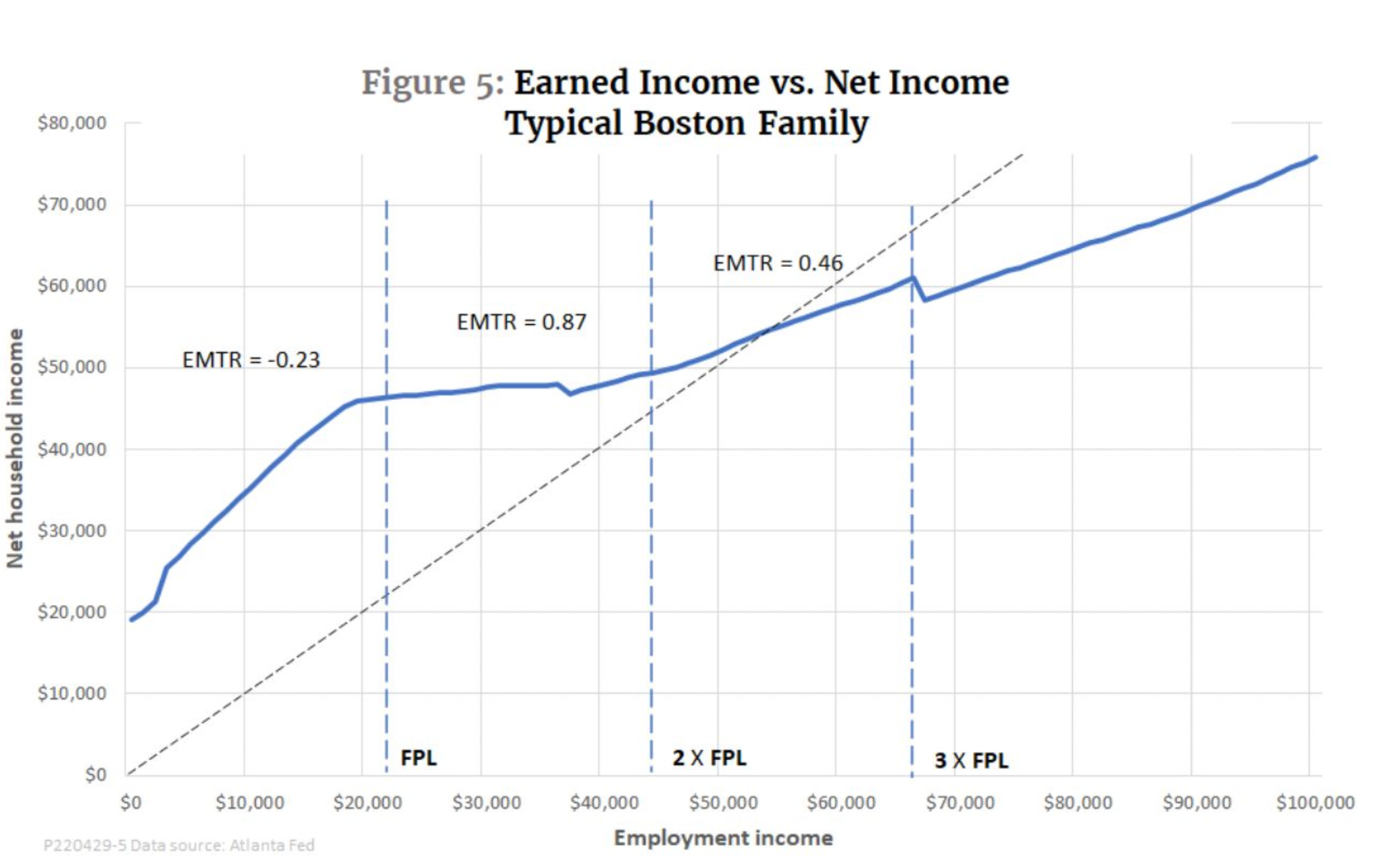
This is an important point because the dominant cultural archetype in the US is the self-made entrepreneur — someone who, through hard work, smarts, and dedication, can build that suburban lord’s life, complete with children who will do better than they did. This is the American Dream, and if there is a single idea unifying our country it is this.
Again, to reference myself, while I do believe in individual agency, I also believe societies come with strong forces that shape expectations and even shape people’s understanding of a ‘good life.’ That is, society provides citizens playbooks that they are urged to follow which are supposed to end in happily ever after, and ours is that you can become a millionaire on your own terms as long as you hustle hustle hustle — and when that doesn’t happen, it’s very lonely and humiliating, because we as a culture have put all our eggs in that one particular basket. At the expense of community, friendships, and even family.
So if you’re working your ass off and yet you keep doing about the same as the family down the street who doesn’t seem to be giving their all, then what the F, man. If we’re going to be the meritocracy we claim to be, you simply can’t do this to those near the bottom pursuing the American dream, who not surprisingly, will justly feel they’ve been sold out, deceived, and/or they themselves have failed, none of which leads to happiness.

That we do this also explains a lot of our politics: People in the aspirational bottom (or the working poor) are going to blame either the dependent poor (or the very poor) who aren’t working as hard and yet are getting government help when they are not, or the elites who already have it all, perhaps because they started life on second base, and have built this “rigged” system, which is especially galling when that top X% seem to be getting wealthy not from the hustle hustle hustle, but from grifts where they’re selling the country out.
So our inequality (large, and growing, by almost any metric compared to other wealthy countries) is more harmful, because it’s more noticeable, since the top X% are the goalpost people measure themselves against far more than in less monomaniacal careerist cultures.
We’re suffering from a culture that accentuates careerism but without the proper policy scaffolding to support that, we are not suffering from material deprivation. It’s a pedantic point, but I believe it is an important distinction because the policy solution is not more stuff, but policies that support the aspirational bottom rather than hinder it.
Or, we as a culture can decide to become less careerist, and emphasize different archetypes, including those with a more relaxed approach to life, akin to Europe. How exactly you make such a deep and fundamental change to a society is beyond me, this substack, and I believe most thinkers. Cultures do change, and their archetypes do shift, but unless you live in top-down authoritarian state like China who can play SimCulture, you can’t mandate a change as fundamental as that.
Which brings me to my last point, which is there has been a large shift in the American Dream archetype in last sixty years, which is that now both men and women are free/expected to pursue it, so a large chunk of the frustration comes from the cost of childcare. Gone is the prior division of labor of one parent (almost always the man) being in charge of building up the bank account, while the other (almost always the woman) focuses on the family. Our scaffolding is broken primarily because it’s yet to fully recognize this change.

So yes, Americans are materially wealthy and unfulfilled, and the primary problem is cultural—we’ve sacrificed community and meaning to emphasize an archetype built on acquiring as much stuff as possible, but then we have made that unnecessarily hard to do. When you give your citizens a cultural script, built on the material, that promises hard work will lead to success, and then your policy design ensures it doesn’t, people will end up both economically frustrated, as well as spiritually empty, sitting in their living room streaming the latest movie wondering what exactly is the point of life. Or, they will feel they have failed at the material, while also having little else to give them meaning.
The dismissive response by pundits to a good economy with frustrated citizens is to say, “the vibes are off”, but the vibes really really matter! Bad vibes are the people saying, I’m playing the game I’m supposed to play, yet it’s not rewarding in the way I’ve been told it would be.
So the solution isn’t more stuff, it’s policies that don’t actively punish the people trying to live out the primary cultural script we’ve given them, or we need a change in the script, and I’ve got no idea how to make that happen, or even if we should.
PS: Next week, while awaiting my next doctors visit, I’m going to try to finally walk New Jersey, a place I’ve lived near for forty years, but know very little about.
Here is my intended path. As usual, if you are in the area, reach out to me.
Until then, have a great week!