Posted by Matthias Gelbmann on 10 February 2021 in News, Content Management, WordPress
Summary:
The incredible success story of WordPress continues by reaching another milestone: 2 out of every 5 websites use it now.
When we announced five years ago that WordPress usage had reached 25%, its creator Matt Mullenweg famously answered by writing "Seventy-Five to go". I found that a quite venturous statement. After all, we currently monitor 737 other content management systems. It's not like there is a lack of choice for webmasters. There is even no shortage of other impressive success stories, where Shopify and Squarespace are just two obvious examples, but there are plenty more.
Yet, WordPress plays in a league of its own. It's not only the usage numbers, also the ecosystem around WordPress is absolutely remarkable. There are more than 58,000 plugins, more than 8,000 themes, and any number of companies and individuals that make a living from creating WordPress sites. There are also a fair number of web hosting providers specialized in WordPress hosting. One of them, of course, is Automattic, the company behind WordPress, and they are not even the biggest one. That honor goes to WP Engine.
W3Techs measurement methodology
Whenever we report our numbers on WordPress, some people challenge these numbers, and that's fair. So, what is our method of measuring usage data, and what is the motivation behind it?
For all our statistics we use the Alexa top 10 million websites, complemented by the Tranco top 1 million list. The reason why we don't count all the websites, is because there are so many domains that are unused or used for dubious purposes. We want to exclude the many millions of parked domains, spam sites and sites that simply have no real content. We are convinced that including all trash domains would make our statistics a lot less useful, as millions of them just run some software stack that auto-generates useless content.
We want to measure the "meaningful web", and the Alexa ranking is a good way to identify sites that are alive and are actually visited by people. We even go a step further and also exclude sites within the top 10m that we consider to be useless. We do this by identifying and excluding sites that just say "this domain is for sale", or sites that only have some default content, that is not even meant to be seen by ordinary visitors. There are many examples, and we invest a lot of effort to identify them. We exclude, for instance, sites that just say
- It works! This is the default web page for this server. The web server software is running but no content has been added, yet. [default Apache page]
- Domain Default Page. This page is generated by Plesk, the leading hosting automation software. You see this page because there is no Web site at this address. [default Plesk page]
- Default Web Site Page. The site may have moved to a different server. [default cPanel page]
- Account Suspended. Contact your hosting provider for more information.
- Site Currently Unavailable. If you are the owner, contact your hosting provider for more information.
- This domain is expired. If you're the owner, you can renew it.
- Hello world! Welcome to WordPress. This is your first post. Edit or delete it, then start writing! [default WordPress page] - yes, we also exclude empty WordPress sites.
There are actually more than 5% of the top 10m sites that are excluded by these means.
On the other hand, when we crawl the web and see some technology being used on a subdomain, we count it to be used by the domain, as described here. For example, WordPress is used by microsoft.com. That doesn't mean that the whole microsoft.com site only runs on WordPress, and we actually specify "used on a subdomain" in our description. WordPress is used on cloudblogs.microsoft.com, in case you are wondering. That's why we say "40% of the web uses WordPress" instead of "40% of the web runs on WordPress".
Does this not vastly inflate our numbers? In fact, no. The reason for that is, that sites such as microsoft.com operate subdomains like cloudblogs, but your next door restaurant website does not. Even if they have a blog subdomain, they would typically avoid using more than one CMS to run their website. We see that 99.1% of the websites that use WordPress use it also on their home page. Only 0.5% use WordPress on inner pages only, and 0.4% use it on subdomains only, where we don't count www as a subdomain in this context. Other CMSs, for example pure forum platforms, have a different distribution, but WordPress has long outgrown its former reputation as pure blogging engine.
Who uses WordPress?
Roughly every two minutes, another top 10m site starts using WordPress. The growth rate in the last ten years is pretty constant.
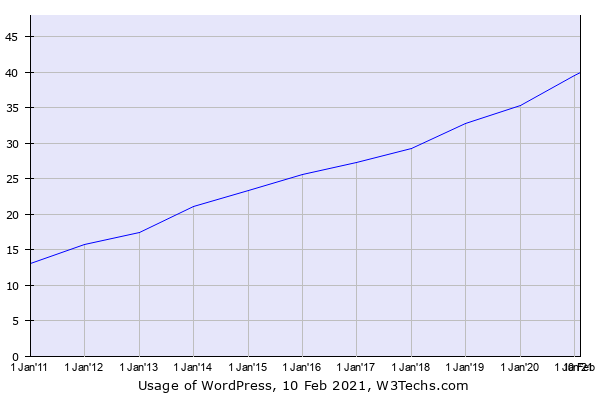
Its CMS market share of 64.3% has never been higher. The market share among new sites is even slightly higher at 66.2%. If we just count the top 1000 sites, the WordPress market share is lower, but still a formidable 51.8%.
The .blog top level domain has the highest WordPress market share at 92.2%. Who said that WordPress has left behind its blogging engine past? The .news domain is not much lower at 87.1%. The countries with the highest WordPress usage are South Africa, Iran, Israel and Spain. Countries with lower numbers are China, South Korea and Russia. The top level domain with the lowest WordPress usage is .mil, where DotNetNuke dominates. I hope the US military is not only attracted by the Nuke part of this particular system.
Congratulations to all WordPress contributors. Well done, and sixty to go, as some would say.
_________________
Please note, that all trends and figures mentioned in that article are valid at the time of writing. Our surveys are updated frequently, and these trends and figures are likely to change over time.