
Recently, I’ve been teaching a class of final-year university students, many of whom are increasingly, and understandably, anxious about the shrinking graduate job market.
At the same time, I’ve started navigating the job market myself again. This has put me in the position of teaching something I am also actively trying to practice.
Early in my career, I understood jobs solely through the front door. A job was a thing that appeared on a job board. You sent your resume into the void and hoped someone on the other side noticed you.
But I do think many people, especially students, are taught the front door so thoroughly that they do not realise the building has other entrances. It can be easy to miss that careers are often houses you learn to enter through side gates, half-open windows, winding garden paths, basement doors, conversations at parties, public artifacts, warm introductions, cold emails, mutual fascination, visible proof of work, and one person willing to take a bet on another person.
In other words, the job market is a search problem. At first, everything is blurry noise. Thousands of applicants, companies, roles with titles like “associate,” “strategist,” “growth,” “operations,” “marketing,” “business development,” each one both specific and completely opaque. Everyone looks sort of qualified. Every job looks sort of plausible. Every application disappears into the same grey machine.
Then, sometimes, a signal begins to form.
A person notices your work, or you notice a company that seems to be solving a problem you genuinely care about. Someone has a need that is not yet a job description. Someone writes something that makes you think, I want to work with that mind. You send an email that is too earnest but specific enough to land. You make a thing in public and it travels to the exact person who needs it.
A career begins, sometimes, as signal in the (velvet!) noise.
Before talking about side doors, it helps to ask what a job actually is.
This sounds almost offensively basic, but I think the most useful insights often come from looking directly at words we have allowed to become too familiar. “Job” is one of those words. We say it so often it starts to feel like a natural object, like a tree or a rock or a chair, as if it were something that exists out there in the world, waiting to be found.
But a job is not really a thing. A job is a bundle of problems someone wants solved badly enough to pay another person to solve them.
Henrik Karlsson, in his essay “How to Walk Through Walls,” describes this beautifully. Growing up, he writes, he was told there were things called jobs, listed on job boards, with qualifications you acquired through education. This is not false, he says, but it is a superficial way of playing the game. A more precise way of seeing the economy is as billions of people trying to solve problems, with “getting a job” meaning finding someone with a problem and convincing them you can solve it.
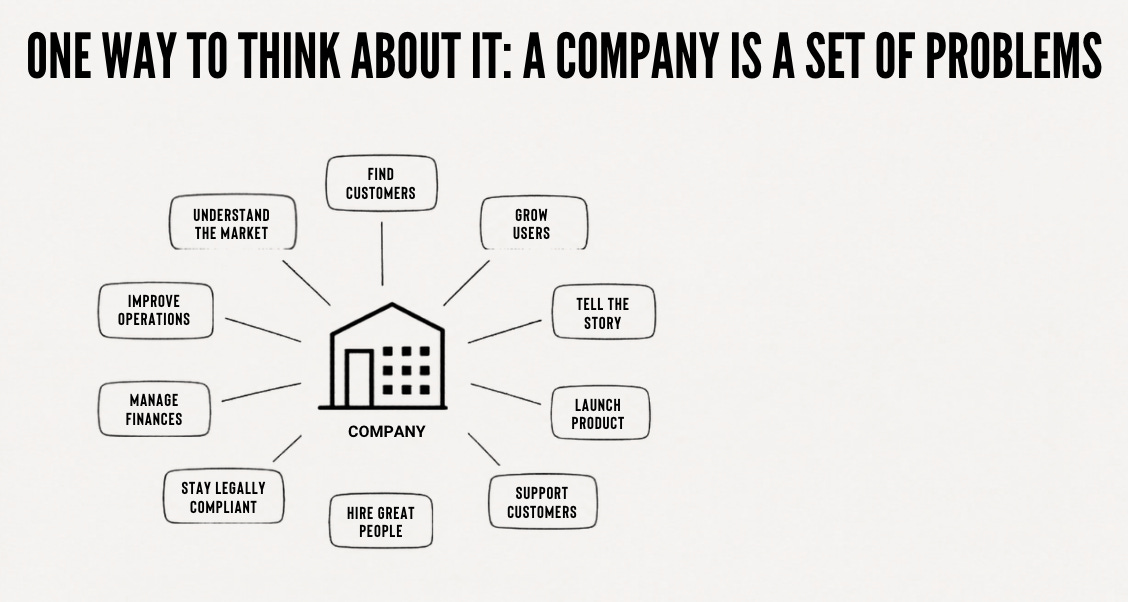
This can be a much more interesting frame.
A company is not, at its deepest level, a logo, careers page, office, employer brand, or collection of role descriptions. A company is a group of people trying to make something happen in the world. They have problems and bottlenecks. They have things they know they need but have not scoped. They have things they do not yet know they need because no one has shown them. They have obvious jobs, which become job posts, and illegible jobs, which hover around the edges as unsolved tension.
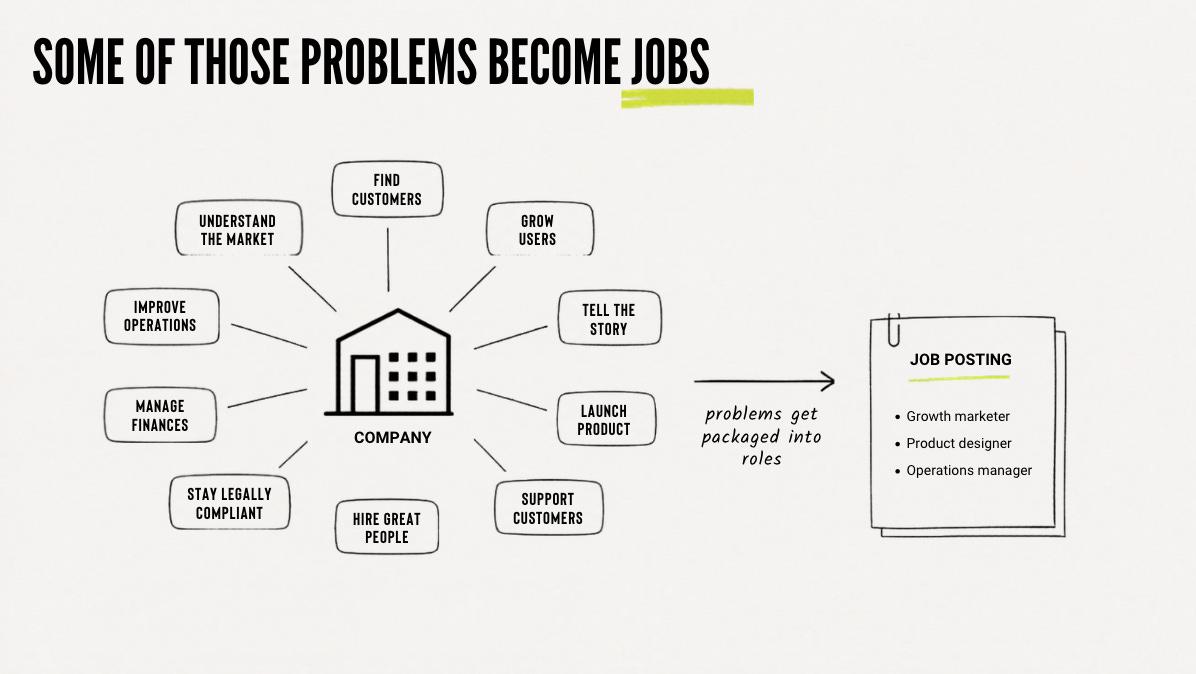
Once you see this, the world gets bigger. Instead of asking only, “What jobs are available?” you can begin asking:
Who is doing work I care about?
What are they trying to make happen?
Where are they stuck?
What do I know how to do, or what could I learn to do, that would help?
Who would be delighted, relieved, or intrigued if I showed up with something useful?
You are trying to notice reality more accurately (also known as hacker’s mindset). Behind every company are actual humans, tired and ambitious and distracted and overextended, trying to solve problems with limited time, limited attention, and limited imagination.
A job is one way they ask for help. A side door is another way of offering it.
One of the hard things about the current job market is that the front door has become incredibly crowded.
I know many talented people right now who are applying to roles online and hearing almost nothing back. These are thoughtful, capable, high-agency people with real skills and interesting backgrounds. They are often failing because the system is lossy, saturated, and weirdly bad at detecting human signal. A company posts a role and receives hundreds or thousands of applications, increasingly polished by AI, many of them using the same language from the job description.
From the company’s side, this is hard. You are trying to infer, from a resume and a few interviews, whether someone will be able to solve the actual messy problems inside your organisation. You are trying to find signal through noise. Credentials and experience help, but imperfectly.
This is part of why side doors work: they create different kinds of signal.
To be clear, this does not make the process fair or easy. Luck, privilege, networks, timing, and taste continue to very much be a part of the equation. But it does expand the set of possible moves.
I think of side doors as falling into two broad categories: outbound and inbound.
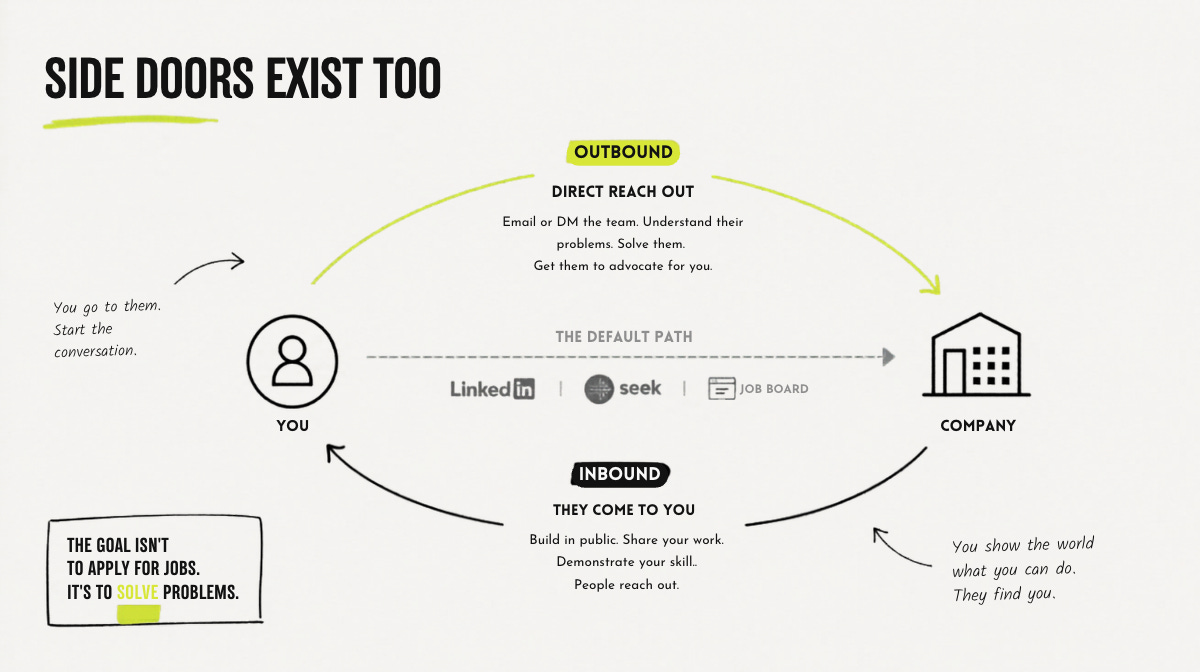
Outbound is when you go directly to the world. You might reach out to someone whose work you admire. You send a specific, thoughtful email to a founder. You ask an employee about the problems they are actually solving. You offer a perspective, artifact, teardown, prototype, memo, analysis, introduction, or idea that makes it easier for someone to imagine working with you. You do not wait for permission to notice where you might be useful.
Inbound is when you make your signal visible enough that the world can find you. You write in public (hello Substack!). Build or research in public. Make small tools, essays, analyses, datasets, prototypes, maps, guides, videos, experiments, events, communities. You create artifacts that let people see how you think. You become discoverable to the kinds of people who care about the same problems you do.
The best careers often seem to contain both. You go out into the world with specificity, and you also become someone the world can find.
The point is that the existing taxonomy of roles is far from the full territory of useful human contribution. There are more shapes than boxes.
A few weeks ago, I had a humbling realisation.
I kept saying I wanted a creative, unusual, narrative-strategy role at an aligned startup in San Francisco. I kept saying I cared about brand, storytelling, distribution, taste, company identity, founder voice, and the way ideas travel. I kept saying I took creativity seriously.
Then I looked at the way I was approaching my own job search and realised I was behaving with almost no creativity at all. I was still unconsciously waiting for the right job title to appear. I was still acting as though the world would eventually publish a perfectly scoped opening called “person who thinks about narrative and culture and growth and meaning and can also be useful in a startup context in San Francisco”. I was still hoping reality would become legible before I had to act.
This is, unfortunately, not how reality usually works. If you want an unusual thing, you often have to be willing to move unusually. This often means becoming more precise, more imaginative, more willing to ask: what are all the possible ways this could happen? Who are all the people who might understand this shape of work? What companies already behave as if they value this, even if they do not have a role posted? What artifact would make my usefulness obvious? What conversation would teach me how the problem looks from the inside? What would I do if I were not waiting to be chosen?

To bring these ideas to life, let me share a few stories. When I was eighteen, I got my first growth consulting job by sending an extremely long, earnest, and probably objectively unhinged email to the CEO of Calm, the meditation app.
I loved the product. I had ideas. I had grown large Instagram pages and understood something about attention on the internet. I was very young and had no reason to believe this would work, except that I also had no sophisticated model of why it wouldn’t.
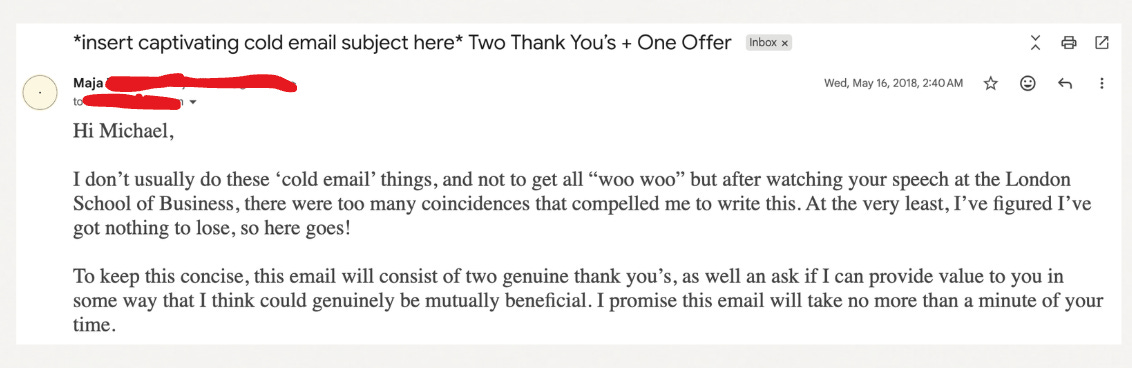
So I wrote to him. It was far from a perfectly calibrated professional message or clean little networking note. It was specific, personal, enthusiastic, full of thoughts. Too much, probably, but distinctly alive.
And somehow, it worked. He replied, asked me to create a pitch and we ended up working together.
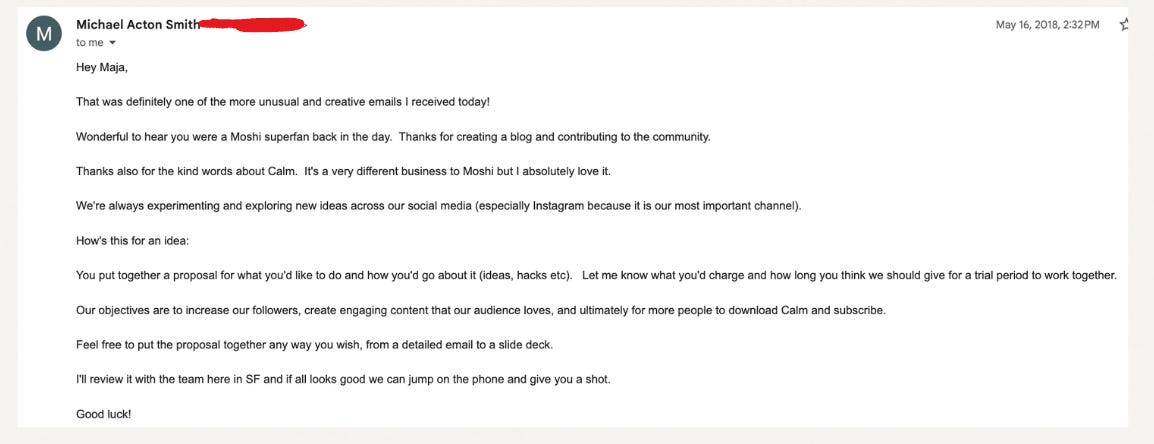
I do not tell this story because I think everyone should send long, unhinged emails to CEOs. Please do not make me responsible for a generation of deranged inbox behaviour. I tell it because there was something in that email that I now think matters: it was specific, it contained proof, and it made my interest legible.
Rather than saying “I am passionate about wellness and would love to contribute”, I was trying to say: I see what you are building, I understand this corner of the internet, here are ideas, here is evidence I can do something, here is why I care.
Specificity is one of the highest forms of respect. It shows you have actually looked and that you are not spraying need into the world and hoping someone converts it into opportunity. It shows you have taken the time to understand the person, the company, the problem, the context. In a market full of generic AI applications, specificity itself becomes signal.
Another time, when I was at university, I became obsessed with working at the Blackbird Foundation. More specifically, I wanted to work with someone called Joel, who has one of the coolest careers paths I have ever seen. He seemed to be doing work at the intersection of startups, creativity, young people, education, ambition, and possibility. I did not just want “startup experience.” I wanted to learn from that specific person, in that specific context, because something about the way he moved through the world expanded my sense of what a career could be.
There was one problem. They did not have internship applications open. Actually, as far as I knew, they had never had interns. So I sent a cold LinkedIn message.
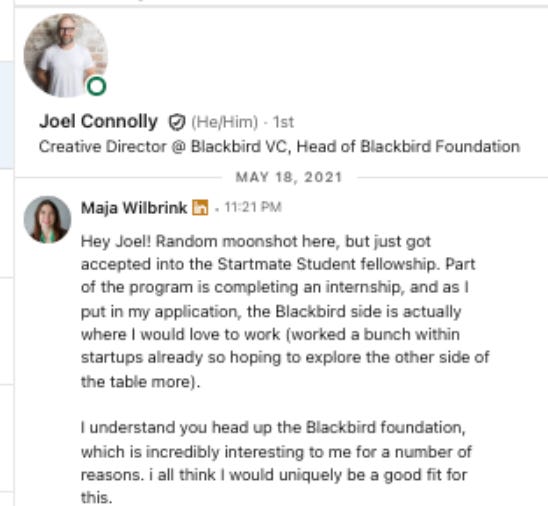
Again, this is far from a sophisticated strategy. It is almost stupidly simple. But the important thing is that I was not asking a generic institution for a generic opportunity. I was reaching toward a live human being whose work I had paid attention to, with a clear reason for why I wanted to be there.
Joel kindly replied and a couple months later, I interned for them and it was incredibly awesome.
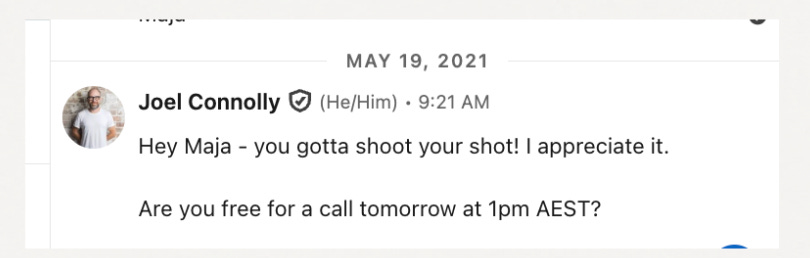
This is one of the odd things about side doors. From far away, they look like luck. From the inside, they often look like a small moment of unreasonable specificity, a person, a message, a moment, a door that did not officially exist until someone tried the handle.
There are also inbound versions of this. My friend Jae published a very sharp philosophical critique essay on taste discourse, sharing it on Substack and LinkedIn.
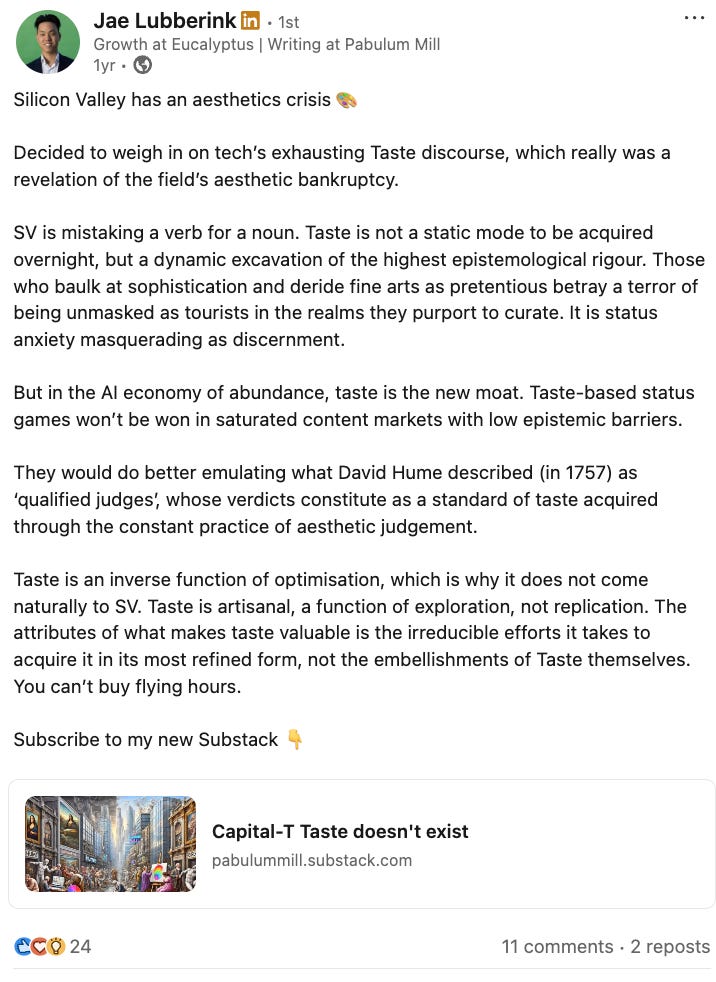
The CEO of Eucalyptus, Tim Doyle, saw it and commented. He appreciated the thinking. They got coffee. Eventually, Jae was hired.
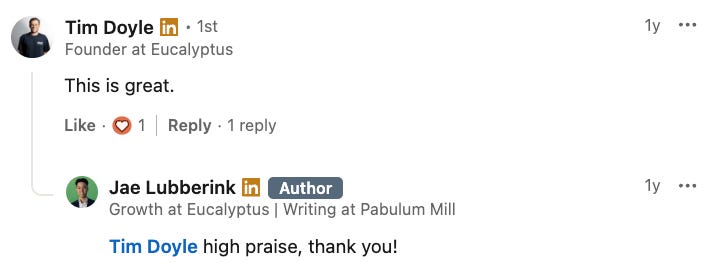
I love this story because it reveals your real work can travel ahead of you. An essay can be a small ambassador for your mind. A project can make a case for you while you are sleeping. A public artifact can enter rooms you do not yet have access to showing that this person sees something.
This is also why “personal brand” is such an insufficient phrase for what is actually happening here. It makes the whole thing sound you are putting on a little outfit for the algorithm. But the deeper version is about making your thinking more findable. It is about leaving evidence of your aliveness in public. The point is to create proof that you are already in relationship with the problems you want to be hired to solve.
Another one of my all-time favourite stories: Back when image models were right at their early stages, Ethan was doing AI research in his college bedroom. He was sharing his learnings on Twitter and in underground hobbyist research Discords, trying to understand what was happening at the frontier.
One day, he published a guide on notion called “The Traveller’s Guide to Latent Space,” which helped other people navigate what he was learning.

Again, this was a findable proof of his very real obsession. The guide showed that he understood the field, because he had made something useful for others who were trying to understand it too.
Then he got a Discord message from a random account in Australia. That person asked him to become his technical cofounder of Leonardo.ai, which was later acquired by Canva.
This is the kind of story that sounds fake if you flatten it too much. “Post online and get acquired by Canva” is terrible advice. Please do not take that from this.
Perhaps the real lesson is: when you are genuinely close to a problem, your work can become a beacon for the small subset of people who know how to recognise it. Most people won’t, but the people tuned to the same frequency might. And occasionally, one of them is carrying a problem your particular obsession has already taught you how to solve.
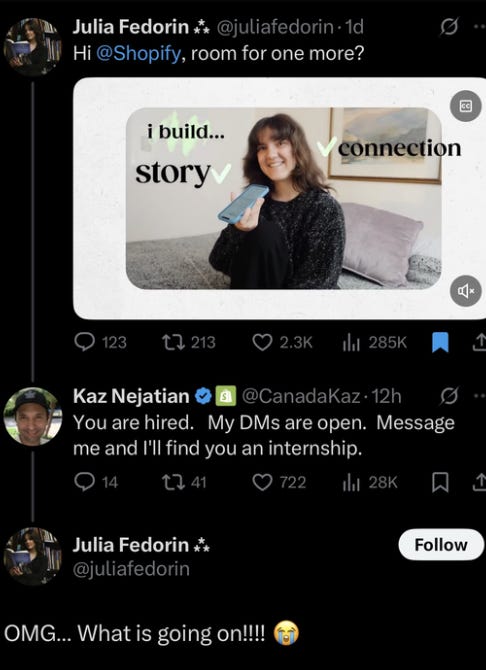
Another really cool example of this is Julia, who created a viral video of herself asking for an internship at Shopify. They had no internship opportunities open and yet...
Side doors tend to work best when they are grounded in generosity, specificity, and proof.
The worst version is entitlement disguised as boldness. “I admire your company, can we chat?” sent to fifty people with the same dead-eyed phrasing, a vague request for mentorship from someone busy, or a cold email that is just asking the recipient to do the work of figuring out who you are, what you want, and why they should care.
The better version is usually much more attentive. You notice a person or company with genuine specificity, study what they are doing and form a view on the problem they might be solving. You ask yourself where you could add value, then make the smallest useful proof that could demonstrate your thinking.
This could be a short memo on a growth opportunity or a teardown of their onboarding. A list of creators they should partner with or thoughtful response to a founder essay. Even a clear note explaining why their work matters to you and where you think you could help. Rather than overwhelm someone with your labour, the goal is to create a small, undeniable unit of signal.
Unfortunately, this approach will not make rejection painless nor eliminate uncertainty. Most doors will not open. Many people will not reply. Some bets will not land. Some signals will vanish into the noise.
But the process becomes less deadening when you are allowed to act, because you are no longer only refreshing job boards, watching your self-worth get converted into application statuses. You are learning the terrain, making things and talking to humans. You are discovering which parts of the world respond to your particular frequency. That is useful information even when it does not immediately become a job.
The job market can be brutal. It can make intelligent, sensitive, capable people feel like ghosts, sending pieces of themselves into portals and receiving only automated silence back. It can make you forget that the economy is not actually made of hiring portals. It is made of people. Confused people, busy people, kind people, distracted people, people with problems, people with budgets, who are sometimes willing to take a bet.
All it takes is one person. One person who sees the signal and who has the problem you can solve. One person who reads the essay, replies to the email, takes the call, forwards your name, invents the role, opens the side door, says, yes, come in, let’s see.
If someone takes a bet on you, honour it. Do the work. Become worthy of the luck. Make them glad they trusted their instinct. And when you are in a position to do so, pay it forward. Open doors for other people and reply to the overly earnest email when you can. Notice the student with the bright eyes and remember that almost every career contains, somewhere in its origin story, a person who did not have to help but did.
The world is dazzlingly big.
There is not one door. There are many. Some are obvious and crowded and fluorescent-lit. Some are hidden behind ivy. Some are opened by an email sent at midnight with your heart beating too fast.
Good luck. Good luck finding the person, the problem, the little crack of light. Good luck placing your hand on the handle. And good luck walking through.
I’m happy to share the workshop PDF I made for my students. If you, or anyone in your life, would find it useful, feel free to DM me.
I didn’t paywall this post because I want it to be accessible. If you did find any value from it, you can buy me a coffee.
Other ways to support are just as meaningful: subscribing or pledging to my Substack, leaving a comment, or sharing this with someone you think would enjoy it. Each small signal helps others find their way into the noise.
My next essay is in this series will be about how to learn what you actually want, which is a useful prerequisite to this process. Subscribe to receive it in your inbox.
Related: