Every morning I take a northbound Caltrain to Menlo Park and wait for a minute at this crossing:
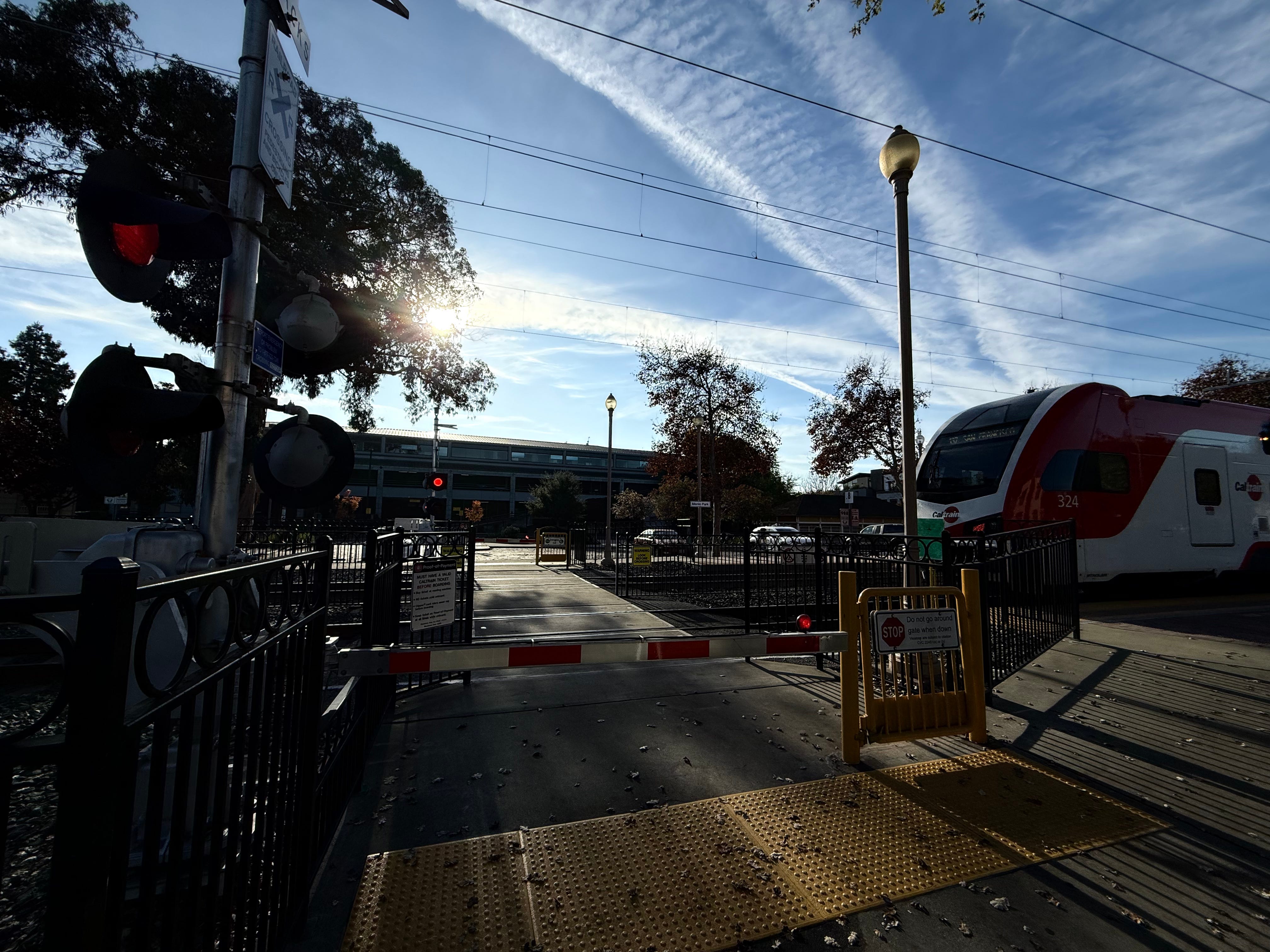
(I know this picture isn’t in the morning, I didn’t want to get a bunch of strangers in my picture so I went back in the afternoon.)
Here’s a diagram of the situation:
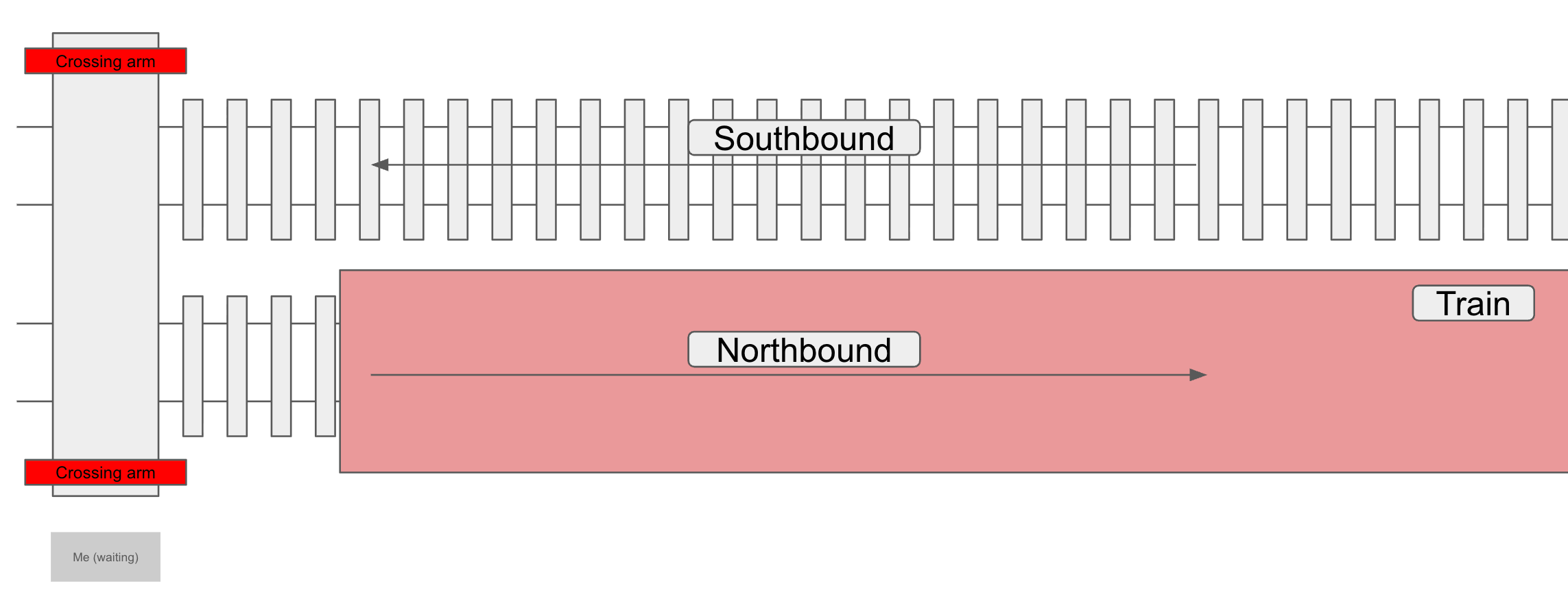
After I get off the the train, the arms stay down for the ~40 seconds that the train stays at the station, and about 5 seconds after the train leaves the arms go up and let me through. There’s this one guy who takes the 7:28 train who always ignores the arms and walks through, but most people (myself included) just wait. It’s a bit of a waste of time, because I can clearly see the train is stationary and preparing to move north (away from me), but I’ve just gotten used to it as an extra 35 seconds added to my commute.
Except when I take the 6:58 or 7:58 or 8:58 train, and the southbound bullet train is running a minute late, it’s actually not a waste of time because the southbound train, completely invisible from where I’m standing, flies through at 79mph.
This is easily the most dangerous Caltrain situation I encounter. The exact source of the danger is a bit unintuitive though. It’s not the 79mph train, it’s not the lack of visibility, and it’s not the combination of those two. Those are just part of having a train system. It’s the overuse of the crossing arms that is the danger. A single signal indicates “a train is about to start slowly moving away from you and we’re just being extra safe” and “you will get erased if you cross”. And to make things worse, the latter is so infrequent that’s it’s easy to incorrectly learn that the signal always means the former. Eventually someone is going to run across with that assumption and die.
The real problem here is that whoever is allowing the station to behave like this is likely working with the axiom “keeping arms down longer can only make things more safe”, and this couldn’t be more wrong.
Crossing arms are not barriers, they’re signals. If Caltrain had a barrier that physically prevented crossing, or if we were talking about a video game where “arms down = no crossing”, that would be completely different. I’d be writing an article about how preventing crossing when the train is moving away is inefficient and annoying, but nothing about added danger. With barriers all you have to do is produce them when they’re needed, and they accomplish what you want.
What we’re actually working with here are signals of danger, and the effectiveness of signals depends not just on when they are produced but also how well they are received. And how well they are received changes over time. You don’t need to just produce them when they’re needed, you also need to not produce them when they’re not needed. People pay attention and learn, and eventually signals indicate what they indicate, not what they claim to indicate.
“Arms down” no longer means “crossing is dangerous” to me. It means “crossing is dangerous or some committee’s rules say arms have to stay down in this situation or the train operator doesn’t feel like raising them yet”. I still prefer to just wait, but the further they get from a clear indication of danger the more people will ignore them. The guy who I see ignore the arms all the time has probably been conditioned to think this signal always indicates a train is slowly moving away, so I hope he never takes the 8:58 train.
If your reaction to this is “well people should just follow the rules”, you’re missing the point. You’re trying to play Sim City instead of operating in the real world. In the real world, all that matters is “how will infinity samples respond to a signal that behaves like X?”, and that always depends on the signal precisely capturing what it intends to.
I’d love for Caltrain to improve the precision of their crossing warnings, but my overall point is that in most systems, precision of signal is just as important as presence of signal. You don’t get guaranteed improvement by adding more alerts. If you start paging for unactionable issues, you haven’t added to the total amount of attention alerts get, you’ve just made people start missing the important pages. If you add a delay before turning a light green (and also stop giving tickets???), people start running red lights and green light stops meaning “safe”. If the tornado siren goes off every day, you can’t be surprised when no one paid attention to the real one. Eventually nothing means anything and you’ve defeated the point of even having a signal.
If you find yourself in a position of responsibility to alert someone of something, remember that your job is not to have alerted, but to get the message through. People learn what signals really mean. Adding alerts “just to be safe” is dangerous.
(Side note, I’m a huge fan of Caltrain and this isn’t really a criticism of them. Systems all over the place have bad signals, this was just a really clear example.)
Thanks for reading Value Town, Please share with anyone you think would be interested!