Gautam Buddha was an 5th century BCE spiritual teacher who found the path to permanently end suffering (also known as Nibbana, Liberation and Enlightenment), and spread the teachings of attaining Nibbana through the Eightfold Noble path of sila (morality), samadhi (concentration) and panna (wisdom).
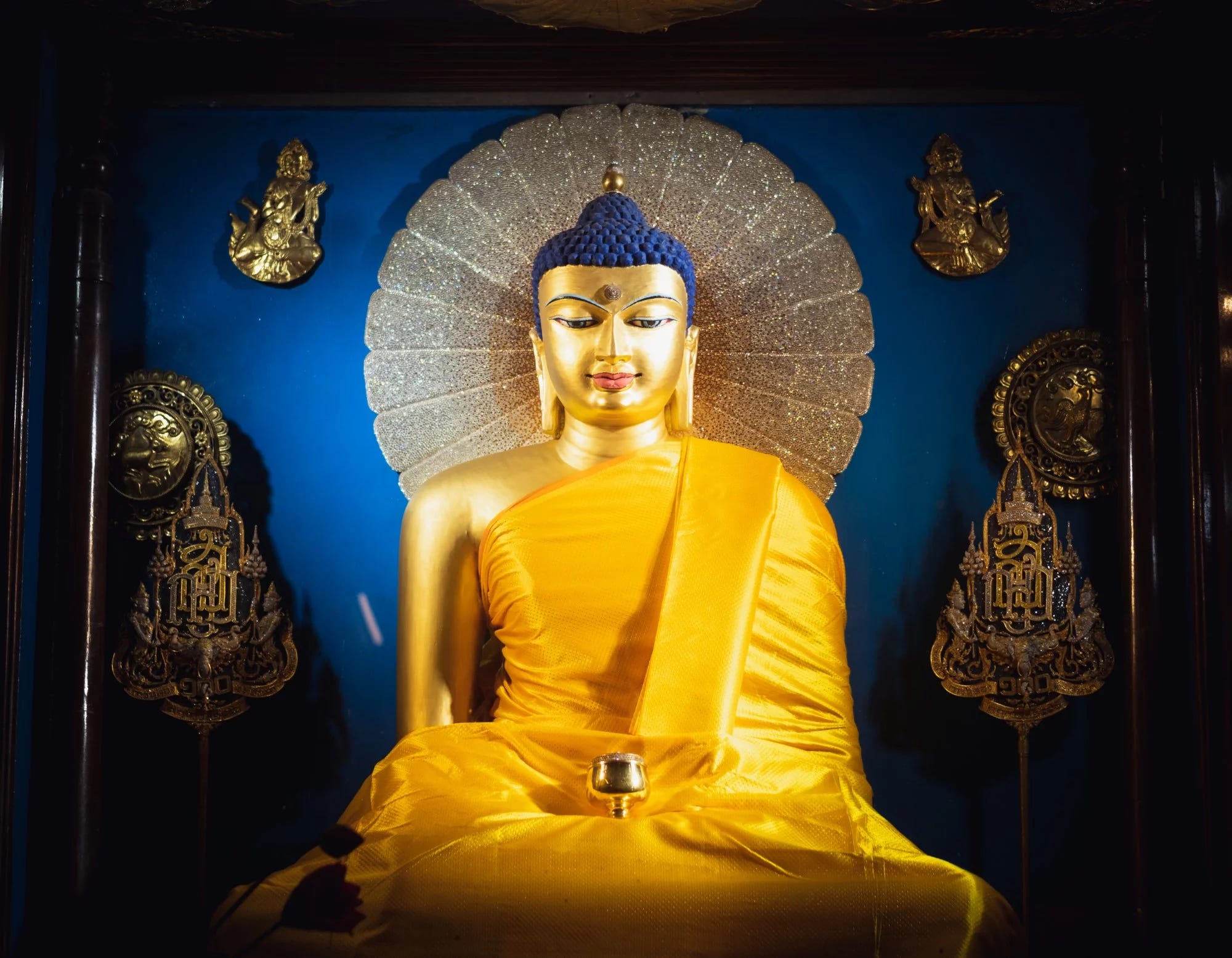
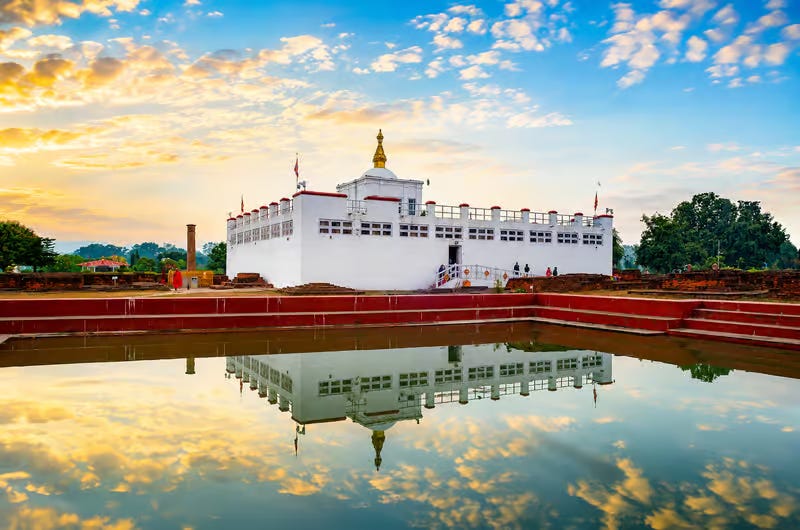
Gautam Buddha was born on 5th century BCE to Queen Mahamaya and King Suddhodana of Kapilavatthu (in present-day Nepal). He was born under a sala tree in the Lumbini Garden on a full moon night. Today, the Mayadevi Temple stands at his birthplace in Lumbini, Nepal.
On the fifth day after the birth of Price, the King Suddhodana selected eight of one hundred eight Brahmin ascetics to prognosticate the marks on the body of prince. Among the eight, seven of them gave two alternate predictions with no decisive answer: “If your son, who is endowed with these marks, chooses to live life of householder will become a Universal Monarch, ruling over four great islands. If he becomes a monk, however, he will attain Buddhahood (enlightenment).” But the eighth Brahmin, the youngest of them all, gave only a single prediction: “There is no reason for the Prince remaining in householder life. He will certainly become a Buddha.”
After King Suddhodāna had his son prognosticated and knowing that his son would become a recluse, he asked the ascetics, “On seeing what will my son become a recluse?”. The ascetic replied: “On seeing the four omens of an old man, a sick man, a dead man and a recluse, your son will renounce the world and become a recluse.”.
On hearing this, the king ordered “If my son will renounce after coming across these four omens, from now on, do not permit any person who is aged, ailing, dead or a recluse to visit my son. I do not want my son to become a Buddha. I want to see him only as a Universal Monarch ruling over the four great islands.”
The king ensured that the prince enjoyed comfort and luzury. He appointed two hundred and fourty female attendents, sixty male servants to help female servants and sixty officers to oversee the duty of the female and male servants. When the price grew to age sixteen, the King constructed three different palaces, one for every season for the prince to live in comfort and luxury in every season.
When the price turned 29 years of age, he wished to visit the Royal Garden. As he travelled to the Royal Garden with his charioteer, he encountered an old men bent with age. Troubled, the Prince asked his charioteer “O charioteer, the hair of that man is not like that of others; his hair is totally white. His body is also not like that of others: the teeth are gone; there is little flesh (on his body); with a stooping back, he is trembling all over. By what name is he known?” The charioteer replied: “Your Majesty, he is called ‘an old man.’”
The Prince, who had never even heard before the word ‘old man’, much less seeing one, again asked the charioteer: “What is meant by an old man?” The charioteer replied: “Your Majesty, one who cannot live longer is known as an old man.” He then asked: “O charioteer, how is that? Am I also subject to old age? Am I also one who cannot overcome the nature of ageing?” Then the charioteer replied: “Your Majesty, all of us, including you as well as I, are subject to old age; there is no one who can overcome the nature of ageing.”
Troubled learning about oldage, the prince returned to the palace. In future again, as the prince on his visit to the Royal Garden, witnessed a sick person and a dead person. On the fourth time, the prince witnessed a recluse with shaven head and asked the charioteer: “O charioteer, This man’s head is not like the heads of others; he is with a clean shaven head and also has his beard shaved. His clothes are also not like those of others and are bark-dyed. By what name is he known?” The charioteer replied: “Your Majesty, he is known as a recluse.”
Troubled by what he learned, the prince decided to renounce the life of price to search for the end of suffering. On the night his son Rahula was born, the price departed from the palace accompanied only by his charioteer Channa and his horse Kanthaka. At the bank of the river Anoma, he cut off his hair, exchanged his royal garments for the simple robes of an ascetic, and sent Channa back to the palace with his horse and ornaments.
As a wandering ascetic, the prince sought out the most renowned teachers of his day. He first studied under Alara Kalama, who taught him deep meditative state (jhana) - the of sphere of nothingness. Mastering this quickly, the prince found it did not lead to the permanent cessation of suffering he hoped for and continued his search to permanently end suffering. He next studied under Uddaka Ramaputta, who taught him even deeper meditative state - the sphere of neither-perception-nor-non-perception. Again, the prince attained this state with ease, yet found that it too did not lead to end of suffering.
Unsatisfied, the ascetic Gotama, along with five companions, turned to a path of severe austere practices believing that practiving severe austere practices would liberate the mind. For seven years he practised extreme austerities such as minimal eating, until his body was reduced to skin and bone. Even after practicing such extreme austere practices, he did not attain enlightenment. He finally realized that path of extreme austerity did not lead to liberation, and decided to end his severe austere practice. He then chose to follow a middle path to enlightenment which avoided both extremes of sensual-indulgement and austerity.
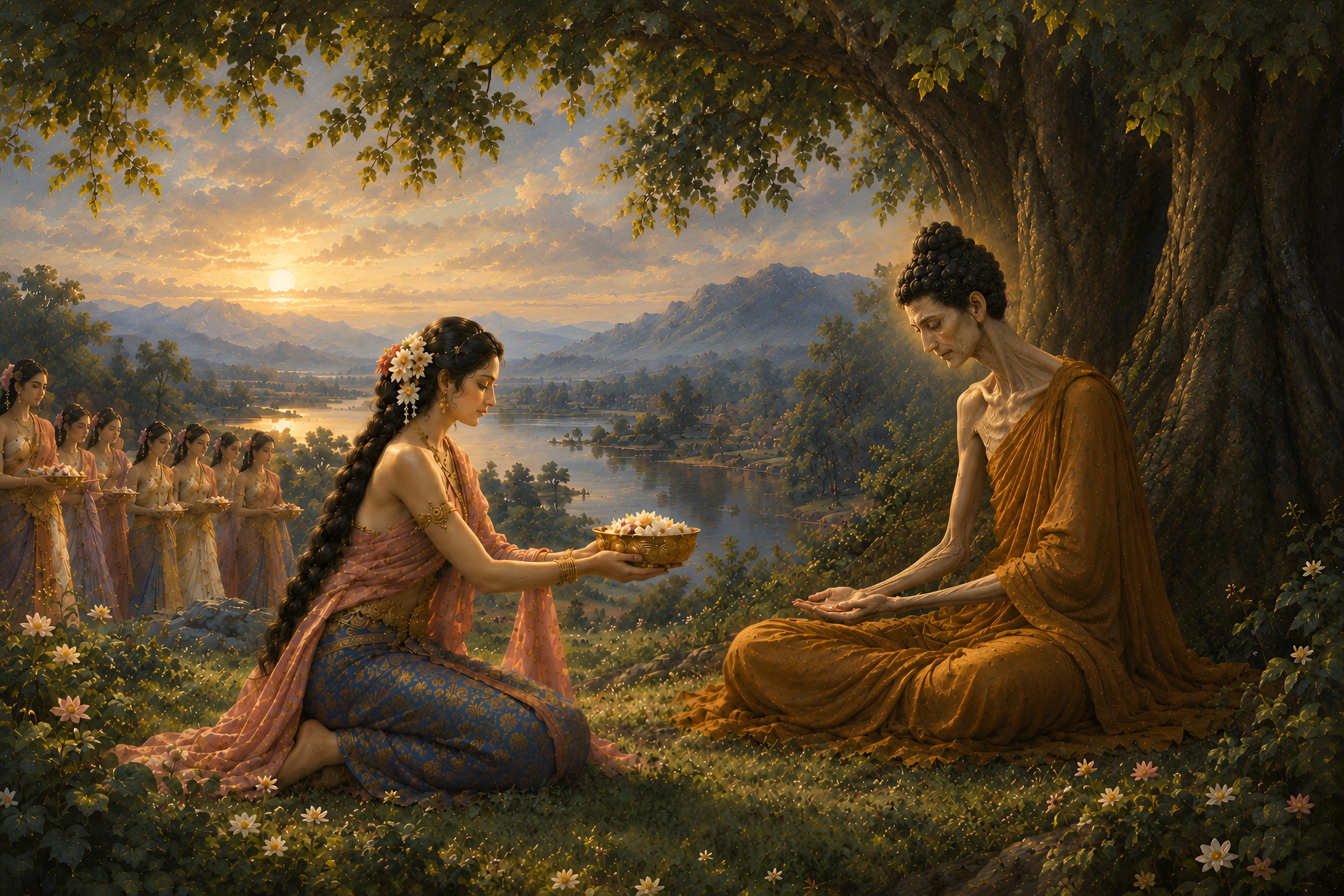
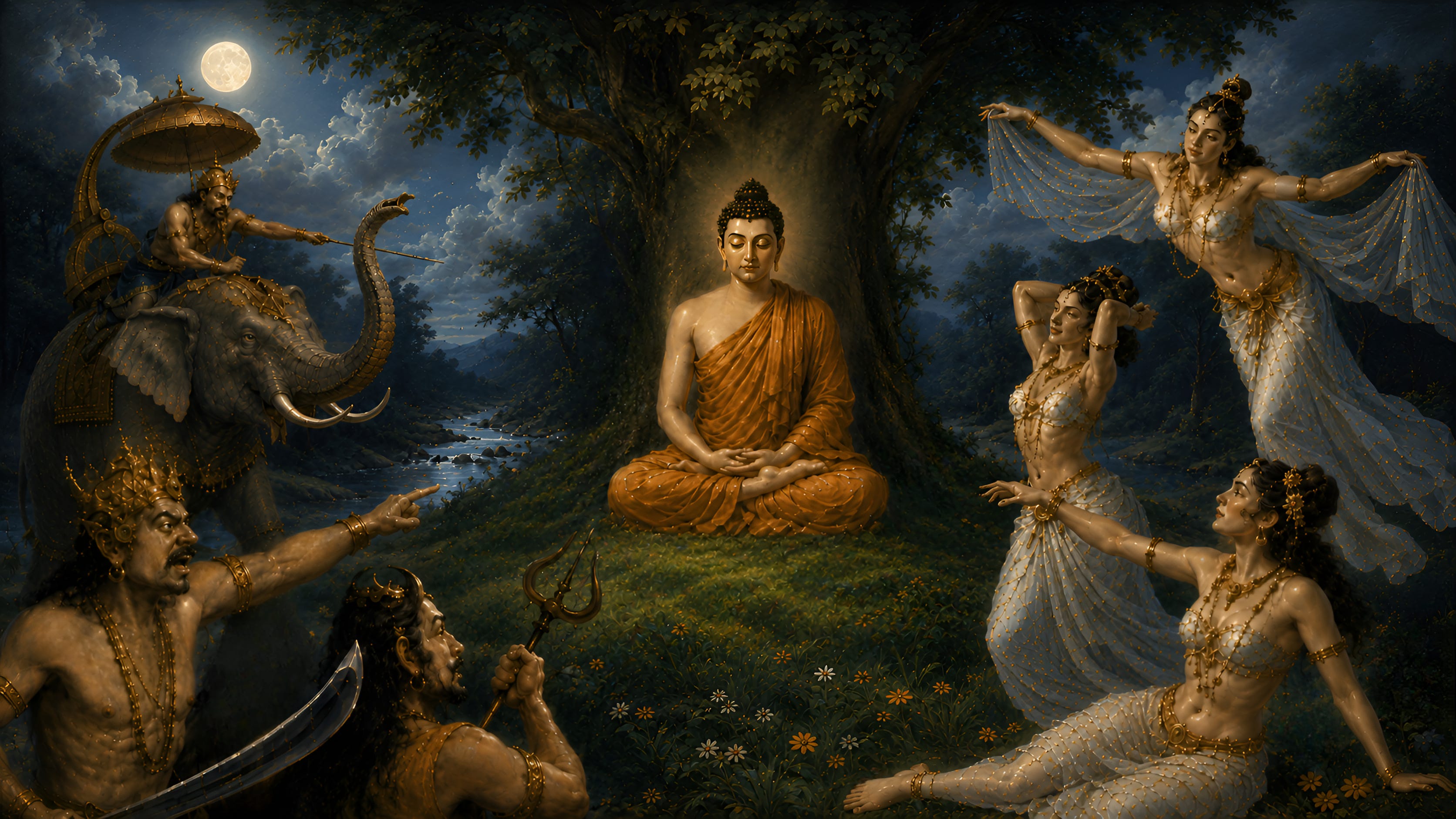
Having regained his body strength, ascetic Gotama sat underneath a pipal tree at Bodh Gaya on full moon night, and vowed not to get up until he had found the end of suffering. Through the night, his mind passed through successive stages of deepening knowledge, insights and realized the Four Noble Truths. Finally, at the age of thirty-five, he attained full enlightenment and became the Buddha, the Awakened One.
For seven weeks after his enlightenment, the Buddha remained in the vicinity of the Bodhi tree, absorbed in the bliss of liberation and reflected on the knowledge he has realized. He then travelled to the Deer Park at Isipatana (present day Sarnath) where he found the five ascetics who had been his companions in austere practices. To them he delivered his first sermon, the Dhammacakkappavattana Sutta (Setting in Motion of the Wheel of the Dhamma) in which he expounded the teachings called the Dhamma. Listening to the sermon, the five ascetics became enlightened.
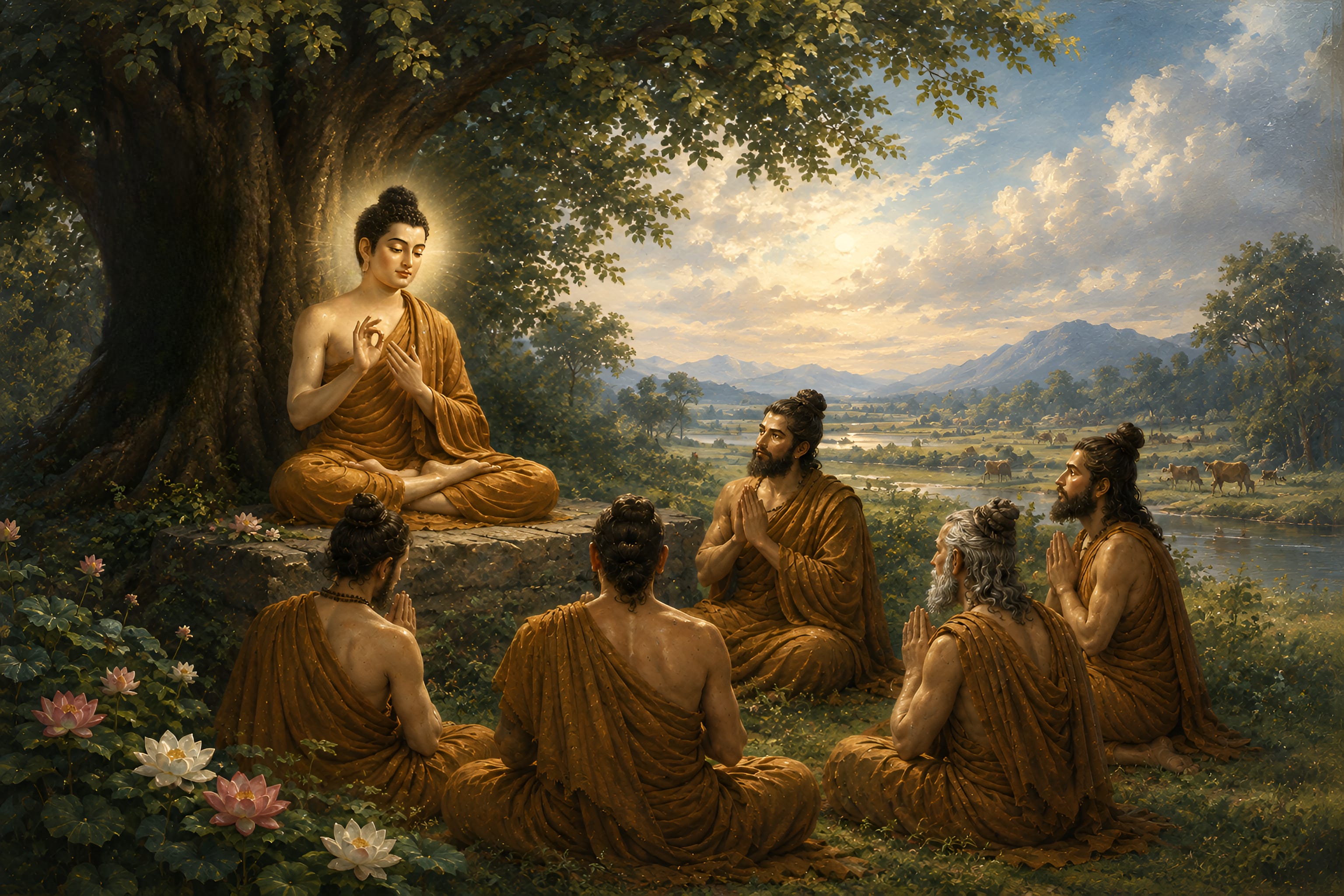
For the next forty-five years, the Buddha travelled across the Gangetic plains in India, spreading the teachings and established a growing community of monks, nuns, and lay followers. At the age of eighty, having grown old, he travelled to Kushinagar, where he delivered his final sermon to his disciples, inspiring them to strive headfully for their own liberation, and to regard the Dhamma (the teachings) and the Vinaya (monastic rules) as their teacher after his passing.
On the night of attaining Enlightenment, the Buddha realized the four noble truths of existence:
Dukkha (The Truth of Suffering) Life inherently involves suffering, dissatisfaction, or unease. This includes suffering of oldage, sickness and death. The suffering of happening of things which we don’t like, and not happening of things we like.
Samudaya (The Truth of the Cause of Suffering) Suffering arises from — craving or attachment. This includes craving for sensual pleasures, craving for existence, etc. This craving is rooted in ignorance (avidya) about the true nature of reality.
Nirodha (The Truth of the Cessation of Suffering) Suffering can end. When craving is permanently abandoned, suffering ceases.
Magga (The Truth of the Path to the Cessation of Suffering) There is a practical way to end suffering by following the Noble Eightfold Path.
To realize these four noble truths by oneself, The Buddha taught the path to permanently end suffering through attainment of Enlightenment called the Eightfold Noble Path. The Eightfold Path can be described as follows:
Morality (Sīla)
Right Speech (Samma Vaca) — Abstaining from lying, divisive speech, harsh speech, idle chatter, etc.
Right Action (Samma Kammanta) — Abstaining from killing, stealing, sexual misconduct, etc.
Right Livelihood (Samma Ajiva) — Earning a living in a way that doesn’t cause harm to others (avoiding trade of weapons, intoxicants, etc.)
Concentration (Samadhi)
Right Effort (Samma Vayama) — Cultivating wholesome states of mind and abandoning unwholesome ones
Right Mindfulness (Samma Sati) — Cultivating clear awareness of mind and body
Right Concentration (Samma Samadhi) — Cultivating concentration of the mind
Wisdom (Paññā)
Right View (Samma Ditthi) — Understanding reality as it is, including the Four Noble Truths
Right Intention (Samma Sankappa) — Cultivating intentions of renunciation, goodwill, and harmlessness rather than desire, ill-will, and cruelty
To practice on the eightfold path is to develop in Sila, Samadhi and Panna. Practicing of Sila can be developed by following different moral precepts in regular life according to ones capability. The five basic precepts for those who follow Sila are: abstain from lying, sexual misconduct, killing, stealing, taking intoxicants. For those who want to develop deeper into Sila, can also take higher precepts such as 10 precepts.
Practicing of Samadhi can be developed by practicing meditation to develop contentment and tranquility on a single meditation object. There are many meditation objects such as mindfulness of breathing (Anapanasati) or visual objects such as Kasina meditation. These meditation can be developed to very deep absorption concentrations also known as the jhana states.
Practice of Panna can be developed by practicing insight meditation also called as Vipassana meditation. As a meditator practices Sila, Samadhi and Panna, all the practices support and strengthen each other on their journey to Enlightenment.