We scored the full text of 12,750 arXiv papers and found that about a third of new ones read as machine-written. Here is the method, the results, and an honest account of the limitations.
A false-positive floor
There is a genre of headline that says "N% of X is now AI," and most are not worth reading, because the detector behind the number also flags some share of genuine human writing. If a tool marks 40% of new papers as machine-written but also marks 20% of papers written before ChatGPT existed, the real story is the 20% nobody mentioned.
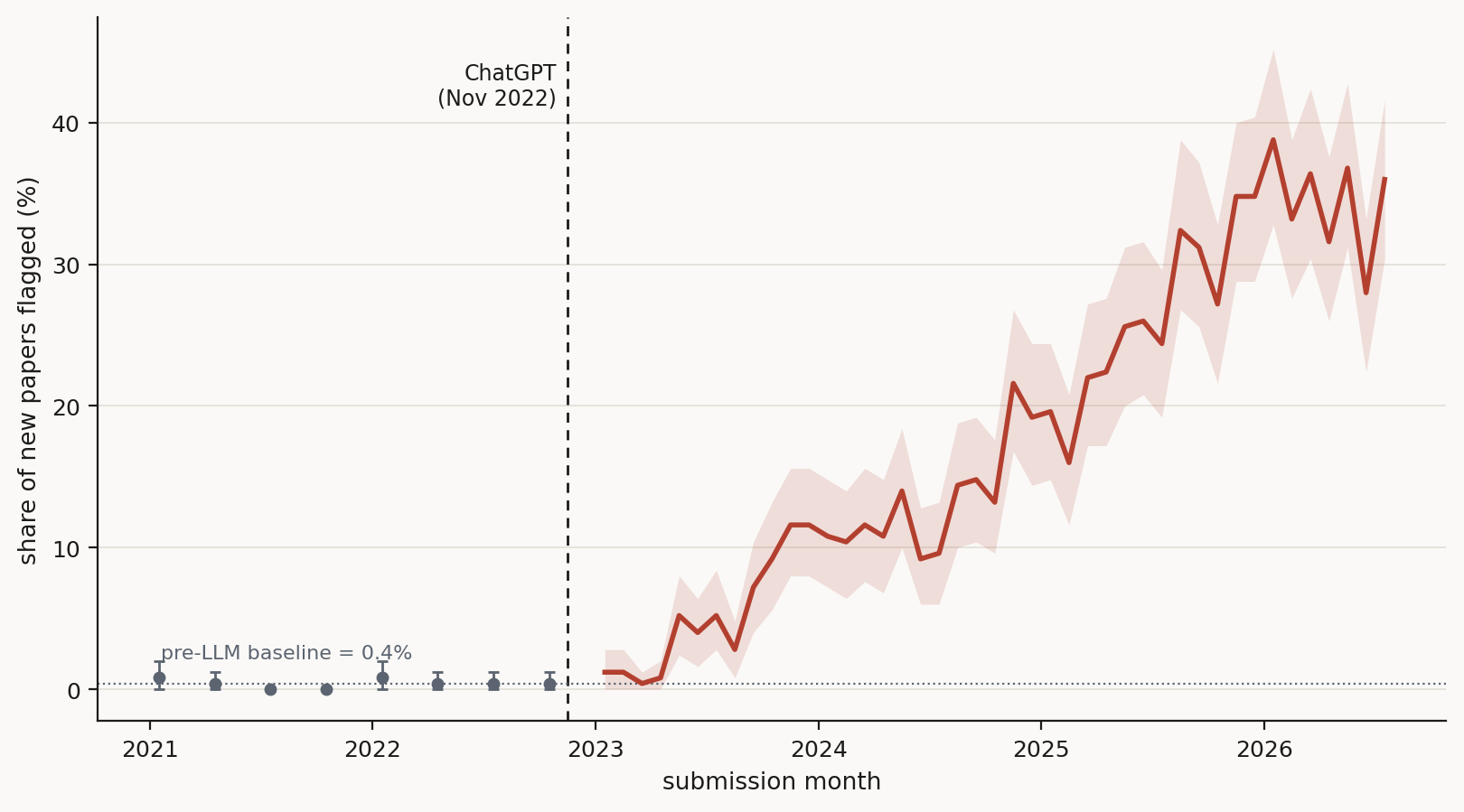
So we built the study around that objection. Our detector, described here, is calibrated for academic writing; at a 0.4% false-positive rate it clears 99.6% of genuine pre-LLM scientific text and recovers 85% of AI academic text. We made that false-positive rate the anchor. We took papers submitted in 2021 and 2022, before ChatGPT, treated them as ground-truth human, and set the flag threshold so that exactly 0.4% of them trip it. That line is the floor. Every number we report is a share of papers above a threshold where genuine pre-LLM writing sits, by construction, at 0.4%. The pre-ChatGPT years then act as a built-in control: if the rise were an artifact of the detector, 2021 and 2022 would flag as high as 2026. The first figure shows they do not.
What we measured
We sampled ten field groups, roughly 25 papers per field per month, from January 2023 to July 2026, plus eight control months across 2021 and 2022, for 12,750 papers in total. For each one we pulled the version-1 PDF, so a paper revised in 2026 cannot leak modern text back into its 2023 slot. We scored the full body text instead of the abstract, because abstracts understate the signal: we have seen the same paper score under 20% on its abstract and over 70% on its body. Every reported figure carries a bootstrap 95% confidence interval.
Results
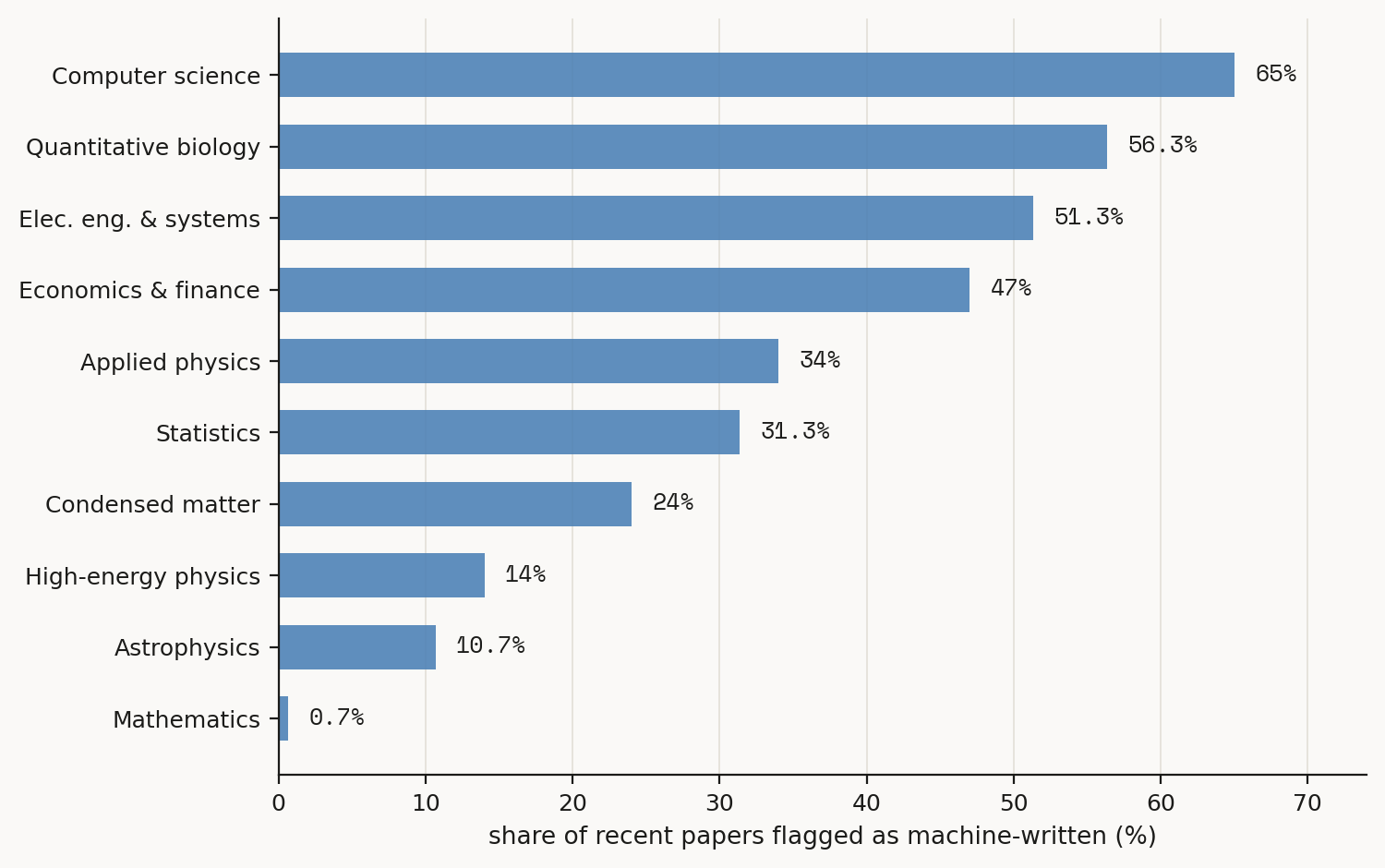
The flagged share is flat at 0.4% through 2021 and 2022, lifts off within months of ChatGPT, and climbs in two waves to about 32% over the most recent complete quarter, peaking near 39% in early 2026. The spread across fields is large, and it is the table and the second figure that carry it. The values below are each field's flagged share over the 12 months to July 2026, alongside its pre-LLM control level.
| Field group | Pre-LLM control | Recent flagged share | 95% CI |
|---|---|---|---|
| Computer science | 0.2% | 65.0% | [59.3, 70.3] |
| Quantitative biology | 3.5% | 56.3% | [51.0, 61.7] |
| Electrical eng. & systems | 1.7% | 51.3% | [46.0, 57.0] |
| Economics & finance | 2.5% | 47.0% | [41.3, 52.7] |
| Applied physics | 1.3% | 34.0% | [29.0, 39.7] |
| Statistics | 1.8% | 31.3% | [26.0, 36.7] |
| Condensed matter | 0.0% | 24.0% | [19.3, 29.0] |
| High-energy physics | 0.5% | 14.0% | [10.0, 18.0] |
| Astrophysics | 0.0% | 10.7% | [7.3, 14.3] |
| Mathematics | 0.0% | 0.7% | [0.0, 1.7] |
Computer science leads at about 65%. Mathematics is lowest, near 0.7%, and the limitations section explains why its low value is hard to interpret. The control column is each field's 2021 to 2022 flag rate averaged over three sensitivity settings; the fields that rise most are not the ones with the highest pre-LLM control level, so an elevated starting point does not explain the rise.
Limitations
Control sample size. Each field's pre-ChatGPT control is 200 papers. At a 0.4% flag rate only eight papers flag across the entire 2,000-paper control, spread thinly over ten fields, so a single-threshold per-field control rate is coarse. The pooled floor is well estimated and is what the study is anchored to, but the per-field control levels are only approximate, and a larger control would not fix this: pinning a fraction-of-a-percent rate per field would require thousands of control papers per field that pre-2023 arXiv volume does not contain.
A low score can indicate low adoption or a detector blind spot. Mathematics is the clearest case. Mathematics papers are dominated by notation and theorem-proof structure, and once equations and references are removed the remaining prose is sparse and unlike the scientific English the detector was trained on. A mathematics paper drafted with heavy model assistance may score low because its prose is out of distribution for the detector, so a low score in mathematics is weak evidence that a human wrote the paper. The result is consistent with two very different explanations, lower adoption or reduced detector sensitivity in that register, and this data cannot separate them. The fields with the strongest in-distribution assumption, the prose-heavy ones, are also the ones that rise most, so this confound does not account for the aggregate trend. But in the low-scoring fields the ranking should be read as a lower bound on adoption.
Detector coverage. The detector is more sensitive to some generators than others, and we cannot evaluate it against the exact, private mixture of models and prompts that authors actually use. Incomplete coverage lowers the flag rate, so the reported prevalence is a lower bound: the true share is at least what we measured. The detector write-up reports the per-generator performance.
A flag is not authorship. The detector estimates whether text reads as machine-written, at a calibrated probability with a known error rate. It cannot separate a lightly-edited document from a wholly-generated one, and a single score is never grounds to accuse a specific person. We report the prevalence of machine-like writing, which includes heavy AI-assisted editing.
Try it
The detector is cheap to run and we make no money from it. You can try it for free on any arXiv paper here, and on your own text here.