In the last few months, the governments of Australia, France, Denmark, India, England, Norway, Spain, and the United States all instituted, introduced, or began to debate laws that would ban teenagers from accessing social media due to its alleged effects on the mental health of young people. Simultaneously, public outlets began to realize that most scholars don’t think social media has virtually any negative health impacts at all. Too little, maybe too late.1
But like the politicians behind this wave of legislation, let’s temporarily ignore the evidence. In fact, I want to make up some data from scratch.
For instance: did you know that daily social media use increases the likelihood a child will commit suicide by 12-18%? Or that teenagers are far more likely to visit the ER for psychiatric problems if they have an Instagram account? Or that a child’s amount of social media use, past a certain threshold, correlates exponentially with poorer sleep, lower reported wellbeing, and more severe mental health symptoms?
If that was all true for social media— and again, none of it is — you and I both would agree that people under 16 or so should not have access to platforms like Instagram or Snapchat. Imagine allowing your child to enter any system that would make them 12-18% more likely to kill themselves. That would be insane. You wouldn’t let your kid anywhere near that system, and the public would protest until it was eliminated once for all.
Great. So let’s get rid of school.
Yes, there’s the obvious twist — all the data I just listed is true for the effects of school. The modern education system is probably the single biggest threat to the mental health of children. At the very least, the evidence for its negative effects is unambiguous: the same cannot be said for social media.
The first statistic is the most damning. In March 2020, COVID was born, and students were removed from school. Generally, we view COVID as an absolute scourge upon the mental health of young people. But when children stopped going to school, something interesting happened. Their suicide rates plummetted and remained low throughout the summer. In the fall — when most schools returned to in-person instruction — they started killing themselves again.
You can see the trend in the figure below. Basically, the line shows suicide rates relative to the number of months before and after the resumption of in-person school. The line down the middle indicates that change. Panel A shows suicide rates for teenagers aged 12-18, while Panel B shows suicide rates for adults aged 19-25.
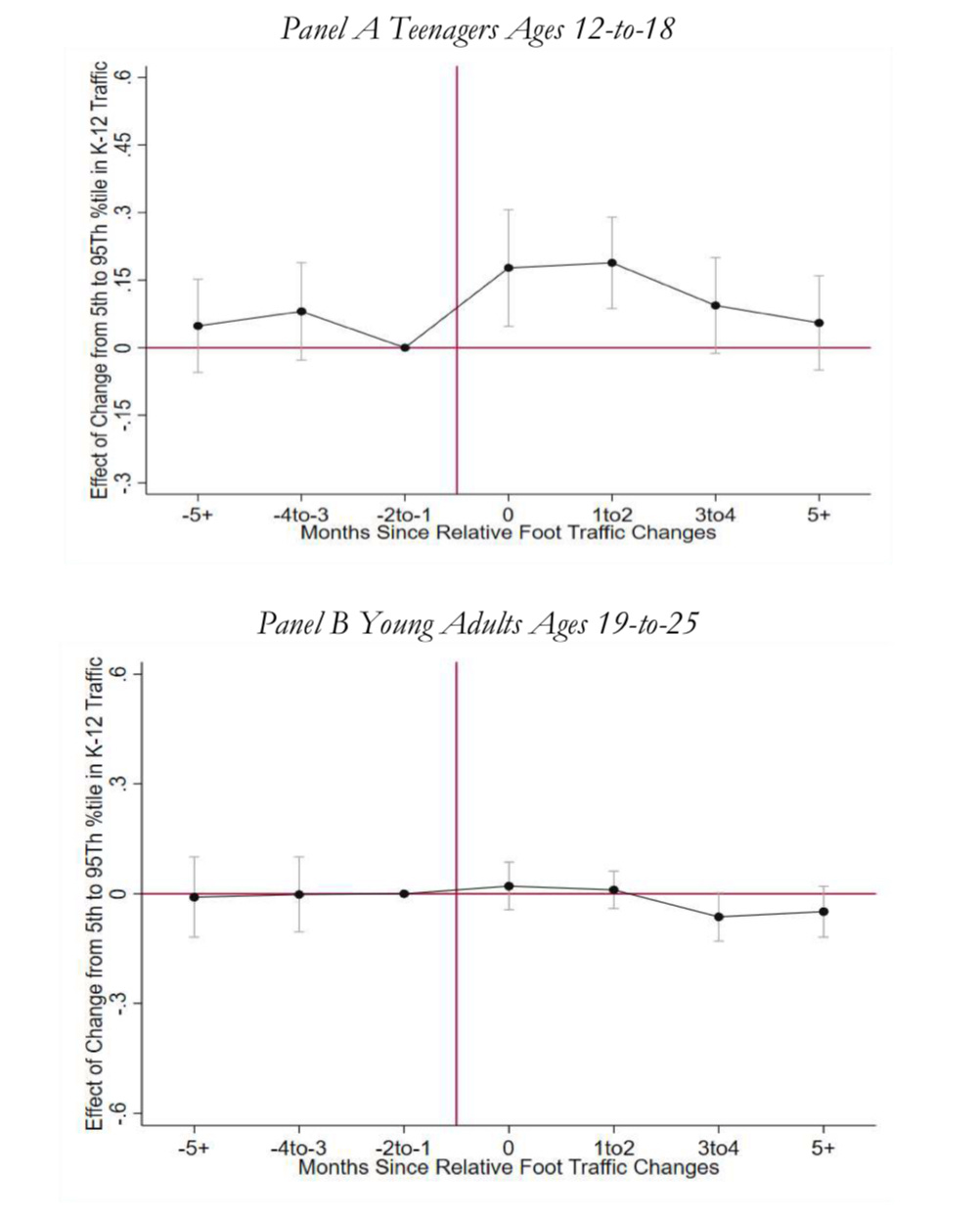
For adults aged 19-25, the resumption of in-person school had no effect on suicide rates. For teenagers, though, it’s a different story.
This data on the effects of COVID — or rather, the effects of escaping and then returning to school — is incredibly telling. The reported shifts appear specifically for adolescents who returned to school, not for their peers who remained at home during the same period. It is causation, not correlation.
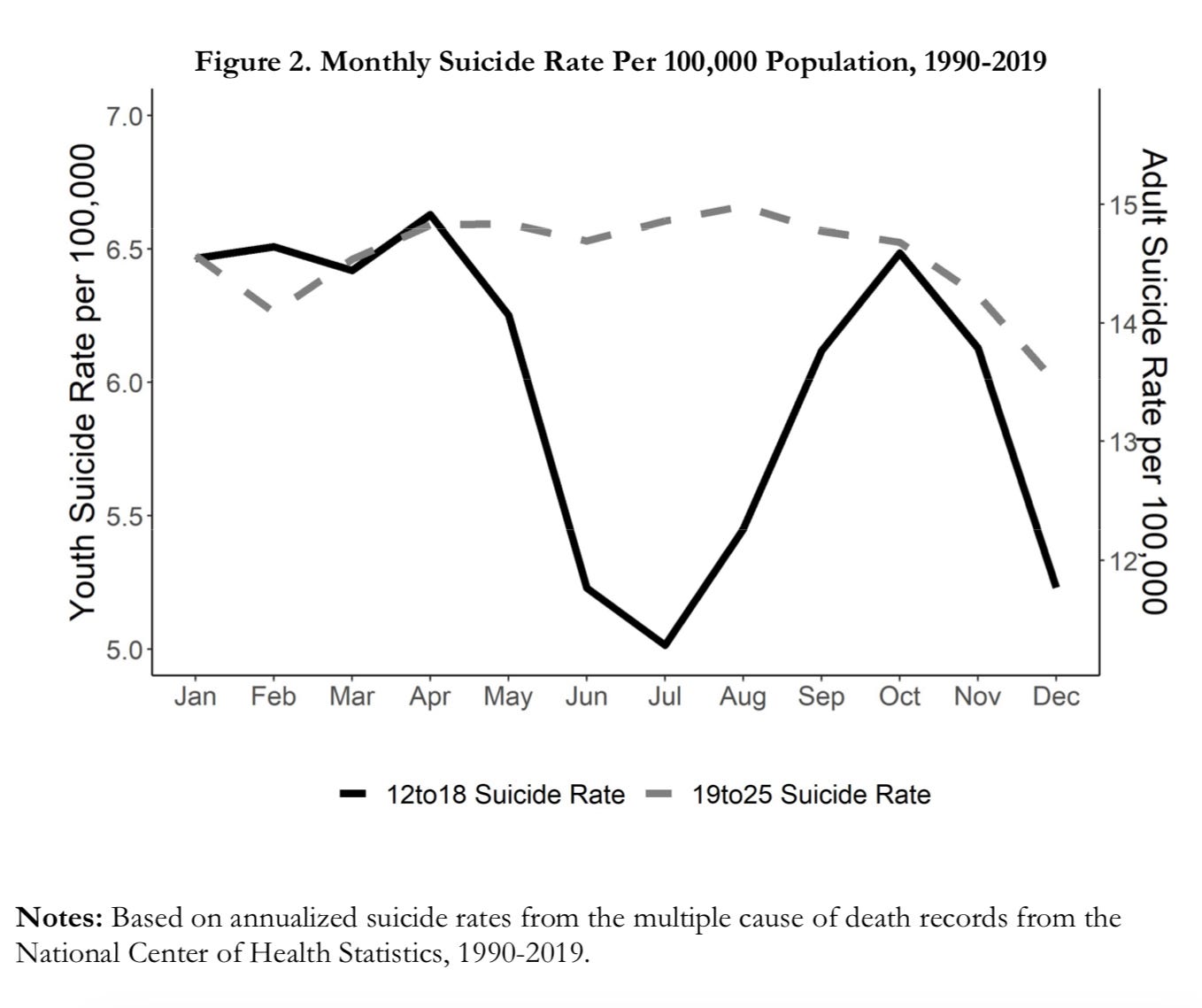
But the correlations are interesting too. For decades, researchers have noted the calendar effects on child suicide and mental health visits. From 1990-2019, suicide rates among young people have always dropped precipitously during the summers and spiked again in September. Adults show no such trend.
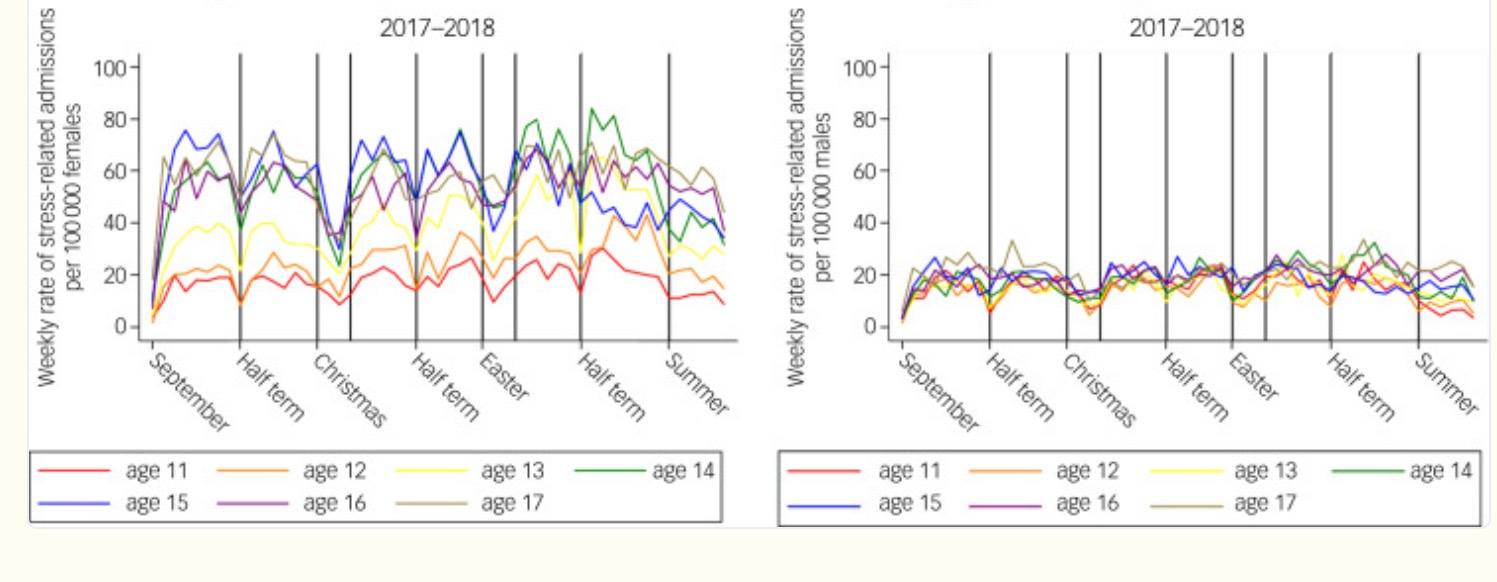
For English students, stress-related presentations in emergency rooms also rise during school periods and drop during holidays. This is true for both girls and boys across four years of data. Below is a figure showing rates from 2017-2018.
Beyond these clinical statistics, there’s also the simple fact that kids say they find school more stressful than pretty much anything else in their life. A study of 2,000 English secondary school students found that roughly half had skipped class due to anxiety. A 2018 survey from Pew Research similarly found that 88% reported academic pressure as a source of distress; comparatively, only 28% felt distressed by pressure to fit in socially.
In short, school sucks so much that it reliably makes students want to hide at home, visit the ER, and take their own lives. The data has been completely clear on these points for years.
However, the negative mental health effects of school do not seem to have stagnated over the last few years. Instead, they’ve gotten worse. For instance only 43% of teenagers cited school as a significant source of stress in 2009. By 2013, that percentage had nearly doubled, with school identified as by far the largest source of stress in the lives of adolescents. As of 2024, stress from academic pressure remained dominant at around 70%.
During the period when that initial jump in school-related stress occurred, suicide rates for children aged 15-19 suddenly spiked.
Of course, the shocking drop-off in youth mental health around 2012 is a well-known phenomenon: it is usually interpreted as the result of newly widespread social media use and smartphone ownership among young people. This is the basic argument Jonathan Haidt famously makes in The Anxious Generation. In the early 2010s, children suddenly became much less happy. What else could explain this shift other than the influence of social media?
While Haidt’s theory is plausible, the aforementioned survey data makes me very suspicious. If social media was the culprit, we should expect that teenagers started feeling more stressed about (for instance) their appearance or social status.
But they didn’t; mostly, they reported feeling more stressed about school. Intriguingly, this effect was potentially sharper for adolescent females: the exact group that, according to Haidt, suffered the most from the advent of social media.
However, to believe that increases in school-related stress largely account for the onset of the current youth mental health crisis, we would want to identify a seismic change in the schooling system around 2012 that could have plausibly driven the trend. And there was, in fact, such a change: the implementation of Common Core.2
Common Core was a set of educational standards meant to nationalize and clarify the skills that K-12 students should acquire over the course of their schooling. The new standards were notoriously difficult and cognitively rigorous: I recall my mother, at the time a fifth-grade teacher, complaining about the impossible word problems laid out in her new math textbooks.
One consequence of Common Core was that children had to spend much more time doing homework and much less time socializing with their friends. Data from the Pew Research Center shows these time allocation differences between 2003-2006 and 2014-2017. (Apologies for the blurry figure).
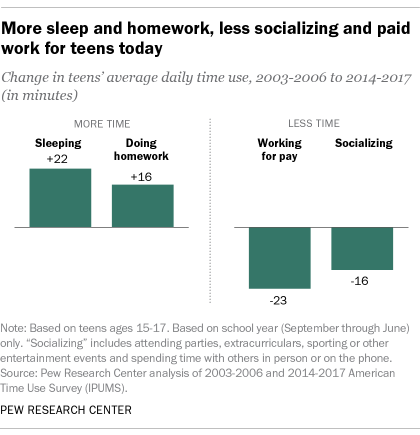
Notably, the increased number of students who reported school as a source of angst were primarily stressed about their homework loads. A survey of parents in 2013 also found that 63% said their child experienced “a lot of stress” due to the amount of homework they were assigned. And most importantly, recent studies suggest that the effect of homework load on mental health is non-linear — once the amount passes a certain threshold, the negative impacts suddenly skyrocket.
Am I willing to say that Common Core, rather than social media, was the singular force underlying the heightened destruction of youthful minds? No, I’m not. As Tyler Cowen pointed out in a conversation with Haidt, reducing these mood shifts to one cause or another is a bit like reducing a hurricane to the flapping wings of one particular butterfly.3
Still, it is striking that most discussions of the 2012 mystery tend to ignore what the kids themselves said about it. The children don’t think social media added much stress to their lives; they think the shift has much more to do with the increased rigor of school. Perhaps we should take their opinions seriously.
Okay, fine — school totally blows. But surely, social media can’t be entirely benign. Right?
Maybe, maybe not. Public assurances to the contrary, we don’t really know either way. The main problem is that most studies on the effects of social media fail to distinguish how users are engaging with their platforms. On Snapchat, you can make group chats with your friends and send pictures throughout the day; you can also receive nude pictures from random sex predators. Both forms of engagement would show up in a study as “screen time” or “time spent on Snapchat” — presumably, the latter is bad for mental health, and the former is potentially good. Whether one is substantially more common than the other is an unanswered empirical question.
The data we do have, however, is extremely murky. If you squint carefully, the studies summarized in The Anxious Generation do suggest that social media is somewhat harmful for teenage girls who are already at risk of mental health problems.
But on the other hand, a major longitudinal study found that using social media or playing video games more frequently had zero impact on the mental health of adolescents. A prior survey drawing from eight years of data had found that daily social media access had no effect on depressive symptoms. Data from Pew also shows that teens are more likely to report positive than negative experiences from their social media use.
Who’s right? Usually, it comes down to comically subtle arguments about survey methods. But one would think that if social media was truly so harmful — if, as Haidt has argued, it is the planet-sized dragon that flapped its wings and started a depressive hurricane — then there would be both minimal ambiguity and a strong academic consensus around his view. Notably, there is no such scholarly confusion about the effects of school.
Nonetheless, my gut (like yours) says that social media is not entirely neutral. My guess is that one particular form of engagement — doomscrolling through an addictive algorithmic feed — is bad for young brains. If studies could distinguish that activity from acceptable or even beneficial forms of engagement — for instance, forming group chats with your friends — then I think the statistics would be stronger. The benefits of socialization through these platforms is probably disguising the harms of consuming algorithmic slop.
Importantly, many platforms now emphasize content feeds over social interaction. That change is bad, and as some kids themselves have suggested, governments should probably move to regulate it.

Even if this somewhat generous intuition is right, though, the step of banning children from social media entirely is extraordinary and uncalled for. As far as we can tell, there is no clear evidence that usage is generally bad for mental health.
What we do know — or what we should know, at least — is that unimpeachable logic should back up any policy that limits the autonomy of a large and vulnerable population. That is clearly not the case for the present bans on adolescent social media access.
If the same fervor switched over to revamping the school system, however, that justification would exist. Scientists, parents, teachers, and children all agree that modern education is horrifically stressful. If we’re searching for a mental health bogeyman, then we adults should follow our own advice: look up from the phones and start paying attention to the classroom.
So if the harms of schooling are so obvious — and particularly, so much more obvious than the harms of social media — why isn’t anyone talking about it?
To wax anthropological for a moment: when we identify an important but opaque problem that we want to solve, we tend to search for a single obvious and comprehensible solution. Factory jobs are gone? Simple: deport all the immigrants who took them. My cows got sick? Simple: figure out who cursed them and reverse the magic spell. Kids aren’t happy anymore? Simple: stop them from doing the things that seem different from the things we did throughout our adolescence, during which we, of course, were entirely pleased with our lives.
Simple solutions are easy to think about and apply. But many important problems aren’t simple, which means that the simple solutions are often wrong. Social media, like fear of witchcraft and immigration, is yet another all too obvious answer to a much more complicated question: how did our children become so sad?
School is also not the only right answer; as always, the truth is multi-faceted. But the data shows that it is one especially important facet.
Yet we ignore the melancholic elephant in the room, because you can’t pass a bill to ban anyone under 16 from going to school. Nor should you, probably. Making school less awful requires careful research and debate. As evidenced by the ongoing panic over social media, that is not a specialty of politicians, the commentariat or, for that matter, most of the public.
It is, however, a speciality of scientists. And fortunately for us, scientists have identified several changes to school that are about as simple as banning social media, which also come with the added bonus of addressing an actual problem.
Excessive screen use (I’ll admit it), early school start times, and heavy homework loads contribute to greater sleep deprivation among students. Obviously, sleep deprivation is bad for mental health.
To address it, one easy step is to push back school start times. Many correlational studies note that starting the school day later is associated with students sleeping longer, feeling better, and getting better grades. This is an easy fix that would be widely welcomed by students.
Homework is the greatest source of academic stress faced by students today. As mentioned above, increases in homework load harm mental health at a non-linear rate. This is a good reason to cut homework loads down, since doing so might provide a similarly non-linear boost to the health of young people.
While there is some evidence that spending more time on homework leads to higher levels of academic achievement, we should probably prioritize the reduction of massively negative impacts on wellbeing rather than the increase of small positive impacts on grades and test scores. State policies should set caps on the amount of time students are expected to spend on homework each night, with the acceptable amount increasing gradually across later grade levels.
Students now receive substantially less time to eat and take breaks during the school day than they did in the 1980s. For instance, after the implementation of No Child Left Behind, 20% of schools reduced recess time by an average of fifty minutes per week. In England, school break times have been utterly slashed since 1996 to allow more time for “learning.” All this, despite the fact that longer recesses and more physical activity both produce happier, healthier, and more academically succesful students.
Many states have mandatory minimums on recess time, mainly for elementary school students: 30 minutes in California, 40 minutes in Arkansas, etc. These numbers are abysmally low, especially when it comes to young children. I always find it slightly tragic when I hear kids say their favorite part of the day is recess. We should indulge those kids, and all the evidence supporting their preferences, by raising the recess minimums and enforcing those rules with all the same vigor that has been applied to the distribution of Yondr pouches.

Like all good interventions, these small changes would probably have outsized effects. Children would be happier, less stressed, and less likely to kill themselves during school time. That’s great. If these modest proposals received half the attention of the latest moral panic, young people would be far better off.
But schooling is a system, and ultimately, it is the system itself that is ruining the minds of young people. Well before 2012, children were still committing suicide in the fall. Fundamentally, school is not what kids have evolved to do: they’re supposed to play freely with their friends, not spend their childhoods performing for adults under constant supervision.
Yet this is our brave new world. For the last fifty years, adults have opted to put their children in a panopticon. Social media bans are yet another brick in the wall.
I hope we won’t let the greatest threat to the mental health of our children go unaddressed. Nor do I know how to fix it: to truly remedy the system, we’ll need a much larger reckoning. But we can, at least, start bringing it down the same way we built it up: one brick at a time. And to decide which bricks to remove first from the prison, we should maybe consider the opinions of the people we’ve locked inside.4