Germany cleared Rocket Lab’s acquisition of Mynaric last week, approving the deal under its foreign investment review process after more than a year in regulatory limbo. (See: The Door Opens) The transaction closes this month. Beck described it as “an exciting step closer to expanding our ability to support the German and European space industry at a much greater level.” The European dimension of the argument that follows takes on additional weight in light of that approval.
In 1966, Hewlett-Packard was the finest precision instrument company in the world. Its oscilloscopes, signal analyzers, and test equipment were the gold standard of scientific measurement — beautiful, reliable, and priced accordingly. The company had built its identity, its culture, and its economic model on the premise that excellence at small scale commanded a premium that volume manufacturers could never replicate.
Then the integrated circuit arrived and began doing in silicon what HP’s instruments had done in metal and glass — cheaper, smaller, and faster with every passing year. HP faced a choice that looked like a product decision but was actually a question about what kind of company it intended to be.
The leadership team chose to become something different. Uncomfortably, expensively, culturally disruptively different. The HP-35 calculator in 1972 put a slide rule in every engineer’s pocket for $395. It required HP to think about manufacturing volumes, cost structures, and distribution channels that were alien to the instrument business. It required them to compete on dimensions — price per function, production scale, supply chain efficiency — where precision manufacturing heritage was not an advantage and was sometimes a liability.
They made the transition. Not every precision manufacturer did.
Rocket Lab is at that inflection point now. The New Space ecosystem that Peter Beck and his team helped build is maturing into something fundamentally different from what it was — just as the semiconductor era transformed HP’s world, and just as the Mac and then the iPhone required Apple to become a series of successively different companies while retaining its essential character. Every player in the New Space economy faces a version of this reckoning. For Rocket Lab, given its specific strengths, its current position, and the direction the market is moving, the reckoning takes a specific form: giga-scale manufacturing or progressive irrelevance.
The signals suggest Beck sees it coming. Whether the organization he has built, the capital he is positioning, and the window that remains are sufficient to execute the transition is the question this article examines. The window is shorter than it appears — and events of the past week make it shorter still.
Rocket Lab is a high-precision, low-volume aerospace manufacturer that has assembled remarkable vertical integration through a series of smart acquisitions.
Since going public in 2021 it has acquired Sinclair Interplanetary for attitude control systems, Advanced Solutions Inc. for flight software, Planetary Systems Corporation for separation systems, SolAero Holdings for space solar cells, Mynaric for laser optical communications terminals, Geost for electro-optical sensor payloads, and Optical Support Inc. for precision machining. Every acquisition filled a specific gap in the vertical integration stack. Every one was additive rather than consolidating. Together they built a company that can credibly supply a meaningful fraction of the bill of materials for any satellite regardless of who builds or launches it.
The financial results reflect this. FY2025 revenue reached $602 million, up 38% year over year. The backlog stands at $1.85 billion, with roughly $685 million expected to convert in the next twelve months before a single new contract is signed — underwritten primarily by Space Development Agency satellite programs following a revenue recognition pattern that provides unusual near-term visibility. Non-GAAP gross margins reached 44.3% in Q4 2025.
Beck’s acquisition philosophy has been consistent throughout: buy capabilities you don’t have rather than scale capabilities you do. That discipline built a company with extraordinary breadth at low volume. It is the right philosophy for assembling vertical integration across a fragmented component market. It is the wrong philosophy for what the market is about to demand.
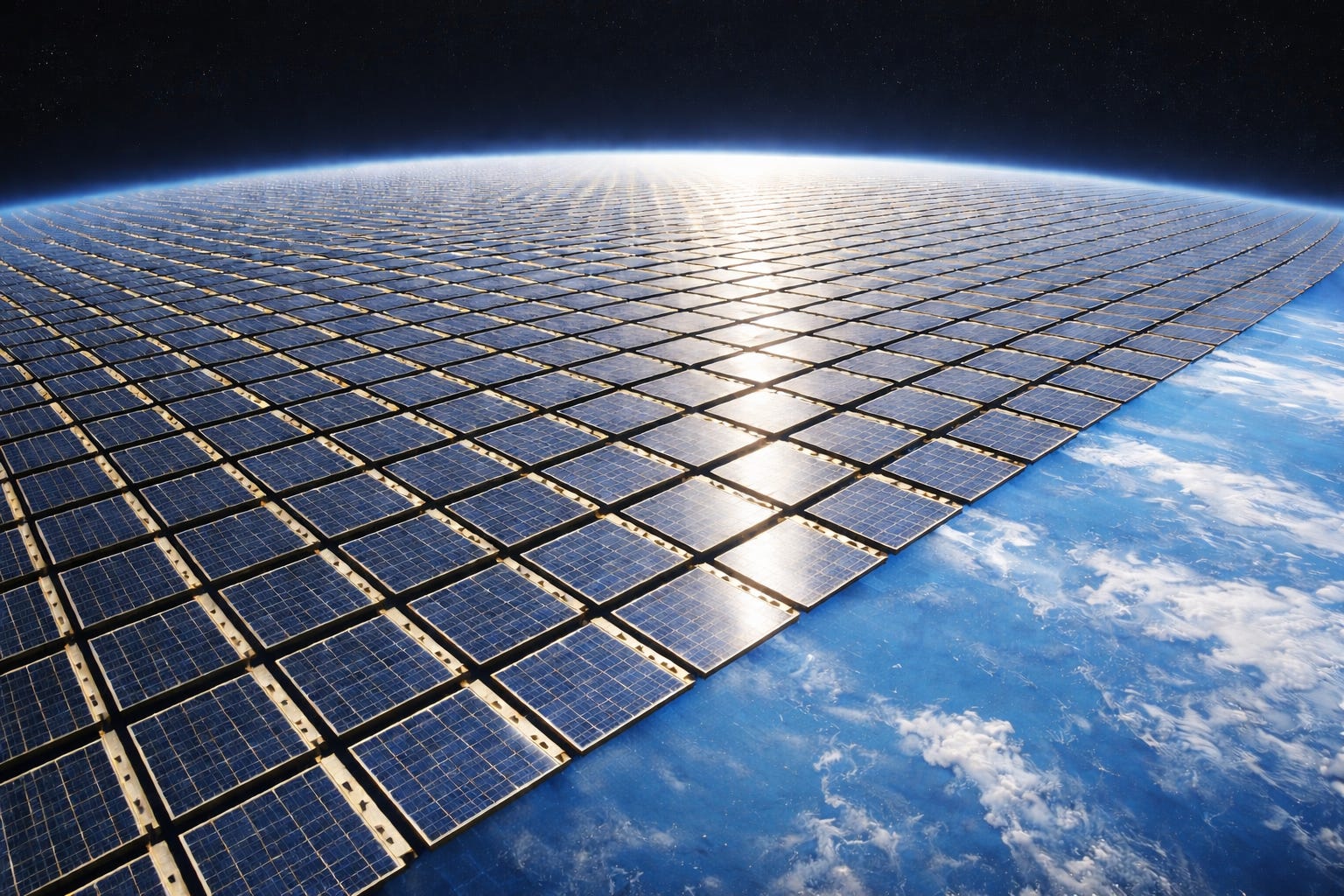
In February 2026, on the same day it reported record annual revenue, Rocket Lab announced radiation-hardened silicon solar arrays designed for what Beck called “gigawatt-scale space-based data centers spanning kilometers in orbit.”
Beck’s timing instinct was right. The orbital data center market is real enough to warrant positioning ahead of it. SpaceX/xAI has filed with the FCC for authorization to deploy up to one million data center satellites. Blue Origin filed for 51,600. Starcloud already has operational hardware in orbit — its first satellite carried an NVIDIA H100 GPU that trained a language model in space. Google’s Project Suncatcher is planning prototype launches by early 2027. These FCC filings are regulatory positions rather than purchase orders, and the full economics of orbital data centers require launch costs still several years away. But the direction is legible, and the window for establishing a manufacturing position runs ahead of demand, not behind it.
SolAero’s Albuquerque facility currently produces roughly one to two megawatts of solar capacity annually. The CHIPS Act expansion — funded by a $23.9 million federal award alongside New Mexico state incentives — will push that toward 1.5 to 2 megawatts. The orbital data center market at any meaningful scale requires gigawatts. The gap is not a scaling challenge in the conventional sense. It is a category change: three orders of magnitude that demand a different manufacturing model, a different organizational culture, a different capital structure, and a different competitive posture than anything Rocket Lab has yet built.
At the World Economic Forum in Davos in January 2026, Musk announced that both Tesla and SpaceX are independently working to establish 100 gigawatts of annual solar manufacturing capacity inside the United States. On Tesla’s Q4 earnings call he was explicit: “We’re going to work toward getting 100 GW a year of solar cell production, integrating across the entire supply chain from raw materials all the way to finished solar panels.” This week, Reuters reported that Tesla is in advanced talks to purchase $2.9 billion of manufacturing equipment from Chinese suppliers — primarily Suzhou Maxwell Technologies, the world’s dominant producer of solar cell screen-printing production lines — with delivery targeted before this autumn, shipment directed to Texas. Some of that capacity, the sources noted, will be used to power SpaceX satellites.
Tesla’s 100 GW ambition targets conventional terrestrial silicon solar panels — monocrystalline wafers produced by screen-printing equipment, the same technology that powers rooftops and utility-scale ground arrays. SolAero makes something categorically different: radiation-hardened compound semiconductor devices, gallium arsenide multi-junction cells and now radiation-hardened silicon, produced through metalorganic chemical vapor deposition and specialized epitaxial processes designed to survive the particle radiation environment of low Earth orbit. The screen-printing equipment Tesla is sourcing from Suzhou Maxwell does not produce space-grade cells. A kitchen knife and a surgical scalpel are both metal, both cut, and share almost no manufacturing process in common. The same is true here.
Similarly, Terafab — the 2 nanometer semiconductor fabrication facility Tesla confirmed this week at an estimated cost of $25 billion — targets AI logic chips and memory for autonomous vehicles and robotics. Its photolithography process, extreme ultraviolet exposure systems, and sub-angstrom process control have no direct overlap with solar cell manufacturing. Terafab and the 100 GW solar ambition are separate initiatives addressing separate supply chains.
Musk announced 100 GWh of battery cell production by 2022 at Battery Day in September 2020. By early 2025, Tesla’s actual 4680 production was estimated at roughly 20 GWh per year — a fraction of the target, five years late. The dry electrode process central to Tesla’s cost reduction claims proved far more difficult than announced. The pattern of transformative manufacturing ambitions that materialize later, smaller, and more expensively than stated is well established.
The distance between large-scale terrestrial silicon solar manufacturing and space-grade silicon solar manufacturing is not infinite. It is a qualification gap — radiation testing, flight heritage, certification databases — that takes years to cross, not decades. Once SpaceX has operating silicon solar fabs at any meaningful fraction of 100 GW, the organizational capability, the process engineering workforce, and the manufacturing infrastructure to develop space-grade variants exist in an adjacent building. At 20% of Musk’s stated target — the kind of delivery ratio the 4680 precedent suggests — SpaceX would still have 20 GW of silicon solar manufacturing capacity. Twenty gigawatts is four orders of magnitude beyond SolAero’s current output. Even a small fraction of that infrastructure redirected toward space-grade qualification changes the competitive landscape permanently.
The CHIPS Act designated SolAero’s Albuquerque facility as strategically important domestic semiconductor manufacturing. Rocket Lab is building its space solar manufacturing base in the US semiconductor corridor, with federal policy support and supply chain infrastructure aligned around it. Tesla is sourcing its 100 GW manufacturing equipment from Chinese suppliers — Suzhou Maxwell, Shenzhen S.C New Energy, Laplace Renewable — and seeking Chinese export approval for delivery. The geopolitical frame that makes domestic space solar manufacturing strategically valuable is exactly the frame that makes Tesla’s sourcing approach complicated. Rocket Lab’s supply chain position and CHIPS Act standing represent a structural advantage that Musk’s approach does not easily replicate, at least not quickly.
SolAero’s product remains differentiated. A kilometer-scale solar wing powering an orbital data center performs identically whether 98% or 100% of its cells operate to full specification — the energy difference is a rounding error. At the efficiency and radiation tolerance levels SolAero delivers, the qualification heritage is real and the flight record is genuine. That is not nothing. But the competitive moat around space solar is narrowing in real time, and the entity doing the narrowing is the same entity that will eventually need to ask whether it makes more sense to buy space solar cells from Rocket Lab or develop them internally from its own manufacturing base.
The CHIPS Act expansion to 1.5 to 2 megawatts is not a response to that dynamic. It is a placeholder. The commitment that the strategic situation actually demands — a specific announced capacity target at gigawatt-level ambition, with financing and a production roadmap that makes the intent legible to anyone reading it — has not been made. And the window in which making it changes the competitive outcome is shorter than it was a month ago.
The deeper danger is not solar alone. The entity that crosses the space solar qualification threshold first — whether Rocket Lab through investment, or SpaceX through adjacent infrastructure and competitive necessity — then commands the cash flow and orbital customer relationships to ask why it continues to purchase reaction wheels, laser communications terminals, spacecraft buses, and separation systems from a third party. Solar is where the competitive moat inversion begins. It does not end there.
Neutron will fly. Beck’s engineering track record on Electron — 83 missions, 22 consecutive successes — provides reasonable grounds for confidence that the technical challenges are solvable. The Archimedes engine has completed full-duration burns at NASA Stennis. The launch complex at Wallops Island is operational. The first launch is targeted for Q4 2026, roughly six years after development began — approximately twice the timeline Beck originally projected.
The financial contribution follows a specific and inconvenient timeline. One launch in 2026 at approximately $55 million is noise against a projected $900 million-plus revenue base. Three launches in 2027 generates $165 million. Five launches in 2028 generates $275 million. Only then does Neutron begin to matter to the income statement in proportion to the capital consumed building it. Meanwhile Neutron’s R&D consumes $270 million annually — capital not available for manufacturing investment elsewhere.
Neutron is strategically necessary. A successful medium-lift reusable rocket with national security certification is genuinely valuable, particularly as the sole credible non-SpaceX, non-Blue Origin option for customers who need assured launch access without dependency on a single provider. The NSSL Phase 3 Lane 1 contract — one of only five awarded by the Space Force — validates the strategic logic.
A European launch dimension adds a cadence multiplier that changes the program’s economics materially. Rocket Lab Europe — a proposed separately incorporated entity with sovereign co-investors that would give Rocket Lab a launch platform accessible to European institutional customers — is one framework through which that dimension could be pursued. The demand is structural: European governments and institutions are actively building alternatives to US launch dependency, for reasons both technical and geopolitical, and the appetite for a credible non-US, non-Chinese launch provider is growing. A European launch complex doubles achievable annual Neutron missions without doubling hardware investment. At ten or more launches annually rather than five, Neutron generates $550 million-plus in launch revenue and the program’s economics justify the investment at a considerably earlier point on the timeline.
Germany’s approval of the Mynaric acquisition this week is the first concrete regulatory signal that a European Rocket Lab entity is viable rather than theoretical. The path to approval wasn’t smooth -- Rheinmetall briefly entered the bidding with a “national solution” argument before withdrawing, leaving Germany a binary choice. They approved. Mynaric brings 300 engineers in Munich, ESA contracts including the HydRON award, and a dual-market position serving both the U.S. Space Development Agency and European institutional programs. That is Rocket Lab’s first genuine European footprint. Whether Beck pursues a governance architecture that makes that identity structurally durable -- a separately incorporated European entity with sovereign co-investors, eligible for IRIS2 and equivalent sovereign programs -- is what the next chapter will reveal. The Mynaric approval opens the door. It does not walk through it.
The problem is not Neutron. The problem is the sequencing logic that has grown up around it — the implicit organizational premise that the manufacturing scaling decisions, the cultural transformation, and the solar investment commitment can all begin once Neutron is flying. That premise treats as sequential what the maturation of the New Space ecosystem now requires to be parallel. The window for establishing competitive position in giga-scale solar manufacturing does not wait for Neutron’s cadence to reach five launches per year. SpaceX is not waiting. The two timelines compete for the same capital and the same leadership bandwidth, and the failure to treat them as simultaneous rather than sequential is a strategic risk — one that deserves a fuller examination than this article can give it, but one that cannot go unnamed here.
Frank Klein joined Rocket Lab as COO in September 2024, bringing 27 years at Daimler across 12 production sites and 13,000 employees, followed by his role at Rivian leading the transition from handbuilt prototype vehicles to volume EV production. Cameron McCarter joined as VP of Supply Chain with experience from Tesla and Rivian standing up critical production operations, alongside earlier work in Northrop Grumman’s space division.
The pattern — not one automotive executive but two, at COO and VP Supply Chain simultaneously — is a deliberate organizational intervention. Beck is importing volume manufacturing DNA at multiple levels because he understands the culture required for what comes next does not yet exist inside Rocket Lab at sufficient depth. That self-awareness matters, particularly against a competitive backdrop that now includes a named adversary with a concrete 100 GW solar ambition and the manufacturing culture to pursue it.
Rocket Lab’s culture has been built around getting it exactly right. That premise has served the company well through 83 Electron missions, through the SDA satellite programs, through the deep space missions it has executed for NASA. Precision as the organizing value is the right culture for a company whose customers care whether their $500 million satellite survives launch and operates for a decade. It is the right standard for every launch vehicle, every interplanetary mission, every system where a single failure is unacceptable.
A kilometer-scale solar wing powering an orbital data center performs identically whether 98% or 100% of its cells operate to full specification. The energy difference is negligible. The cost difference between pursuing 98% yield and 100% yield at gigawatt production volume is enormous. Volume semiconductor manufacturing runs on different premises than precision aerospace: yield, throughput, cost per watt, and process consistency across millions of units are the metrics that matter. A process engineer who produces ten thousand good-enough cells is more valuable than one who produces one thousand perfect ones — and the organizational instinct to treat those two outcomes as equivalent, which precision manufacturers develop over decades, is specifically what has to evolve.
The transition is not from precision to volume. It is toward applying precision where it is genuinely irreplaceable — launch vehicles, mission-critical systems, interplanetary hardware — and volume discipline where scale economics determine whether you survive the next decade. Holding both simultaneously, and knowing with clarity which applies where, is the actual cultural challenge Rocket Lab faces. It is more demanding than either pure approach.
Klein can provide the manufacturing philosophy. McCarter can build the supply chain infrastructure. The transformation runs deeper than two hires can reach alone. It requires Beck to find the same satisfaction in a factory running at 95% yield across a million units that he finds in a rocket that works perfectly on its 83rd consecutive flight. When manufacturing scale, yield, cost per watt, and production throughput enter Beck’s public vocabulary alongside precision and heritage, the transition is becoming real rather than aspirational.
The rolling ATM structure with forward sale provisions positions capital for specific deployment against defined events rather than general overhead. The CHIPS Act semiconductor designation signals regulatory strategy aligned with the right manufacturing pathway. The silicon cell announcement signals market awareness ahead of demand. Klein and McCarter signal cultural intent.
The commitment that turns intent into trajectory has not yet been made publicly. It looks like a specific manufacturing target at gigawatt-level ambition, with financing and a production roadmap that makes the intent legible to anyone reading it. The gap between that commitment and the current CHIPS Act expansion is not incremental. It is the difference between a placeholder and a strategy.
The orbital data center market will not arrive next year. The full economics require launch costs still several years away.
A manufacturing commitment at gigawatt-level ambition. Not the CHIPS Act expansion already announced, but something an order of magnitude larger — specific capacity targets, a financing structure that goes beyond incremental ATM equity, and a production roadmap with dates attached. The urgency of this signal has increased materially since Musk’s Davos announcement. Every month without it is a month in which the competitive window narrows.
A strategic partnership bringing volume manufacturing process expertise Rocket Lab doesn’t have internally. The right partner brings compound semiconductor production experience at scale. The right geography is the US semiconductor corridor — Albuquerque to Chandler — where the CHIPS Act ecosystem provides both capital and policy continuity. This is where Rocket Lab’s sourcing advantage over Musk’s Chinese equipment strategy becomes most legible.
Neutron’s second flight timeline. The cadence between flights one and two reveals more about the reusability thesis than the first flight itself. Any indication that Beck is treating the solar manufacturing commitment as a parallel priority rather than a post-Neutron consideration would signal the sequencing logic has changed.
European infrastructure development. Launch site engagement, sovereign capital discussions, or institutional partnerships suggesting the cadence multiplier is being built rather than theorized. The structural demand for non-Musk, non-Chinese space infrastructure is growing. A European Rocket Lab entity addresses that demand directly.
Beck’s own language. Manufacturing scale, yield, cost per watt, and production throughput entering the CEO’s public vocabulary alongside precision and heritage is the clearest signal available from outside the company that the transition is underway. Watch also for any response to the SpaceX and Tesla solar manufacturing announcements in Beck’s public commentary — whether he frames them as validating the market or as the competitive forcing function they actually represent.
When HP shipped the HP-35, the precision instrument business didn’t disappear. HP’s oscilloscopes and signal analyzers continued to be excellent, continued to command premium pricing, continued to serve customers who needed exactly what they offered. The center of gravity of the company shifted. The culture that would build the PC division, the printer division, and the enterprise computing business was planted alongside the precision instrument heritage, not in place of it.
Rocket Lab’s SDA satellite programs, its Electron launch business, its defense component supply chain — these remain valuable, defensible, and growing. The qualification advantage in space solar cells is real. The Lightband separation system flies on every major launch vehicle globally with a 100% success record. National security customers will pay premium prices for domestic, non-SpaceX assured access for the foreseeable future. The CHIPS Act designation gives Rocket Lab a geopolitical advantage in the domestic manufacturing conversation that SpaceX’s China-sourced equipment strategy does not replicate easily. These positions endure.
What the transition requires is adding something alongside what exists: a manufacturing culture, a capital commitment, and an organizational posture oriented toward the volume layer of the space economy — not instead of what Rocket Lab has built, but in addition to it. Precision where precision is irreplaceable. Scale where scale determines survival.
Beck has assembled the right pieces. Klein and McCarter are the right cultural imports. The capital instrument is positioned. The technical product is announced. The US manufacturing corridor exists and is being rebuilt with federal support. The competitive pressure is now explicit, named, and moving.
The declaration hasn’t come yet. In capital allocation terms it looks like the announcement that Rocket Lab intends to own the volume layer of the space solar market before SpaceX crosses the qualification bridge from its terrestrial manufacturing base into orbit.
Hewlett and Packard made that declaration while the window was open. Beck must now do the same.
Bob Krause writes Unlocked Value on Substack, applying first-principles analysis to investment theses at the intersection of technology, energy, and the space economy. Nothing in this article constitutes investment advice.