Somewhere around 40,000 years ago, Homo sapiens arrived in Europe and encountered their cousins, the Neanderthals. The Neanderthals were, by any individual measure, formidable. Their brains were at least as large as ours, possibly larger. They were stronger. They made tools. They buried their dead. They made sophisticated artworks. They survived ice ages that would have killed anything less tenacious. They had been running the European continent for a quarter of a million years.
Within about ten thousand years of our arrival, they were gone.
The conventional story goes something like this: Sapiens were smarter, better adapted, more technologically sophisticated. But the archaeological record makes this surprisingly hard to sustain. Neanderthal toolkits were comparable to early Sapiens toolkits. Their hunting strategies were effective. One-on-one, a Neanderthal would have absolutely destroyed a Sapiens in a fight, and it’s not clear that any individual Sapiens was meaningfully “smarter” in the ways that matter for survival on an ice-age steppe. So what was it that gave Sapiens such an advantage?
Sapiens sites from the Upper Paleolithic period often contain artifacts made from materials sourced from hundreds (or occasionally thousands) of miles away. Not just functional items like tools either, but decorative and purely symbolic items too. Neanderthals made sophisticated jewelry as well, but all of their artifacts have been from local materials. We have not found any evidence of long-distance trade networks among Neanderthals or other species of hominid besides Sapiens.
Beyond trade, there is also evidence of shared symbology across hundreds of miles and thousands of years. The same underlying cognitive difference presumably enabled trade, shared symbology, shared inter-band ritual practices, and other forms of relationships between groups of Sapiens that other hominid species lacked. This enabled greater genetic flow to prevent inbreeding, trade for locally scarce resources, and possibly other types of cooperation.
In other words, groups of Sapiens were able to coordinate. Through this ability, they were able to find a variety of mutually beneficial means of relating which were previously unavailable. This ability, coordination capacity, is central to the story of humanity.
I want to try to make precise what I mean by “coordination capacity,” because I think it names something real and important that doesn’t quite have a standard term.
Let’s say Joe and Jane are neighbors. Every spring, flooding threatens both their properties. If they each build their own individual levees, it costs them each $5,000 and provides mediocre protection. But if they build one shared levee system along the river it costs them each $3,000 and provides better protection.
This is a Pareto improvement. Both parties are better off. The shared levee is the $4,000 in value just sitting on the table, waiting to be picked up. No one has to lose. It’s the closest thing we get to a “free lunch” in the real world.
The catch is that we can only pick up these free lunches if we can coordinate. We have to agree on a design. We have to trust that the other person will actually do their share. We have to resolve disputes about whose property the levee runs through. We need some mechanism — a contract, a shared sense of obligation, a local government or other third party — that makes the cooperation actually happen.
Once some such mechanism is in place, it can be used to coordinate many mutually beneficial arrangements. But not every coordination mechanism is equally good. Some arrangements are harder to reach than others. Not all are pure Pareto improvements, where both sides benefit with no cost. In reality, such efficiency gains are not that common relative to ones such as Kaldor-Hicks, which entail one party bearing a greater cost than the other to reap mutual net benefit. More common yet are arrangements that are not purely net-benefit, but involve some party that loses at least something for a large total net benefit.
Often you have some proposed efficiency gain that produces a large number of losers of unknown identity. You could compensate them for their losses, but you need to be able to identify them first, as well as have the upfront cash to give them. That’s no easy task. The more complex the arrangement needed for an efficiency gain, the more sophisticated the coordination mechanism needs to be in order to facilitate the arrangement. Imagine if instead of two neighbors trying to build a levee, it was 100. A shared sense of obligation alone probably wouldn’t be enough to ensure compliance.
This is coordination capacity — the limit on how well a group of agents can act together toward a shared objective. In particular, I want to focus on the objective of finding efficiency gains, as in the above examples. Despite our advanced coordination capacity relative to Paleolithic Sapiens, there is an absolutely staggering number of free (or at least very cheap) lunches lying around. The world is not, in general, anywhere near the efficiency frontier. It’s not even close. Increasing our ability to pick those up is a free banquet. The reason no one is eating it is not that they don’t want to — it’s that they can’t coordinate well enough to sit down at the table together.
You can read much of history through this lens.
The invention of money? Coordination technology. Barter requires a coincidence of wants; money lets you coordinate trades across time and across parties who would never otherwise be able to transact. The efficiency gains were so enormous that every society that used money rapidly outcompeted those that didn’t.
Religion? Coordination technology. A shared set of abstract values, symbols, and metaphysics enables trust between groups and faster development of new shared concepts and easier theory of mind. If you know the trader from a faraway land worships the same god, you have some idea of what sorts of things he values and what you can expect in dealing with him.
Property rights? Coordination technology. Without clear ownership, you get the tragedy of the commons — everyone’s individual incentive is to overgraze, overfish, overextract, even though everyone would be better off with restraint. The right to keep what you produce also incentivizes more production. Property rights are a mechanism for aligning incentives so that the Kaldor-Hicks improvement (investment, sustainable use) becomes the individually rational choice.
Courts and contract law? Coordination technology. They let strangers cooperate on complex, long-term projects by making promises credible. A world without enforceable contracts is a world where most business relationships can’t exist, which means most of the value those relationships would create simply doesn’t get created.
Containerization of shipping is a great recent example, not broadly instituted and standardized until the 1970s. Adapting ports and ships to accept standardized shipping containers unlocked global trade at an unprecedented scale. Previously the transaction costs of international trade were high enough to prevent it from being economical in many cases, containerization ushered in an economic revolution.
And of course there’s the Internet. It’s not hard to think of ways that has increased coordination capacity.
The pattern is always the same: there’s value sitting on the table, inaccessible because of coordination problems. Someone invents or discovers or evolves a mechanism that solves the coordination problem. The value gets captured. Sometimes there are short-term losers, but in the long run, everyone involved is better off.
In his classic essay “Meditations on Moloch,” Scott Alexander uses Allen Ginsberg’s imagery of Moloch from his poem “Howl” to personify a form of coordination failure, which he calls a “multipolar trap,” where every party with a system is unhappy with the system, but the parties are unable to coordinate with each other to reform the system. If you haven’t read Scott’s essay, I highly recommend you do so.
Arms races are a classic example of a “Moloch” style problem. Both sides of a cold conflict would prefer not to invest some large fraction of their GDP into building up their militaries, and instead spend it on more productive, positive-sum areas like infrastructure improvements. But the risk of unilaterally cutting spending is too great, as the opposing side may see it as an opening to strike. In order to implement something like an arms control treaty, you need some baseline level of coordination, some means by which each side can trust that the other is adhering to the terms of the treaty. That might entail a neutral third party, or some jointly controlled institution accountable to both sides. Without this, the arms race is doomed to continue.
Pollution, aquifer depletion, there are plenty of examples of such uncaptured Pareto improvements out there. Most of them are not as extreme as a Canaanite deity who demands child sacrifice, but nevertheless, they result in great costs to humanity.
Moloch wins when coordination capacity is insufficient. Moloch is defeated when coordination improves enough to capture the Pareto improvement that everyone already wanted. Moloch too is made up of coordination mechanisms though. Otherwise, the actors within the system would simply stop doing the thing they don’t like out of self-interest. The issue is that there is not enough coordination, because capacity is limited. The two states in the arms race have enough internal coordination to make weapons, but not enough coordination between their respective leaders to sign a treaty. If you gave each of their leaders a crystal ball that allowed them to know instantly if the other side is violating the terms of the treaty, they’d be a lot more likely to come to the table.
There’s a concept that has grown popular recently known as “state capacity.” Essentially, it’s the government’s ability to get things done. It’s all well and good for a state to pass laws, but unless they have police officers to enforce them, courts to hear the cases, and prisons to put the criminals in, the laws may as well not exist. State capacity is a type of coordination capacity, limited to the internal workings of the state.
State capacity is a double-edged sword though. If the state has the ability to do good things, like build infrastructure and enforce laws, it also has the ability to do bad things, like bulldoze beloved neighborhoods or jail political opponents. In their book The Narrow Corridor, Acemoglu and Robinson use the metaphor of a “chained leviathan,” in reference to Hobbes. If you don’t chain the leviathan, it becomes an agent of Moloch.
Let’s return to an earlier point I made about needing to coordinate complicated tradeoffs for a net efficiency gain. If there are a lot of losers, you need to find them in order to compensate them. Well, isn’t that what governments are for? They can just track down the losers and pay them out of the treasury, right? In Seeing Like a State, James C. Scott lays out many of the ways powerful states can go wrong. In order to exercise their will, states seek legibility—knowledge of what they govern—which on its own leads states to curtail rights and traditions. Think of illegibility as one of the chains on the leviathan. If the state can’t easily identify its people and redistribute their wealth for good reasons, that means they also can’t do it for bad reasons.
Striking the balance between a constrained state and a powerful one is perhaps the biggest political challenge of liberal governments in the present day. In our complex civilization, we often need coordination that markets alone cannot provide and thus turn to governments. Often the result is bureaucracy, waste, and graft. Why?
Modern states are complex machines that employ millions of people. Democratic systems of government are supposed to hold these massive machines accountable and ensure they act in accordance with the people’s will, but it seems the leviathan has grown too big for its chains. Increasingly we see a misalignment of incentives between the governors and the governed. It seems every passing year, the chained leviathan looks a little more like Moloch.
Instead of state capacity, perhaps the focus needs to be on general social coordination capacity. That is to say, the machinery of government needs to get better at identifying and reconciling the various preferences of its citizenry and stakeholders, and the citizenry and stakeholders need to get better at aligning the activity of government. There are efficiency gains lying around everywhere, waiting to be picked up, we just have to get better at finding them.
In 1951, Taiwan implemented a system called the Uniform Invoice Lottery. Every receipt you get from a store essentially functions as a lottery ticket. This incentivizes customers to demand receipts from merchants, leaving a paper trail of transactions and making tax evasion difficult. Needless to say, this system is far cheaper than the government hiring a bunch of auditors to review the records of shopkeepers. It achieves the government’s desired result with a far smaller degree of state capacity. Less state capacity means lower cost and less risk from government misalignment.
I said two paragraphs ago that we need to get better at finding such free lunches lying around. The truth is, we are already not bad at finding them. We have academic fields such as social choice theory and mechanism design dedicated to finding them. Our real difficulty is in picking them up. Why can’t we just pick up the free lunches and have our banquet? Who is stopping us? Moloch.
Remember, without coordination capacity, you get caught by Moloch, and often you need to coordinate in order to build up coordination capacity. People who are incentivized to perpetuate the status quo block improvements, and there’s no mechanism to or override their resistance. Society gets stuck in a bad equilibrium, staring at the banquet through a window.
This, I think, is the deep explanation for why “just copy the institutions of successful countries” often fails as a development strategy. The institutions are as much the output of coordination capacity as they are the source of it. Transplanting institutions into a society that lacks the underlying coordination capacity to support them is like giving someone a bicycle when they haven’t learned to walk — the tool is right, but the prerequisite capability is missing.
It also explains why improvements in coordination capacity can be so dramatically nonlinear. For a long time, a society might be stuck — unable to reach the threshold needed to start the virtuous cycle. Then some development — a new communication technology, a new form of social organization, a charismatic leader who solves a key trust problem, a new religion — pushes coordination capacity just past the tipping point. Suddenly the virtuous cycle kicks in, and what follows looks from the outside like a miracle of rapid development. The banquet was always there. They just finally found the door.
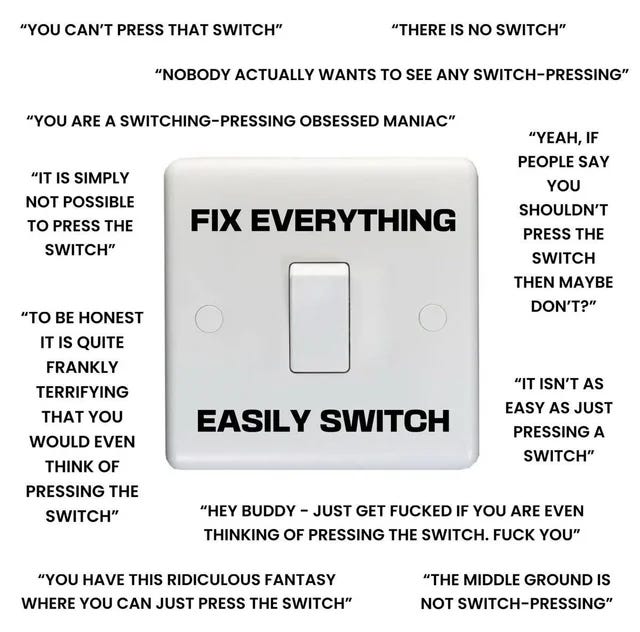
So how do we get to that next level? How do we beat our molochs, push the “fix everything easily” button, and pick up all those lunches? How do we get coordination capacity? Where does it come from?
There are a number of sources:
Individual coordinators: Some individual humans are just really good at coordinating. They are intelligent, prudent, and have good memory, and can plan lots of things efficiently without being overwhelmed. Better yet if they are charismatic and good at getting people to trust them.
Institutions: Really, coordination is the goal of every institution when you think about it. Institutions are machines made of people glued together by incentive mechanisms. They are made of coordination. They are not limited by the bounds of human lifespans or memory. They can maintain norms, procedures, archives, absorb new individuals to replace those who leave or die, etc. in the service of coordination.
Mechanistic coordination: The price system is a perfect example. If something is scarce, people pay more for it, the price goes up. That is an information signal that can be cheaply communicated. People want money, so they’ll provide things that are expensive. As long as you maintain a basic minimum of security and property rights, prices emerge. If you’re able to have currency as well, the price system is more efficient yet.
Technology: Databases, clocks, calendars, communication systems. Anything that makes it easier to exchange, store, and find information.
Shared mental models: Culture, religion, ideology. Shared axioms lead to shared conclusions.
Exogenous forces: Crises, common enemies, etc. Extreme necessity reshuffles incentives and may lead to finding better local optima.
Biological imperative: Humans are a social species, one of many. We may be better at coordinating, but we are far from the only species that does. Ants and other hive insects are capable of incredible feats despite their puny brains. Maybe call this “endogenous forces” if you want to abstract further.
Combinations of the above: Sometimes two or more of the above sources combine to multiplicative effect.
It’s not an exhaustive list, but I believe it covers most of the bases.
Another taxonomic lens for coordination is whether coordination problems have stable, unstable, or semi-stable solutions. Stable problems are ones where some amount of coordination is required to find an efficiency improvement, but then that improvement stays in place more or less permanently so long as the underlying conditions remain. These are the low-hanging fruit that were picked long ago, such as property rights or the use of currency. It’s not that they’re *perfectly* stable. There are reasons that they might be undone, but the overwhelming majority of actors are incentivized to keep them in place.
Semi-stable solutions require some degree of coordination to maintain, but much less than it took to establish the solution to begin with. For example, Joe and Jane’s levee from earlier. Levees need maintenance, but it’s much cheaper to maintain a levee than to build a new one from scratch. Joe might consider telling Jane he is hard up on cash (lie) and can’t pay his maintenance share one year in the hopes that she’ll cover it since she has an incentive to keep his side of the levee maintained. But it wouldn’t take much coordination capacity from something like social norms or outside enforcement by individuals or institutions to keep the deal in place.
Unstable solutions require a lot of coordination to maintain, often a similar amount as it took to establish the solution. Institutions are a perfect example. Their natural tendency is to decay, as members leave or other actors seek to parasitize them. Constant vigilance is required. The arms race example from earlier is also this — a system where the natural incentives lead to a bad stable equilibrium, and thus both sides need thorough policing. Moloch situations tend to be these. This is where coordination capacity really comes in handy.
I don’t mean to suggest that improving coordination is easy. The Free* Banquet comes with a catch.
*Table, chairs, and silverware not included. Guests must adhere to the dress code and code of conduct while enjoying the Free Banquet.
If increasing coordination capacity were easy, it would have been done already. Bad local optima are still local optima and therefore hard to get out of. Powerful individuals and institutions are incentivized to preserve the status quo. I’m just saying that increasing coordination capacity is a worthwhile and, at the moment, underrated endeavor. If you want it in Effective Altruist terms, it’s a high leverage cause area.
The EA movement is actually a good example of #5 in the above list. By creating new mental models and spreading them around, they built coordination capacity. Then they used that to start building institutions, further increasing capacity.
Shared mental models are often the most accessible ways to start building coordination. Institution-building is hard and requires coordination to begin with. New forms of mechanistic coordination likewise require some other coordination such as institutions or technologies to establish the new incentive mechanisms. Altering the DNA of the human species as a whole is probably not on the table, and creating an exogenous crisis (a la Adrian Veidt) is not exactly practical, not to mention likely to backfire.
New tech and individual coordinators are lower hanging fruit. You just need one hyper-dedicated, highly talented individual, who can then go on to found institutions, spread new mental models, establish a common enemy, or facilitate the invention of new technology. Likewise, new technology can be created by a relatively small group, though adoption tends to be a bottleneck. For example, containerization didn’t really work until standardization was enforced by institutions such as the ISO.
Memetic coordination, that is the creation and spread of shared mental models, well that’s the OG human coordination capacity-building mechanism. That’s the one that led us to beat Neanderthals. Religions, ideologies, cultural norms — these are all coordination mechanisms. Expect more essays about this topic in the future. For now, I’ll just implore you, reader, not to underestimate the amount of coordination capacity still on the table, waiting to be picked up; it’s an invitation to a free banquet.
There’s an information theory paper by Paul Cuff, Haim Permuter, and Thomas Cover from 2009 entitled simply “Coordination Capacity” that seems to have coined this concept. Their version of the idea is far more constrained, however, dealing only with mathematical modeling of networks with a finite and known number of nodes. I thought about calling my concept “social coordination theory” instead, but the name struck me as a bit redundant, so I kept the shorter name even after learning about this paper.
Those of you familiar with my writing know that I am an advocate of sortition and may see some connection between this concept of coordination capacity and that work. Indeed, I believe that sortition-based social technologies such as civic assemblies have the potential to dramatically increase coordination capacity through the alignment of incentives and improvements to information flow. Rest assured, I intend to write another essay entirely about this.
Yes, I’m aware that I have abused the free lunch metaphor in this essay, and some of the things I referred to as “free lunches” are not even Pareto improvements, much less true free lunches. I’m claiming artistic license.