Iran Update Special Report, June 15, 2026
The Institute for the Study of War (ISW) and The Critical Threats Project (CTP) at the American Enterprise Institute are publishing daily updates to provide analysis on the war with Iran. The updates focus on US and Israeli strikes on Iran and Iran and the Axis of Resistance’s response to the strikes. The updates cover events from the past 24-hour period.
Key Takeaways
- US and Iranian sources have expressed diverging interpretations of some key aspects of the recent US-Iran agreement. The full text of the agreement has not yet been published, which makes it difficult to ascertain which interpretations of the agreement are accurate.
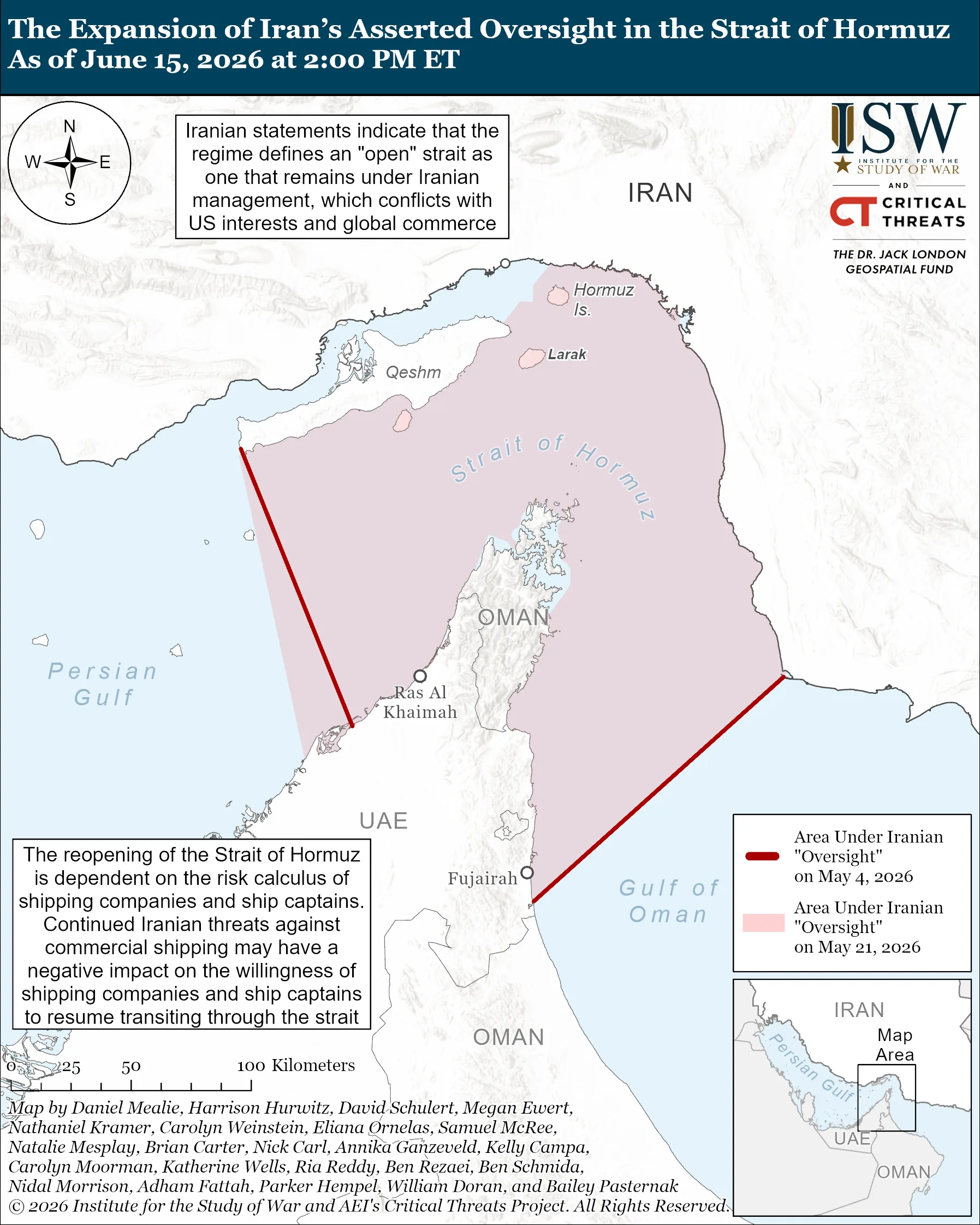
- Iran’s interpretation of the agreement’s provisions about the Strait of Hormuz would constitute a significant strategic victory for Iran if its interpretation became the recognized reality. Iranian statements indicate that the regime defines an “open” strait as one that remains under Iranian management, which conflicts with US and global commercial interests.
- The reopening of the Strait of Hormuz depends on the risk calculus of shipping companies and captains. Continued Iranian threats against commercial shipping may have a negative impact on the willingness of companies and captains to resume transiting through the strait. Iran’s mine-laying activities and threats to mine the strait are also a key component of this effort.
- Hezbollah has signaled that it will adhere to the Lebanon ceasefire outlined in the US-Iran agreement and suggested that the group views the agreement as a precursor for Israel’s withdrawal from Lebanon.
- Israeli officials have stated that the IDF will continue to operate in Lebanon to degrade Hezbollah. Hezbollah and Iran could make their implementation of the US-Iran agreement contingent upon the cessation of Israeli operations against Hezbollah in order to push Israel to halt these operations.
Toplines
US and Iranian sources have expressed diverging interpretations of some key aspects of the recent US-Iran agreement. The full text of the agreement has not yet been published, which makes it difficult to ascertain which interpretations of the agreement are accurate. The United States and Iran reached an agreement on June 14 to end the war and are expected to formally sign the agreement in Geneva on June 19.[1] The agreement reportedly calls for a ceasefire on all fronts, requires Iran to “open” the Strait of Hormuz, and requires the United States to lift its naval blockade on Iranian ports.[2] US and Iranian officials have stated that additional negotiations, including discussions over Iran’s nuclear program, will occur during the 60 days following the agreement’s signing.[3] US Vice President JD Vance stated on June 15 that the United States expects the strait to be open “in a toll-free way for the long term.”[4] Islamic Revolutionary Guards Corps (IRGC)-affiliated media, by contrast, reported on June 15 that Iran will pause imposing “fees” on vessels transiting through the strait for the next 60 days but intends to resume charging vessels “service fees” after the 60-day period.[5] Iranian officials have also continued to signal their intent to jointly manage the strait with Oman.[6] US officials have also denied Iranian claims that the agreement will immediately release a portion of Iran’s frozen assets and lift some sanctions. US officials, including US President Donald Trump and Vice President JD Vance, have instead insisted that sanctions relief and the release of Iranian assets are dependent on Iran’s implementation of the agreement.[7] IRGC-affiliated media argued that Iran must “strictly implement its interpretation” of the agreement and disregard the United States’ “nonsense interpretations,” which further highlights the apparent divergence between Iran and the United States’ understandings of the deal.[8] These diverging interpretations of key provisions in the agreement will likely complicate the implementation of the agreement and the next phase of negotiations.
Iran’s interpretation of the agreement’s provisions about the Strait of Hormuz would constitute a significant strategic victory for Iran if its interpretation becomes the recognized reality. Iranian Foreign Affairs Ministry Spokesperson Esmail Baghaei stated on June 15 that Iran and Oman will manage traffic through the strait, provide maritime “services,” and collect related fees.[9] IRGC-affiliated media similarly claimed that the text of the US-Iran agreement was revised to emphasize Iranian and Omani sovereignty over the international waterway.[10] Iranian reports that Iran intends to resume “fee” collection in some capacity are consistent with repeated Iranian claims that these charges are “service fees” rather than transit tolls and therefore do not violate a “toll-free” arrangement.[11] Imposing tolls is one mechanism through which Iran exercises authority over the strait, but ISW-CTP previously assessed that Iran likely prioritizes securing recognized sovereignty over the strait over imposing a toll scheme in the strait.[12] The Iranian regime defines an “open” strait as one that remains under Iranian management, which conflicts with US and global commercial interests. Iranian officials have repeatedly identified control of the strait as a core strategic objective and a central pillar of Iran’s long-term deterrence posture.[13] ISW-CTP previously assessed that Iran likely views control over the strait as essential to restoring deterrence against the United States and Israel following the degradation of its other deterrent capabilities.[14] Any agreement that permits Iran to retain any form of authority over the strait, regardless of whether it imposes tolls or not, would allow Iran to reimpose restrictions in the international waterway at its discretion. Such authority would give Iran significant leverage over global commerce, which Iran could use to extract concessions and advance its strategic objectives.
The reopening of the Strait of Hormuz depends on the risk calculus of shipping companies and ship captains. Continued Iranian threats against commercial shipping may have a negative impact on the willingness of companies and captains to resume transiting through the strait. Trump stated on June 15 that vessels have begun transiting through the strait via the “southern highway,” almost certainly referring to the internationally recognized traffic separation scheme.[15] Shipping companies will likely remain reluctant to resume normal operations, at least for the time being, due to the ongoing risk of Iranian attacks and naval mines, however. The IRGC Navy announced on June 15 that it has not issued transit permits over the past 96 hours and emphasized that the strait remains closed to all vessels.[16] The IRGC Navy reportedly warned ships not to approach areas under Iranian control “until further notice,” which is an implicit threat to attack vessels that attempt to transit through the strait without Iranian permission.[17] These threats are part of a broader Iranian effort since March 2026 to use force to deter vessels from transiting the strait without Iranian authorization.[18] Iran’s mine-laying activities and threats to mine the strait are also a key component of this effort. Reuters, citing shippers in Asia and Europe, reported that shipping companies intend to resume navigation only after authorities fully confirm the safety of the waterway.[19] Reuters, citing Western maritime security services, added that mine-clearing operations could take 40 to 50 days.[20] Trump stated on June 14 that mine-removal operations will begin after the agreement is signed on June 19.[21] Iranian officials and media have not commented publicly on potential mine-clearing efforts.
Hezbollah has signaled that it will adhere to the Lebanon ceasefire outlined in the US-Iran agreement and suggested that the group views the agreement as a precursor for Israel’s withdrawal from Lebanon.[22] Hezbollah issued a statement on June 15 in which it congratulated Iran for reaching an agreement with the United States that includes “a comprehensive ceasefire across all fronts, including Lebanon.”[23] A Hezbollah official told Reuters on June 15 that the group has ceased offensive operations since the US-Iran deal was announced and that Hezbollah’s compliance with the ceasefire is linked to Israel’s adherence to it.[24] ISW-CTP has not observed any Hezbollah attacks on northern Israel since the United States and Iran announced the agreement. Hezbollah also implied in its statement that the US-Iran agreement sets conditions for an IDF withdrawal from southern Lebanon, stating that the agreement “is a prelude to completing the liberation” of Lebanon.[25] Hezbollah has repeatedly demanded a full IDF withdrawal from Lebanon as part of any comprehensive ceasefire agreement.[26] Iranian media similarly implied on June 15 that an IDF withdrawal from southern Lebanon is part of the US-Iran agreement.[27] The Hezbollah official speaking to Reuters added that Hezbollah rejects IDF “freedom of movement” in Lebanon, which further illustrates Hezbollah’s maximalist demand for an IDF withdrawal.[28] A senior US official told an Israeli reporter on June 15 that “an Israeli withdrawal from southern Lebanon is not a condition for reaching an agreement with Iran,” however.[29] Israel does not appear to be a party to this agreement, which complicates the clause that calls for a ceasefire in Lebanon.[30]
Israeli officials have stated that the IDF will continue to operate in Lebanon to degrade Hezbollah. Hezbollah and Iran could make their implementation of the US-Iran agreement contingent upon the cessation of Israeli operations against Hezbollah in order to push Israel to halt these operations. Israeli Defense Minister Israel Katz said on June 15 that Israel will maintain an indefinite IDF presence in security zones in Lebanon, Syria, and the Gaza Strip in order to maintain Israel’s security.[31] Katz added that the IDF’s establishment of security zones in southern Lebanon is “among the IDF’s greatest achievements” in the war and emphasized that Israel ”oppose[s] an IDF withdrawal from Lebanon, despite all the existing pressures and those that will still come.”[32] A US official separately told an Israeli journalist that Israel has the right to respond to any Hezbollah attack.[33] Lebanese media reported that the IDF continued to strike targets in southern Lebanon as recently as the morning of June 15.[34] There are also conflicting reports on whether the IDF has continued ground operations in southern Lebanon. Two IDF soldiers in southern Lebanon told an Israeli journalist on June 15 that all IDF activity has ceased since the announcement of the US-Iran agreement.[35] Lebanese sources continue to report IDF movements and advances, including in towns beyond the ”Yellow Line,” however.[36] Iran recently linked US-Iran negotiations to the Lebanon issue in order to pressure the United States to push Israel to halt operations against Hezbollah.[37] Iran could similarly seek to make its implementation of the US-Iran agreement contingent upon Israel agreeing to a ”comprehensive ceasefire” in Lebanon.
US-Iran Negotiations
See topline section.
Maritime Activity in the Strait of Hormuz and Persian Gulf
See topline section.
US and Israeli Air Campaign
Nothing significant to report.
Iranian Domestic Affairs
Supporters of the US-Iran agreement within the Iranian regime continue to attempt to build a consensus around the US-Iran agreement amid criticism from the regime’s anti-negotiations camp, led by the ultrahardline Paydari (Stability) Front. Iranian President Masoud Pezeshkian and Parliament Speaker Mohammad Bagher Ghalibaf continued to defend Iran’s decision to sign the agreement and repeated their calls for Iranians to maintain unity and national cohesion.[38] Pezeshkian stated on June 15 that “nearly all” Iranian parliamentarians support the agreement and emphasized that the agreement was signed under the “guidance” of Supreme Leader Mojtaba Khamenei.[39] Pezeshkian’s comment comes amid criticisms from some Paydari Front members toward Iran’s negotiating team and the US-Iran agreement. A Paydari Front parliamentarian criticized the agreement’s reportedly vague timeline for the release of Iranian assets, for example..[40]
Iran’s Axis of Resistance
Lebanese Hezbollah and the Israeli Campaign in Lebanon
See topline section.
Other Axis of Resistance Activity
Nothing significant to report.

[1] https://truthsocial.com/@realDonaldTrump/116750587569914985 ; https://x.com/CMShehbaz/status/2066268332832194810?s=20 ; https://x.com/shoaam_ir/status/2066293795897925979?s=20
[2] https://truthsocial.com/@realDonaldTrump/116750587569914985 ; https://x.com/shoaam_ir/status/2066293795897925979?s=20 ; https://www.tasnimnews dot ir/fa/news/1405/03/25/3617286
[3] https://www.tasnimnews dot ir/fa/news/1405/03/25/3617286 ; https://www.nytimes.com/live/2026/06/15/world/iran-war-trump-us-deal/b69e5be2-daea-5e50-b04b-82e362069a75?smid=url-share
[4] https://www.cnbc.com/2026/06/15/vance-iran-deal-negotiations-nuclear.html
[5] https://t.me/Tasnimnews/422821
[6] https://www.mehrnews dot com/news/6861084
[7] https://abcnews.com/video/133884252/ ; https://www.youtube.com/watch?v=3uE2UZP4uxQ
[8] https://t.me/Tasnimnews/422869
[9] https://t.me/Tasnimnews/422866
[10] https://t.me/farsna/442352
[11] https://t.me/mehrnews/381432
[12] https://www.criticalthreats.org/analysis/how-iran-hopes-to-control-the-strait-of-hormuz-its-not-just-about-fees
[13] https://understandingwar.org/research/middle-east/iran-update-special-report-may-27-2026/ ; https://x.com/Drvelayati_ir/status/2059519530854977593?s=20; https://understandingwar.org/research/middle-east/iran-update-special-report-april-30-2026/; https://t.me/rahbar_enghelab_ir/313
[14] https://understandingwar.org/research/middle-east/iran-update-special-report-may-27-2026/
[15] https://truthsocial.com/@realDonaldTrump/posts/116754269577470122
[16] https://t.me/iribnews/345446
[17] https://t.me/iribnews/345446
[18] https://t.me/farsna/414226; https://understandingwar.org/research/middle-east/iran-update-evening-special-report-march-1-2026/
[19] https://www.reuters.com/business/energy/one-lng-tanker-passes-hormuz-after-us-iran-agree-deal-shippers-stay-cautious-2026-06-15/
[20] https://www.reuters.com/world/middle-east/scouring-strait-hormuz-mines-could-take-weeks-2026-06-15/
[21] https://www.npr.org/2026/06/15/nx-s1-5858113/crude-oil-futures-drop-after-trump-promises-an-iran-deal-will-be-signed-friday
[22] https://t.me/mmirleb/17488
[23] https://t.me/mmirleb/17488
[24] https://www.reuters.com/world/middle-east/hezbollah-has-not-carried-out-operations-since-iran-us-deal-hezbollah-official-2026-06-15/
[25] https://t.me/mmirleb/17488
[26] ] https://www.naharnet dot com/stories/en/320518-berri-hezbollah-to-withdraw-from-south-litani-if-full-truce-reached-israel-pulls-back ; https://www.reuters.com/world/middle-east/iran-declares-support-hezbollah-with-wider-peace-deal-doubt-2026-06-05/ ; https://t.me/mmirleb/17065 ; https://t.me/mmirleb/15588 ; https://t.me/mmirleb/15474 ; https://t.me/defapress_ir/60079 ; https://www.almanar dot com.lb/article/921897/
[27] https://www.entekhab dot ir/fa/news/925968
[28] https://www.reuters.com/world/middle-east/hezbollah-has-not-carried-out-operations-since-iran-us-deal-hezbollah-official-2026-06-15/
[29] https://x.com/BarakRavid/status/2066552103812608228
[30] https://www.reuters.com/world/middle-east/netanyahu-trump-collision-course-us-iran-agree-halt-war-2026-06-15/
[31] https://x.com/manniefabian/status/2066414276596690986
[32] https://x.com/manniefabian/status/2066414276596690986
[33] https://x.com/BarakRavid/status/2066552103812608228
[34] https://t.me/sameralhajali/7483 https://t.me/MTVLebanoNews/74533 ;
[35] https://x.com/AmitSegal/status/2066460264308830464
[36] https://x.com/MarioLeb79/status/2066545785135567288 ; https://t.me/sameralhajali/7494
[37] https://understandingwar.org/research/middle-east/iran-update-special-report-june-8-2026/
[38] https://x.com/drpezeshkian/status/2066575577683771606?s=20; https://x.com/drpezeshkian/status/2066575755123831114?s=20; https://x.com/drpezeshkian/status/2066256613581652357?s=20; https://x.com/mb_ghalibaf/status/2066544344694141104?s=20
[39] https://x.com/drpezeshkian/status/2066575577683771606?s=20
[40] https://x.com/nabaviantwt/status/2066399686685052937?s=20; https://x.com/nabaviantwt/status/2066399689260298574?s=20; https://x.com/nabaviantwt/status/2066399694444515714?s=20; https://x.com/nabaviantwt/status/2066399698739482799?s=20