In the future, we will still have CO2 credits.
But instead of allowing companies to release CO2 into the air…
Credits might allow companies to capture CO2.

How is this possible? Because CO2 will not be seen as a pollutant anymore, but rather as a resource.
Humans dislike CO2 in the air because it causes a greenhouse effect, traps heat, and increases the planet’s temperature.
But plants love it. That’s what photosynthesis is: plants’ use of energy to extract carbon out of thin air so they can use it to build their body.

Plants love CO2 so much that they’ve been extracting it from the air for billions of years, releasing O2 as a byproduct pollutant, as we saw previously.
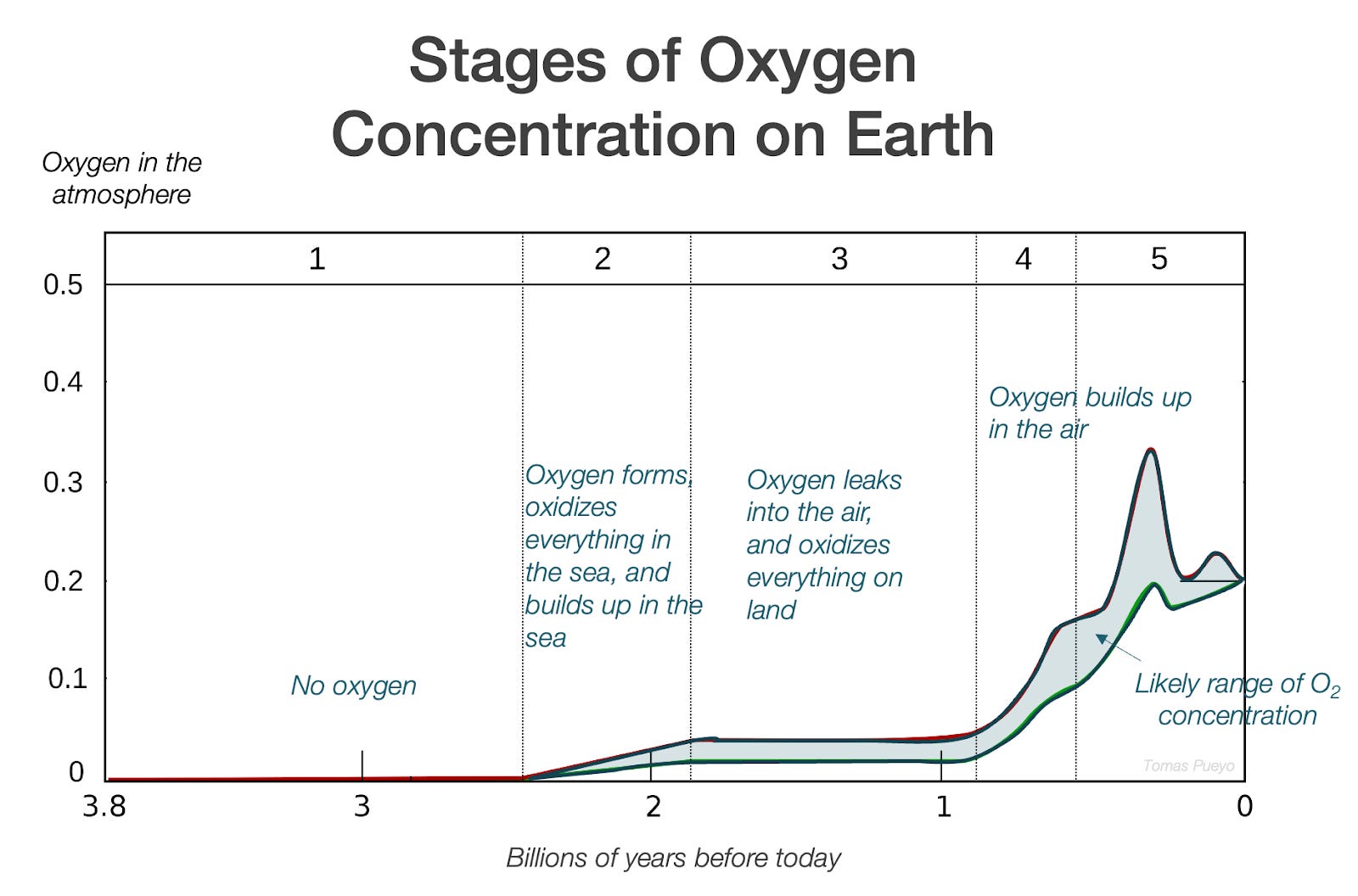
Now that we’ve got CO2 back to levels last seen about one million years ago, plants are happily consuming it, growing 20%-40% faster than before1. With more CO2, they will grow even faster.
So plants see CO2 as a convenient way to access carbon that only requires a little energy. If we could help plants capture carbon faster, we would do it. But plants have evolved for millions of years and they’re still not there. Plants are inefficient at capturing sunlight to absorb CO22. And remember: It took them 2.5 billion years to get carbon to pre-industrial levels. If we want to extract carbon from the air before the Earth warms up too much, we need a faster way to do it than relying on plants, and we can do that if we, too, view CO2 as a resource.
One of the fossil fuels that we’ve been consuming faster and faster is methane—CH4. Today, we pull it mostly from the ground in the form of natural gas.

But we could do like plants and build this carbon-based molecule by extracting carbon from the air, using the energy from the Sun.

The only difference is that plants produce sugar, and this machine would produce methane3.
Notice this: The only elements you need to produce methane are CO2 from the air and water! The only expensive thing you need is energy.
This becomes a question of energy cost: How can it be cheaper to generate CH4 from the air than by pumping it from the ground?
It’s a matter of time.
Over the long term, the cost of natural gas can only go up, because it becomes scarcer and scarcer, driving prices up. Also, companies must dig deeper and deeper to find it and pump it, which increases costs, and hence prices.
Meanwhile, the cost of solar energy is only going down.

It’s reducing so quickly that you need a logarithmic version of the graph to know what’s going on:
For the last 45 years, photovoltaic costs have been dropping by 12% per year!4 You could use the dropping cost of photovoltaic energy to generate the methane.
Important sidenote: It’s not time that reduces solar panel costs, but scale. The more we build them, the better we learn how to improve their efficiency.

But since our volume of solar panels has been growing exponentially over time, we end up with a consistent reduction in solar panel costs over time.
If pulling CH4 from the ground is only getting more expensive, and the energy needed to pull it from the air is only getting cheaper, at some point it becomes cheaper to pull it from the air than from the ground. The question becomes: How low does the cost of solar photovoltaic energy need to drop for this to happen?
To answer that, we need to understand how much energy is needed to produce methane. And for that, we need to understand the process to create methane.
First, you use some energy to take in air and isolate its CO2 in a concentrator.
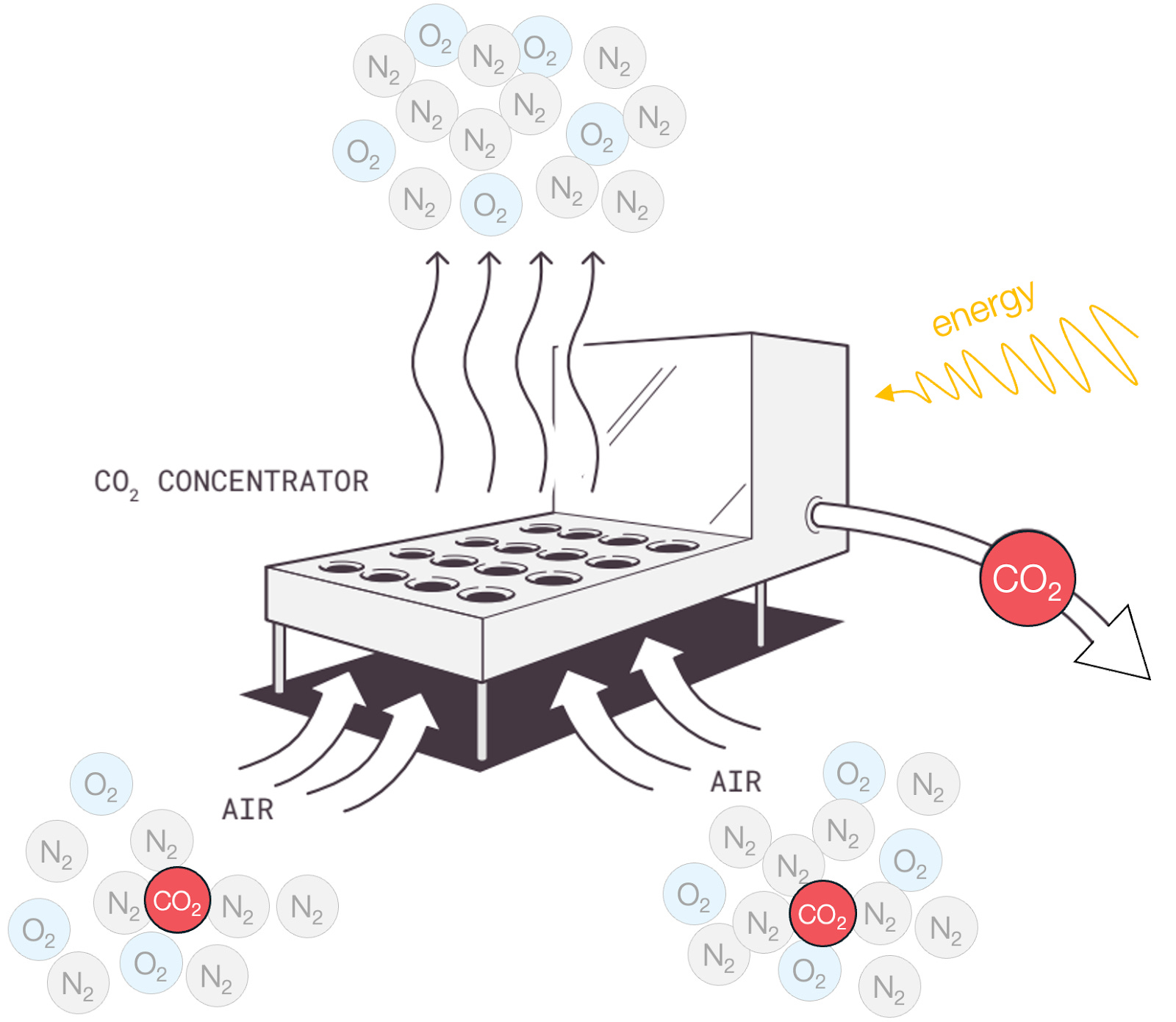
The energy can come from solar panels.

Then you need to take some water and split its hydrogen and oxygen, forming H2 and O2. You throw away the oxygen, like plants do.
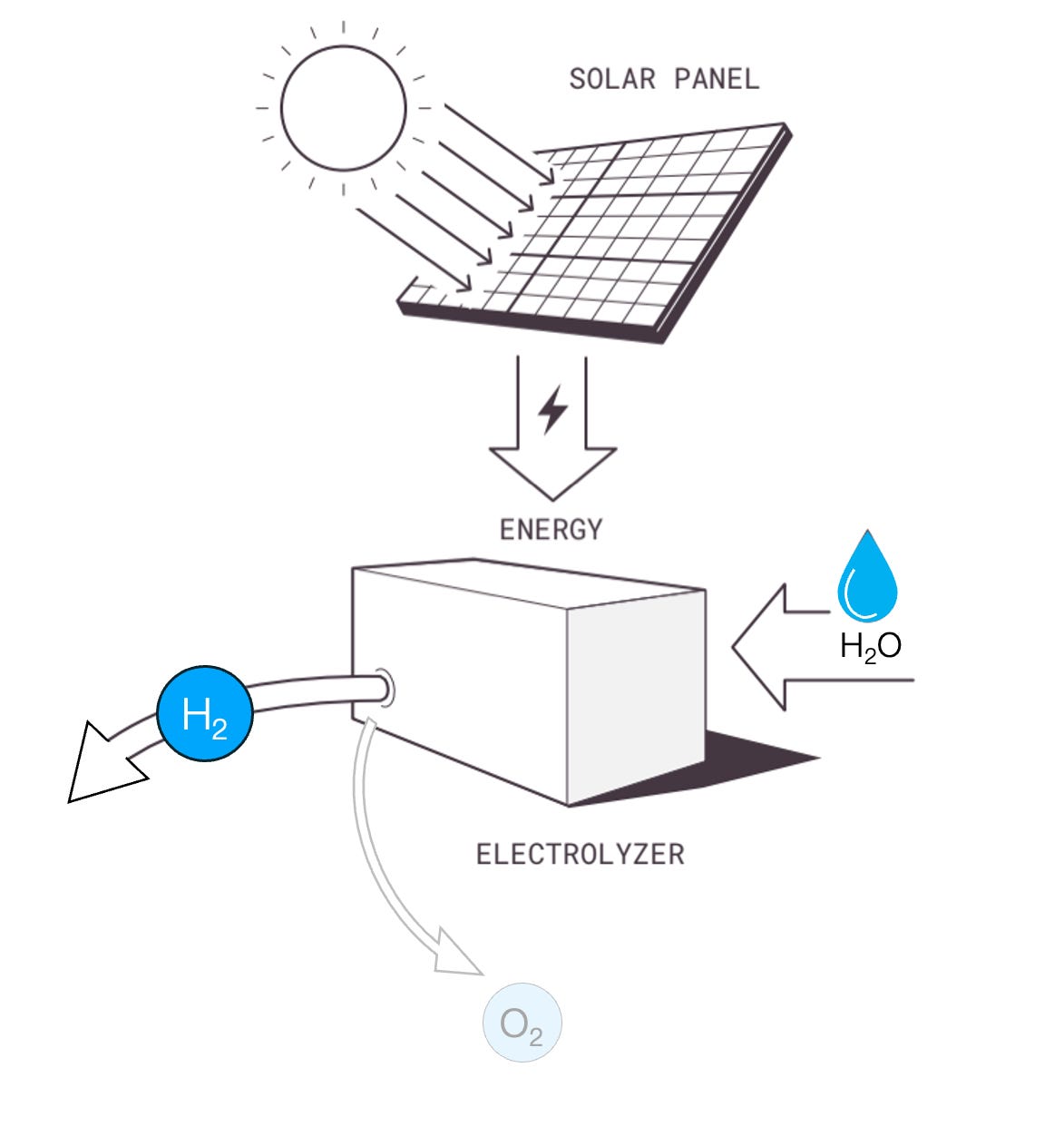
This machine is called an electrolyzer. So you need two machines so far: a CO2 concentrator and an H2O electrolyzer to get H2.
Finally, you combine the CO2 and H2 into a reactor to form CH45.

This machine is now being built, and will be on sale starting next year.
Remember how we talked about the Haber-Bosch process to create fertilizer? It’s been around for over a century and is probably the biggest driver of human population. This process to generate methane is nearly the same, but instead of extracting N2 from the air to produce NH3, we get CO2 from the air to get CH4. Aside from these details, it’s very similar.
You put in air, water and energy, that’s all
Air is free
Water is nearly free6
The only big cost here is energy
This process must produce a cubic meter of CH4 cheaper than the current market price, which historically has been about $0.187—and reached about $2 at the beginning of the Ukrainian war.
How much energy does this process need?
If you install solar panels that have a capacity of one megawatt (1 MW), they should produce about 128 m3 of CH4 in a day. Since we said the historic price of CH4 is about $0.18, that means a 1 MW solar panel can produce $23 per day of operation, or about $10,000 per year. With 30 years of operation8, that’s $300k generated.
If you look back at the graph above, you’ll see that the cost per W of solar panels was $0.27 in 2021. So 1 MW is $270k. In other words, these are already at the same order of magnitude!9
The costs of gas from the ground and from solar energy are in the same order of magnitude.
Obviously, the cost is not just the panels—it’s also the land, transmission lines, the people, and the machines (concentrator, electrolyzer, and reactor) to produce the methane. But the point here is that the single biggest cost—energy (via solar panels)—could already allow the process to break even10. Now drive that cost down by 12% every year, and it’s a matter of time for gas from the air to become cheaper than from the ground.
This is all high level, and rests on many assumptions. For example, natural gas costs increased by a factor of 10 during Russia’s invasion of Europe. In such circumstances, methane from the air becomes extremely cheap in comparison.
Not only that, but given the political climate, countries might decide to pay a premium for methane from the air vs from the ground, if the ground methane comes from Russia or similarly hostile countries.
This is one of the reasons why the US approved the Inflation Reduction Act (IRA), which is so generous that, in some parts of the US, this air-to-gas system would already break even after a few years.
Of course, this would probably be more true in Arizona than in Vermont, since the Sun shines stronger there. Which illustrates yet another varying condition.

The Sun shines more strongly in countries near the equator, which tend to be poorer11. This means they can obtain solar electricity—and methane—for cheaper. However, since most countries farther from the equator get as much as 50% of the solar irradiation of warmer countries, and solar panel costs generally drop by 12% per year, it will only take about five additional years for the same economics to apply there.
This means the breakeven point between methane from the ground and from the air will arrive at different times in different places. What matters is that it arrives somewhere soon, so we can get this process going as fast as possible. And as we saw, it’s already cheaper in some parts of the US than others.
What this means is that the right company figuring out how to efficiently produce methane from the air can already replace traditional fossil fuel companies in the US by selling their product more cheaply.
This is a profound change, because we could keep using natural gas as we’ve been doing, but in a carbon neutral way: by only consuming what we get from the air, rather than pumping carbon that had been trapped underground for millions of years into the atmosphere.
We want this to happen as fast as possible. Who is working on this? How can you help?
While researching the space series, I stumbled upon Casey Handmer’s blog. In his study of the necessary processes to live on Mars, he explored the generation of methane and realized that this process was viable on Earth. So he decided to do it here.
He created Terraform Industries a couple of years ago, and recently raised their Seed Extension. Given his very thorough and clever understanding of the space, I decided to invest12. They’re now looking for great people to join their team:
Candidates with hardware experience, execution capacity, autonomy, judgment, integrity and non-conformist tendencies. Degrees in business and/or various engineering disciplines are a plus but subordinate to the ability to get the job done.
You can get a sense of their team at the bottom of their vision paper. If you’re interested and qualified, or know somebody who might be, please send them my way or reach out directly!
There are a few times in history when you can make history by doing the right thing while also making money. This is one of them. If you’re interested in the topic and equipped to help, you should do it.
But generating methane is only one way of using the carbon in the air as a resource. Any fuel can be formed with a similar approach. Farmers see it as a resource, both for nourishing land- and sea-based plants. There are probably many more uses.
The moment energy becomes cheap enough to allow reliable extraction of CO2 from the atmosphere, people will use that source of carbon. And not all of it will be re-released into the atmosphere. As we saw in the Ocean Farming article, some of it will sink in the oceans13. Even today, 3% of methane is not burned, but used in other ways like plastics production, thus leaving the carbon cycle altogether…
In the next few years, we won’t be able to scale this fast enough to make up for our CO2 emissions. But at some point, all the fuels we use will come from the air, not the ground. Every year, we will sink CO2 rather than emit it. Eventually14, we will deplete it to the extent that measures might be taken to prevent companies from sinking it, or to make them pay for the privilege.
Until then, we still need to reduce carbon emissions, sink carbon as fast as possible, and lower the temperature of the Earth until we get CO2 back to reasonable levels. I’ll keep writing about this.
In this week’s premium article we’re going to answer a question many of you asked me: What about hydrogen? This is especially relevant in the context of this article, because here we’re saying we should be producing methane. But for that, we need hydrogen. Wouldn’t it make sense to stop at hydrogen?