Prediction markets have been called "truth machines" because anyone who has information missing from the market can profit.
A recent, notorious example is the suspected Google Insider, trading under wallet 0xee50a31c3f5a7c77824b12a941a54388a2827ed6 (aka AlphaRacoon, although since renamed) who managed to predict with surprising accuracy whether famous people would feature in "Google Year in Search" markets:

AlphaRacoon made over $1m and got a perfect record of predicting very specific markets like that d4dv would be the most searched person of 2025 (almost doubled their money on that one)!
They were also surprisingly good at knowing when Gemini 3 model would be released in late 2025:
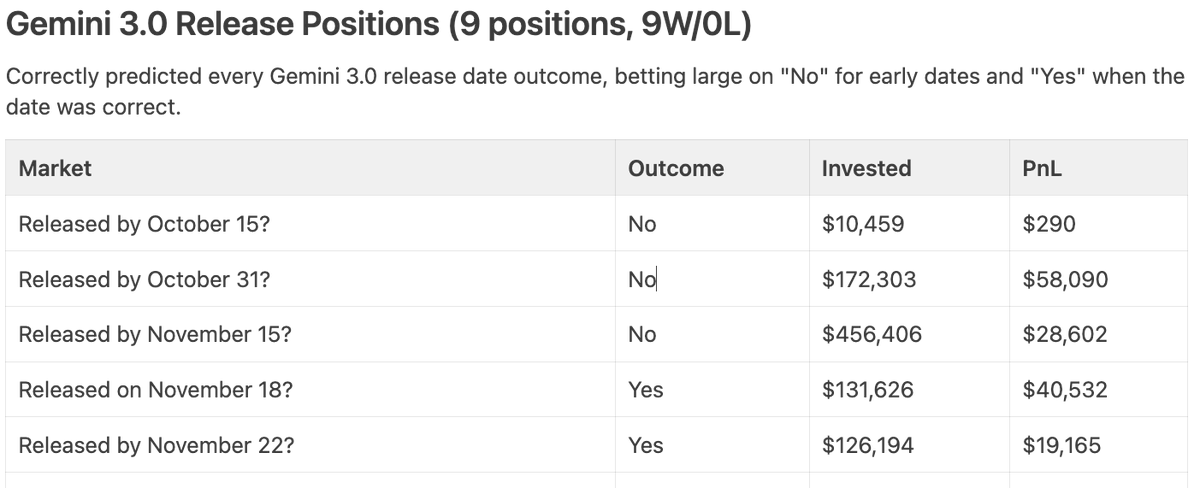
They knew it'd be released between Nov 15-18 and made over $100k in profit on this model release ... probably more than Google 🤣
Clearly, these insiders have figured out a way to cash in on information. Whether that's kosher is out-of-scope here, but it's clear prediction markets like Polymarket incentivize sharing information. And information and intelligence is where investors get most of the alpha.
Using AI to Find Insiders
We at Compound AI decided to build a first-party integration and automatically find such insiders using our AI financial analyst.

Indeed, Compound found AlphaRacoon although they tried to hide under the new name 0xafEe (wallet prefix, basically user id).
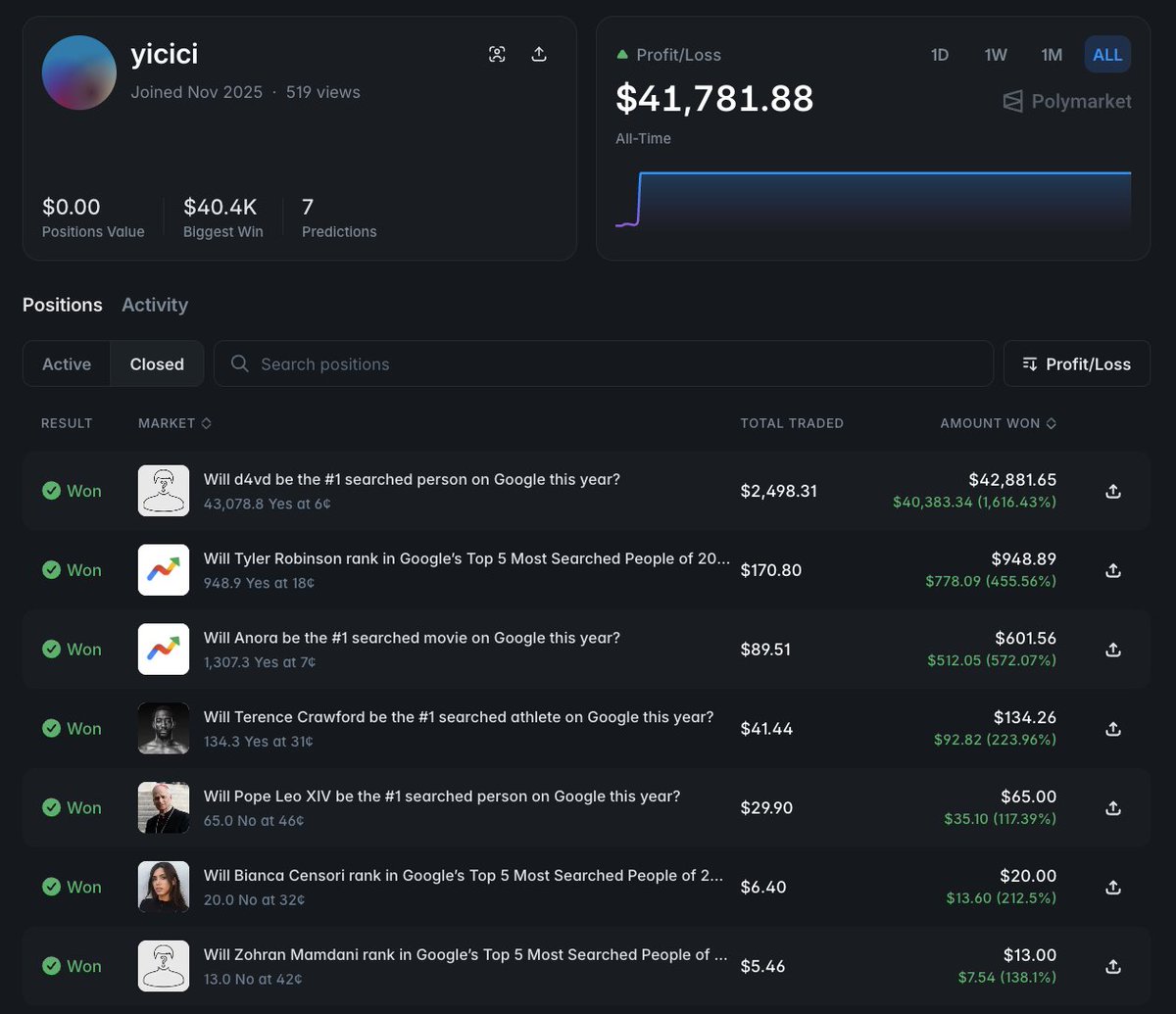
And it turns out they have friends, e.g. yicici, who made money in the same markets:
What if we look for OpenAI insiders? Turns out there are some folks who are also good at predicting OpenAI events:

Some of those on the shortlist may just be super-predictors, but one of them exclusively traded in OpenAI events:

Again, it seems we've found someone oddly good at predicting OpenAI launch dates for models and products.
It is likely there are many other insiders lurking around other companies' markets.
Predicting everything
Polymarket has a lot of other interesting markets that may be of use for investors. Continuing along the AI theme, we could figure out what the market thinks about the chances that OpenAI/Anthropic IPO this year:

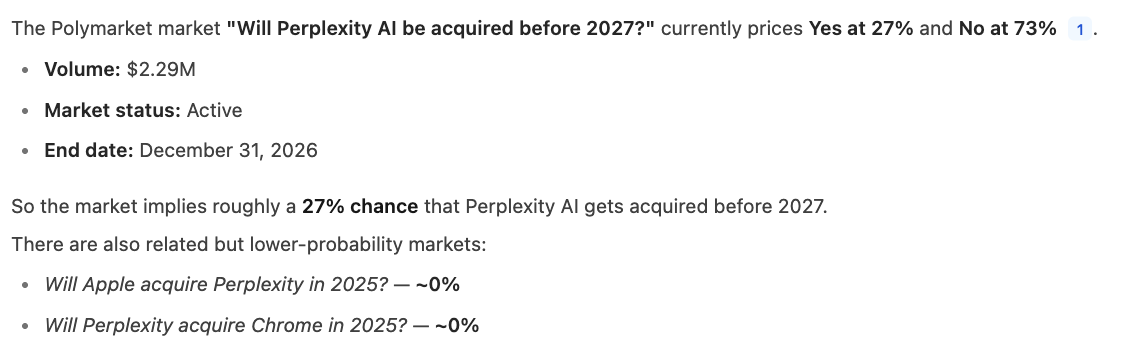
Or we could get the market sense for whether certain startups might get acquired:
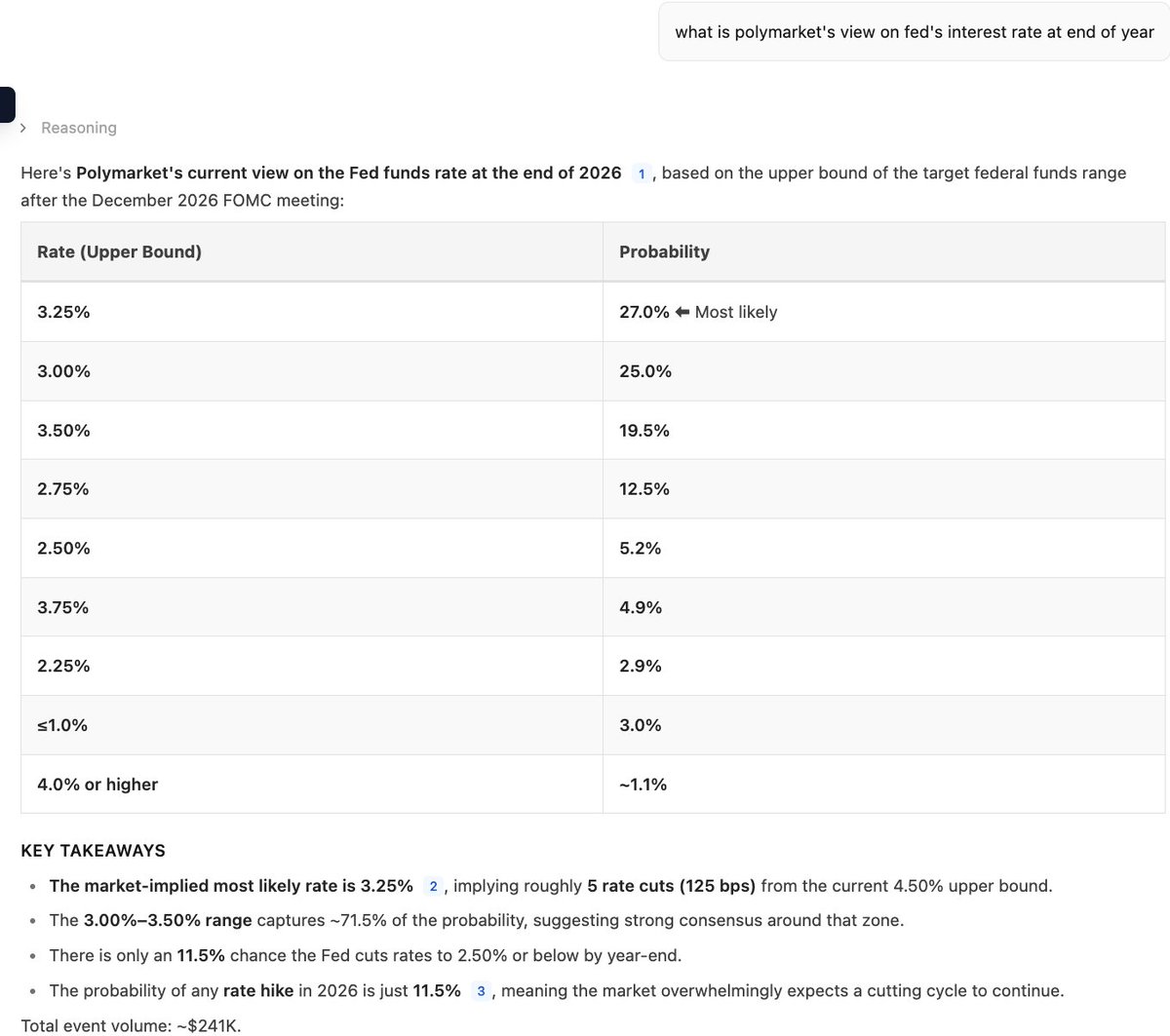
Macro predictions on the Fed interest rates
Predictions of price of oil

Recently the market thought it less likely (~25%) that the Supreme court would rule in favor of Trump's tariffs (you don't even need to read the news to know what happened):

Scaling databases for agents
To get this to work well and fast involved building a custom DB, designed for agents, which we find are super-human at making data science queries. An agent is more like 10 concurrent human users, and to scale well means a hundred thousand human users of our product may feel more like a millilon. Simply using the Polymarket API would be really slow, and is also conservatively rate-limited.
In a traditional finance team, an analyst might ask the data team to "pull some data" from the db, then do the analysis in Excel. Compound produces work output end-to-end, you just have to ask.
An interesting question is if agents are much better at querying data than humans, do we even need the awkwardness of SQL, which is intended to be a friendlier language for data scientists who may not be as comfortable with code. Let the AI write code, it loves code. Let humans use natural language.
Alpha: Information + Intelligence
Talk to any investor and they'll tell you most of the alpha is either from being smarter, or having better data.
We focused a lot on getting our Compound agent as intelligent as possible, but information is also critical to getting an edge.
Hedge funds invest a ton in "alternative data", like credit card transaction data or satellite-imagery (are Walmart's parking lots full?) and need to process as much relevant information as possible to make predictions that are relevant to investments.
You could try to parse the latest breaking news, run some NLP to glean its meaning and extract predictive factors, or you could go straight to a prediction market that, when efficient, takes into account all relevant information to give a perfectly calibrated prediction on any event.
Polymarket has predicted elections better than polls, and the overthrow of governments before they happen, and of course before the news breaks. With recent favorable regulatory conditions in the US, prediction markets are likely to explode in popularity and only get more accurate and cover more events.
It is our bet that Polymarket provides rich information that complements the intelligence of Compound AI very well.
