Everyone's talking about AI agents like Clawd. Where I work as CTO we're actually deploying them as colleagues.
ZAR is a 25-person fintech enabling people in emerging markets (Argentina, Kenya, Bangladesh) to dollarize their savings via USDC. We're backed by major venture firms like a16z. And we've made a decision that most existing companies will find impossible to realize: that a small team of exceptional people with autonomous agents will outperform any other kind of organization.
ZAR is not AI-assisted. We don't do "copilots." Our agents are full organizational participants with identities, communication channels, and budgets.
Here's a glimpse into how we're making it work for us.
We built multiple new in-house systems to support our agent infrastructure:
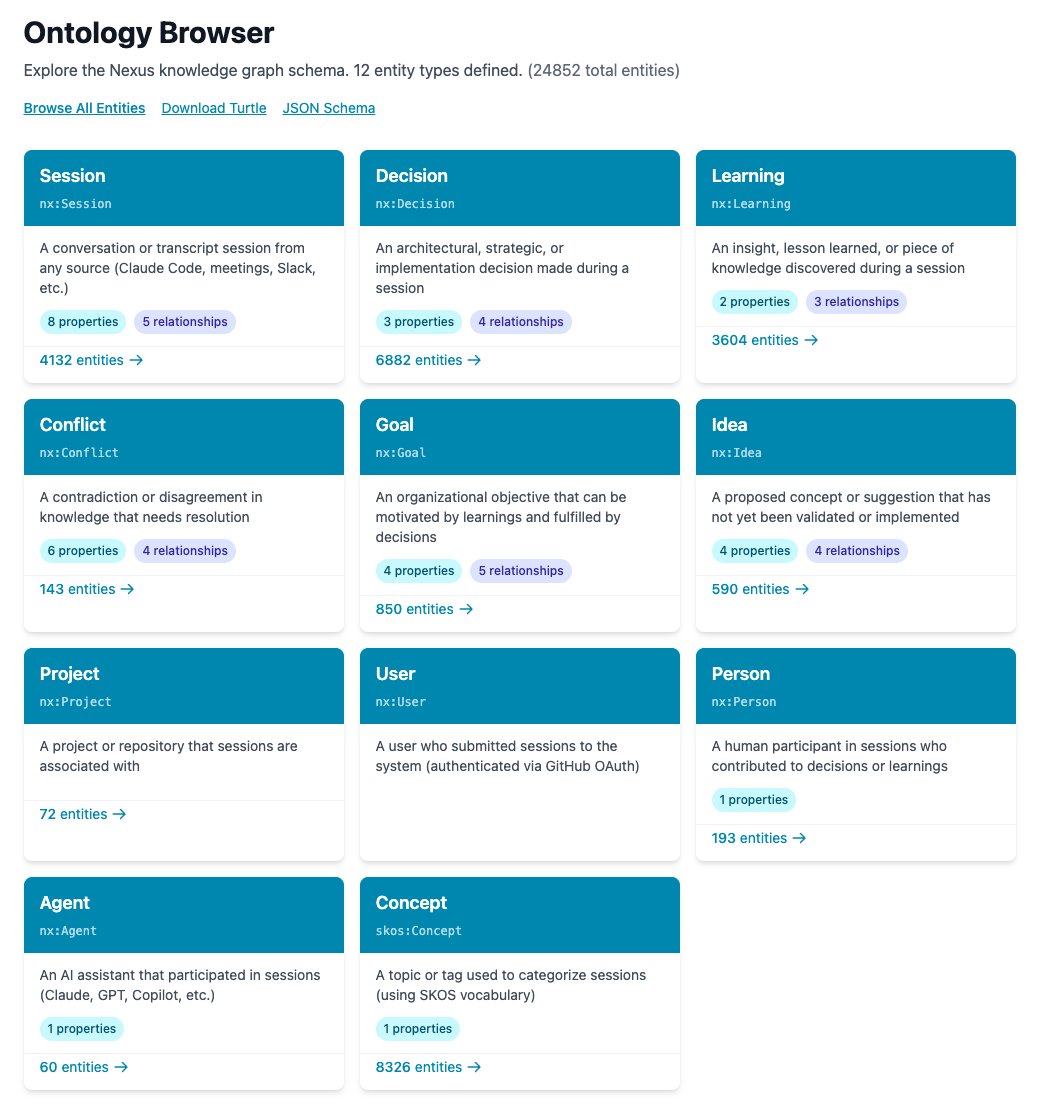
Nexus is a Rails app containing our organizational knowledge graph, implemented in Oxigraph. Every decision, every learning, every meeting, and every PR gets captured and connected. This is the institutional memory that humans and agents alike draw from and it doesn't require a room full of Mac Minis. I wrote the first version of Nexus over the Christmas break.
Agentus is the platform that lets agents interact with us as first-class participants. They get identities and personalities. They get Slack channels. They get budgets. They have access to our Github repos as individuals. Most importantly, they are purpose-driven: directed by the capacity, potential, or goal that the Role will pursue or express on our behalf.
Agora is a Rails app within Agentus that handles agent creation and orchestration. It manages their lifecycles, scheduling, monitoring, and coordination of inter-agent communication, as well as the bridget to let them talk to humans as individuals on Slack. Agora also provides heartbeats and the ability for the agents to wake themselves up in the future outside of their scheduled runs. It where we setup shared and individual authenticated MCP connections.
On the roadmap: additional in-house systems to enable an organization-wide event mesh and various other components that will allow us to automate everything that can be automated.
Our real agents have names, unique identities, and specific goals that will not be revealed in detail here. However the following examples should give you an idea of the kind of work that they handle.
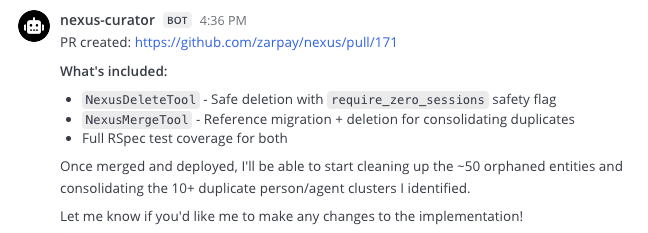
We have an agent that autonomously addresses technical debt such as making sure that no feature flags stay in the codebase longer than two weeks. No tickets required. No sprint planning. No human in the loop, unless needed for clarification, in which case he will have a conversation with the proper person over Slack. The agent runs as needed and the codebase gets cleaner every day.
When production errors hit there's an agent that triages, researches root causes, writes a fix, and opens a PR. Other agents provide code review and decide whether the PR needs human review or can be rolled out automatically. Most of the time, the fix is correct on the first try.
We operate across markets with different languages and merchant profiles. Context agents create localized training materials and test variants to optimize onboarding. What used to require a localization team now happens continuously.
Agents evolve their own directives and can be asked to submit PRs that change the behavior of the platform. That's pretty mind-blowing, especially if you haven't been following the space closely.
But some of the most advanced stuff we're working on is straight out of science fiction.
For example, our cloud-based agents operate with persistent workspaces that can be forked like a git repo and run in different contexts such as our engineer's personal computers, collaborating with Claude Code. These clones are free to explore, experiment, and use resources that are not available to their main agent running in its isolated container. When they're done, they file their state changes with their main as a pull request.
At any given moment, the main agent is aware of its clones and can delegate tasks to them. Clones can escalate to their main identity for certain kinds of tasks that require global awareness. This is collective intelligence brought to life.
We call it distributed consciousness. Not as a metaphor.
We're scaling across dozens of countries. The traditional playbook says: hire proportionally. Open offices. Build local teams. That's slow, expensive, and fragile.
Instead we're staying small. Exceptional humans will continue to set strategy and make the most important judgment calls. Agents will handle everything else: execution, monitoring, and the long tail of operational work that would otherwise require 10x the headcount.
We're already proving it that the future is all about small teams of humans becoming unreasonably effective.
Longer article with more details on our blog: zar.app/blog/agents-as-teammate