Bufo entered my life on a February afternoon. We met over Slack, introduced by one of our wonderful customers.
In a matter of days Bufo had permeated our internal channels. You see, he is a chameleon, enigmatic and highly adaptable but ontological in the sense that he is everywhere and nowhere at once. Bufo exists less as an emoji and more as a guarantee, a promise that the future has been accounted for and that whatever comes, be it an incident or another update on your coworker's IBS-adjacent-condition-that’s-not-quite-IBS, you are prepared to react.
At the core of Bufo’s appeal is the knowing that you no longer must explain yourself to be understood. Once minted as currency on a team, Bufo enables the free and open exchange of feeling, whether it be dread, contempt, fear, elation, mild amusement, or agony. There is freedom in that shared understanding.
I know who Bufo is today. But recently, I sought to understand – why?
But first, where did he come from?
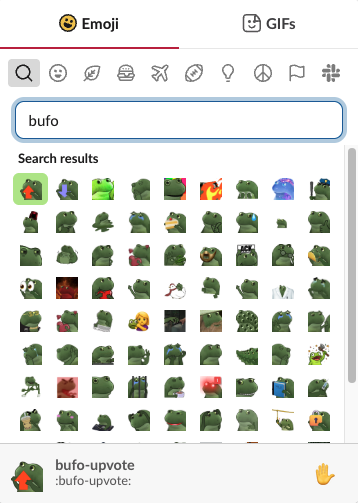
In the early days of my Bufo indoctrination I was introduced to bufo.fun, the emoji repository containing over 1,200 downloadable Bufo versions. We’ve adopted 100 of these in our own channels.
I came across a helpful blog post from Alex Chan in my research that explores Bufo’s origins. Per Alex, citing a Bufo-focused GitHub repo:
“Bufo also known as Froge or Concerned Frog refers to a set of Discord emotes of a worried or concerned frog expressing various emotions, similar to Pepe emotes. The frog image comes from the now-inactive mobile game Froge, released in 2014 by Fandom Inc. and became popularized as a set of Discord emotes starting in 2020.”
Alex digs more into the Froge game in his post, which you should check out. I’m more interested in how Bufo moved from the Froge to Discord to our Slack. How did that happen?
The elephant other frog in the room
We cannot talk about frogs in Discord channels without acknowledging the Original Internet Discourse Frog, which is of course Pepe. I didn’t want to search Pepe on my work computer, so I asked Claude to explain his whole deal:
Pepe came first. Matt Furie drew him in 2005 for the comic Boy's Club, where he was a stoner frog with the famous "feels good man" line. From about 2008, 4chan users started drawing their own Pepes, and he became a general-purpose reaction image: sad Pepe, smug Pepe, rare Pepes. Furie himself described the frog as "all eyes and lips," a blank canvas you can make emote into anything. That property is exactly what made him useful and what made him easy to hijack.
Around 2015 the alt-right adopted him during the Trump campaign. In September 2016 the ADL added Pepe to its hate symbol database. Furie ran a #SavePepe campaign, then in May 2017 literally drew Pepe in a casket and declared him dead, and later spent years suing people like Infowars for using the image. None of that killed Pepe, but it did make him radioactive for any corporate or professional setting. Pepe emotes stayed enormous on Twitch and Discord (monkaS, PepeHands, FeelsBadMan, and so on), which is where the "one frog, hundreds of moods" emote-pack format was fully developed.
Now you’ll recall from Alex Chan’s post that the game Froge wasn’t released until 2014 and Discord users didn’t start cutting that frog – an entirely different frog – into emojis until around 2020.
The obvious visual similarities between Bufo and Pepe are that they’re both frogs and they both emote with their frog-like characteristics (big eyes and a wide mouth).
Sociologically speaking, both Pepe and Bufo signal in-group currency, but only one (Pepe) is embraced by a contingency of terminally-online, far-right, 4chan weirdos comfortable being perceived as Nazis.
Bufo, by contrast, is embraced by nerdy software company subculture, also terminally online, but in the employed, quotes-Paul-Graham-essays, cares-about-Github-green-squares, reads-Hacker-News-instead-of-4chan kind of way. Make sense?
The big leap hop to corporate America
We adopted our first Bufo from the aforementioned wonderful Hatchet customer. Their engineers (allegedly) first encountered Bufo in a Stripe-owned channel, and it has been said* that Stripe owns The Original Bufo Slack Channel.
It makes sense, right? Stripe has alumni everywhere and presumably a ton of shared channels** with customers and vendors. Since my first introduction to Bufo, we’ve seen him deployed by companies of all industries and stage, which implies that he is well-embedded*** into the tech ecosystem.
* I have not independently verified this information, but I’m not a journalist and will run with it.
** I also cannot independently verify this, as Stripe is not a Hatchet customer (yet). They should be.
*** Much like Stripe. We use Stripe!
To Bufo, or not to Bufo?
Dear reader, it’s time to be honest. I initially rejected Bufo. I even encouraged my colleagues to cast him aside in favor of other emojis:

Today, I am able to recognize that the overuse of Bufo is core to his charm.
Consider how we weighed the offering of an emoji in the past, each a discrete object with a discrete meaning. The unflattering, surreptitiously-captured Huddle screenshot, immortalized in the emoji banquet, the this-is-fine-dog, the spinning cat. Every custom reaction is a small act of curation, an inside joke forever eluding broader group appreciation.
Bufo is the cure. He is one frog with over 1,200 moods. We speak the shared language of his green, pixelated face, but his expression shape-shifts. Is he offering a piece of cake or is he Hannibal Lecter? The truth requires closer examination of his assigned text label.
We are ready for this now. Today, we spend our days assigning personalities to software, thanking it, apologizing to it, quarreling or questioning its judgement. We have anthropomorphized The Machine and so it would be strange to hold the line at emojis.
Bufo is the logical next step. A single, reusable frog emoji to replace all human-to-human contact in the workplace, so we can finally stop typing words at each other and get back to yelling at Claude.