New age software does not provide the infrastructure for work. It creates the infrastructure that does the work itself.
To execute any piece of work, you need three essential elements. A mind. A body. A place to work.
The mind does the thinking. It understands the goal, breaks it into steps, makes judgment calls, and recovers when the plan fails. Software always had a mind: yours. Every decision the software would ever make, you made in advance and froze it into code. AI models end that. The thinking happens at runtime, during the work, not at design time.
The body does the doing. A mind alone can only instruct. It can tell you how to fix the bug, but it cannot fix the bug. The body gives the mind hands and eyes: it runs commands, edits files, calls tools, reads the output, and try again. This is what agent harnesses are. You stop asking AI about the work and start handing AI the work.
The place holds the work. Every worker needs a workshop: a place where work happens, is recorded, and is iterated. Iteration is the key part. No quality output is ever produced in one pass. Quality comes from a loop: attempt, feedback, delta, attempt again, until the quality is acceptable. That loop only works if state survives between passes. Yesterday's draft is today's starting point. Sandboxes like @e2b and Daytona are workshops as a service: created in milliseconds, one for every project.
This is how @BamBam_vid agents work today. Every project on our platform is born with all three elements. The mind is a GPT model. The body is a Codex agent whose sessions resume exactly where they stopped. The workshop is an E2B sandbox that belongs to that project alone.

One BamBam agent: a mind, a body, and a workshop of its own.
Work starts with a user instruction: what they want done. The agent takes it from there, alone in its workshop. It plans, generates media, manipulates it, and delivers a cut.

An instruction becomes files. Files become a first cut.
Then the customer provides feedback on the output. Nothing is re-briefed. Nothing starts over. The workshop still holds every file from round one, so the agent picks up where it stopped and moves the work by exactly the delta the feedback asked for.
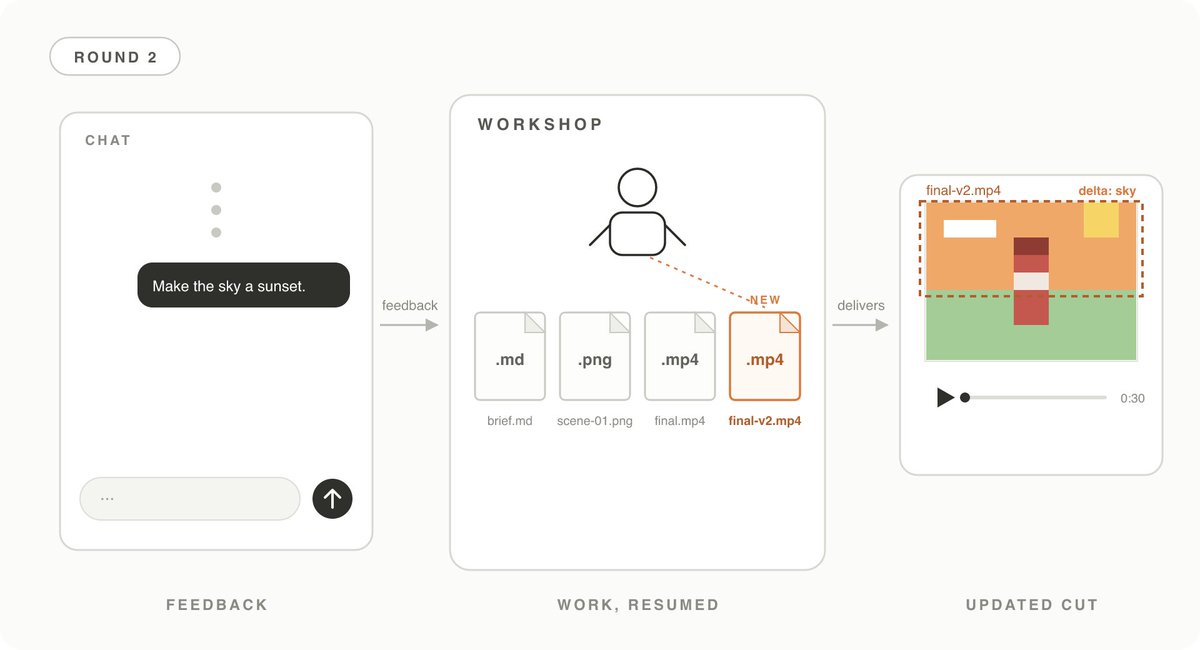
Same workshop. Same files. One delta.
The platform around all of this only relay the messages and collect the output. The work never touches our code. Our code only provisions the workshop and monitors the work.
The primitives for replicating knowledge work inside scalable software systems are available today: models, harnesses, and workshops. They mimic how real work gets done: call in a mind, give it a body, open its workshop, and let it iterate its way to quality work.