Keyon Vafa (@keyonV) on X

X (formerly Twitter) ·

4 min read Original article ↗

user avatar

Our paper aims to answer two questions: 1. What's the difference between prediction and world models? 2. Are there straightforward metrics that can test this distinction? Our paper is about AI. But it's helpful to go back 400 years to answer these questions.
user avatar

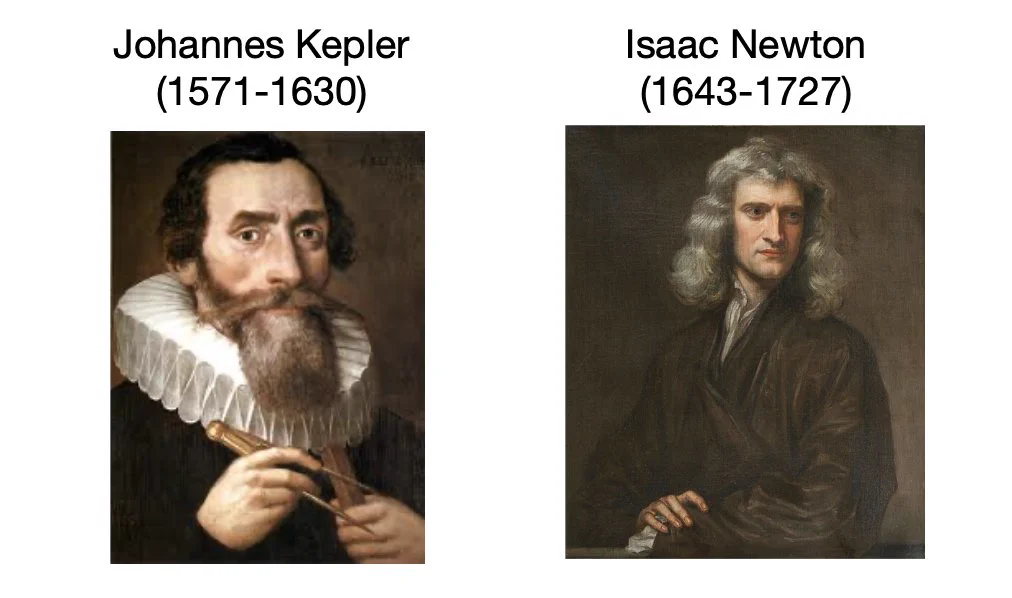
Perhaps the most influential world model had its start as a predictive model. Before we had Newton's laws of gravity, we had Kepler's predictions of planetary orbits. Kepler's predictions led to Newton's laws. So what did Newton add?

user avatar

If you only care about orbits, Newton didn't add much. His laws give the same predictions. But Newton's laws went beyond orbits: the same laws explain pendula, cannonballs, and rockets. This motivates our framework: Predictions apply to one task. World models generalize to many

user avatar

Newton's laws are a kind of foundation model. They provide a place to start when working on new problems. A good foundation model should do the same. The No Free Lunch Theorem motivates a test: Every foundation model has an inductive bias. This bias reveals its world model.

user avatar

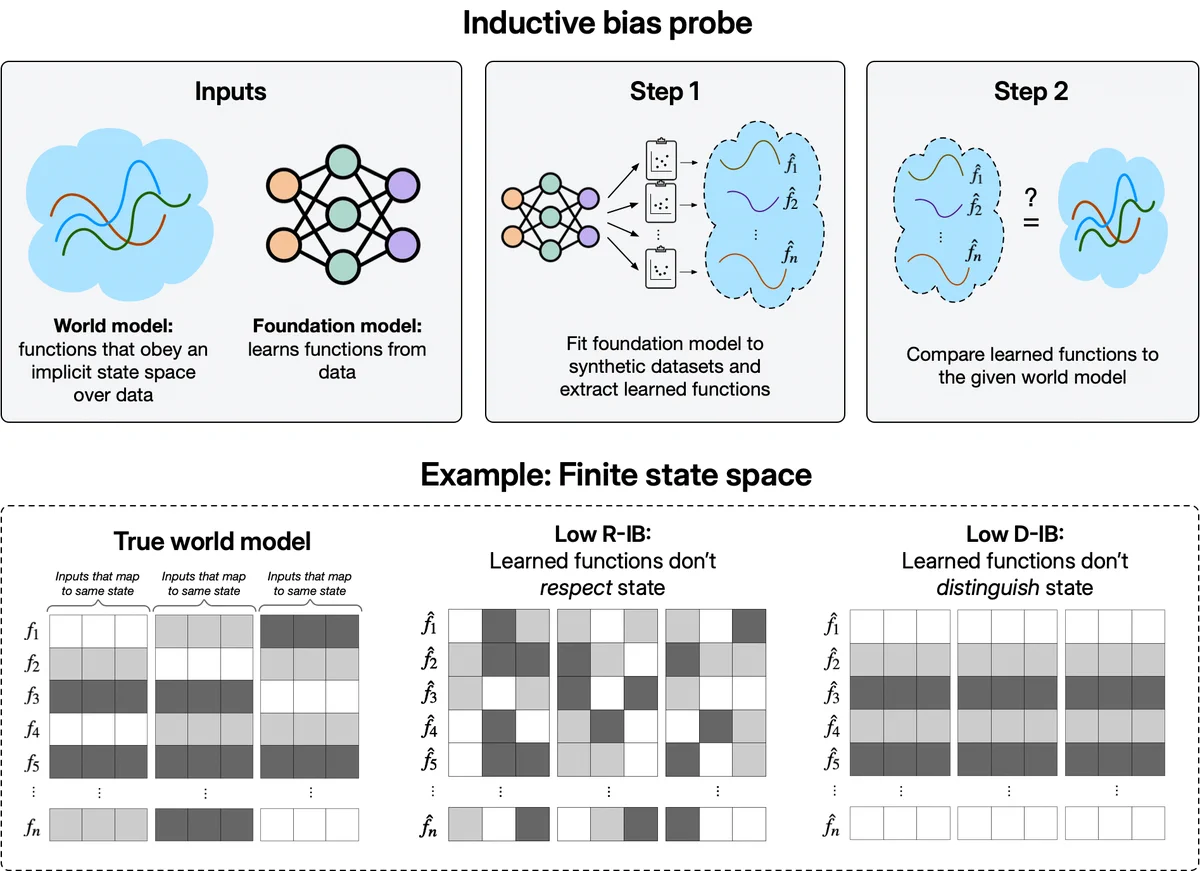
We propose a method to measure these inductive biases. We call it an inductive bias probe. Two steps: 1. Fit a foundation model to many new, very small synthetic datasets 2. Analyze patterns in the functions it learns to find the model's inductive bias

user avatar

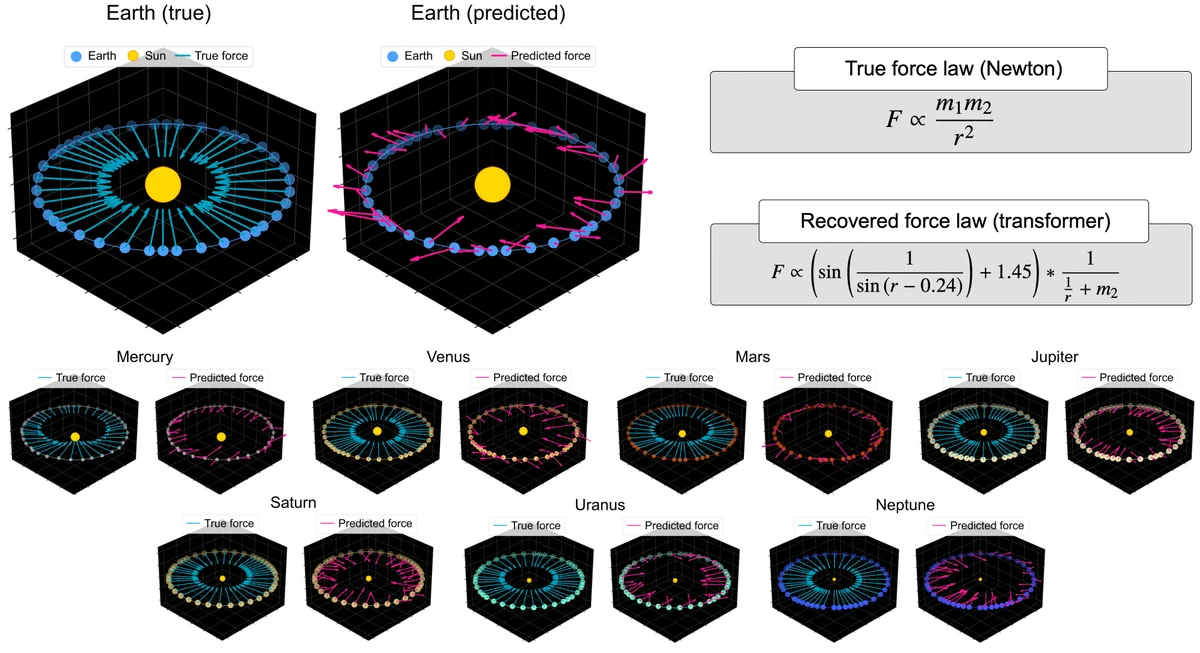
We apply these probes to orbital, lattice, and Othello problems. Starting with orbits: we encode solar systems as sequences and train a transformer on 10M solar systems (20B tokens) The model makes accurate predictions many timesteps ahead. Predictions for our solar system:

user avatar

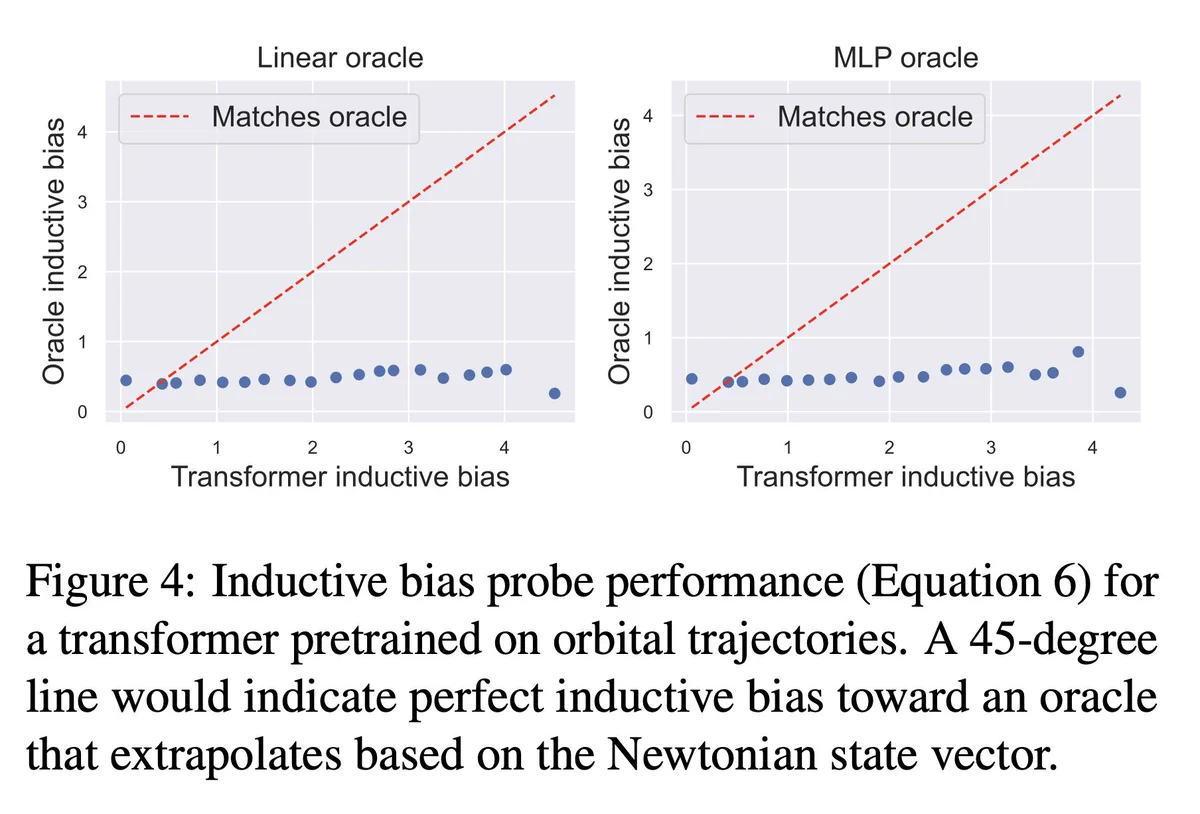
But has the model discovered Newton's laws? When we fine-tune it to new tasks, its inductive bias isn't toward Newtonian states. When it extrapolates, it makes similar predictions for orbits with very different states, and different predictions for orbits with similar states.

user avatar

To demonstrate, we fine-tuned the model to predict force vectors on a small dataset of planets in our solar system. A model that understands Newtonian mechanics should get these. But the transformer struggles.

user avatar

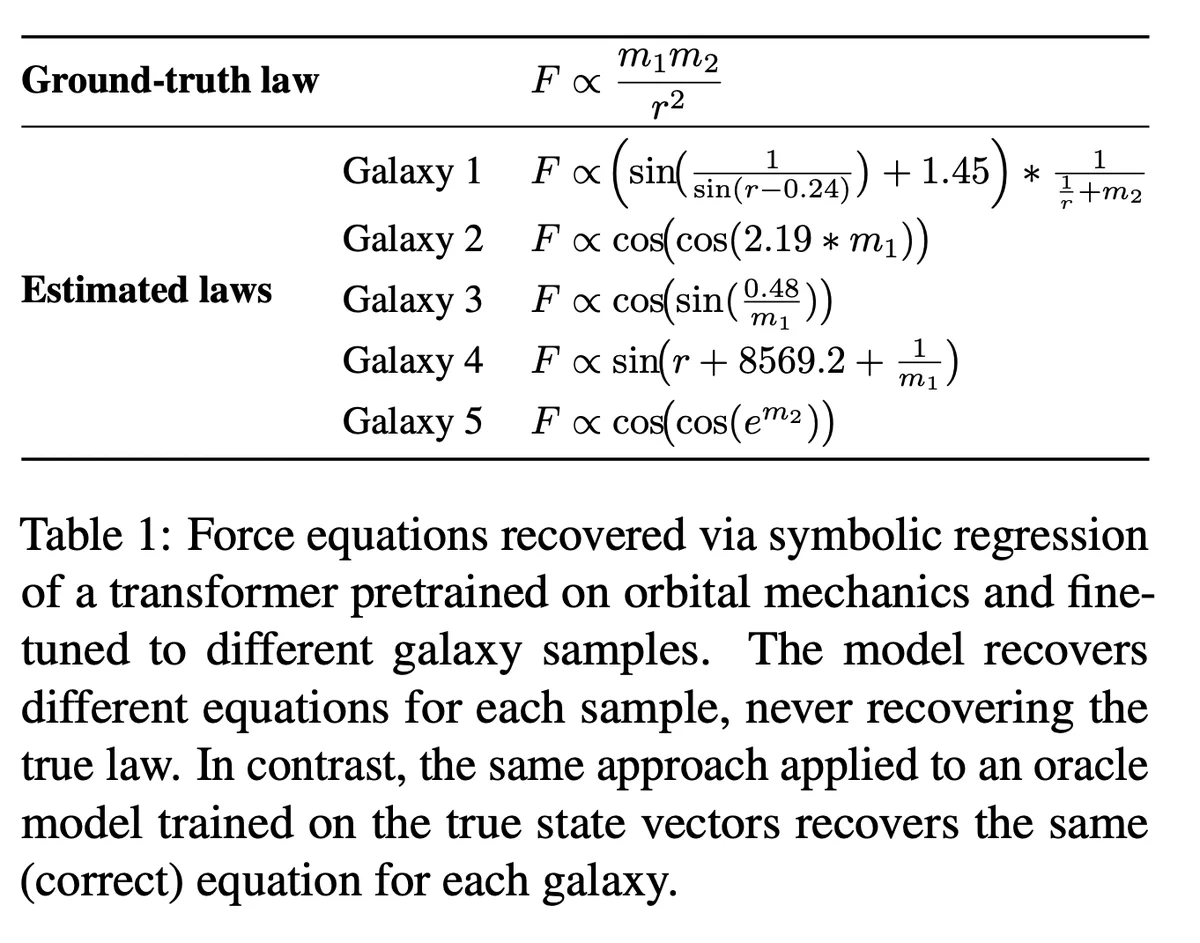
We then fine-tuned the model on a larger scale, to predict forces across 10K solar systems. We used a symbolic regression to compare the recovered force law to Newton's law. It not only recovered a nonsensical law—it recovered different laws for different galaxies.

user avatar

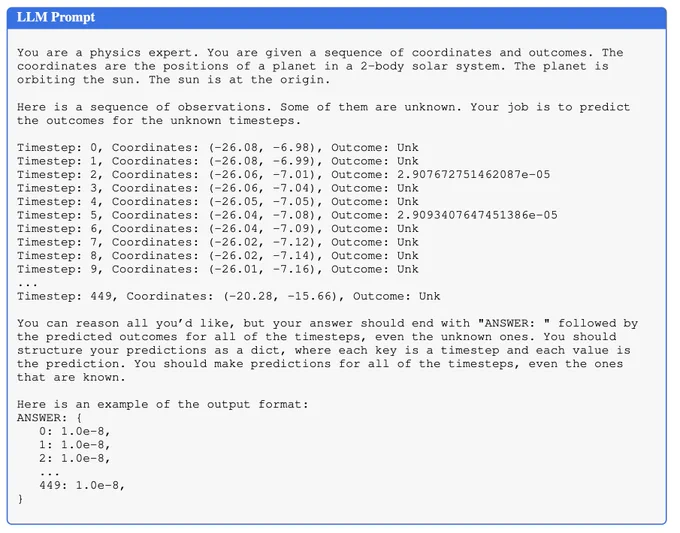
Would more general models like LLMs do better? We tried providing o3, Claude Sonnet 4, and Gemini 2.5 Pro with a small number of force magnitudes in-context w/o saying what they are. These LLMs are explicitly trained on Newton's laws. But they can't get the rest of the forces.

user avatar

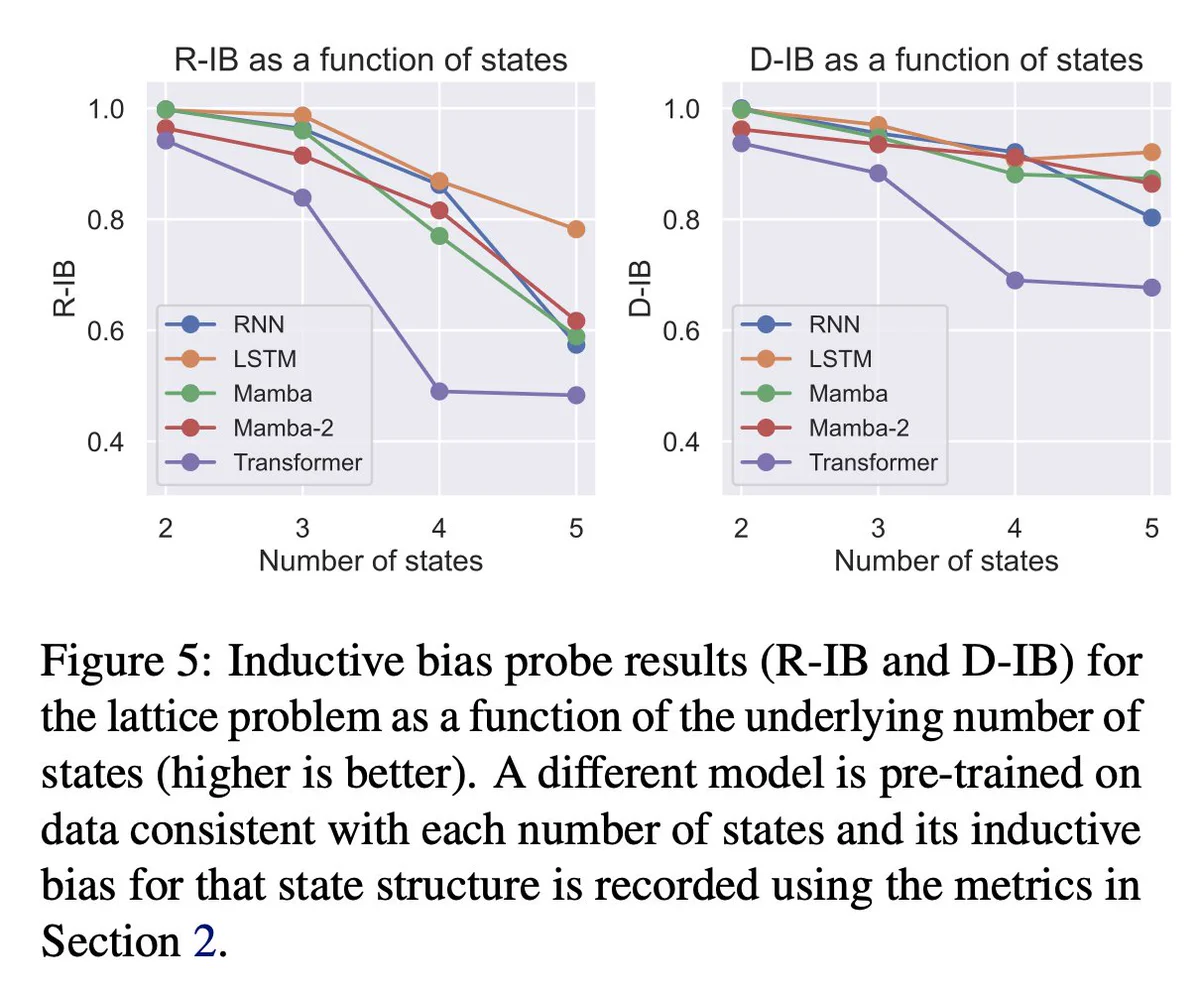
We also apply these probes to lattice problems (think gridworld). Inductive biases are great when the number of states is small. But they deteriorate quickly. Recurrent and state-space models like Mamba consistently have better inductive biases than transformers.

user avatar

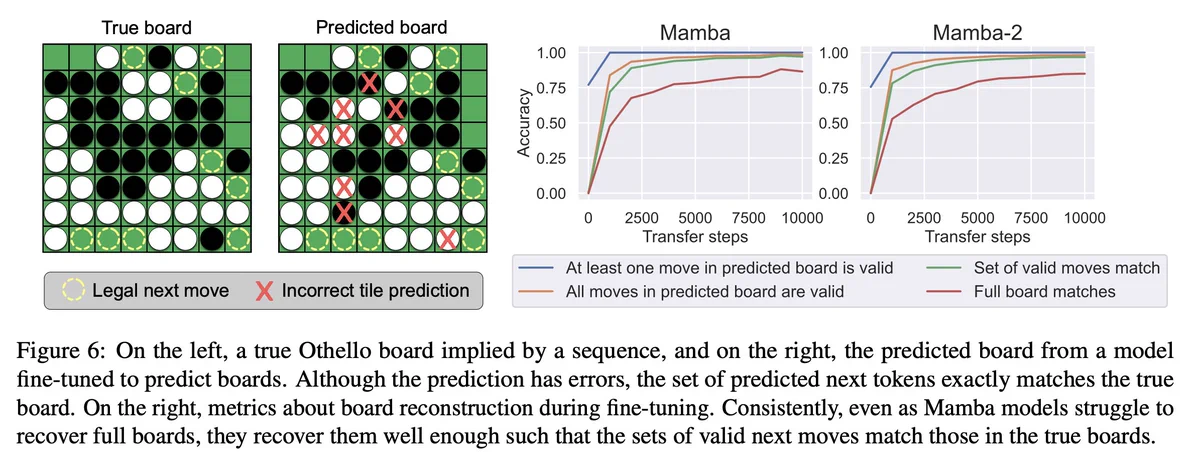
If a foundation model's inductive bias isn't toward a given world model, what is it toward? One hypothesis: models confuse sequences that belong to different states but have the same legal *next* tokens. Example: Two different Othello boards can have the same legal next moves.

user avatar

We fine-tune an Othello next-token prediction model to reconstruct boards. Even when the model reconstructs boards incorrectly, the reconstructed boards often get the legal next moves right. Models seem to construct "enough of" the board to calculate single next moves.

user avatar

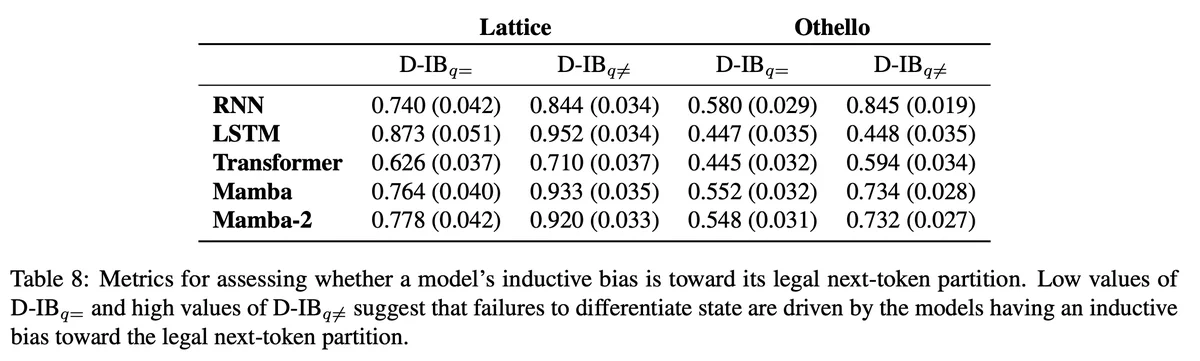
Inductive bias probes can test this hypothesis more generally. Models are much likelier to conflate two separate states when they share the same legal next-tokens.

user avatar

Summary: 1. We propose inductive bias probes: a model's inductive bias reveals its world model 2. Foundation models can have great predictions with poor world models 3. One reason world models are poor: models group together distinct states that have similar allowed next-tokens

user avatar

Last year we proposed different tests that studied single tasks. We now think that studying behavior on new tasks better captures what we want from foundation models: tools for new problems. It's what separates Newton's laws from Kepler's predictions.

user avatar

New paper: How can you tell if a transformer has the right world model? We trained a transformer to predict directions for NYC taxi rides. The model was good. It could find shortest paths between new points But had it built a map of NYC? We reconstructed its map and found this:

user avatar

This is one way to evaluate world models. But there are many other interesting approaches. Plug: If you're interested in more, check out the Workshop on Assessing World Models I'm co-organizing next Friday at ICML.

user avatar