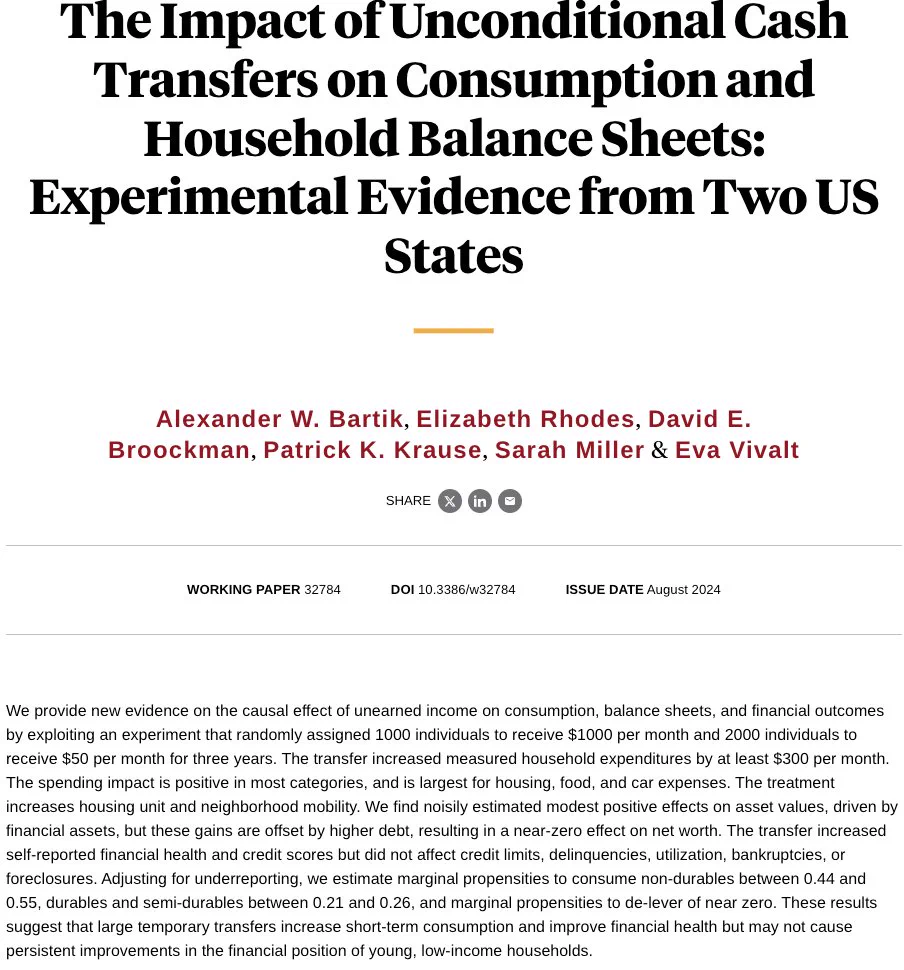
How do households change their consumption and household balance sheets in response to large, but time-limited, unconditional cash transfers? We study an experiment that provided $1000 a month for 3 years to 1000 young, low-income households. 1/
X (formerly Twitter) ·
How do households change their consumption and household balance sheets in response to large, but time-limited, unconditional cash transfers? We study an experiment that provided $1000 a month for 3 years to 1000 young, low-income households. 1/
1. Resource theories of political participation would expect big increases in turnout & participation: participants had more $ and free time. But we find nulls on participation, knowledge, etc. & can rule out observational association.
Those null findings contrast with studies finding gov't-sponsored transfers mobilize, consistent with interpretations that it matters where people think $ is coming from when they experience income shocks. Our participants were (correctly) aware that this $ was not from gov't.
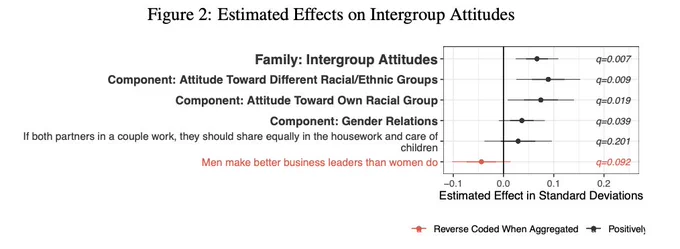
2. We find evidence consistent with "mood misattribution": recipients feel (a bit) warmer towards other racial groups, their own racial groups, & even governor of their state (& maybe both political parties). But no fx on dispositions like authoritarianism or trust in democracy.
3. Does getting a big cash transfer make ppl more supportive of... cash transfers? Liberal policy in general? Surprising answer: no! Political dispositions are hard to change! E.g., in interviews, some who received the transfer said they thought *others* would misuse it.
Today we released the first papers from OpenResearch's Unconditional income Study, which gave 1k ppl $1k/mo for 3 yrs & had a N=2k control group This 🧵 is for RCT nerds: how did we measure the cash's fx? Learn about 96% response rates, blood draws, changing a state law & more..