Anne Meng (@annemeng_) on X

4 min read Original article ↗

Post

Post

  • user avatar

    🚨NEW PAPER ALERT!! @anthlittle and I are excited to share our new working paper “Subjective and Objective Measurement of Democratic Backsliding.” 🔥Our hot take🔥: Contrary to the current narrative, we DON’T find evidence that we are in a period of global democratic decline 🧵1/

  • user avatar

    There are surprisingly few empirical studies that document systematically whether the global backsliding narrative is true. Also most studies rely on SUBJECTIVE indicators that use expert coder judgement. Since backsliding has become a hot topic, coder bias is a big concern! 2/
    user avatar

    We survey other more OBJECTIVE indicators of democracy (e.g. electoral competitiveness, executive constraints, media freedom). TLDR: We find LITTLE EVIDENCE of global democratic decline over the last decade. The real story is global democratic STABILITY 🌎 Some fun graphs: 3/

    user avatar

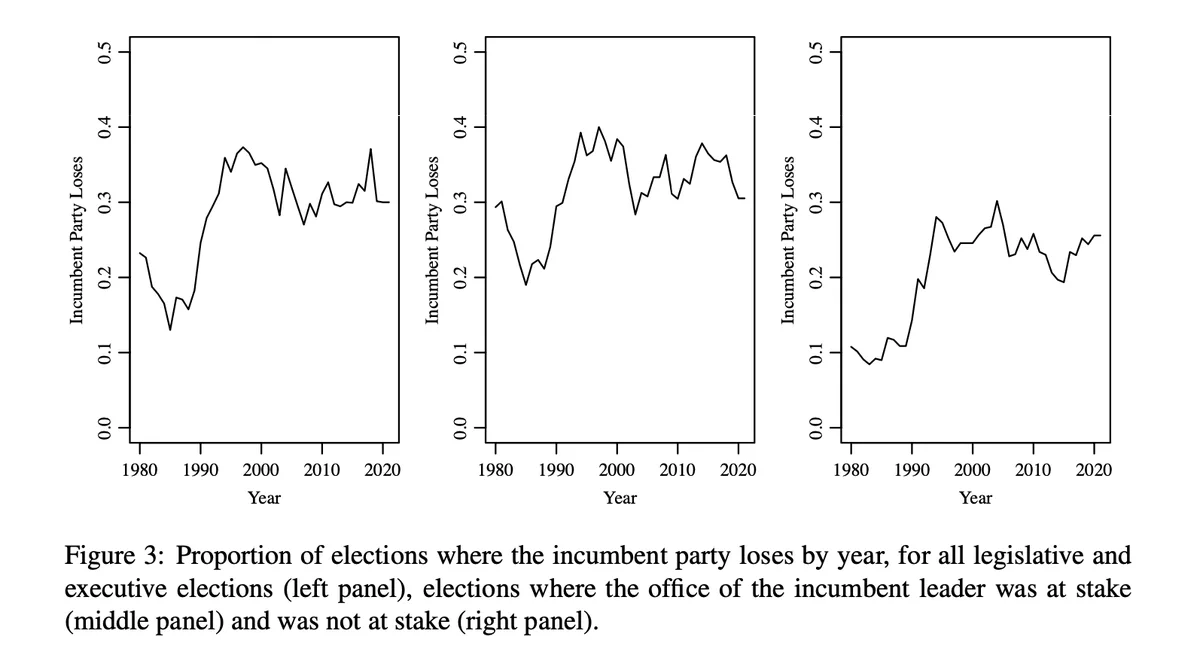
    Do incumbents continue to lose elections? Yes! We look at all legislative and executive elections worldwide 1980-2021 (left panel), and also separated by cases where the office of the incumbent leader was at stake (middle panel), and not at stake (right panel) 4/

    user avatar

    👉Turnover is super useful to look at bc 1) Most agree it's an integral part of democracy 2) Winning power is the ENDGAME 3) Undemocratic actions (banning parties, controlling the media, etc) influence the prob of winning elections - EVEN the sneaky stuff that’s HARD TO CODE! 5/

    user avatar

    We slice the data a bunch of different ways and also look at a ton of different election outcomes and process variables from NELDA and DPI (check out the paper linked below!). The picture does NOT change: incumbents continue to lose! 🗳️ 6/

    user avatar

    Are incumbents constrained? Yes! LH graph plots the % of countries with constitutional constraints (term limits, succession, dismissal rules). And rates of term limit evasion have NOT increased recently (RH graph plots successful and unsuccessful TL evasion) 7/

    user avatar

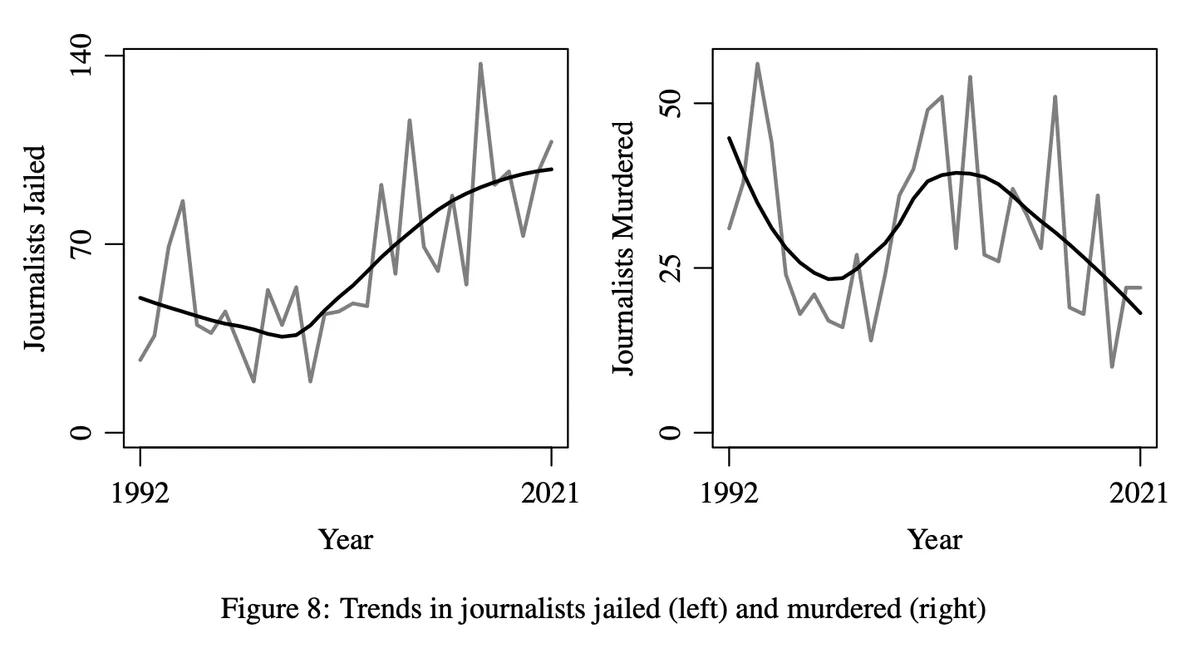
    The data on media violence is a bit more mixed. The number of journalists jailed (LH graph) has increased slowly over time since 2000, but the number of journalists killed has decreased over time (RH graph) 8/

    user avatar

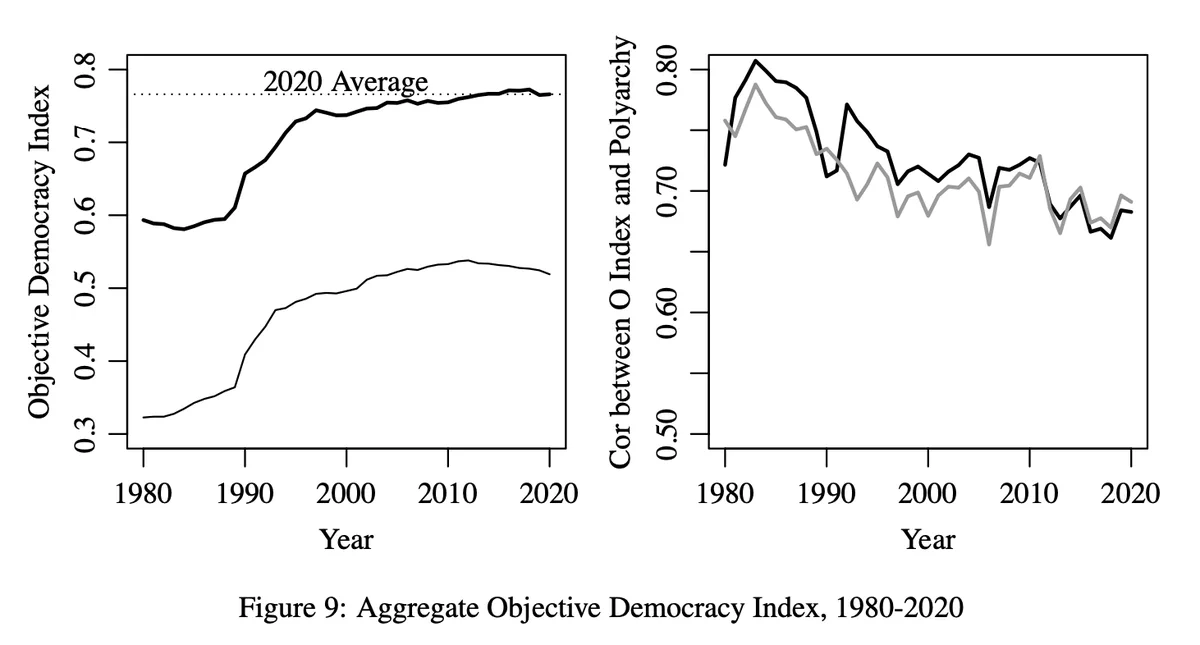
    We summarize all our objective measures in an Aggregate Objective Index – thick line in the LH graph. V-Dem polyarchy score is plotted as the thin line as comparison. We also show the correlation between the two: pretty high but decreasing recently 9/

    user avatar

    ☝️BTW, for those only interested in DEMOCRACIES backsliding, the results look very similar when we separate by democracies and autocracies. In general, democracies have not been performing worse in recent years 10/

    user avatar

    So what’s going on?🤔Why do expert coded scores show some global decline, but objective measures not? We develop two formal models to help make sense of the discrepancies🧑‍🔬11/

    user avatar

    One model considers the possibility that leaders are substituting blatant undemocratic actions for more subtle means of subversion. But shifting strategies does not explain why incumbents are NOT winning more 12/

    user avatar

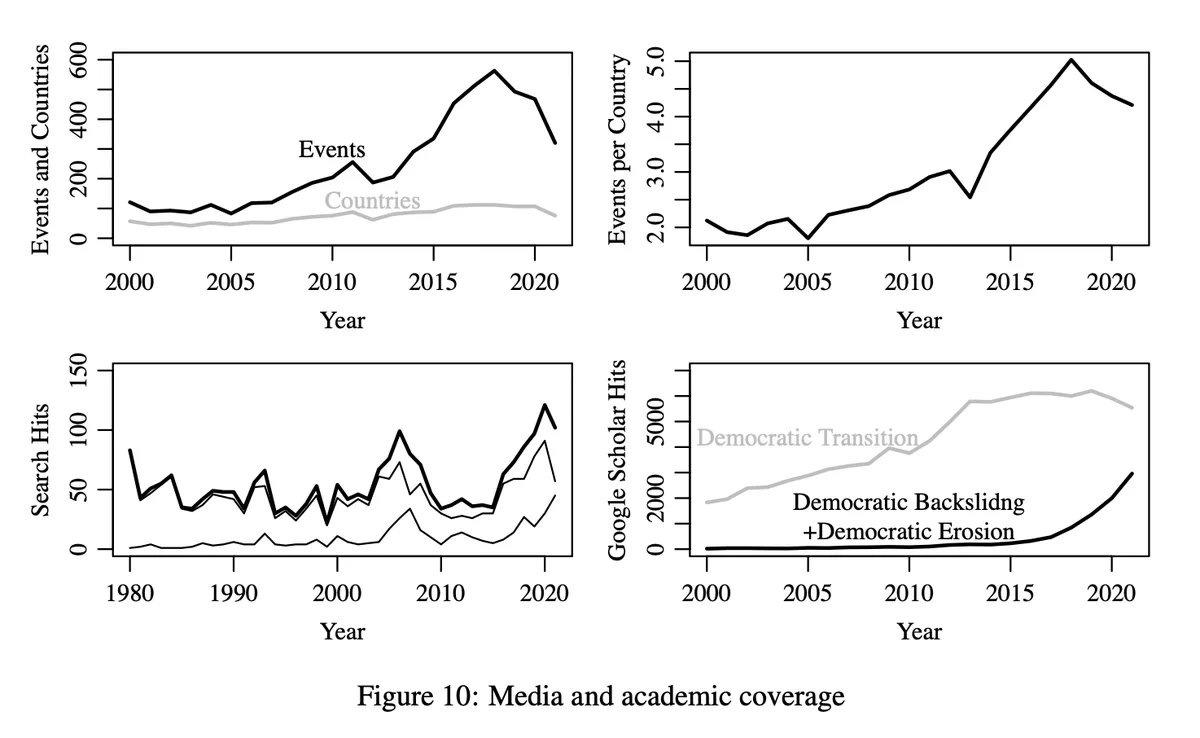
    The simpler explanation is that coders are being more HARSH now, potentially because they have much more information about recent democratic violations. Consistent with this explanation, backsliding has gotten SO MUCH MORE media & scholarly attention lately!📰📢 13/

    user avatar

    The top two graphs plot media reports on backsliding. Bottom LH graph plots NYT articles that include the terms “democratic backsliding or democratic erosion.” Bottom RH graph plots Google Scholar hits. After Trump got elected EVERYONE STARTED TALKING ABOUT BACKSLIDING 14/

    user avatar

    TO BE CLEAR: We are NOT saying that backsliding is not happening anywhere. There are around 200 countries in the world, and there is usually backsliding going on SOMEWHERE. In fact, we probably should have been paying more attention to backsliding this WHOLE TIME 15/

    user avatar

    ❗️Our core contention is that if the world really is experiencing major backsliding in the AGGREGATE, we should see some evidence to this effect on objective measures (like incumbent leaders and their parties winning elections). But we do not. 16/

    user avatar

    Only focusing on a handful of prominent backsliding cases can create misleading views about the resilience of democratic institutions. We hope that our focus on MEASUREMENT can help researchers and policymakers better target solutions 17/

    user avatar

    Democratic backsliding is an important problem and we SHOULD keep studying it! Thanks so much for reading! 🙋‍♀️🙋‍♂️Any feedback is appreciated, particularly from those who disagree or think we are missing something 18/

    user avatar

    You can find the paper on OSF preprints, SSRN, and both our websites: 19/

    user avatar

    user avatar

  • user avatar

    Looking forward to reading this. Resonates with my take on corruption. The popular narrative of things getting worse holds in places (how could it not?) but the global trend is in the right direction when looking at objective measures. I’ll be sharing this one…

Don't miss what's happening

People on X are the first to know.