If you do any shopping online at all, you should know your measurements.
I’m not saying measurements are “nice to have,” or something optional to make shopping easier, I’m saying that if you don’t know your measurements (and how to use them), you are doing yourself a disservice that can and probably often does result in frequent returns, wasted money, and ill-fitting outfits. Not to mention, if you’ve ever shopped vintage or secondhand online, you probably know that number sizing of the past is nowhere near what it is today.
That said, the inconsistency in women’s clothing sizes simply cannot be overstated. I once wrote in Why Does Fast Fashion Suck?:
“You’re a size 4 in one brand, but a size 12 in another, but a size 14 in jeans from the second brand but only if they’re dark wash, and a size medium in jackets but sometimes a medium fits like a small and it just doesn’t make any sense, does it?”
I dove into the reasons why this happens in that article—a combination of poor patternmaking, lack of quality control, distance from manufacturers, and good ol’ human error—but not the solution. Most would say said solution is obvious: universal sizing, but I don’t think so, as I said in The Perfect Industry:
Universal sizing is not a reasonable ideal to chase, nor would it solve the fit issues that, let’s face it, are simply inevitable when it comes to mass producing clothing. We know this because we’ve tried it: in 1939, the USDA published a study of women’s body measurements including stature, hip height, neck-base girth, waist girth, bust girth, shoulder length, forearm girth, posterior hip arc, and trunk line, with the goal of averaging this data in order to create a standardized size chart.
The problem—beyond the near impossibility of being able to gather enough data to represent every single unique body shape—is that…no body is really average. Maybe you and I have the same waist circumference…but do we have the same distance between our waist and our hips? Our shoulders may be the same length, but are our arms? Our inseams may be the same but we could be different heights. Body measurements are not enough to build a full range of sizes: you need to take proportions into account, as well, and if every single brand sizes their garments based on an average of all those measurements and proportions, then everyone who’s more than a couple of inches off from that average simply will simply not be able to fit clothes off the rack.
I want to briefly note here that size and fit are different, and when I use each word, I am referring to two separate concepts: Size is simply whether a garment can actually get onto your body, and the designations that let you know the likelihood of that. Fit, however, is about whether you feel comfortable and can move freely in that garment, and—most importantly—that the garment itself hangs as intended, with seams in their proper place and no excess tension or sagging.
In my, perhaps, unpopular opinion, we do need individual brands to have their own size charts, for the most part. We need fewer global brands making millions of every style, and more brands catering to their own niche—with some brands providing a variety of fits—available locally, with tailoring and alterations accessible at the point of purchase. Maybe some brands will work better for short torsos, with others more ideal for apron bellies, and some with options to accommodate both large and small busts: In an ideal world, you know what fit you need, and brands present the information necessary to decide whether their particular fit is for you and/or if it can be altered.
That, unfortunately, is merely a dream for a dream future in a dream world. And dreams don’t help you find clothes that fit, today, in the real world. In the real world, sizes are just a single number that represents another group of numbers, and which numbers align with your numbers is far more important than what that single number ultimately is. What matters is knowing how to use all those numbers.
So, how do you take your measurements?
First, you need a cloth measuring tape. I recommend looking locally at your nearest fabric and craft store, the laundry aisle at your nearest drugstore or big box retailer like Target, or, ordering from a site for sewing supplies like Wawak. They’re almost always less than five bucks and there are even extra long (up to 120 inches) versions.
The main measurements you’re gonna need for womenswear are the bust, waist, and hip. If you wear pants, you’ll also want your inseam. Here’s how to figure yours out:
Bust: Wrap the measuring tape around the fullest part of your bust---right over the nipples. For the most accurate and useful measurement, ideally, you should wear whatever bra you’d typically wear, especially if your breasts hang lower than your armpits (which is true for, like, most of us).
Waist: Bend over sideways: wherever your torso “hinges” is your natural waistline. This will typically be about 1-2” above your belly button.
Hip: This is the fullest part of your butt. Be careful to not pull the tape too tight, otherwise, you might not be able to move in whatever you purchase using that measurement!
Inseam: By far the most awkward measurement to take, you’re gonna wanna put the measuring tape pretty much right at your crotch, and measure down the inside of your leg to your ankle (or, wherever you want your pants to hit).
If you have difficulty with wrapping a tape measure around yourself and/or reading the measurements, you can also try the string method: get a long piece of string and knot it around your measurement points—be careful not to tie it too tight, you want it to be able to shift around your body, or to fit two fingers behind it (same with the measuring tape)—make sure the knot is secure and snip off the excess, then you can cut the string off, measure it like normal and voila, there’s your body measurement.
Taking your body measurements is just one method to help you pick the right size(s) when shopping online. But for those who have particular needs/preferences, or don’t want to measure their bodies, or—in some cases—just want to get a little more specific, there is another way: measure your clothes that fit (the way you want them to). This will get you a rough measurement that’s ideal for those who wear more tailored clothes, but unfortunately, absolutely will not work with clothes that stretch as stretch factor varies from garment to garment, even those with the same percentage of elastane/spandex.
If you’re not sure which of your clothes fit properly in order to use them for measurements, I wrote about how to figure that out.
For the easiest, basic measurements, you’ll want to measure pit-to-pit on a fitted shirt for the chest/bust, and across the top of your favorite pants for your waist/low-waist/high hips (depending on where you typically wear your pants). As this is only half the full circumference, be sure to double it.
If you don’t wear your pants at your waist, getting an accurate measurement for the natural waist is a little more difficult. Measuring at the narrowest part of anything that fits your waist the way you like is going to be your best bet, typically a dress or possibly a well-made blazer. Remember, no stretch.
Hips are also a bit difficult to measure this way, because laying pants flat typically doesn’t accommodate for the fact that the back is (usually) wider than the front to allow for the curvature of the seat (your booty). What I would do, especially if you have a very curvy booty, is fold your pants in half, with the back facing up, making sure to get it as flat as possible (no bumps, no bulging, no folds), and measure across the curve, multiplying it by 4. Consult the diagram, below.
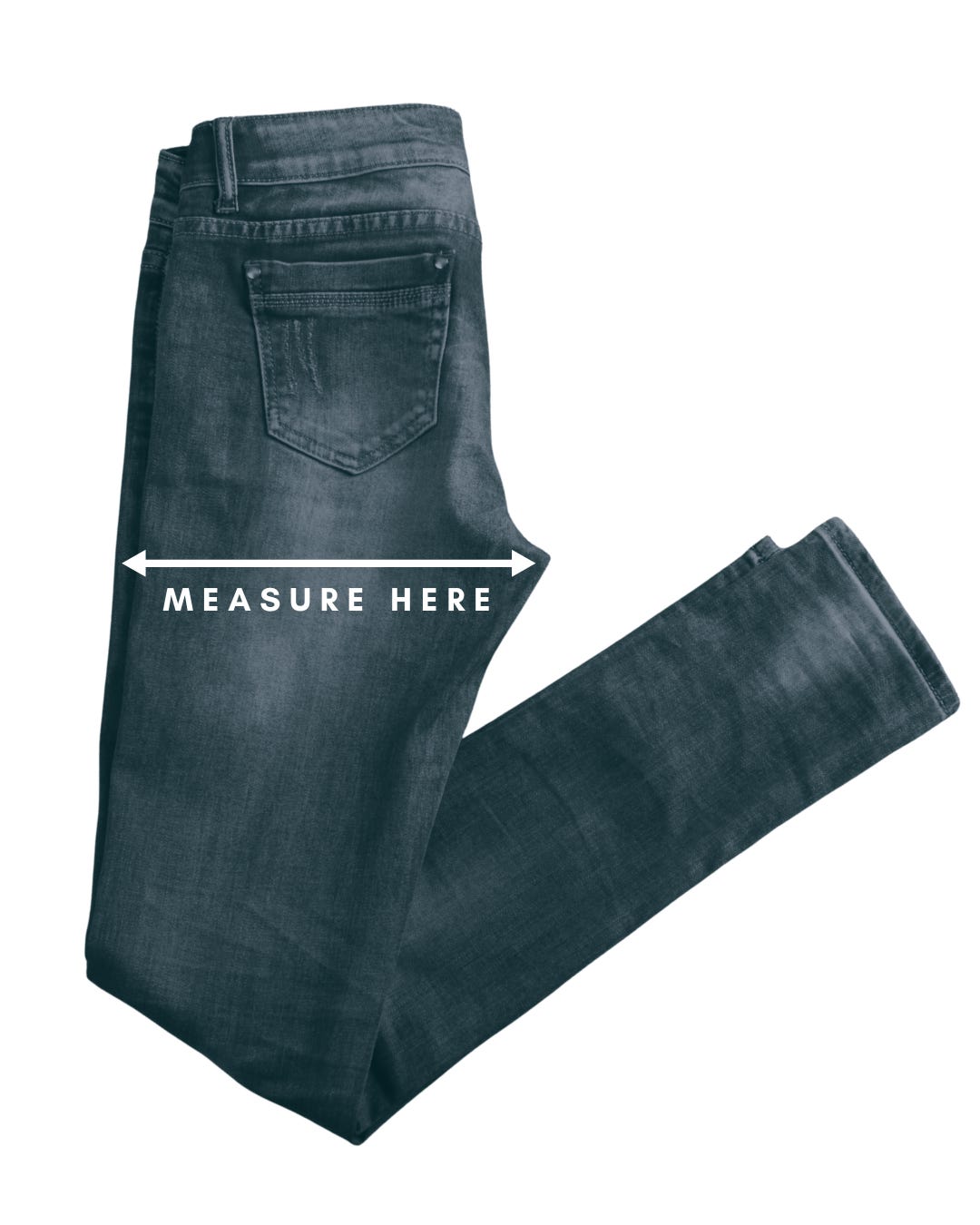
Please note, this is a very rough measurement that will leave you with room in the seat.
Measuring your clothes is not just useful for picking a size, it’s also useful for deciding whether you should buy something at all. Measure how long your favorite skirt is, so that you don’t buy one that’s way too short to cover your butt. Measure the inseam on the jeans that hit you in just the right spot, so you don’t buy pants that make you look ready for a flood. Measure the oversized shirt you already have (measure from where the sleeve meets the underarm for the “pit to pit” or approximate bust measurement) so you don’t buy an “oversized shirt” that ends up making you look like Winnie the Pooh. Measure the shaft height on your boots (from where the heel meets the shoe) so you know those knee high boots actually, you know, go up to your knee.
Keep these measurements in mind while you shop, and don’t buy anything where the measurement that matters most isn’t listed and doesn’t match up.
So, what happens when your measurements put you all over the map? Your bust aligns with a size 18, but your waist is a 12, but your hips are more of a 20. Here, you have to actually look at the garment, as the body measurements that matter most—and the degree to which they matter—are entirely dependent on how it’s intended to fit. Take a dress like the one below, for example:
This dress has what we would call a “free” hip measurement, meaning it’s very flowy and therefore will accommodate any size booty—and while it’s fitted in the bust, it’s also meant to hit at the natural waist, so, lower belly fat will also fit with very little issue. Here, the most important measurement in determining which size you want is going to be your bust—as that’s likely the largest measurement that the dress has to fit over—while the hip measurement doesn’t really matter at all. So, you would choose whichever size is intended to fit your bust measurement. Compare that to something like the dress below:
This dress is fitted along the entire body, which means, while you still need it to fit over your largest measurement, that could be your bust, midsection, or your hips, depending on your unique body. So, you’ll want to pick whichever size aligns with your largest measurement. But, look at this dress:
This dress is not particularly flowy nor particularly tight, but, because it’s got a fairly straight silhouette, you want to make sure it not only fits over your biggest measurement, but also leaves room to actually hang freely, otherwise, it’s not going to look the way it does on the model. If your largest measurement is in your midsection or hips, you may actually want to size up, if you want that very loose, relaxed fit.
Basically, ask yourself: where is it tight? Where is it loose? Or, in the case of something like the jumpsuit below, where is there a little “margin for error?”
On this jumpsuit, there’s elastic at the waist, which, even though the fabric itself has no stretch, will give you a little room to size down if your waist measurement is within 1-3” of a given size (but the measurements match everywhere else). Ideally, you’ll be provided with both the stretched and unstretched waist measurements, though, to be absolutely sure.
All that said, my fellow busty babes will know: sometimes, fitting your largest measurement means the garment is baggy and loose everywhere else…unfortunately, only a sewing machine can fix that…or a well-placed belt…or a few safety pins.
Size charts are for bodies, garment measurements are for clothes: they’re both useful, but in different ways. Let me explain:
A size chart tells you what body measurements are intended for a brand’s clothing. They essentially say “if you want our clothes to fit you the way they do on the model, these are the measurements you should have.” And each number is typically the biggest intended, meaning, if the measurement given is, say, 42”, and your own measurement is 43”, even if there’s some stretch in the garment, it’s almost always better to go the next size up, unless it's a very loose garment. Some size charts make this a little easier to decipher with a range, like “41-43.” Again, if there’s stretch in the garment, it’s important to not try to cheat, as the upper end of the range is usually the largest measurement that can comfortably wear the garment without risking too much tension in the elastic (leading to it wearing out faster) or tightness in the actual fit.
Garment measurements are, well, just that: they tell you exactly what the dimensions of the garment are and give you the freedom to essentially pick your fit. For instance, while my bust measurement typically (not always, but often) puts me in a US size 18/20 according to most size charts, I prefer a blouse with a bust measurement about 4-6” bigger than my own, for the drape I feel I look best in, so, I’ll pick whatever size has that measurement. If a top is meant to be very oversized, sometimes that means sizing down, but, it also occasionally means sizing up. The numbers on the tag are meaningless: it’s the dimensions that matter.
Something to take into account with garment measurements that most people don’t realize—especially with clothing that has no stretch—is ease, or extra allowance in the garment beyond the measurements of the intended wearer so that they can, you know, move and bend and breathe.
Even if you want a garment to fit your body closely, you do not want to go with something with no stretch where the measurement is exactly equal to yours. You usually want at least 2 inches of wiggle room. That’s ease. Different brands, and even different garments will have different amounts of ease. What helps is knowing how much you personally need to feel comfortable, and to ensure that any garment measurements you use to determine your size match up with that.
It’s kind of a common theme, here, isn’t it? Knowing your preferences. If a garment or brand does not fit your preferences and it’s not something you care to/can get altered, it’s okay to move on. Likewise if a brand is wildly inconsistent with their own size charts or doesn’t provide enough information to make you confident that their clothing will fit you: Skip!
Remember, you are not a size, clothes are a size, and they either fit you, or they don’t. If they don’t, it doesn’t mean something is wrong with you, you just need a different size.