![[pic of L19 board]](https://tromp.github.io/img/go/legal19.gif)
Number of legal Go positions
The 361 points on a 19x19 Go board can be colored empty, black, or white. Only some of the 3^361 possible positions are legal, namely those where every group of connected stones of the same color has an empty point adjacent to it. In the position above, black stones at E18 and N9 lack such ``liberties'', making the position illegal. Due to its capture rule, the positions that can arise in a game of Go are exactly the legal positions. On Jan 20, 2016, the number of legal positions on a standard size Go board was determined to beL19 = 208168199381979984699478633344862770286522453884530548425639456820927419612738015378525648451698519643907259916015628128546089888314427129715319317557736620397247064840935
or in more compact form
2081681993819799846
9947863334486277028
6522453884530548425
6394568209274196127
3801537852564845169
8519643907259916015
6281285460898883144
2712971531931755773
6620397247064840935
weighing in at 9*19=171 digits. We can write this more naturally in base 3 as the 19*19 ternary digits
0 0 0 0 2 2 2 0 1 1 0 0 2 0 1 1 1 0 1
2 1 1 2 1 2 0 0 2 1 2 1 0 0 0 2 2 0 2
2 1 0 0 2 1 0 1 1 1 1 1 0 1 1 1 1 1 2
0 0 2 2 0 1 1 0 2 0 0 1 2 1 0 2 0 1 0
1 0 2 0 2 0 1 2 0 1 1 2 2 1 0 0 1 2 1
1 0 0 0 1 1 1 2 0 2 2 0 0 0 2 0 1 2 2
0 0 2 1 2 0 0 2 0 0 1 1 1 0 2 0 2 0 0
0 0 2 2 0 2 2 2 0 0 0 2 1 0 1 0 0 0 2
2 1 0 0 2 0 2 2 2 2 1 0 0 2 1 1 1 2 1
2 0 0 1 0 2 2 1 2 1 1 2 2 0 2 0 1 2 0
2 1 1 1 0 0 2 1 0 0 2 2 1 2 2 2 0 1 1
2 2 1 2 0 1 1 1 0 2 0 1 2 0 2 2 2 0 2
2 0 1 0 1 2 1 1 0 1 1 0 2 1 2 0 0 2 1
2 0 0 0 1 2 2 1 1 2 0 2 2 0 0 1 0 1 0
1 1 2 2 0 0 1 2 2 0 2 0 2 0 1 2 2 1 0
2 0 1 0 0 1 1 0 2 1 2 1 2 1 1 0 2 2 0
2 2 1 1 2 0 1 0 2 0 1 2 0 2 1 2 1 0 0
0 0 0 1 1 2 2 1 0 2 1 0 1 0 2 1 1 2 0
2 2 0 2 1 0 2 2 0 0 2 1 1 1 1 1 2 2 2
which bears a striking resemblance to the image above.
It should come as no surprise that L19, viewed as a position, is itself illegal. The initial ternary digits show that the probability of a random position being legal is about 0.0000222 in ternary, close to 3^-4, or 1 in 81. This 1.2% chance was already computed by random sampling back in 1992. The approximation
L19 ~ 2.081681994 * 10^170
has been known since 2006. So what took us 10 years to nail it down to the last digit?
A Computational Challenge
Consider the problem of factoring. How do we find the prime factors of L19? Repeated trial division, the dumbest possible approach, takes time exponential in the number of digits, so it's utterly infeasible. Instead one should use an advanced algorithm, like the General Number Field Sieve, or the Elliptic Curve Method (ECM). These still take exponential time, but not in the number of digits itself, but rather (roughly) in the cube root or square root thereof, thereby vastly extending the range of inputs on which they're feasible in practice.Using an ECM implementation courtesy of Dario Alejandro Alpern, I was able to factorize L19 in mere hours on my laptop, yielding 8 prime factors:
5 *
401 *
4821637 *
964261621 *
2824211368611548437 *
2198466965002376001759613307922757 *
65948646836807567941440434317404197 *
54536540603346595211722061421378072820459376985314707345317470047
of 1,3,7,9,19,34,35, and 65 digits respectively. The challenge of constructing (rather than deconstructing) L19 is surprisingly similar. Individually testing 3^361 positions for legality is as insane as doing trial divisions. Detecting illegalities early during position generation, as this small program for legal probability approximation does, offers only the slightest improvement. Just as with factoring, we need an advanced algorithm that is exponential not in the number of points, but rather in the square root thereof, the board dimension.
Such an algorithm was developed in the early 2000s, and is described in detail in our paper Combinatorics of Go. It essentially reduces computing L19 to taking the 361st power of a very sparse matrix of 363 billion rows and columns. The computational power required for this only became available to me last year.
363 billion what?
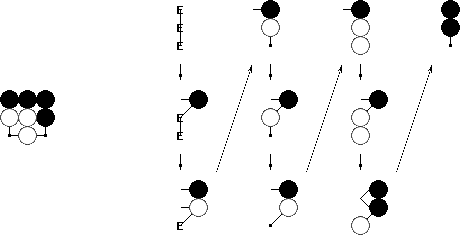
The matrix rows and columns represent so called border states, which describe all pertinent information about a cross section of the board, such as the presence of stones still needing liberties and how they are connected. Matrix powers represent counts of the number of paths from one border state to another. Each legal position uniquely corresponds to a path from the edge border state to one without libertyless stones, as illustrated for this 3x3 position:
Chinese jobs
Clever use of the Chinese Remainder Theorem allows for splitting the computation into 9 independent parts, each computing L19 modulo 2^64 minus some small number, contributing 64 bits of the 566 bit result. Starting from March 6 2015, running on big servers at- the IAS School of Natural Sciences in Princeton, where the L18 computation was recently performed, generously provided by Piet Hut and administered by Lee Colbert,
- the IDA Center for Communications Research, on the other side of Princeton, generously offered by Michael Di Domenico, who spent many hours setting up, monitoring, streamlining, and patching the jobs, as well as helping improve the jobflow scripts,
- and the HP Helion Cloud, generously provided by HP courtesy of Eric Moore,
Verifiability
The software used for these computations is available at my github repository. Running "make" should compute L(3,3) in about a second. For running an L19 job, a beefy server with 15TB of fast scratch diskspace, 8 to 16 cores, and 192GB of RAM, is recommended. Expect a few months of running time. Please use a modulus index outside the set {0,1,2,3,4,5,6,11,19} that we used. The computation has many built-in checks to guard against memory and disk corruption. Values L(m,n) where n<m, are checked for matching L(n,m) (computed in a very different way), while all values L(m,n) have to closely match the approximation formulaL(m,n) ~ 0.8506399258457 * 0.965535059338374^{m+n} * 2.9757341920433572493^{m*n}
derived from earlier results. Finally, application of the Chinese Remainder Theorem provide an important safeguard in that a tiny change in any of the inputs results in a huge change of output.
A big number game
Large numbers have a way of popping up in the game of Go. Few people believe that a tiny 2x2 Go board allows for more than a few hundred games. Yet 2x2 games number not in the hundreds, nor in the thousands, nor even in the millions. They number in the hundreds of billions! 386356909593 to be precise. Things only get crazier as you go up in boardsize. A lower bound of 10^{10^48} on the number of 19x19 games, as proved in our paper, was recently improved to a googolplex.Server benchmark, anyone?
Go counting could make a decent server benchmark:- The task is well defined, easily understood, and non-artificial.
- The program code is small and self-contained.
- The generated data sets are huge.
- The problem is a typical instance of map-reduce, and thus representative of a wide class of popular problems.
- The computation requires a good balance of multi-core processing power, memory for sorting, and disk-IO.
- The board size parameter gives an entire family of benchmarks, where each increment corresponds to a factor of about 5 in effort.
Legal counts for all boardsizes
This is sequence A094777 in the fabulous On-Line Encyclopedia of Integer Sequences.Click on the left links to find tables for m by n boards.
| n | number of legal n*n positions |
| 1 | 1 |
| 2 | 57 |
| 3 | 12675 |
| 4 | 24318165 |
| 5 | 414295148741 |
| 6 | 62567386502084877 |
| 7 | 83677847847984287628595 |
| 8 | 990966953618170260281935463385 |
| 9 | 103919148791293834318983090438798793469 |
| 10 | 96498428501909654589630887978835098088148177857 |
| 11 | 793474866816582266820936671790189132321673383112185151899 |
| 12 | 57774258489513238998237970307483999327287210756991189655942651331169 |
| 13 | 37249792307686396442294904767024517674249157948208717533254799550970595875237705 |
| 14 | 212667732900366224249789357650440598098805861083269127196623872213228196352455447575029701325 |
| 15 | 10751464308361383118768413754866123809733788820327844402764601662870883601711298309339239868998337801509491 |
| 16 | 4813066963822755416429056022484299646486874100967249263944719599975607459850502222039591149331431805524655467453067042377 |
| 17 | 19079388919628199204605726181850465220151058338147922243967269231944059187214767997105992341735209230667288462179090073659712583262087437 |
| 18 | 669723114288829212892740188841706543509937780640178732810318337696945624428547218105214326012774371397184848890970111836283470468812827907149926502347633 |
| 19 | 208168199381979984699478633344862770286522453884530548425639456820927419612738015378525648451698519643907259916015628128546089888314427129715319317557736620397247064840935 |
The results for n=14,15,16 and 17 were obtained in a joint effort between Michal Koucký and John Tromp.
Many thanks to Gunnar Farnebäck and Michal Koucký for their contributions. Gunnar wrote a legal counting program in pike, while Michal suggested the use of Chinese Remaindering and implemented a file based program.