Last week, we had ourselves a little retrospective on the classic Fallout games from the late nineties, focusing on the uncommon qualities that made them stand out amid a sea of repetitive, underwritten crap in their era and that keep them elevated atop a pedestal of critical admiration to this day. I repeatedly teased an exploration of the classic games’ long-lasting and still-active modding community and, after a week spent wrangling third-party installers and sifting through obscure forum posts, that’s precisely what I have in store for you this week. We’re all about elevating the prestige and esteem of games-as-art here at The Spieler, so what better than to spend a week focusing on a diverse variety of fan games that exist for virtually no purpose other than the desire to create artwork using Interplay’s Fallout 2 as both canvas and brush?
Aside from the choice of engine, the central characteristic that unites all of these games is that they’re noncommercial by legal necessity. Interplay never licensed the Fallout 2 engine for commercial use by independent creatives, of course. And you won’t be shocked to learn that, following their acquisition of the intellectual property rights in 2007, Bethesda Game Studios (a division of Bethesda Softworks LLC and proud subsidiary of ZeniMax Media Inc., a proud subsidiary of Microsoft Corporation) never did so either. Consequently, the hard-working folks who pour thousands of hours into developing these ambitious fan games have never grossed a dollar from their efforts and never will.1 Then again, PC games modding has never been known as a lucrative endeavor at the best of times. At least these passionate creators are showered with adulation by their legions of adoring fans and so develop large bases of industry clout that they can leverage into greater opportunities, right?
Wrong! I hate to break it to you, but the classic Fallout games’ extant playerbase is vanishingly small these days, and the subset that still makes and plays mods for them is so microscopic that it scarcely reflects visible light. These are profoundly obscure, utterly niche products that only a very narrow segment of gamers are culturally equipped to enjoy, and so their creation is first and foremost a labor of love. Despite the wholesale lack of material compensation, these things are still getting made even twenty-seven-plus years after the industrial development of classic Fallout came to an end. This all evinces the unquenchable flame of creative passion that motivates the folks making these games, and so it should come as no surprise that some of gaming culture’s most brilliant works of independent craftsmanship are to be found among the handful of finished, fully released examples below.
These days, what with machinic facsimiles of artwork dominating whatever’s left of our collective discourse, it feels more important than usual to show love to creative work that’s motivated above all by the satisfaction intrinsic to producing art. So, let’s do exactly that and see just what the proud children of Fallout have wrought from the base metal of late-nineties computer roleplaying. In the interest of time and concision, most of our focus for this week will be on the handful of artisan RPGs that, by my reckoning, deserve direct comparison with the great classics of the medium. But, since those represent only a fraction of the worthwhile output produced by the Fallout 2 modding community, let’s start by briefly recognizing some less fully realized concepts and incomplete works-in-progress.
I don’t necessarily recommend that you take the time to install and play any of these unless you’re a true devotee of the form, but I hope you’ll at least get some food for thought out of reading about them. Consider the below an amuse-bouche in advance of the more thorough examinations that follow. Presented in no particular order.
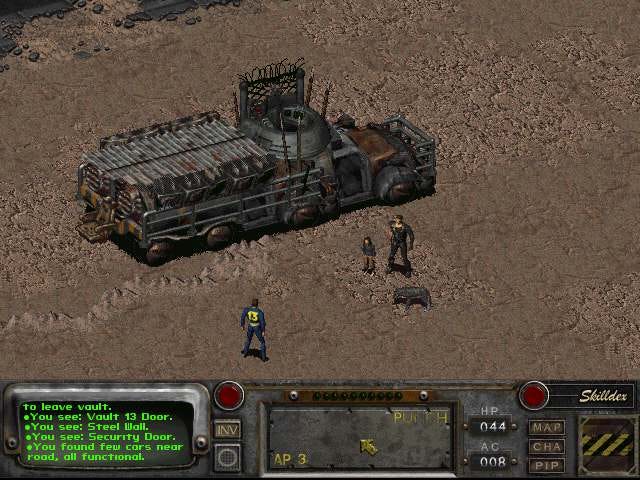
A genre-bending total conversion of mysterious origin, 13V is a parodic adventure game that just happens to use classic Fallout’s engine and setting. I’m leading with this one because it illustrates the creative flexibility that modding can enable — 13V bears only incidental resemblance to the game upon which it’s built, playing more like a point-and-click adventure game from the early nineties than an RPG. It follows a linear story about proactively seeking replacement parts for the eponymous Vault-Tec supercomputer that manages the protagonist’s crappy Vault, which I take to be a tongue-in-cheek parody of Fallout 1. The gameplay itself is structured around inventory puzzles and sardonic dialogue that rarely offers any freedom of choice, but it’s occasionally pretty funny and showcases some asset work that punches well above its weight. The game’s real standout feature is its creative mapping: rather than spriting new assets from scratch, 13V’s creator cleverly merged existing sprites from the old games to evoke different objects, and this is done with such attention to detail that only a long-time veteran of the early series would recognize it. The game is available in English, and I’d say it’s worthwhile if you’re at all intrigued by the premise of a comedy adventure on the Fallout 2 engine.
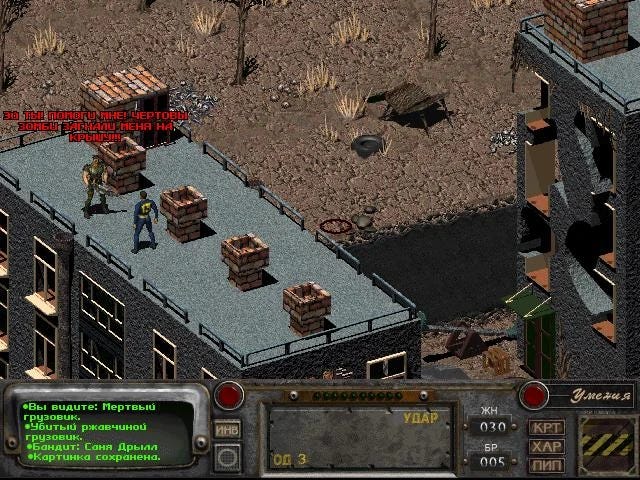
Gosh, this is a strange one. Developed over about a year-and-a-half by a pair of Russian fans, Oblivion Lost is an absurdist remix of the base game whose central premise is the transposition of S.T.A.L.K.E.R.: Shadow of Chernobyl into the world of Fallout. It begins like FO2, but then your character is waylaid by SoC protagonist Strelok on the way out of the starting village. He insists you drink with him and, after a two-week bender, you come to your senses having somehow learned to speak Russian. Mutants, anomalies, and other mainstay features of the S.T.A.L.K.E.R. series are integrated into the game loop in a manner that might be genuinely stimulating for a very specific kind of Fallout fan, but this one is all but completely impenetrable to decadent Westerners even if you can get past the thick, sludgy layers of buginess and jank. It’s the sort of thing you’re probably better off experiencing as a video on YouTube rather than playing for yourself, but Oblivion Lost has a reputation among Fallout modders for a reason and it’s definitely worth a few yuks at the least.
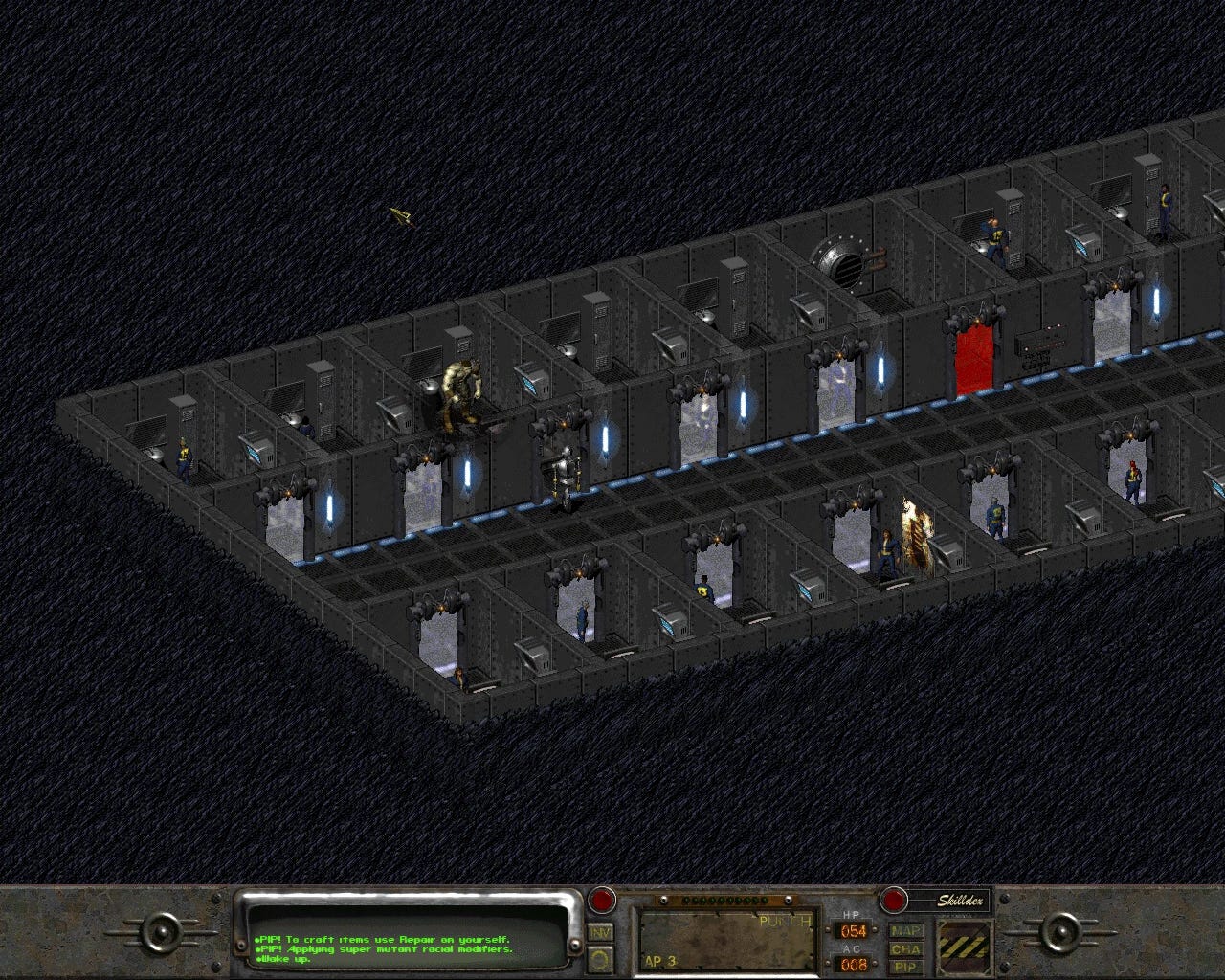
Arguably the most notorious modding project for Fallout 2, Yesterday is an audacious attempt to recreate Fallout 3 on the classic engine. Not Bethesda’s actually existing Fallout 3, mind you — this is a recreation of the sequel that Black Isle Studios was slated to develop (codenamed Van Buren), which was cancelled several years before Todd Howard et. al got their hands on the franchise. Crucially, Black Isle’s original design document for Van Buren survives to this day, which is how the Yesterday team was able to credibly approach so ambitious a project. It’s an absolutely huge undertaking and is reportedly years away from completion even after ages in development, but a playable version does exist on Nexus and it’s possible to finish the main story under very specific circumstances despite much of the game remaining wholly unimplemented. It was last updated this past January and, while it has a lot of problems, the amount of effort on display in the mapping, spritework, and scripting is astonishing. Of all the games on this list of Honorable Mentions, this is the one that comes closest to a recommendation. Not for general audiences, of course, but Fallout obsessives will almost definitely find something to love.
We come now to the modding projects that can stand on their own not only as complete RPG experiences built atop Fallout technology, but as worthy successors to the legacy of the classics in their own rights. Veterans of the classic games should enjoy all four of these. Note that they all assume their players have some familiarity and comfort with the classic engine, so interested parties who never got around to the Interplay games would do well to get their feet wet with Fallout 2 at the least. Presented in release order.
Created by Václav Panoš, Marek Štípek, Milan Ratičák, and Marián Lóži
Given that barely a year passed in between the releases of Fallout 1 and Fallout 2, it’s unsurprising that fans started getting antsy for a third game as the new millennium dawned. Around 2003, a group of Czech Fallout fans decided they’d waited long enough and resolved to take matters into their own hands. The resulting decade-long development effort eventually culminated in the release of Resurrection, which became the first completed Fallout game of the 2000s to credibly recreate the feeling of the classic games. Its name drips with symbolism: at the time of its release, the most recent game to unmistakably evoke Fallout’s presentation and gameplay was probably Arcanum: Of Steamworks & Magick Obscura all the way back in 2001 — it was a resurrection of the Fallout aura that had until then lied dormant. And, not for nothing, it begins with the left-for-dead protagonist rising up and emerging from a cave. Go figure.
Resurrection begins in 2170, between the events of Fallouts 1 and 2. The player-created protagonist, thoroughly amnestic, awakens with a strange talisman in their possession and gradually pieces together their involvement with a mysterious cult whose machinations threaten the emerging civilization in the wastes of New Mexico. It features a small but entirely new map, a variety of scratch-made 3D cutscenes, and an extraordinarily bleak tone that sets up a wasteland more foreboding and depressing than any Fallout setting that came before.
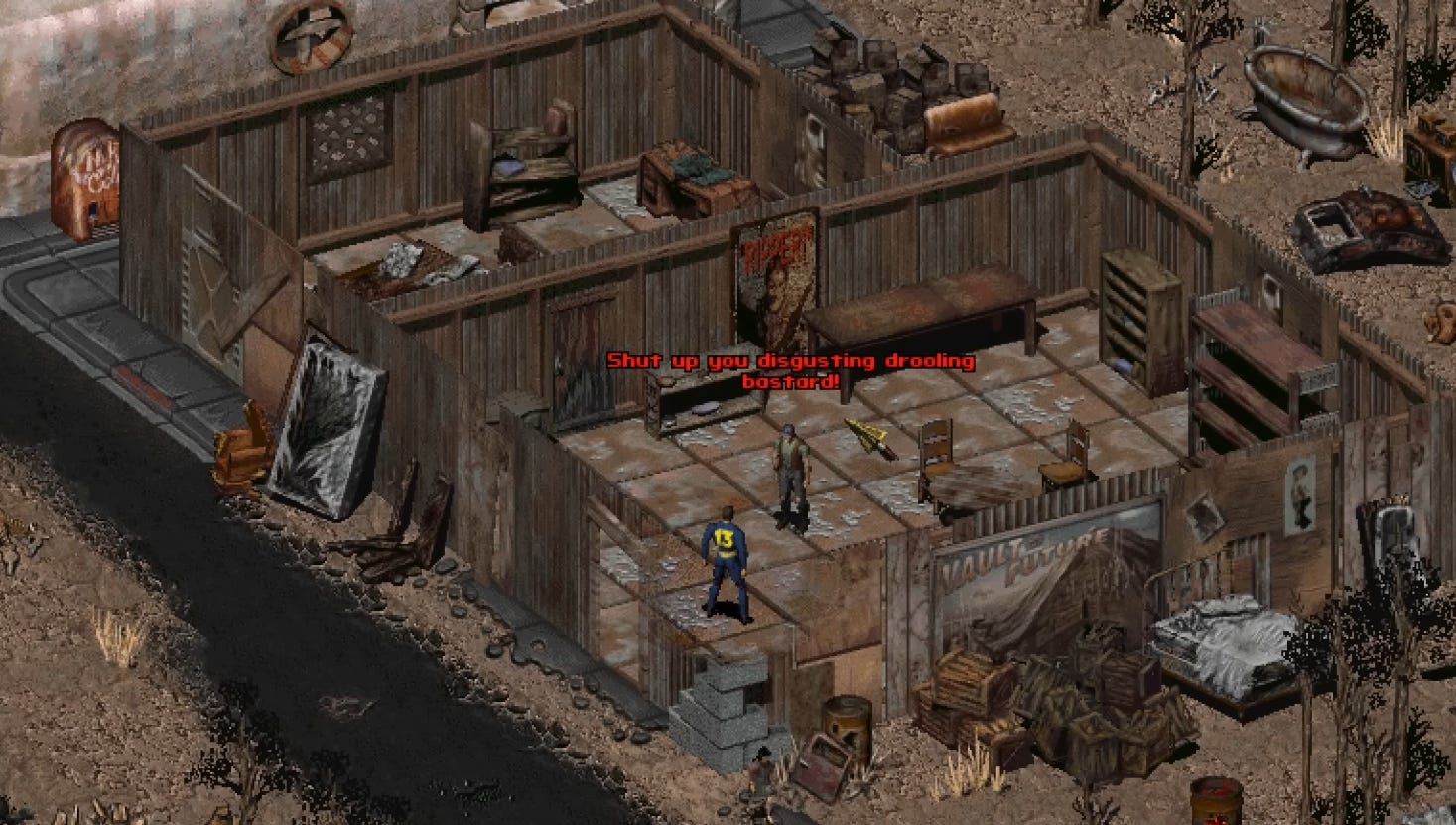
In its capacity as a self-described successor to the classic gameplay formula, Resurrection delivers in spades. Of the three games on this list that take place within the Fallout universe, it feels the most thematically coherent and arguably features the most robust and fully realized original story of the bunch. It’s also extremely successful at replicating the classic games’ practice of empowering players to drive the narrative according to their own whims, and its two possible endings — while almost agonizingly melancholic regardless of the player’s choices — are powerful denouements whose progression throughout the game mirrors the thematic weight of Interplay’s writing, if not its penchant for well-placed moments of levity.
Created by Aleksandr Poshelyuzhin and Nevada Band
Created principally by a single obsessive from Siberia, Fallout Nevada is among the largest and most ambitious fan games yet completed on the FO2 engine, at least where its design goals are concerned. A plot prequel to Fallout 1, it takes place a little over a decade after the civilization-destroying Great War and centers around the former residents of Vault 8 in the years immediately following their emergence from underground. The player, also a former Vault-dweller, investigates a dark conspiracy against the burgeoning Vault City that clarifies much about the figure who would eventually become Fallout 1’s central antagonist.
At its core, this is a complete adventure setting with reams of original content that, aside from a lack of voice-acting and copy-editing, feels like a Fallout game from the nineties that never hit the market. It’s not perfect — popular criticism of Nevada tends to focus on its immense scope that occasionally overleverages the project’s limited development resources. There are loads of gorgeous new sprites, hub cities with hours of engaging sidequesting each, and a great soundtrack with some high-quality original music. There are also a number of characters copied right from other gaming franchises and a handful of tiny backwaters with at-best marginal roles in the game’s fiction, so the conflict between aspirations and reality is readily apparent. Indeed, a first-party design document for a redux version produced as a thought experiment went as far as cutting around half of the game world in order to better focus the experience.
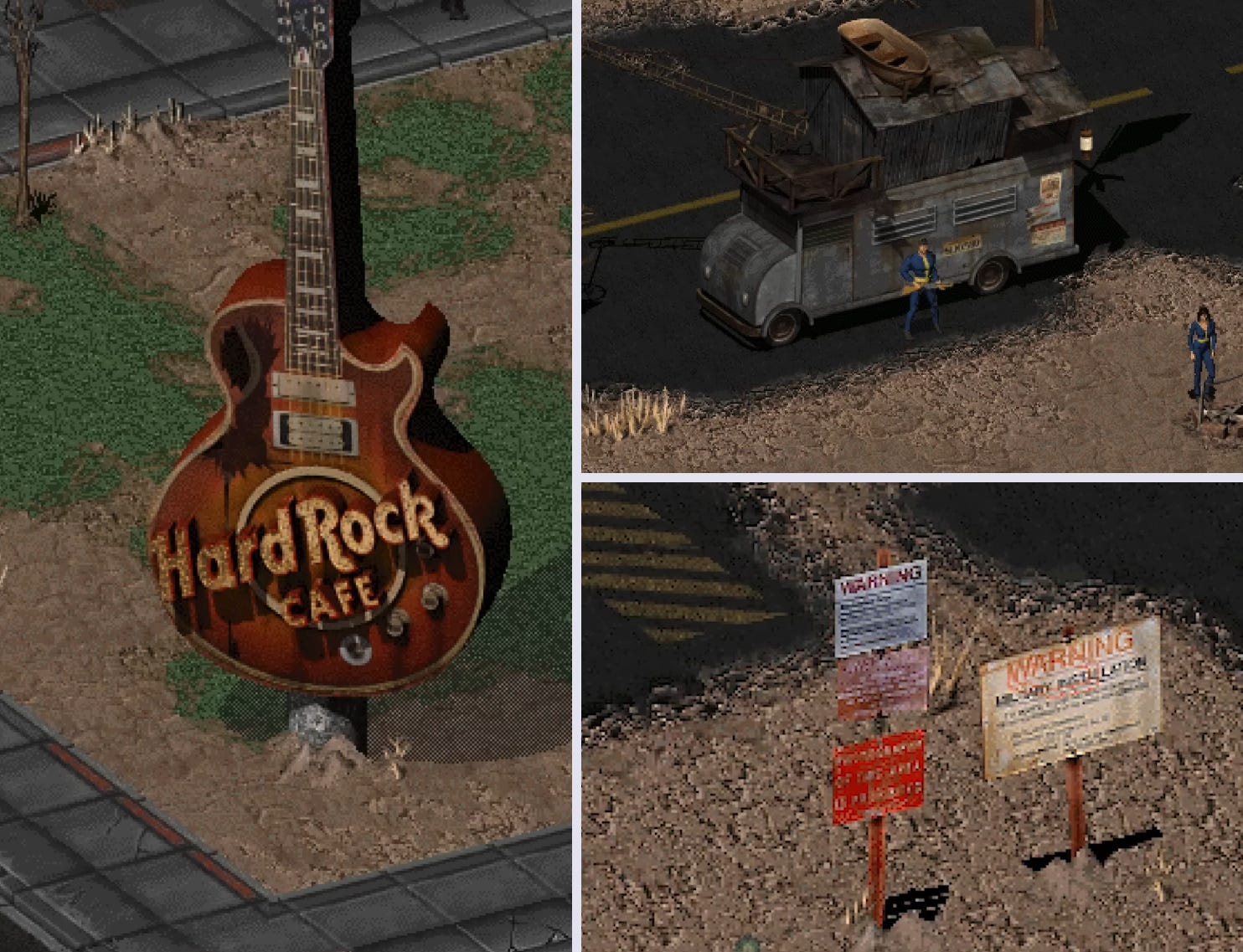
But, scope-creep aside, Nevada was a broadly successful effort and a tremendously encouraging debut outing for Poshelyuzhin and Nevada Band. It reflects an intense love for the classic Fallout games that inspired it, and that admiration comes across throughout practically every sequence, even those visibly affected by compromise. It presaged more excellent work to come in Fallout Sonora, which we’ll talk about shortly. First, though, something completely different.
Created by Artem Samoylov, Aleksandr Berezin, and Sergey Bokarev
Olympus 2077 is unique among completed fan games on the FO2 engine in that its setting takes place beyond the Fallout universe. In service of that, it features a remarkably well-realized dieselpunk aesthetic with loads of original spritework that feels distinct from but utterly authentic to the Fallout aesthetic that unavoidably inspired it. I think this one is my pick for best-looking fan game on the classic engine, and its alt-universe take on Power Armor is instantly iconic.
The player character begins the game as a lowly slave in the bowels of the titular Olympus tower, a colossal monolith of industry and repression in the ruins of what was once Silicon Valley. The first part of the game is a recollection of the protagonist’s childhood, adolescence, and early adulthood in the tower’s basement (a bit like Fallout 3, but not half as cloying) that ends with a bizarre misunderstanding that forces them from the bleak but relatively stable hole in which they’ve spent their entire life. After climbing out and witnessing the Sun for the first time, the player explores the wasteland of Northern California in search of aid for their people and a resolution for their suffering. Horrifyingly, you soon learn that your people’s short and repressive lives in bondage are a target of envy for many factions of free folk who have it even worse. Post-nuclear society is in a rigid state of arrested development, and nothing short of a change in management at the peak of Olympus stands any chance of moving it forward.
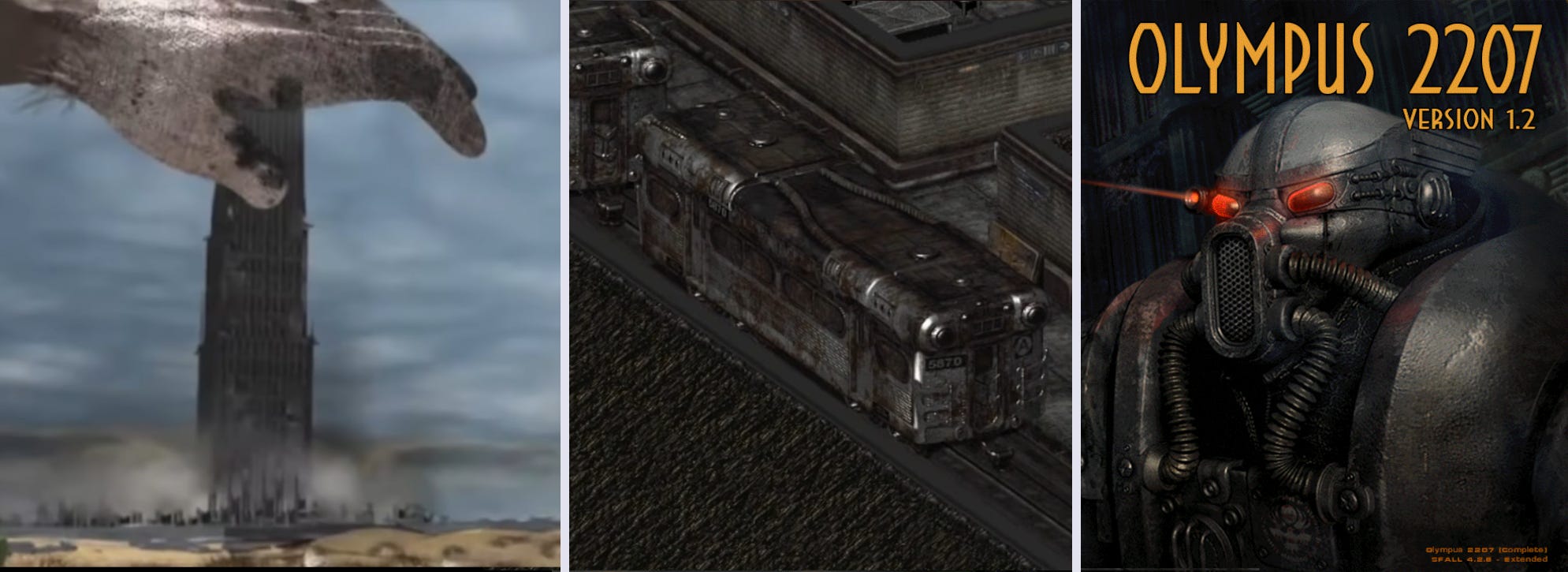
Olympus 2077 is about as ambitious a display of unadulterated passion as fan games get. The amount of custom assets on display, from spritework to animations to mapping to scripting, is nothing short of staggering for a noncommercial project with a lifetime player-count that might not exceed three figures. It’s a Fallout game beyond the Fallout universe, and it’s a contribution of profound importance to the series’ legacy for having pushed the classic engine’s limits as a storytelling engine. Despite being a mod at its core, it looks and feels like an entirely original product that might as well have come out right alongside Fallouts 1 and 2.
Created by Aleksandr Poshelyuzhin and Nevada Band
The second major release from Poshelyuzhin and his team, Fallout Sonora takes place across a vast swath of the southwestern U.S. and part of northern Mexico. The latter in particular was all but completely unexplored by the official Fallout games, and that’s what inspires Sonora’s fascinating survey of how America’s neighbor to the south was affected by the hardcore jingoism and subsequent nuclear annihilation that form the aesthetic and thematic foundations of the series’ fictional universe. It wears this inspiration on its sleeve, even as soon as character creation — adventurous players can take a trait to gain basic literacy in Spanish, and this adds a breadth of interactivity to the world. Even without it, though, you’ll still get to experience a bevy of artwork that colors the Mexican Fallout experience, from a variety of new environmental tilesets to a kickass original soundtrack by Russian musician Nobody’s Nail Machine.
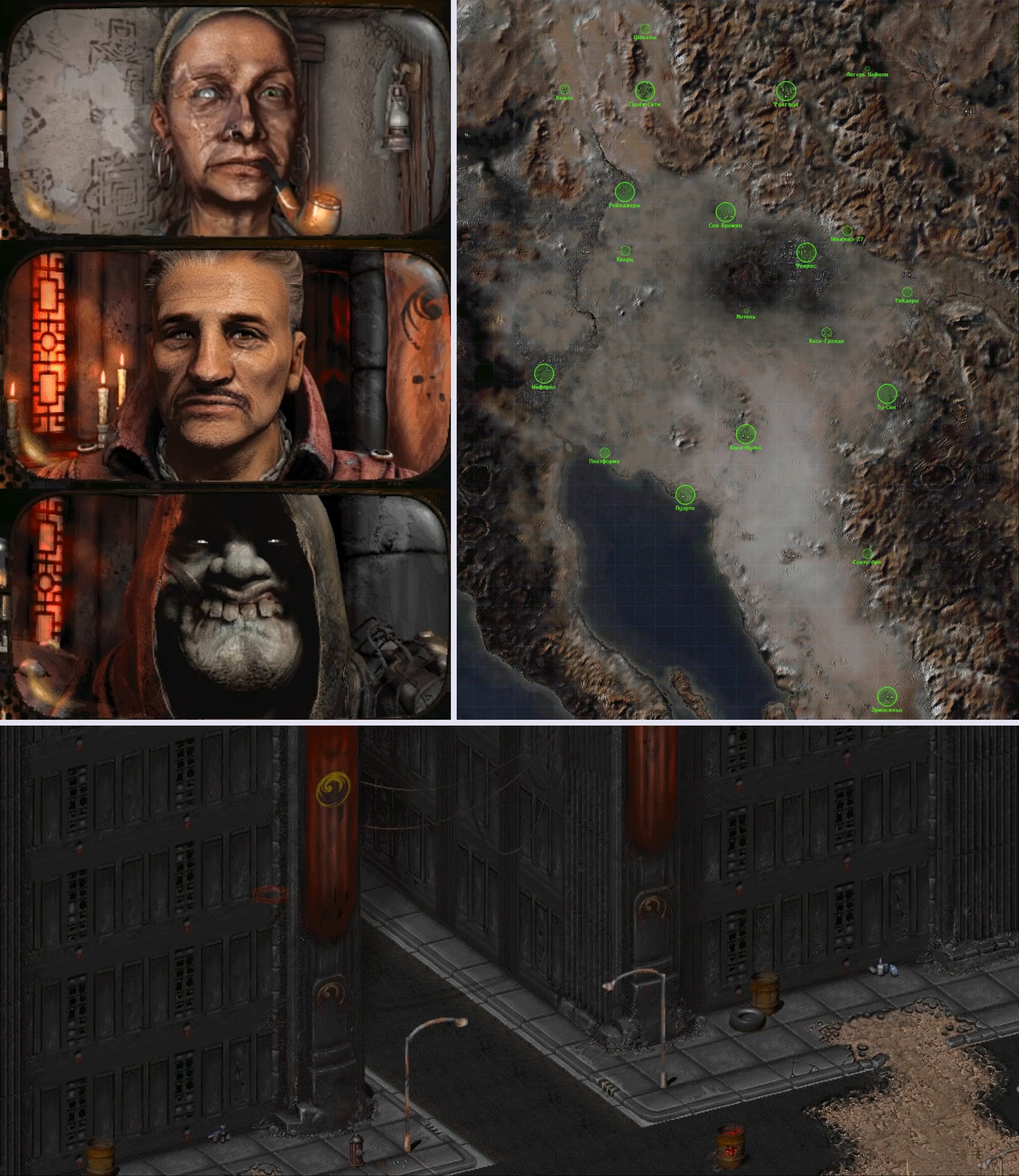
Sonora’s central premise is immediately evocative of Fallout 2 — the player character is a villager in a humble, technologically unsophisticated society on the margins of post-nuclear civilization, and the action kicks off when the village is raided by a mysterious force that absconds with most of your friends and relations. The latter half of the game then draws comparisons to New Vegas as your sprawling investigation gradually reveals a multi-faction power struggle, giving way to a political conflict in which you play a decisive role. There are a ton of named characters to meet, persuade, and liquidate, many of whom have absolutely incredible Talking Heads that match and sometimes even exceed the already sky-high standard set by Interplay in the nineties.
Sonora further distinguishes itself among its craft RPG fellows in that it’s the first Fallout fan game to have its own expansion, called Dayglow, which adds the eponymous ruins from franchise lore as an off-map location populated with unique items, characters, and quests. Dayglow is integrated into the main Sonora campaign in a manner that will feel instantly familiar to anyone who’s played the Honest Hearts expansion for Fallout: New Vegas. If you play it as part of a complete Sonora campaign, you’ll be looking at a playthrough of comparable length to Fallout 2. Of all the games on this list, I think Sonora is the one that fans of the Interplay games will most effortlessly enjoy.
In this degenerate era of monocultural stagnation, AI-generated Call of Duty sequelization, and Dubai chocolate in the water supply, creativity for its own sake is one of the most refreshing things in the entire world. Video game modding has always been a hotbed for such undertakings, but even work as wholesome as independent mod-craft has seen itself colonized by disingenuous financial and social incentives over the past decade or so. Particularly in the still-rippling wake of Fallout 4’s Anniversary Edition shitting the bed and alienating legions of fans with its half-baked approach to integrating community work into the core game, the classic Fallout modding community’s enduring strength despite its small size gives one room for hope in the sea of hypercorporatized darkness that defines so much of the modern professional industry.
One more thing I’d like to note that didn’t really fit into any of the specific writeups above: for reasons that nobody has yet convincingly elucidated, almost all of the projects we discussed today — and indeed the majority of the Fallout 2 modding community writ-large — hail from former Eastern Bloc nations. Despite said community’s relatively small size and commensurately limited output, this strikes me as too strong a correlation to write off as a coincidence. Is there some discernible, verifiable reason why gamers of the East gravitate so strongly toward these artifacts of late-nineties computer roleplaying? This is where I’d ordinarily make some flippant remark about the general bleakness of the post-Soviet condition, but I find that chaos caused by economic liberalization hits a little too close to home lately. Let me know downstairs if you have any speculation you’d like to share.
So, there’s our brief look at one of gaming’s proudest creative micro-cultures. It’s been going strong for over a decade, and work continues even as you read these words. I really do consider it no exaggeration to say that the best of this community stands alongside the paid, professional work from the similarly passionate creators who inspired it all those years ago. And to think that all of it was built atop a CRPG from 1998 that never even had official modding support! Incidentally, a comprehensive reflection of Fallout modding as a series-wide phenomenon could probably fill an entire book, so I’m sure this isn’t the last time we’ll be talking about the subject. Sometime soon, I’d love to tell you about the politically anarchist Fallout: Tactics mod whose production was directly funded by the Canadian federal government. See ya next time <3