Michael Jordan: A history of flight - ESPN
🧬 MJ’s identity is rooted in place, family, and Southern ancestry
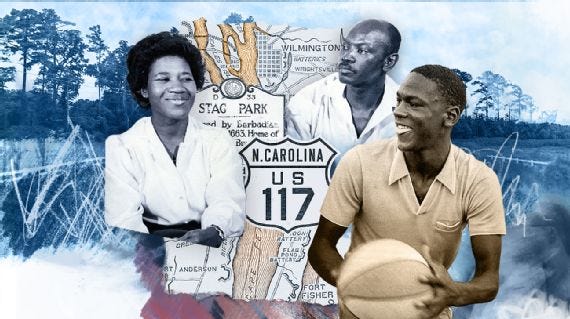
The story reframes Michael Jordan not as a mythic, self‑created figure but as the product of six generations of Jordans who lived along rural Highway 117 in coastal North Carolina. His competitive fire, work ethic, and emotional wiring are tied to country Black Southern culture, ancestral land, and the values of his parents, James and Deloris. The piece argues that to understand MJ’s public persona, you must understand the private Mike shaped by woods, farms, church, and a lineage stretching back to enslaved ancestors on the Stag Park plantation.
🔥 The engine of his competitiveness comes from childhood lessons
Stories from his youth—BB‑gun battles, pig‑pen mishaps, chopping wood, sibling rivalry—illustrate how he learned pain tolerance, stubbornness, and the instinct to turn slights into fuel. His famous “cut from the varsity team” narrative is reframed: he wasn’t truly cut, but he used the story as a lifelong psychological tool. His parents taught him to convert every negative into a positive, which became the core of his competitive mythology.
🌍 The private MJ is shaped by loyalty, fear, and the burden of fame
His closest relationships were with Chicago cops who formed his security team—men who reminded him of home and grounded him amid global fame. Fame frightened him; the death of Princess Diana crystallized the danger of being one of the world’s most recognizable people. He maintains a strict inner circle and a dual identity: public symbol vs. private country boy.
🏀 His legacy is a fusion of past and future—embodied in the Jordan Brand
The Air Jordan empire almost collapsed early; Tinker Hatfield’s design of the Jordan III and James Jordan’s guidance kept MJ with Nike. The Jumpman logo has transcended MJ himself—focus groups don’t even identify it as a person, only as excellence. Obama’s Medal of Freedom ceremony is framed as a rare moment where MJ allowed himself to feel the weight of his journey.

Jack Makes Severe Cuts to Block
🔪 Massive, immediate restructuring: Block is reducing headcount from 10,000+ to just under 6,000, affecting 4,000+ employees. Jack frames it as one of the company’s hardest decisions, but insists the business is not in trouble—profitability and customer growth remain strong.
🤖 AI-driven operating model shift: The core rationale: AI + smaller, flatter teams fundamentally change how companies are built and run. Jack chose a single decisive cut over slow, repeated layoffs, arguing that drawn‑out reductions destroy morale and trust.
🧭 Human tone + future direction: Departing employees receive 20 weeks’ salary + tenure-based weeks, equity through May, 6 months healthcare, devices, and $5K (with variations outside the U.S.). Jack emphasizes transparency, open communication channels, and a “human, not cold” process. For those staying: the mandate is to rebuild Block with intelligence at the core, enabling customers to compose their own features directly from Block’s capabilities.

US e-commerce sales to reach $1.8 trillion by 2030
📈 E‑commerce keeps growing fast, but stores still win the majority share. Online will reach 29% of U.S. retail by 2030, while 71% (~$4.4T) will still come from physical stores—driven by tactile experiences, comparison shopping, and human interaction.
🧠 Growth drivers: Gen Z income, logistics upgrades, and agentic commerce. Forrester highlights workforce shifts, faster fulfillment, and AI‑driven shopping flows as key accelerants of online spend.
🔄 Physical retail’s resilience is underrated. In‑store sales have declined only once in 15 years (2020 lockdowns). Stores now function as loyalty engines and experience hubs, even as online holiday spend hit $257.8B and AI‑driven traffic surged 693% YoY.