08.10.26
Posted in Broadband, D2D, Operators, Services, SpaceX, T-Mobile at 9:47 am by timfarrar
As I pointed out in a Wednesday interview on TITV, the most startling claim in last week’s SpaceX results call was Elon Musk’s assertion that “probably a year from now, we will be doing at least 1 flight a day [of Starship], possibly more”. A smart Bloomberg piece by Liam Denning on Thursday highlighted that “Musk is on an accelerating treadmill of prediction” and while “moon factories may be taken seriously-not-literally by investors”, both robotaxis and Starship launches are “quantified and verifiable” so “Musk is on the hook to deliver ever more and, crucially, ever more quickly”.
To date, daily (or even hourly!) Starship launches have been most easily been explained by the supposedly unlimited demand for orbital data centers. But those are dependent on two things: 1) a Starship launchpad suitable for sun-synchronous orbits (for which land is now being acquired in Louisiana) and 2) new chips made at Terafab that are suitable for operating at much higher temperatures (this is in order to maximize radiative cooling in space, since increasing the operating temperature by 100°C will shrink the required radiator size by ~70%). However, neither the launchpad nor the new Terafab chips will be ready until 2030 or beyond, so they won’t contribute to Starship demand next year.
That leaves Starlink as the only realistic source of demand for frequent Starship launches next year and so Musk has been on a rant for much of the weekend on X, seeking to justify demand for 100K+ Starlink V3 satellites (since 365 launches of 60 Starlink satellites each year, times a five year lifetime would be ~110K satellites on orbit) as opposed to Gwynne Shotwell’s far more rational forecast in March that “I don’t think we’ll have more than 15 or 20,000 Starlink satellites” (she instead leaned on the FCC application for “up to a million AI satellites” as the primary driver of Starship demand). Musk has been egged on by cheerleaders such as ARK and Mach33 fawning over the supposed 100x increase in bandwidth (although the latter are at least aware enough to acknowledge that the space industry is now “replete with grifters”).
But remember that current Starlink V2 mini satellites can each serve around 2000 consumers globally, and even if the provisioning rate is doubled, each Starlink V3 satellite should be able to serve 10,000 consumers. So 15K-20K V3 satellites would be enough for 150M-200M customers (fewer if some satellites are devoted to D2D), whereas 100K V3 satellites would only be justified by Starlink acquiring a billion fixed broadband customers, which is more than the total available worldwide market (today there are about 1.6B fixed broadband users, but nearly half of those are in China and Russia).
This problem has forced Elon Musk to make ever wilder claims about demand coming from an “orders of magnitude” increase in demand from “AI and robotics” and subsequently that “AI agentic Internet traffic will obviously VASTLY exceed human usage”, not to mention that “All cars will have Starlink in the future”. First he started with “I would expect Starlink to reach at least 25% market share outside of China…It’s not out of the question that Starlink carries more than 50% of Internet traffic long-term, which would probably be over a trillion/year”, then moved on to “Future versions of our satellites may exceed 50X the throughput of a V2″ and by late Sunday night he was claiming that “It’s possible that Starlink may end up doing >90% of IP traffic, even if competitors 10X their bandwidth”. All I can say is, don’t do drugs kids!
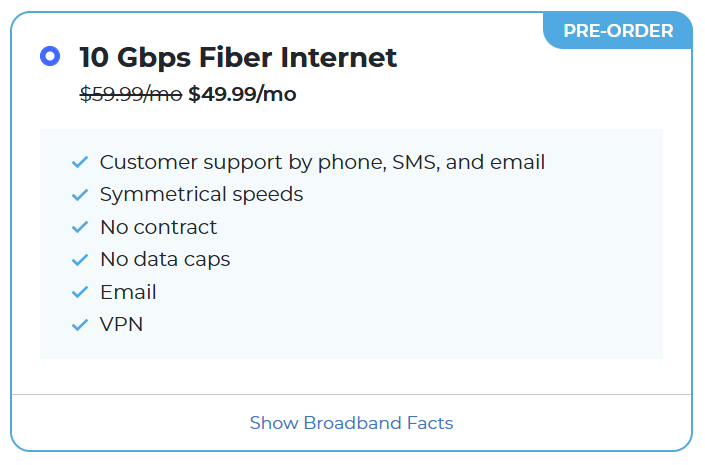
Of course this is total nonsense: except for a very few outliers (such as military users) high bandwidth customers use fiber today and the cost of increased provisioning once fiber is already installed is minimal, in the US the extra IP transit bandwidth if residential customers used 10 times more bandwidth (say 5Tbytes per month instead of 500Gbytes per month) would be about $1-$2 per subscriber per month. Where available, residential fiber users can already get symmetric 10Gbps connections for as little as $50 per month (this example is from Sonic). For comparison, Starlink’s existing community gateways, capable of the same throughput, were reportedly priced at $75,000 per Gbps per month.
Starlink’s fixed broadband service is and will remain inferior to fiber, not least because of constraints on uplink speed, and unlike fiber, Starlink will need to invest huge sums of money in these new satellites if customer usage increases by an order of magnitude in peak demand areas like the US. SpaceX’s S-1 indicates that there has been reduction in manufacturing cost per Gbps of satellite capacity of 3 times from V1 to V2 mini and the expected reduction is 9 times from V1 to V3, but this implies that the V3 satellites will cost around $2M each, to which the cost of launch needs to be added. Thus, even taking an optimistic view of Starship launch costs, 100K Starlink V3 satellites will require a capital investment of well over $200B and most likely $300B+.
Musk also fails to distinguish between fixed and mobile use cases: yes you may want to access AI via your phone, but Starlink Mobile’s D2D (i.e. satellite) service will be far inferior to terrestrial cellular networks in urban and suburban areas (especially indoors), which SpaceX acknowledged by asserting that they now intend to build out a terrestrial small cell network in the US because AT&T, Verizon and T-Mobile have refused to offer an MVNO deal. Ironically, one of the triggers that prompted Musk to make his litany of exaggerated claims this weekend may have been the FT’s interview with T-Mobile’s CEO, which claimed that “The threat posed to mobile operators from satellite companies such as Starlink has been exaggerated”, as the fight over pricing with T-Mobile becomes ever more tense (I expect Starlink’s next moves may include a deal with the cable companies and an acquisition of EchoStar’s CBRS spectrum).
So where does that leave us? Most likely we will never need to find out if there is demand for daily Starship launches next year, because SpaceX won’t actually achieve that goal: a launch every 1-2 weeks by mid year is plausible, but many of those launches will need to be devoted to Starlink Mobile not V3 broadband.
However, a key signpost will be how much manufacturing capacity SpaceX builds out for Starlink terminals: the plan is to double capacity in Bastrop TX this year (while apparently closing down production in El Segundo CA), implying that SpaceX will make around 12M-13M terminals this year and have a run rate of around 300K terminals per week by the end of the year. Unless production increases further, that’s only enough to add about 2M customers per quarter, after allowing for churn. But even to believe claims that Starlink could launch as many as 4000 V3 satellites next year (enough for ~40M net adds but only 2 launches a week on average), Starlink would have to increase production to about 1M terminals per week over the course of next year.