I recently added a small tool to T.LY: What Is My IP Address.
It does the obvious thing first. It shows your public IP address. Then it gives you the extra details people usually want after that: location, ISP, organization, ASN, usage type, and whether the connection looks like a VPN or proxy.
Simple tool. Very crowded keyword.
Try the T.LY What Is My IP Address tool.
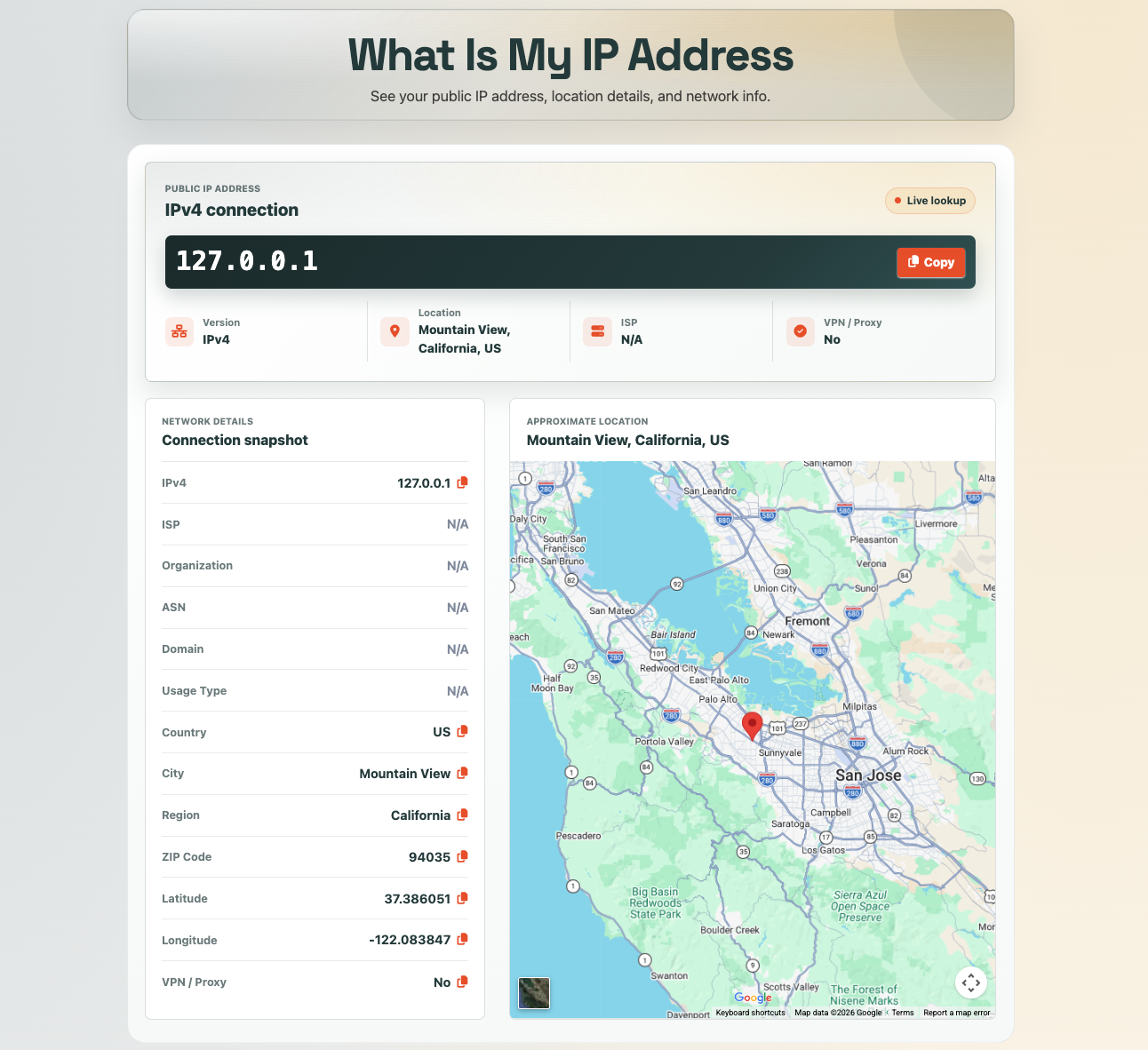
The screenshot uses 127.0.0.1, not my actual IP. Publishing a real IP in a blog post about IP privacy would be a pretty special kind of self-own.
Why build this?
I like building free tools because they line up with how people actually search.
Most people do not wake up and think, "I need a SaaS product." They search for a tiny job they need done right now. Shorten a link. Expand a short URL. Make a QR code. Find their IP address.
That is the whole idea behind the T.LY tools section. Each tool gives someone a useful answer before asking anything from them. No account wall. No weird popup. Just solve the problem.
The IP address tool is a good fit because it sits close to a few things T.LY already cares about:
- link security
- network details
- QR code campaigns
- analytics
- location and device context
It is also a classic search utility. People look this up all day because they are troubleshooting VPNs, setting up allowlists, checking office networks, or trying to explain something to IT without sounding like they are guessing.
For this kind of tool, the product bar is different from a normal app.
The page has maybe two seconds to prove it is useful. If the IP address is buried under a hero section, newsletter box, and 900 words of filler, the page already lost.
So the main requirements are pretty blunt:
- Show the public IP address immediately.
- Make it easy to copy.
- Show IPv4 and IPv6 clearly when available.
- Explain location as an estimate, not a guaranteed street address.
- Show ISP, ASN, country, city, and region when the data is available.
- Load fast on mobile.
- No Ads.
- Do not make people sign in for a one-second lookup.
The part people forget: the answer is the product. The supporting content matters for SEO, but the page should never make the user hunt for the thing they came for.
The SEO problem
The query is brutal.
Search "what is my ip address" and you are not just competing with random blogs. You are competing with exact match domains that have been answering this query forever.
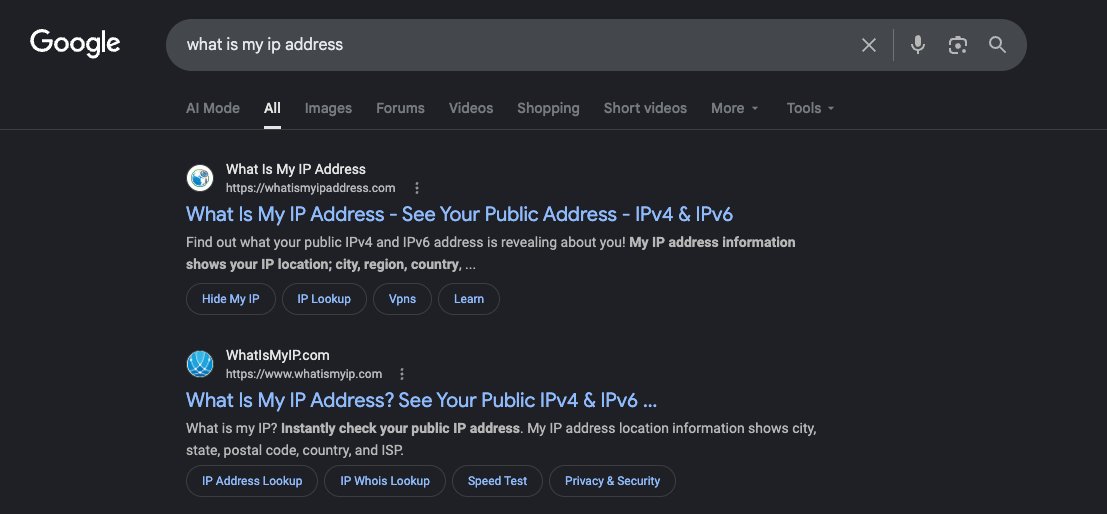
This is where SEO gets annoying in an interesting way.
Google's own SEO starter guide says the keywords in a domain name or URL path alone have "hardly any effect" on ranking. Google has also said you do not get a special ranking bonus just because the keyword is in the domain.
And I believe that.
But exact match domains are still hard to beat.
Not because the domain has magic dust on it. Because everything around the domain compounds:
- The brand name matches the search.
- People link to it with the exact phrase naturally.
- Users remember it.
- It has years of history around one topic.
- The page intent is obvious before you even click.
If your domain is whatismyipaddress.com, every branded mention is also a keyword mention. That is a nice advantage. I would not pretend otherwise.
The backlink profile backs that up too. Ahrefs shows whatismyipaddress.com with a Domain Rating of 85, 7.3M backlinks, and 18K linking websites. These third-party numbers are not perfect, but they are useful directional data.
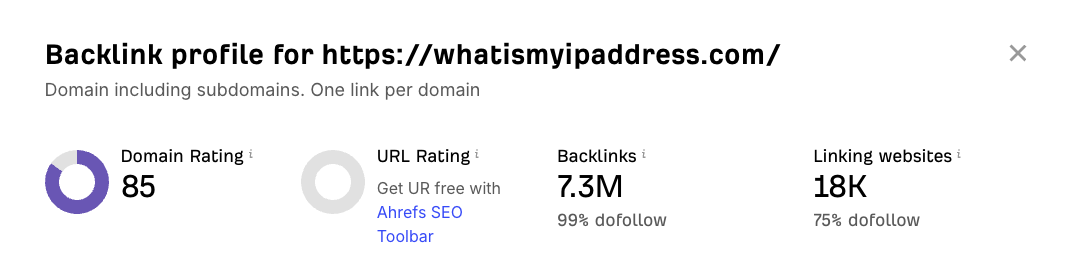
So the question is not, "Can T.LY beat them tomorrow?" Probably not.
The better question is, "Where can T.LY win first?"
There is another wrinkle: Google itself can become the competitor. For some IP-related searches, Google may show the user's public IP address right in the search results. When that happens, the first "result" is not whatismyipaddress.com, T.LY, or anyone else. It is Google's own answer box.
That makes the click problem harder. Some users get what they need without opening a website at all. So the page has to earn the click by offering more than the raw IP address: location context, ISP details, copy buttons, VPN/proxy signals, and a clean interface people can trust.
One place is experience. A lot of the top IP lookup pages are covered in ads, VPN promos, sticky banners, and other stuff fighting the actual answer. I get why they do it. That traffic is valuable. But it also makes the pages feel heavier than they need to be.
For a tool like this, clean is a feature. Show the IP address fast, make the details easy to scan, and let the page breathe. That may not beat a monster domain by itself, but it gives people a reason to prefer the T.LY version once they land on it.
The early data
This is very early, but Search Console is already useful.

In the last 28 days, the page had 134 impressions, 1 click, a 0.7% CTR, and an average position of 67.2 for the filtered query/page view.
That is not impressive. It is also not nothing.
The more interesting part is the long tail. Some queries are already showing in much better positions with tiny impression counts. Things like "whats my ip location" and "how to find my ip address" are not the trophy keyword, but they are searcher intent. That is where I would start.
Option 1: Make the tool page the best answer
The first option is the boring one, which usually means it is worth doing.
Make the main tool page better.
Not longer for the sake of being longer. Better.
I would add short, useful explanations below the tool for the questions people naturally have after seeing their IP address:
- What is a public IP address?
- What is the difference between IPv4 and IPv6?
- Why is my IP location wrong?
- Can a website see my exact location from my IP?
- Why does my IP change?
- How do I know if my VPN is working?
These should be written like support answers, not like an SEO intern got trapped in a thesaurus.
I would also tighten the basics:
- Title tag: "What Is My IP Address? See Your Public IP, Location, and ISP"
- Meta description that says what the tool shows.
- A direct H1 that matches the job of the page.
- Descriptive image alt text.
- Internal links from other T.LY tools and relevant blog posts.
- Fast first load, especially on mobile.
Google's guidance on helpful content is a good sanity check here. SEO is fine when it helps search engines understand a people-first page. It gets dumb when the SEO work makes the page worse for the person using it.
Option 2: Build the IP address content cluster
The main keyword is going to be hard. So I would not only attack the main keyword.
I would build a small cluster around real support questions:
- How to find your IP address on Mac, Windows, iPhone, and Android
- Public IP vs private IP address
- IPv4 vs IPv6 explained simply
- Why your IP address location is wrong
- How to check if your VPN is hiding your IP
- What your ISP can see
- What is an ASN?
- Can someone track you from your IP address?
Each article should link back to the tool. The tool should link out to the best explanations.
This is how you avoid making one giant page that tries to answer every networking question on earth. Google gets cleaner topical signals. Users get pages that match what they actually searched.
One tool can become a small network.
The obvious additions:
- IP location lookup
- IPv6 test
- VPN and proxy checker
- DNS lookup
- WHOIS lookup
- ASN lookup
- Browser and user agent checker
These are not random. They are the next searches people make after "what is my IP address."
The mistake would be spinning up a bunch of thin pages that all say the same thing. Each tool needs a real job. If it has a real job, it can earn internal links, external links, and repeat use.
This is the advantage exact match domains do not have against T.LY.
T.LY already has users, tools, links, and branded search. So I would lean into that instead of pretending this page is starting from zero.
On the domain side, T.LY is not weak. Ahrefs shows a Domain Rating of 93, 139M backlinks, and 275K linking websites. That does not automatically rank the IP tool, but it means the page has a strong domain behind it if the internal linking and intent are handled well.
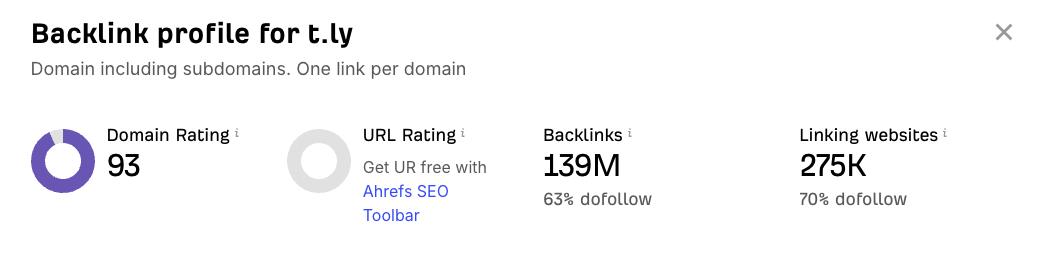
Places I would add internal links:
- the main T.LY tools page
- link expander and link unshortener pages
- security-related blog posts
- analytics or QR code help docs where IP/location context matters
- support docs for teams troubleshooting access rules
Internal links will not magically rank a page by themselves, but they help Google understand that this is a first-class tool on the site, not a random orphan page.
Option 5: Do a domain play
This is the tempting one.
You could buy an exact match or partial match domain and build a standalone IP tool on it. Something like a clean "my IP" domain, if one were available at a sane price.
Would I do it? Maybe, but carefully.
A separate domain can work if it becomes a real product with its own links and brand. It can also split your effort. Now you are building authority for two sites instead of one.
For this tool, I would probably keep the main page on T.LY first. T.LY has domain strength, and the tools section already has a reason to exist. If a great domain came up cheap, I would consider using it as a focused microsite or redirect strategy, but I would not chase a domain at the expense of the page people are already finding.
Option 6: Earn links by making it useful for support teams
The best link angle is not "please link to my IP tool."
It is making the tool useful in places where people already need to ask for an IP address.
For example:
- "Send us your public IP" support instructions
- VPN troubleshooting docs
- firewall allowlist setup guides
- remote work IT onboarding
- network debugging checklists
If the tool has a clean URL, loads fast, and does not feel sketchy, support teams can link to it. That is a much better link source than random directory submissions.
What I would not waste time on
A few SEO moves sound good in a spreadsheet and bad in real life.
- I would not bury the IP result under a huge article.
- I would not create doorway pages for every city or ISP.
- I would not stuff "what is my IP address" into every heading.
- I would not buy garbage backlinks.
- I would not rely on FAQ schema as the big trick.
That last one matters. Google says FAQ rich results stopped appearing in Search as of May 7, 2026, and the related Search Console/Rich Results Test support is being removed over the next few months. FAQs can still be useful for humans. I just would not expect the old FAQ rich-result boost.
The 30-day plan
If I were trying to move this page up, I would keep the plan simple.
Week 1: Fix the page
Make sure the tool is fast, the answer is visible immediately, the title/snippet are clean, and the page has concise explanations below the tool. Add WebApplication or SoftwareApplication structured data if it fits cleanly. Do not overdo it.
Week 2: Publish support content
Write the first four supporting articles: public vs private IP, IPv4 vs IPv6, why IP location is wrong, and how to check whether a VPN is working. Link them together naturally.
Week 3: Add one adjacent tool
I would probably start with the VPN/proxy checker or IPv6 test. They are close enough to the core query that the internal links make sense.
Week 4: Watch Search Console
Look at impressions by query, not just average position. If a long-tail query starts getting impressions in positions 5-20, improve that section or publish a page for that exact intent.
Do not change everything every two days. Search Console is useful, but only if you give changes enough time to settle.
My honest take
Ranking for "what is my IP address" is not easy. Exact match domains are entrenched, and this is the kind of query where users want an answer instantly. Some people will never click anything if Google gives them enough in the results.
But I still like the page.
It is useful. It fits T.LY. It can win long-tail searches first. It can support other tools. It can become part of a broader security and network utility cluster.
That is usually how these things work. You do not beat the giant exact-match sites by writing one giant page and hoping. You win the edges, make the tool better, build the cluster, and keep improving based on real search data.
You can try the What Is My IP Address tool on T.LY.