Sales don’t happen when benefits exceed price. I did not know this. Here’s what I learned.
I started this newsletter to incentivize me to finish Tidy First?. It worked. The prospect of losing a paying subscriber because I couldn’t be bothered to write one more chapter this week was too much to bear. So I wrote. And I finished the book.
Along the way I got caught up in the turbulence & eddies of the newsletter revolution. The top newsletters were earning life-changing money for their authors. After a slow start I was earning life-modestly-enhancing money. How far could this accidental business take me? (Previous reviews of my progress towards a sustainable business are here & here.)
To review, my four financial goals are:
Predictable revenue exceeds fixed expenses. “Predictable” in this case means my Mechanical Orchard salary + newsletter subscriptions.
Newsletter revenue exceeds fixed expenses. I love working at Mechanical Orchard but it would still feel good for employment to be a choice, for my own business to be sustainable.
House & retirement. Newsletter income exceeds fixed expenses by enough that I can buy a house & be saving towards retirement.
(This is an asset goal, not an income goal) Savings exceeds predicted future needs. I never have to earn another dollar.
Here is my newsletter revenue to date:
Before December I had a revenue stream that was nice but didn’t address my financial goals. When I announced the price increase in January, revenue jumped. People (like you) who had been reading but weren’t paying now signed up to avoid paying more later.
That was a great month, I can tell you. Money & subscribers were rolling in all day. If every month was like that, I would be able to devote more time & energy to ideas & writing. Goal #1 was in sight. The growth wasn’t sustainable.
The smaller blip in March was my 30% off birthday sale. Took me closer to goal #1. However, even though my churn numbers are smaller than average, without something driving new paying subscriptions, revenue is going to drift downwards.
Okay, so that’s goal #1. How close am I to having a sustainable business?

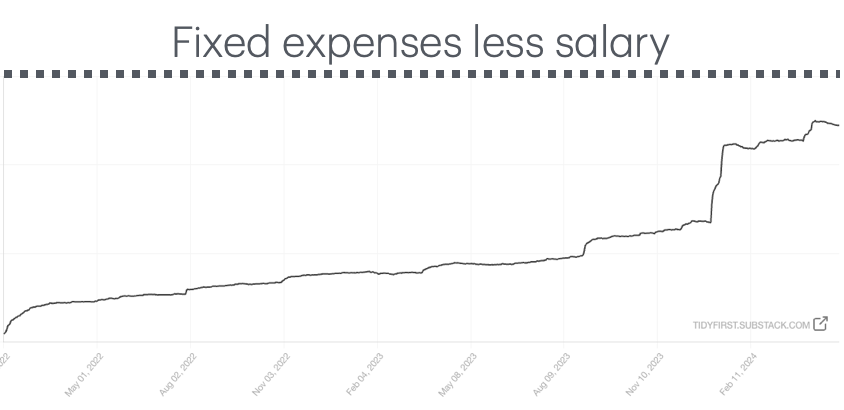
At this scale I don’t look so close. I’m not almost there, I’m a third of the way there. For further perspective, here are goals 2 & 3:

Relying strictly on newsletter revenue to reach my financial goals doesn’t look like a winning strategy. I’m going to need other sources of revenue. The first Tidy First? book is selling well, but “well” for a technical book doesn’t move this graph noticeably.
I don’t know what to do with my business that would reliably get me through my goals. I’m going to do what I know how to do: write. You’ll see chapters on book 2, Tidy Together?, coming soon. I expect to take about 6 months to write the sequel. The theme of the book is “software design is an exercise in human relationships” at the team level.
I will also hustle other parts of my business:
Speaking. This used to provide significant revenue but collapsed during the tech downturn.
Consulting. Expensive for me to provide (time & energy) but rewarding & potentially valuable for clients.
Sponsorships & ads? Eww.
Education. Seems like the material on software design should be valuable to companies who want the benefits it provides. However, I have no experience selling to companies. Leading me to the lesson of this essay.
I naively assumed that people transacted when value exceeded price. I blindly pursued adding more value to this newsletter. It sort of worked—revenue grew, just not at a pace that approached sustainability.
The big jump in revenue came not from a big jump in value, but from the prospect of losing out on the chance for the value of a paying subscription. I’m trying to apply this lesson as I think about corporate sales—not, “What is the ROI to the company? How can I improve it?” but rather, “How can I communicate what the company is missing out on by not getting better at software design?”
“Don’t miss out” goes against all my instincts. Having dealt with truckloads of negativity in my life I have made a consistent habit of positivity. (Several Thinkies deal in positivity—you’re missing out on a weekly Thinkie if you aren’t paying for a subscription.)
When I tell non-geeks about my revelation the consistent response is “duh”. Okay, maybe most everyone understands this about human motivation, but I sure didn’t. Now I’m trying to rewire my brain so I have a chance of creating a sustainable business.