This issue brings something new. Pedro spent two days at Web Summit in Lisbon attending sessions from teams building real AI agents, and he brought back a set of insights directly from the builders at Replit, Intercom, Decagon, Parloa, and more.
You will find his full take at the end of the issue.
But before, we have some news in the AI Agent space:
EU plans to relax parts of GDPR for AI
New evidence that AI agents support neurodiverse workers
Microsoft introduces Agentic Users inside Teams and 365
Financial institutions create new jobs to supervise AI agents
The EU is preparing changes to the GDPR to help AI companies train and operate models more easily in Europe.
The proposal creates new exceptions that let AI developers process certain sensitive data for training
It also reframes pseudonymized data, so some of it may fall outside strict GDPR obligations
The Commission wants to update cookie rules to give websites broader legal grounds for user tracking
Privacy groups warn that this could weaken core protections and was drafted too quickly
Member states are split, with some pushing back strongly while others see it as essential for EU competitiveness
This could mean faster paths to build and ship AI products in Europe, with companies needing stronger compliance planning as rules shift toward a more practical stance.
A new UK government study shows that AI agents are helping neurodiverse workers succeed at work in ways traditional tools never did.
Neurodiverse employees were 25 percent more satisfied with AI assistants and more likely to recommend them
People with ADHD, autism, and dyslexia say AI note takers, schedulers and communication tools remove barriers that made work harder
Many describe AI as a “leveling” force that supports focus, time management and executive function
Researchers highlight that companies need strong governance to avoid bias and protect privacy for neurodivergent staff
Inclusive AI practices are linked with higher revenue and stronger ROI for organizations
This points to a clear shift where AI agents become empowering tools for people who were previously underserved by traditional workplace systems.
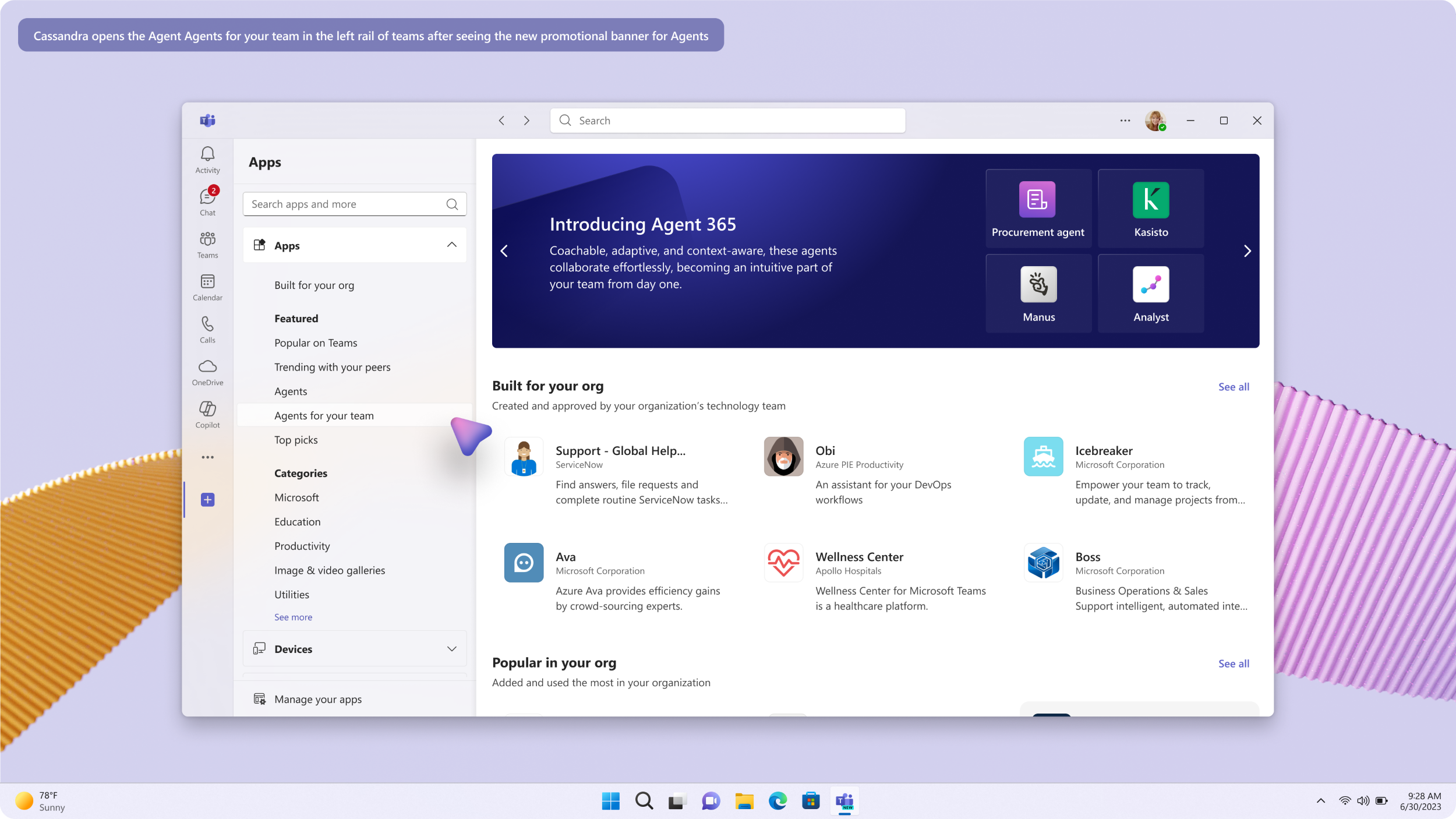
Microsoft is rolling out Agentic Users, autonomous AI colleagues with full identities inside Teams and Microsoft 365.
Agents act as real users with their own email, Teams presence and directory profile
Companies can pick templates in Teams or the Copilot Store to create digital workers
They can join meetings, send emails, chat with teams and access enterprise data
Agents appear in the org chart, can be paused and can be deleted when no longer needed
This gives organizations a structured way to deploy AI colleagues directly into everyday workflows.
A new Capgemini report shows banks and insurers rapidly deploying AI agents and creating new roles to manage them.
Nearly 50 percent of banks and insurers are creating new jobs to supervise AI agents, with customer service and fraud detection leading adoption
BNY, Citigroup and Wells Fargo already run agents that handle vulnerability management, code fixes and onboarding tasks
Adoption is rising fast, but only 10 percent of firms have scaled agents due to skills shortages and compliance hurdles
This points to a major shift in financial services as agentic systems move from pilots to operational roles.
Cursor raises $2.3 billion funding round at $29.3 billion valuation 😳
Wonderful raised $100M Series A to put AI agents on the front lines of customer service
Upwork study shows AI agents excel with human partners but fail independently
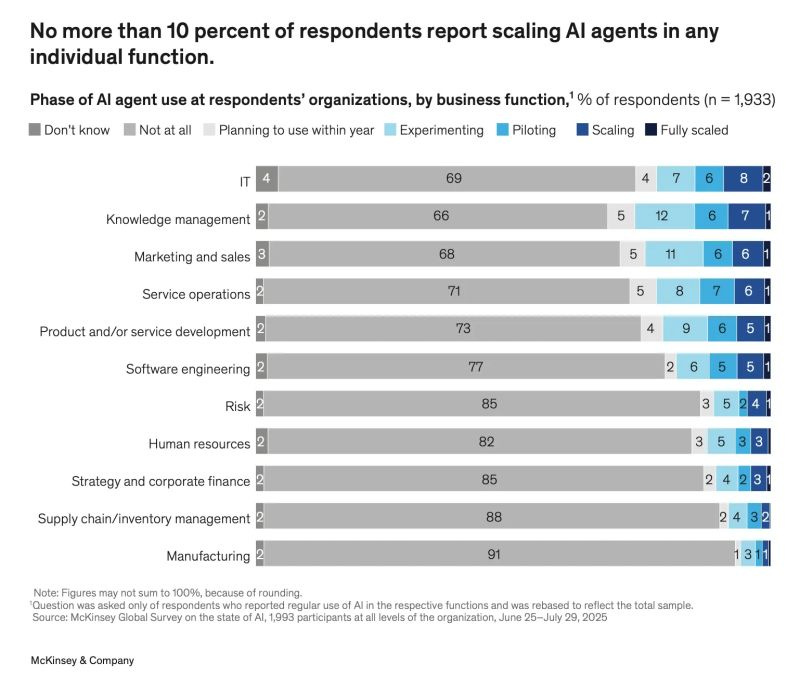
Only 10% of companies move AI agents beyond experimentation.
McKinsey’s report “The State of AI in 2025” shows that 62% of respondents are already experimenting with AI agents, yet only 10% manage to scale them within any single function. Interest is high, but real adoption stays limited.
The problem is execution and the challenge of turning prototypes into production agents that teams trust.
These are the main blockers to scaling:
Lack of clear workflows where agents can run reliably
Difficulty integrating agents with existing tools and data
Low trust in autonomous actions inside the business
Limited ownership inside teams for maintaining and improving these systems
Organizations are seeing more advanced use of AI agents in IT, marketing and sales, service operations, product development, and software engineering. Fewer experiments are happening in areas like manufacturing, supply chain, risk, and strategy.
We will reveal the results next week. Tell us how far you are! 🤔

AI agents aren’t just support channels anymore. They’re becoming the primary interface between brands and customers. Jesse Zhang from Decagon called it “the new UI for the brand.” Think personalized concierge, not chatbot.
Real results: Chime got 60% cost savings with 2 points NPS improvement. Oura solved 70% of problems with AI at a 1:20 people-to-agent ratio.
The prediction: in 2-3 years, most customers will prefer AI agents over humans. And complex UIs will be replaced by simple search bars where you just ask what you want.
Des Traynor from Intercom: “The Death of SaaS, The Rise of Agents.” His mantra? Agentify, agentify, agentify.
AI is a convergent force that collapses multiple tools into one. Agents are going to penetrate the data layer directly. Big SaaS companies will struggle. The only advantage they have is owning the data, but that won’t be enough.
Three big ones: context management, hallucinations, and data quality.
Replit uses sub-agents to protect context. For hallucinations, the solutions are fine-tuning, multiple models, citations, and LLM juries. But 80% reliability isn’t enough.
The biggest surprise? Most companies are working with incomplete, messy data. You can have the best AI team, but if your data isn’t organised, you’re building on sand.
Organisational transformation is the hardest part. Employees start managing agents instead of doing work. Companies need to rethink structure, KPIs, and what counts as “human work.”
New roles: Agent Managers, CX Architects, engineers with different responsibilities.
Contrary to normal tech adoption, big companies are investing way more in AI than SMBs. This creates a real competitive gap.
Someone said: “If you’re not deploying agents right now, your company is probably dead soon.”
It’s not a death sentence. It’s a warning. You have time, but you need to start now.
The good news? AI won’t take your job in the next 5 years. It will take away boring tasks.
The right question: How can AI solve problems for your customers and your team?
👉 Read the full article on Inside AI Agents
Our AI Automation Readiness Assessment helps you identify where to start on bringing AI yo your company. Take 5 minutes to see how ready your company is for AI-driven workflows. You’ll receive personalized insights tailored to your business.