You sit at the kitchen table on a Wednesday afternoon. The phone has been put down, face-down, on principle. The tea you made for yourself an hour ago has gone cold without you noticing. Forty-five minutes are unaccounted for. You picked up the phone to check the time. You don’t remember the rest.
You know what’s supposed to happen next. There’s a script for this moment. The world rushes back. You notice the light. You hear the fridge humming. You feel your hands on the wood. You become, briefly, a person again. There is a small spiritual victory in this, a kind of returning.
That isn’t what happens. What happens is that nothing is wrong. The room is exactly the room. The light is exactly the light. And underneath the surface of all of it sits a low-grade hum of restlessness that has nothing to do with the phone. The hum was already here before you picked up the phone. The hum, in fact, is why you picked it up. Forty-five minutes ago your hand reached for the device because something underneath the surface of you was looking for somewhere to go that wasn’t here.
We’ve been having the same argument for a decade. Engineers in San Francisco built machines to capture us. The machines work. We are captured. The cure, depending on which book you read this month, is meditation, or a flip phone, or a cabin, or a deliberate practice of attention recovery, or a Sunday Sabbath from the screen. Most of these are real and several of them help, but none of them touch what is actually wrong, which is that the phone never stole anything you weren’t already trying to give away.
I’ve watched myself do this. I’ll come back from a good ride, the kind that should leave a person settled, and within five minutes of leaning the bike against the wall, my hand is in my pocket. No notification. No buzz. Just me, the satisfying tiredness still in my legs, and the recognition that being present with a quiet body and a quiet mind is a kind of work I’d rather not do. So I reach for something. Usually the phone. Sometimes a chore that does not need doing. The shape of the avoidance is the same regardless. The phone is just its most efficient form.
William James saw this in 1890, when the only attention-capturing technology in most rooms was a window. He said his experience was what he agreed to attend to. He didn’t say his experience was what was attractive enough to capture him. He said agree. The verb is doing serious work in that sentence. Attention is not extracted from us. It is, at some level we don’t quite want to examine, given.
The attention economy is a real adversary. The engineers are real. The infinite scroll runs on the same neurological reflex that makes a slot machine work, and Gloria Mark’s research is sober and a little disturbing: the average person switches screens every forty-seven seconds, and the fragmentation costs us the texture of our days. None of this is in dispute. The question the conversation prefers not to ask is: what would you be paying attention to if the phone were gone?
If the honest answer is “the dishes, the weather, my breath, my child’s face, the work I love,” then yes, the phone is robbing you, the cure is straightforward, and you should put it down and not pick it up, and your life will be richer for it. Most people are not in this category. We pretend to be. We are not.
If the honest answer is “the rumination loop about something somebody said in 2018, the fantasy of a different life I am clearly not going to start tomorrow, the low-grade dread about money I do not actually have an emergency about, the quiet conviction that I’m not living the life I was supposed to be living,” then the phone isn’t robbing you of anything. The phone is doing you a favour. It’s a more polished surface for the same internal weather you’d have had anyway.
Take the phone away from a calm person and you get a calm person reading a book. Take it away from a restless person and what you get isn’t calm. You get a restless person walking around the kitchen looking for something to do with their hands. The restlessness was always there. The device gave it an outlet that produces enough faint stimulation to feel like activity, without requiring the person to be present with whatever the restlessness is actually about.
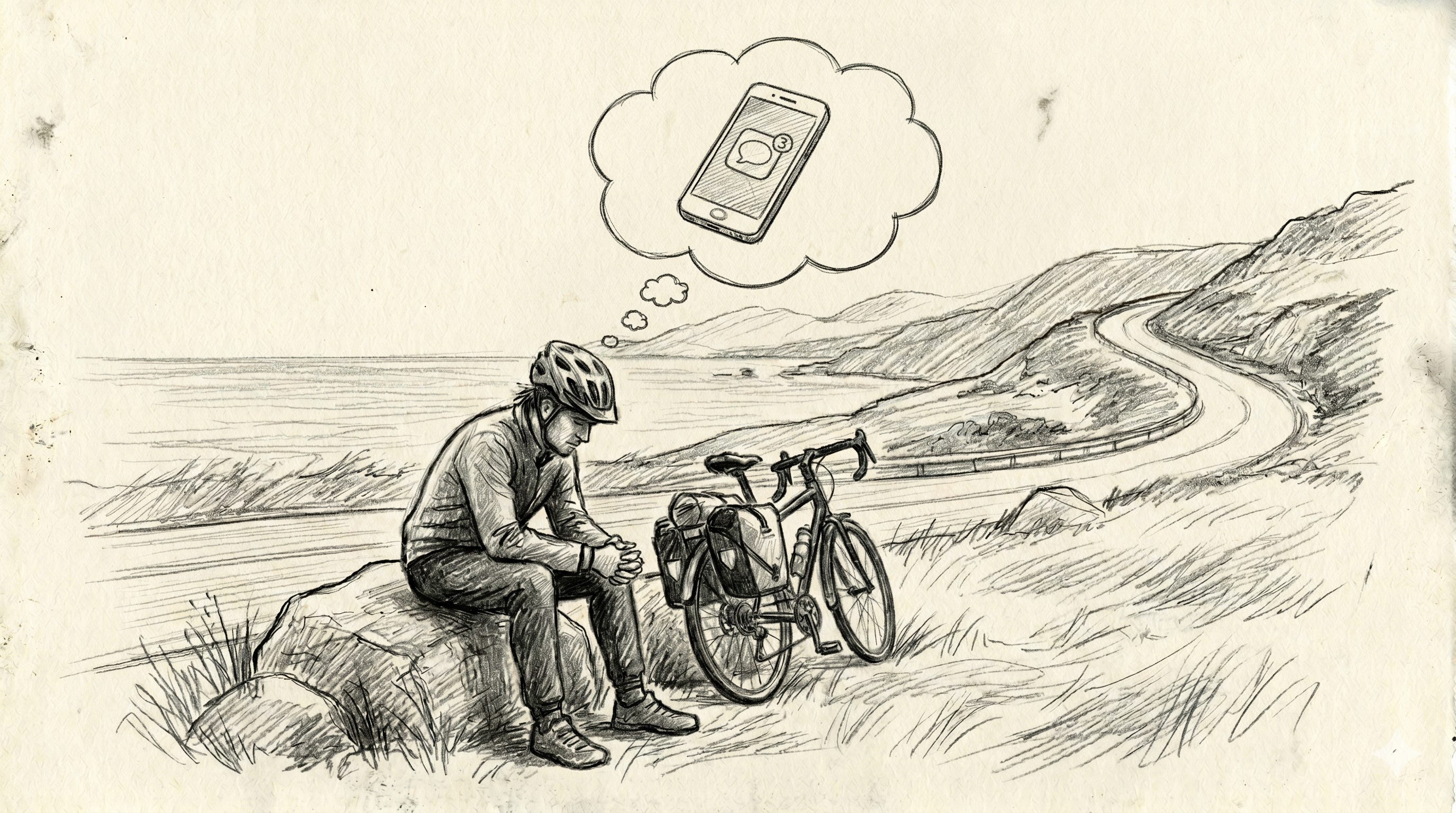
This is why bike touring sometimes produces a strange, embarrassed disappointment. After months of planning, you ride out into a week of nothing but the road and your own legs, the phone in airplane mode at the bottom of a pannier where it cannot reach you. You wait for the presence that was supposed to arrive once the noise stopped. It arrives, sort of. Then somewhere on day three, climbing a long grade in Cape Breton with the wind in your ears, you notice that your brain is composing a letter you will never send to someone you have not seen in three years. The phone has been untouched since breakfast. The thing you rode out here to escape was already inside the helmet.
Simone Weil, who shows up in the chapter this piece came out of, said attention was the rarest and purest form of generosity. She meant something more demanding than the productivity industry has done to the line. Generosity is not the same animal as resource-management. Most of what gets sold as attention practice, like productivity optimization or deep-work systems, is fine, but it is downstream of the actual work.
The actual work is being willing to be present with whatever is here, including the parts of being here that are uncomfortable. The hum included. Including the recognition that your life, at this exact moment on this exact Wednesday, is the only one you have, and that a fair amount of it is dull, and that underneath the dullness is a quiet ache about something you cannot quite name. The phone offered to take the ache away. It didn’t. It just postponed it for forty-five minutes at a time, three or four times a day, every day, for years.
The next time you reach for the phone without having decided to, don’t put it down with any drama. Don’t make a vow. Just notice, as your hand is already moving, what you were about to leave behind. Sit with whatever that is for ten seconds. Not as meditation, not as a practice. Just as a small, honest accounting. What were you trying not to be here for?
Most of the time the answer is small and slightly embarrassing: a dull task you don’t want to start, or a stretch of empty afternoon you don’t want to sit inside. The size of the thing being avoided is wildly out of proportion to the elaborate machinery that has been built to help you avoid it.
I wrote a book about this kind of accounting, about the daily question of where the life is actually going, and about twelve recognitions that make a person harder to capture, both by their own habits and by the systems engineered to exploit them. It’s called The Twelve Truths, and the chapter this piece came out of is one of the twelve. If the hum I described is familiar, the book may be useful to you. Or not. You’ll know.
The tea on the table has gone cold. The afternoon shifted while you were elsewhere; the light is in a different place now. Whatever was waiting for you to look at it directly has been waiting all along.
Like what you read? Please support my work with a coffee. Thank you! This means more to me than you know. Also, check out my other writings HERE.