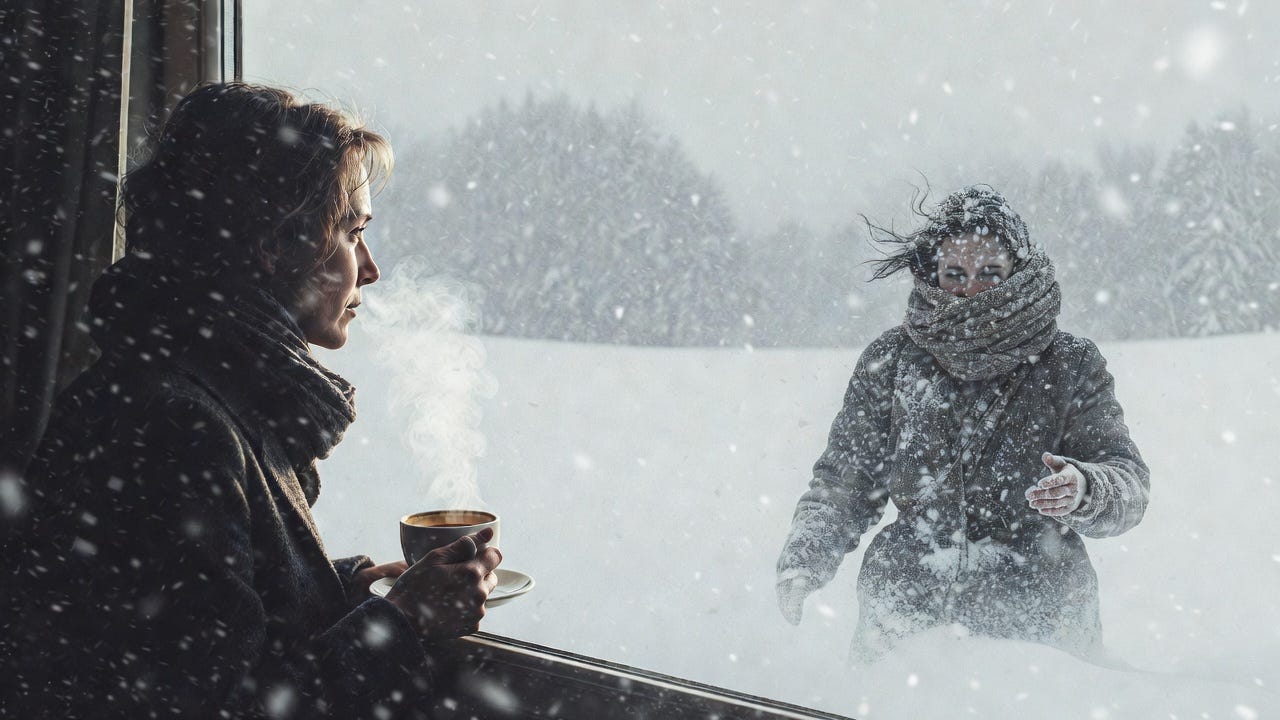
It’s a Thursday morning in late January. The world outside has disappeared. Snow falls so thick and constant that the trees across the road exist only as suggestions, grey smudges against a white void. The thermometer reads minus eighteen, and the wind makes that number feel like a lie, a generous underestimate. Drifts climb the side of the house like slow-motion waves. You stand at the window with your coffee, watching the relentless accumulation, and you think: Not today. Maybe not this week.
This is the reasonable response. This is what sensible people do. The forecast confirms it. Your body agrees.
But here’s what I’ve noticed, after years of stepping into conditions that every instinct screamed to avoid: watching a winter storm and being in a winter storm are two entirely different experiences. From the window, that wall of snow looks hostile. It looks like the world has turned against you. But once you layer up and push through the door, once you stop being a spectator and become a participant, the cold that seemed brutal becomes just cold. The snow that looked punishing becomes crystals landing on your eyelashes, your outstretched palm. You’re no longer observing conditions; you’re inhabiting them.
We treat weather as an inconvenience to be managed, a problem to be solved with the right forecast or the right excuse. But I’m starting to suspect that what we call “bad” weather is actually necessary. And we are quietly starving ourselves by avoiding it.
I’ll confess: I used to be the person checking the forecast obsessively, rearranging my week around weather windows, treating anything below minus ten as a personal insult from the atmosphere. I had elaborate justifications. I was being practical and sensible.
What I was actually doing was sealing myself inside a narrow band of acceptable sensation. Think about your average January day. You wake in a house heated to 21 degrees. You start your car remotely so it warms up before you reach it. You drive to a workplace maintained at precisely the temperature that offends no one. You return home the same way, sealed inside climate-controlled chambers for the entirety of your waking life, never once feeling the season on your skin.
I call this thermal monotony, and I’ve come to believe it flattens our capacity to feel much of anything.
When I never felt genuinely cold, the kind of cold that makes your lungs ache and your cheeks burn, warmth lost its meaning. It became the default rather than the gift. When I never experienced the particular silence of heavy snowfall, the ordinary quiet of my living room registered as nothing at all. I had flattened my physical existence into a temperature-controlled line, and then wondered why I felt so numb.
Anyone who’s spent real time in winter knows this: the best cup of coffee you’ll ever drink has nothing to do with the bean.
It’s the gas station coffee after two hours of shovelling the driveway while the wind erased your progress. It’s the hot chocolate at the end of a walk where your breath froze in your scarf, and your toes went numb despite two pairs of socks. It’s the lukewarm dregs from a thermos when you’ve been outside long enough that your eyelashes have frosted together. These are transcendent experiences. Not because the coffee is good, but because you have been prepared to receive it.
Joy is often found not in the thing itself, but in the relief of discomfort. The hot shower feels divine because you were frozen to your core. Your feet had forgotten what warmth meant, so the wool socks feel like absolution. The blanket on the couch becomes sacred after an afternoon fighting a storm that didn’t care whether you won.
If you want to feel intense gratitude for simple things, warmth and shelter and the mere existence of a working furnace, you must first expose yourself to their opposites. The blizzard is the setup. Comfort is the punchline. And you can’t have the punchline without sitting through the setup.
We’ve tried to skip straight to the comfort part. We’ve engineered lives where we never have to earn the pleasure of warmth, never have to deserve the relief of shelter. And so these things have become invisible to us. We take them for granted because we’ve forgotten what it feels like to need them.
Winter teaches humility, and we desperately need that lesson.
You cannot negotiate with a blizzard. You cannot debate a wind chill of minus thirty. You cannot send an email explaining why the snow should really reconsider its timing and its complete indifference to your calendar.
A winter storm is magnificently, refreshingly indifferent to your schedule and your carefully constructed plans. Schools close. Roads become impassable. The whole machinery of modern productivity grinds to a halt because the sky decided to empty itself, and there is absolutely nothing you can do about it.
I used to find this infuriating. Now I find it calming, or at least close to it. Restful, maybe. There’s relief in encountering a force that simply doesn’t care what you want. It strips away the exhausting illusion that you’re in charge of everything. It reminds you that you’re small and the world is big, and honestly, that proportion feels more honest than the alternative.
Bad weather makes strangers into friends and neighbours into family.
I’ve noticed that mild days scatter people. Everyone retreats to their own property, maintains a polite distance, and waves from driveways. But storms draw us together.
A few years ago, the power went out across our neighbourhood for eighteen hours. By hour three, I was standing in my driveway when Dave from four houses down appeared with a camp stove and a question: You have any eggs? We’ve got some meat that’s going to spoil. Within an hour, there were six of us in his garage, the doors open to the snow, huddled around that little stove, passing a frying pan back and forth.
Someone produced a bottle of whiskey. Someone else had a deck of cards. We talked about things neighbours don’t normally discuss: job fears, whether our parents were getting too old to live alone, how strange it felt to work ten feet from your bed and never see anyone.
When the power came back, we all went inside. The emergency was over. But the pretense had dropped, and it stayed dropped. Now Dave waves differently. Now I know his daughter is struggling in school, and his wife just started a new job. You can’t look composed when you’re eating scrambled eggs in a freezing garage, breath visible in the air. You can only look human.
There’s a reason our ancestors huddled together for warmth. Harsh weather triggers a biological memory in us, the old knowledge that we need each other, that we survive together or not at all. Shared struggle is better glue than shared ease. The stories we tell years later are never about the pleasant afternoon. They’re about the storm of ‘22, the night the furnace quit, the morning we dug out together, and someone brought thermoses of soup down the street.
We’ve engineered most of these bonding opportunities out of modern life. We’ve made it possible to never need anyone, never depend on shared shelter, never experience the particular intimacy of weathering a crisis together. And we wonder why we feel so alone.
Stop waiting for the storm to pass.
The perfect day is a myth. It’s a moving target that keeps you from ever actually stepping outside. The forecast will never be ideal, the temperature will never be precisely what you wanted, and if you wait for comfortable conditions in a Canadian winter, you’ll wait until April.
Don’t look at snow as bad weather. Look at it as texture. It’s the texture of reality, the proof that you’re actually here, inhabiting a body on a planet that doesn’t arrange itself for your convenience. The cold on your face is evidence that you’re alive. The ache in your fingers is your nervous system confirming your existence.
I came home yesterday from a walk in conditions I would have once called miserable. My skin burned with the glow of returned circulation. My mind felt scrubbed clean, as blank and fresh as the snow itself. I stood in my doorway for a full minute just appreciating the simple fact of a roof, of warmth, of dry clothes and a furnace that worked.
The sun is pleasant enough. But the cold makes you feel alive.
The door is right there.
This shift, from avoidance to acceptance, from comfort-seeking to meaning-seeking, doesn’t happen overnight. It’s a practice. If you want to build this kind of inner steadiness, I’ve written about resilience and the small daily choices that shape how we meet difficulty. The Resilience Toolkit is a collection of four books on cultivating a calmer, stronger relationship with the world as it actually is.
Like what you read? Please support my work with a coffee. Also, make sure to subscribe, “like”, restack, or comment. Thanks! You being here means a lot!