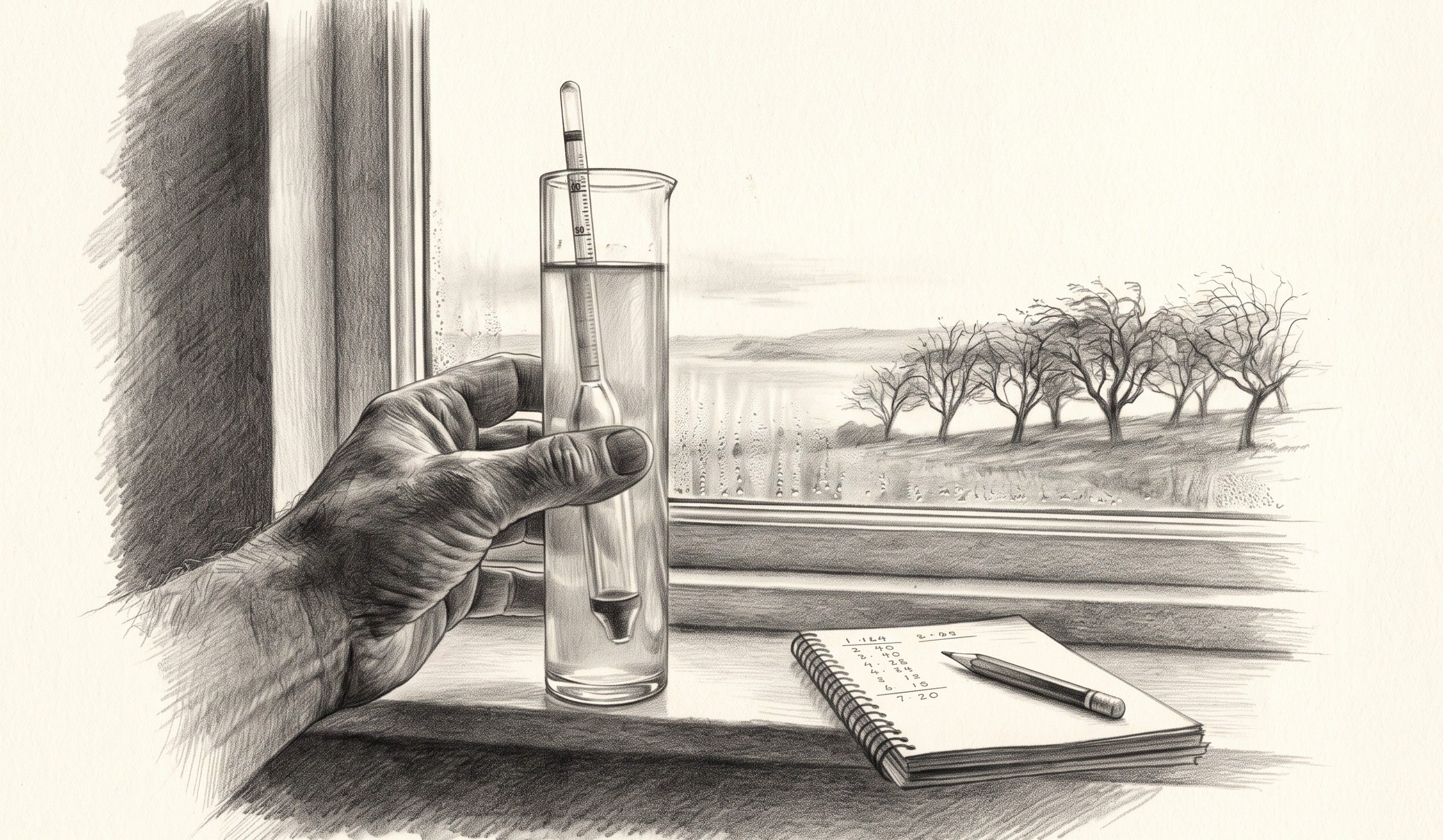
Seven in the morning, first week of September, and the hydrometer is giving me a number I don’t want. The Gravensteins came from an orchard down the valley eight days ago and went into the tank at 1.048. Yesterday it read 1.043. This morning, 1.041. Eight days in, it ought to be twenty points lower than that, and I ought to be thinking about racking. Instead I’m holding a sample up to the window.
Cloudy, still working, but tired. I’ve seen this kind of tired a few hundred times. Could be nutrient. Could be the juice went in colder than I thought. Or the yeast simply doesn’t care for this fruit this year. Yeast are not obliged to give reasons.
My phone has a message on it from the man who grew the apples. No caption, just a screenshot of the radar, a green and yellow blob coming up the Bay. Growers don’t do captions. Everyone who works with fruit in this Valley learns to read those blobs the way other people read faces, and what he’s reading is a night of wind against trees that are still holding most of his season.
Standing there with the glass, I want the hydrometer to be a prophet and the radar to be a verdict. Some instrument, any instrument, that will tell me whether this is going to be all right so I can decide how to feel about it and get on with my day. Nothing in the building does that. A hydrometer tells you where the ferment is this morning. In thirty years, it has never once told me where it will be on Friday. The radar tells him what’s over the water right now. It says nothing about which trees will still have fruit on them at dawn.
Conditions can be observed. Outcomes can’t be. Nearly every expensive mistake I’ve made in this trade came from confusing the two.
There are two ways out of that cold room, and I have taken both of them more often than I’d like to put in writing.
The first is to decide it’s going to be fine. Add a little nutrient, bump the tank two degrees, remind yourself Gravensteins are always a bit slow, go make coffee. Sometimes it is fine, and I get to call that experience. But notice what the decision does. Once the outcome is settled in your head, the tank stops needing you. You’ve been excused.
The second is to decide it won’t be. This one feels more grown up. The juice was off, the season’s a write-off, the yeast is shot, the whole lot is headed for vinegar or the drain, and a man with three decades in fermentation ought to recognize a lost cause when he’s looking at one. It has exactly the same effect as the first. If it’s already lost, why sanitize the racking hose? Why take the temperature again at noon? Why phone the yeast supplier and try to describe a smell to a man in Montreal? The tank stops needing you, and this time you get to feel wise about it.
I’ve come to think despair is mostly a costume that intelligence puts on when it’s tired. It always sounds like the smarter position in the room. It asks so little of the person wearing it.
Denial says there’s nothing to worry about. Despair says there’s nothing to do. They disagree about everything except the one thing that matters to the person holding the glass, which is that either way you get to go back inside.
What actually happens, on the mornings I get it right, is dull to describe. I take the temperature. I write it in the book with the time beside it, in handwriting only I can read. I pull a second sample in case the first was a bad draw. I smell it, because the nose knows things about a ferment three days before the hydrometer admits them.
I check the nutrient log and discover I was a day late on the second addition, which is probably half the story. Then I find the grower’s number and ask what he needs from me if the wind does what the radar says, and it turns out what he needs is for me to take fruit off his hands faster than we agreed, which means freeing a tank, which means a call to a client about moving a delivery.
None of that is control. I can’t argue a ferment into finishing. I can’t talk a low-pressure system into turning north. The work that’s left after the guarantee is gone is smaller than control and a good deal more stubborn. Fidelity is the nearest word I have for it. Showing up to the part of the process that still answers to you, and doing that part properly, while the part that doesn’t answer to you does whatever it was going to do.
That’s most of what I know about hope, and it took me a long time to recognize it as hope at all, because it doesn’t feel like anything. It doesn’t feel like optimism. It feels like a logbook and cold hands.
A tank is small enough to see. The harder version arrives through the phone.
Most of what we call staying informed is a daily lesson in the size of things we can’t touch. Currencies, borders, elections, interest rates, wars three time zones away, a climate that keeps sending the Valley weather my grower’s father never saw. I don’t think any of that anxiety is irrational. It isn’t. The world really is that large, and it really is that far out of hand, and I’m not going to be the writer who tells you your fear is a failure of perspective.
Hold enough of the uncontrollable in your head at once, though, and the controllable starts to look like a rounding error. What’s a phone call to an old friend against a collapsing currency? What’s one properly kept fermentation log against a warming ocean?
The scale of the problems makes the scale of your reach feel embarrassing, and that embarrassment is a category mistake. Small responsibility is where a human being’s agency actually lives. It’s the only place it has ever lived. Nobody has ever cared for a planet. People have cared for rows, and neighbours, and tanks, and the person across the table, and the planet got looked after, wherever it did get looked after, by that.
A couple of weeks ago, I lost most of a morning to the border.
A good share of what leaves my tanks goes south. It has for years, and a trade war turns that from a business model into a bet. The tariffs arrive, get lifted, come back at a different number, decided by people in two governments who have never heard of me, and every time the number moves, a spreadsheet I spent a week building becomes fiction. You can’t price a contract against a wall that changes height every few weeks. You can’t tell a client what a load will cost landed when the answer depends on what someone announces on a Sunday. Planning, which is most of what running a business actually is, turns into guessing with better formatting.
So I sat with the news. Not reading. Refreshing. Anyone who has done it knows the difference. In the next tab was an email from a grower down the Valley who wanted a yes or no on his fall commitment so he could book his picking crew, and that email sat there, unanswered, while I read the same three paragraphs about a border I do not control in four different outlets. I told myself I was staying on top of things. What I was doing was letting a thing I couldn’t affect permit me to put off a thing I could. The anxiety was real. So was the excuse it was working as.
He got his answer Wednesday. He’d have preferred Tuesday. It cost him a day of planning, and I, of all people, should know what a day of planning is worth this year. It cost me something I’m still a little ashamed of, which is that for one morning I preferred the feeling of watching the weather to the work of being the weather for somebody else.
What I mean by practical optimism has nothing to do with cheerfulness. I’ve tried cheerfulness. It lasts until about the second coffee. This is a sequence, and a short one.
See the conditions as they are. Don’t round them up. The hydrometer says what it says.
Refuse both fantasies. The one where it’ll be fine on its own, and the one where it’s already over.
Find the piece of the work that’s within your reach today. It’s usually smaller than you’d like.
Do that piece with the care you’d give it if you already knew the ending was good.
Tomorrow, do it again.
A forecast is a claim about the future. Hope is a decision about the present, made without any forecast worth trusting, and made again every morning because it doesn’t keep.
If you want somewhere to put this, keep it small. One square metre. Pick one bounded piece of the world, for this week only, and take full responsibility for it. The garden bed that’s gone to seed. A friendship that’s drifted down to likes and no phone calls. The staff member who’s been quiet lately. One family dinner with the phones in the other room. The email you’ve been managing around instead of answering. Mine is from June. It should be concrete enough to finish and small enough that you don’t have to believe anything about the next ten years to start.
That’s the whole practice. It won’t fix the tariffs. It was never going to. What it does is put you back in the room with the cloudy glass.
Which is where I’m headed now. The tank read 1.041 at six. At noon I’ll take it again. I don’t know how this one ends. I’ve got a scoop of nutrient in one hand, the hose is clean, and the next thing to do is visible from here.
This essay is the short form of an argument I made at book length in The Practical Optimist. Subscribers to The Thinking Rock get the book free.
Like what you read? Check out my books and support my writing with a coffee. You being here means more than you know!
