Table of Contents
As Mind separated from Body, Church fractured from State, Time’s Circularity gave way to its Linearity (progress), and God “died”, humanity found itself across the Rubicon on shores strange.
While it is hard to overstate the spectacular material success of Modernity (about which scores of progressive screeds have been written), our primary concern here is the set of thinkers who have contested Modernity. They do so on a variety of distinct grounds: some reject its metaphysical claims; others its political forms; still others the spiritual desert it has created.
In order to conquer a mountain, one must first study the routes other explorers have attempted. We will do so only very briefly, for we still have far to climb.
This essay, therefore, is a taxonomy of anti-modern thought along two axes:
axiology (where does meaning originate?)
teleology (is history open to transformation?).
From this mapping, four camps emerge: each with its own players, diagnosis, mood, and mission. I will outline these.
Finally, I will offer desiderata for what I believe the appropriate path is: one that neither flees modernity nor surrenders to it, but seeks instead to alchemize it—to transform base metal into gold.
It is not enough to ride the Tiger. One must transform it entirely.
We consider two distinct questions:
Axiology: is Meaning transcendentally received or immanently created?
Teleology: is History open? Is it subject to human agency or ultimately closed to us?
This gives us:
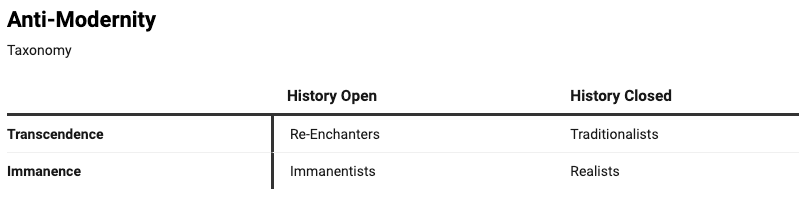
Let us look at each in turn.
Important Disclaimer: I do not assert that all the figures here have views corresponding precisely either to each other, but that does not mean that we cannot distill themes, patterns, principles that underlie both the worldview, and activity of these thinkers. Finally, ideas do live on a spectrum, so some thinkers sit more neatly inside these quadrants than others.
Finally, some thinkers in some of these boxes will appear strange next to each other, but they are placed where they are with respect to their attitudes towards the two questions above that define their placement.
“What is needed is not a revolution in the opposite direction, but the opposite of a revolution.” — Joseph de Maistre
The Thesis
History is inevitable, degenerative, and cyclical. It does so generally in 4 cycles1. In Hindu thought, each of the 4 ages has with it an associated virtue:
Krita Yuga or Golden Age (Austerity)
Treta Yuga or Silver Age (Knowledge)
Dvapara Yuga or Bronze Age (Sacrifice)
Kali Yuga or Iron Age (Charity)
“In the Golden Age, austerity is supreme. In the Silver, knowledge is paramount. In the Bronze, they speak of sacrifice as the path. In the Iron, simple charity alone suffices.” — the Laws of Manu
This specifies the idea that as history unfolds inevitably, mankind’s capacity for spiritual practice diminishes, where first was needed an extreme devotional austerity to the Divine, and culminating ultimately in an age where simple goodwill is sufficient. This degenerative view of history, of course, is not unique to the Dharmic faith,
"Holding fast to the Faith at the end of times will be like grasping burning coals." — the Holy Prophet of God
"The best generation is my generation, then those who come after them, then those who come after them." — the Holy Prophet of God
"However, when the Son of Man comes, will he find faith on the earth?" — Luke 18:8
The Truth is to be preserved primarily by anchoring oneself diligently and faithfully to perennial metaphysical principles one finds across Traditions that modernity has foregone. These principles, in descending order of abstraction, are roughly:
the Unity of God
The Divine is unified, the Ultimate Cause, and the Ground of all Being.the Transcendental Unity of Religions
The exoteric is no more than the contextual social and scaffolding for the esoteric Truth within.the Doctrine of Correspondences:
There is a vertical hierarchy of being itself from the Divine to the Angelic to the Imaginal to the Material.the Rejection of Anthopocentrism
Man is to mediate between Heaven and Earth, not to become the measure of all things.the Primacy of Metaphysics over Philosophy
The former in this context is conceived of as direct-access, intuitive knowledge of Reality, rather than the latter which, in this context, is mere rational speculation.the Necessity of Initiation
Access to the Truth mandates the symbolic transformation of the self: this is the nature of initiation.the Hierarchical Organisation of Society
There are those capable of esoteric access to the Divine and whose responsibility it is to animate and vivify exoteric human activity.the Reign of Quality over Quantity
Traditionalism values essence, being, and hierarchy. Modernism values material accumulation, pleasure, and freedom.
The Proponents
The critical proponents are2:
René Guénon
Frithjof Schuon
Julius Evola
Seyyed Hossein Nasr
Ananda Coomaraswamy
Mircea Eliade
Alexandr Dugin
To this list, we can append many others including Alduous Huxley, Titus Buckhardt, Wolfgang Smith, Reza Shah-Kazemi and we would be remiss if we did not also include King Charles III.
(While this represents what we normally refer to as the Traditionalists, I’d include the likes of Heidegger in this camp vis-a-vis his “The Question concerning Technology”.)
The Mood and Mission
Descriptively, the mood here, as a result of both their strong view of history’s degeneracy, as well as their fatalism in its face tends to be broadly eschatological.
To the Traditionalist: the End is nigh, we live in the Reign of Quantity, and nearly everybody alive is fundamentally incapable of accessing the Divine (both as a result of spiritual decay, but also because esotericism is intrinsically closed). What is the only coherent way to exist in this world?
You withdraw, contemplate, and quietly attempt to preserve the Light in quiet, peaceful, reflective obscurity.3
Reject the world, think about God, and wait for the End.
(While Evola and Dugin are the most outwardly political and polemical of the Traditionalists, by the end of Evola’s life, as becomes apparent in Riding the Tiger, he too ultimately comes to terms with what he sees as the inescapable degradation of the modern world.)
The Failure
There are two principal failures here:
There is no meaningful translation of the esoteric truth, the essence they so deeply cherish, into activity that affects the masses. There is a fear that the principles will be distorted or grow dilute.
Guenonian quietism ultimately withdraws entirely from the plain of history, offering up the field on a silver platter to those who would desecrate it instead. Ironically, this only accelerates history’s decay, which I suppose they feel vindicated by.
Not for me, I’m afraid.
The Thesis
The Inaccessibility of the Transcendent
Even if Transcendence exists (which it likely doesn’t), it offers no legible meaning, no destination for history. God, if present, is silent on the question of life. We are thrown into existence without telos, and without redemption.The Fixity of Human Nature
History offers no “moral progress”. Man does not improve. Beneath the veneer of civilisation there remains the will to power, tribalism, status-seeking, and self-deception.The Closure of History
If human nature is frozen and transcendental purpose inaccessible, then history has no “direction”. Civilizations rise and fall in patterns, either Spengler’s organic cycles, or Pareto’s elite circulation, but there is no cumulative movement toward justice, enlightenment, or peace. Modernity’s faith in progress is simply secularised eschatology.The Functionality of Truth
In the absence of telos, truth is whatever works: what coheres societies, tempers violence, enables survival. Myths are not believed because they are true; they are true insofar as they are functional.The Primacy of the Political
If history offers no destination, then the urgent questions are immediate and exoteric: Who rules? On what grounds? How do incompatible groups coexist without mutual annihilation? Politics is not the application of prior moral truths but the creative negotiation of power in a void. Friend-enemy distinctions, the sovereign exception, the elite’s instrumentalisation of myth: these are the fundamental categories. Furthermore, all utopian projects are simply fantasies born of the illusion that progress is possible. The Realist’s job is not transformation but management. It is order. Authority derives not from Truth but from necessity.
The realist ethos is tragic endurance: to remain dignified, with your eyes open, expectations low, and commitments stripped bare.
The Proponents
Carl Schmitt
Oswald Spengler
Vilfredo Pareto
James Burnham
John Gray
Sigmund Freud (Civilisation and its Discontents), Hobbes (Leviathan), and Macchiavelli (The Prince) are intellectual forefathers of this style of thinking, one that views the End of History and the Last Man with skepticism, and maybe even contempt.
The Mood and Mission
As a natural consequence of both their intrinsic pessimism, their fatalism, and their rejection of transcendental value, Realists tend to be stoic in their bearing, tragic in their outlook, and disillusioned in their pronouncements.
The mission here is descriptive largely. The chief virtue is clarity, incisiveness, and order. If the enchantments and religious attachments of old were illusions that modernity quelled, and if the new gods that were erected in their stead are just as, if not more, fraudulent, then the best we can do is ensure firstly, that we are no longer fooled, and secondly, that we survive long enough to no longer remain fooled.
There is no redemption, no telos, simply the remorseless march of Time, and the unending competitive struggle that characterises all human endeavour.
The Failure
The fundamental rejection of both transcendental value and the human ego’s desire to fill the void rings intuitively false. If Reality, civilisation, and human life consists solely of competitive games to delay inevitable despair, life would be fundamentally impossible. After all, not everybody (certainly not me) comforts themselves with the idea their lives (can) have meaning to make it tolerable. This is backwards: we find our lives tolerable because we believe they (can) have meaning.
This is not simply incorrect on instrumental grounds (“it’s hard to live or build society in a state of tragic disillusionment”) but because it is in denial of both the value of Reality and of our lives themselves, things we intuitively and fundamentally feel.
“Dead are all the Gods: now do we desire the UBERMENSCH to live.” — Friedrich Nietzsche
The Thesis
God is Dead and we are meant to take His place
God is dead. Further, this is not a tragedy, but an opportunity. The transcendent has dissolved, and in its place stands the soverign man, terrible and free. We are invited to step in to take the Throne.Man is the Measure
This is the absolutisation of the ego. Man no longer needs to mediate between heaven and earth but remains the sole arbiter and standard of value, meaning, and truth (whatever these words mean).Liberal Modernity has failed
Modernity, with its universal reason, egalitarianism, bureaucratic governance and material comfort, is a spiritual desert. Democracy is no more than the institutionalisation of ressentiment, and an affront to the possibility of greatness. The Enlightenment was simply humanity’s coming-of-age in the march of man towards the stars: we are no longer so naive.
Aristocracy of Spirit
This is the return of the Great Man. Not everybody is equal in capacity, vision, worthiness, and nor do they need to be. Hierarchy is not regrettably necessary, but simple nature. It is to be affirmed joyously: its resentment is a hallmark of mediocrity.Struggle is an Intrinsic Good
Existence requires no justification, and meaning emerges in the act of overcoming: nature, other men, your self. Creation and destruction are not means to a tepid peace, but goods in and of themselves.Liberty is as close as we get to the Sacred
Freedom is not simply an instrument for the pursuit of broader virtue, but the opportunity for the self to fulfill its deepest desire: to express itself.The Future is Open
Nature and history are not constraints, but obstacles to be technologically overcome in the pursuit of the self’s desire for expression. The future is whatever we want it to be.
The Proponents
Friedrich Nietzsche
Ayn Rand
Max Stirner
Peter Thiel
Nick Land
Marc Andreessen
Curtis Yarvin
The Mood and Mission
The feeling here is defiant, creative, fundamentally agonistic. There is a Promethean impulse, the valourisation of activity for its own sake, and agency as the highest good. The mission is one of discarding survival but affirming life, and its capacity to afford ambition, excellence, and glory: to embrace joie de vivre in the twilight of the idols.
The Failure
Of course, the issue here is one of the confusion of vigour for grace, glamour for beauty, power for justice, and control for truth. Nowhere is this clearer than in the amoral freneticism surrounding Silicon Valley.
We all intuitively recognise the fickleness, impecunity, and insufficiency of the human soul. Indeed, the soul expands only in accordance with what it is held up as a sacrifice for: this is why we revere those who lay down their lives for God, Family, and Nation, but if the self itself is the highest thing we dedicate it to, then it remains fundamentally stunted, and no amount of material success can detract from the niggling intuition that there is something petty or compensatory about all the worldly gain.
Passion without a purpose is not particularly inspiring. We once called it madness.
"Beauty is vanishing from our world because we live as though it did not matter." — Roger Scruton
The Thesis
The Reality of Transcendental Order
There is an intrinsic meaning, order, and value to Reality independent of human perception. This can be construed as the Absolute, the Sacred, Beauty, or Natural Law. In any case, it is real and intelligible.Meaning is not dead, it is simply dormant
God is not dead. He’s simply been obscured. Modernity did not destroy transcendental meaning (for it cannot be destroyed) but simply obscured it by its focus on material accumulation, proceduralism, and abstraction. Reality stays as is, it is simply our knowledge of it that has grown 2-dimensional.Tradition is the way
Ancient and mediaeval traditions, whether philosophical, aesthetic, theological, or contemplative, all embody cogent and sophisticated mechanisms of drawing our attention to Reality, and elicit a path to recovering its symbolic depth. Recovery consists of a ressourcement: a retrieval of the eternal way of living.Modernity is simply a detour
Re-Enchanters generally believe modernity’s pathologies are addressable. Their attempts to do generally result in what we now think of as conservative politics (at least when it is principled): the sensitivity that good things are difficult to build, and easy to destroy.It is a question of depth
With symbolic depth, oikophilia, and a return of attention to the transcendental within the circumstances and vicissitudes of modern life, we can nevertheless reclaim a quiet meaning, and add dimensionality to existence, one that will persist even as the clothes we wear, the professions we pursue, and the spaces we inhabit change.Renewal through practice
The project is not revolutionary, but its opposite: education, ritual, community, family, and contemplation. The cultivation and exaltation of the practices that afford life meaning combats the corrosive and “deracinating” influence of modernity otherwise.
The Proponents
Roger Scruton
Alasdair MacIntyre
Eric Voegelin
Charles Taylor
Michael Oakeshott
In the modern world, we have David Bentley Hart, Iain McGilchrist, John Milbank and the rest of the Radical Orthodoxy, Paul Kingsnorth.
The Mood and Mission
The mood here is hopeful, patient, reparative, and largely incrementalist: suspicious of dramatic upheavals. The mission of course is to point out that even in secular modernity’s spiritual desert, through attention, practice, and the cultivation of the soul, we can once again come to recognise the essential attributes of existence that deem it worthwhile. The focus remains largely internal, local even, and to the extent that it takes political shape, does so in the form of a conservative tilt to politics.
The Failure
It’s incomplete. In general, there is not only not the fervent esotericism of the Traditionalists, nor the vibrant exotericism of the Immanentists. The project’s incrementalism dooms it to a quaint irrelevance: a popular curiosity amongst the clever youth who may raise an eyebrow, stirred by nostalgia for a past they’ve never felt, before heading out into industry.
Practice, internal cultivation is quite simply just not enough: it is tepid compromise. Where the scale and power of Immanentists, or the intense spiritual focus of the Traditionalists could potentially be inspiring, the project as it is currently set up inspires neither deep and meaningful institutional nor internal transformation. What we risk instead is an effete, ineffectual, largely academic exercise.
It’s evident that each camp is expressing something important about Reality and the human condition:
The Traditionalists are evidently correct that without a near-fanatical commitment to the Divine, expressible almost entirely in the esoteric tradition, we are lost.
The Realists highlight that the ego and human nature is stubbornly persistent and severely constrains virtuous and political possibility.
The Immanentists recognise that survival is simply not enough: we must live. And to live is to overcome, to achieve, to ascend, and if needed, to struggle.
The Re-Enchanters insist that hope remains, that history (and thereby mankind) are not ultimately doomed, and that it is in fact possible to protect, and perhaps even re-animate the traditions that connected us to the Sacred.
And yet,
The Traditionalists have the Truth but no Agency.
The Realists have the Clarity but no Hope.
The Immanentists have the Vigor but no Justice.
The Re-Enchanters have the Temperance but no Ambition.
All of this of course, is simply story-telling.
The question remains: what do I want instead?
I want a worldview and disposition that does not cower in the face of the overwhelming, that seeks not to justify or abide or cope or accept but which seeks to alchemicalise modern life instead.
I want the intense esotericism of the Traditionalists and the vivacity and will of the Immanentists. (Note that they’re diametrically opposed on the diagram. The former is all Intellect and the latter all Spiritedness.)4
The Goal
To transform modernity into something genuinely beautiful, just, and true. We must do so not by a blanket, inane rejection of its achievements, but by a interpretation, interrogation, contextualisation within a framework capable of discernment: one that can elevate what is worthy and destroy what is base (and much will have to be destroyed).
But even this is not enough, for it is insufficient to carry this epistemic and moral standard in our minds, it must be institutionalised and imbued with the expansionary impulse.
It is not enough to simply re-interpret mercantilism or to protect dead traditions, one must also build new institutions, new practices, new etiquette, new life itself. One must compete, and have the confidence, wherewithal, and belief that the Divine does not constrain activity, but liberates it.
The goal is to free essence from form, to have the imagination to determine forms capable of encapsulating and manifesting the Divine, and ultimately the courage and impulse to animate, breathe life into and will them into existence in the Name of the Most High.
(Note ofcourse, the parallel with the Divine Emanation via the Universal Intellect and subsequently the World Soul.)
The Method
This requires answering five questions in order:
What is the Divine? (Ontology: the principles of Reality)
How can we know the Divine? (Epistemology: the criteria for Discernment)
How does that knowledge transform us? (Anthropology: the act of Redemption)
What is the effect on society of redeemed persons? (Politics: the just city)
What therefore is a transformed society? (Eschatology: the City of God)
The criteria for discernment must therefore necessarily be ontological, and subsequently epistemological. It comes down to establishing what constitutes principle and subsequently how can we know it. This is not window-dressing for predetermined conclusions. It is establishing criteria by which modern forms: technologies, institutions, aesthetics, dispositions, attitudes, political forms, or commercial pursuits can be judged and either abandoned, transfigured, or created.
Ultimately, we absolutely must reject:
Guenonian quietism (as a disposition)
Liberal managerialism of decline (as an option)
Creative destruction (as an end)
Spiritual pessimism
And warmly embrace instead:
Ontological realism (The Sacred is all that matters)
Fanatical agency (Man is God’s Vicegerent on Earth)
Principled praxis (Thought must issue in Action)
The elevation of Man (Every man is capable of Redemption)
The Mandate of Heaven is not to withdraw, nor accommodate, but to transform, to reanimate, to revive.
The alchemist does not flee base metal. He transmutes it.